A retail and travel digital systems guide must account for a journey that crosses discovery, offer, payment, order, fulfillment, service and settlement. Ordinary retail may complete fulfillment through delivery or collection; travel fulfillment unfolds over time through reservations, check-in, transport, accommodation, ancillaries and disruption. In both sectors, customers expect one coherent commitment while many suppliers and systems participate. The architecture must preserve what was offered, purchased, changed, delivered and refunded, with enough evidence to serve the customer and reconcile money.
This guide is for commercial, operations, customer service, finance, data, risk and technology leaders. It focuses on capabilities and control boundaries rather than a specific vendor stack. IATA's passenger developer resources describe standards spanning offer and order management, ticketing, passenger services and settlement. Retailers and travel providers should use relevant industry standards where they reduce partner ambiguity, while keeping customer rights, local law, product rules and operating accountability explicit in their own systems.
Define the customer promise and commercial boundary
Start with a specific journey: buy and collect an item, book a flight plus seat, exchange a ticket, recover from cancellation or refund an undelivered service. State the promise, eligibility, price components, supplier obligations, time limits and proof of completion. Identify which entity is merchant, retailer, agent, carrier, fulfiller and data controller in each market. Marketplace and interline models can make those roles differ by product. Customer-facing terms and internal system state must agree; an operational status cannot silently narrow a commitment displayed at purchase.
Create a capability map from product and inventory through offer, order, payment, fulfillment, service, disruption and settlement. Mark authoritative systems and decision rights. Preserve the accepted offer with price, currency, taxes, restrictions and included services rather than attempting to recreate it from a current catalog later. The retail travel implementation checklist converts these boundaries into acceptance scenarios, and the retail travel FAQ supports stakeholder decisions.
| Journey record | Authoritative question | Evidence to preserve |
|---|---|---|
| Product | What can be sold and under which conditions? | Versioned attributes, restrictions and supplier |
| Offer | What exact commitment was shown to this customer? | Price components, expiry, availability and terms |
| Order | What was accepted, paid, changed and owed? | Immutable history of lines, status and ownership |
| Fulfillment | What service or item was actually delivered? | Events, location, time, quantity and exception |
| Settlement | Which party owes or receives each amount? | Transaction linkage, fees, adjustments and reconciliation |
Design the offer-to-fulfillment architecture
Separate product definition, availability, offer construction, order commitment and fulfillment events. An offer can combine base products, ancillaries, promotions, loyalty value, taxes and supplier services. Validate price and availability at commitment, assign a stable order identifier and make every later change an attributable state transition. Avoid coupling the customer experience directly to a legacy record format; use a canonical business contract while preserving supplier-specific identifiers for reconciliation. IATA's Passenger Standards Conference maintains standards across distribution, delivery and settlement that can inform travel interfaces.
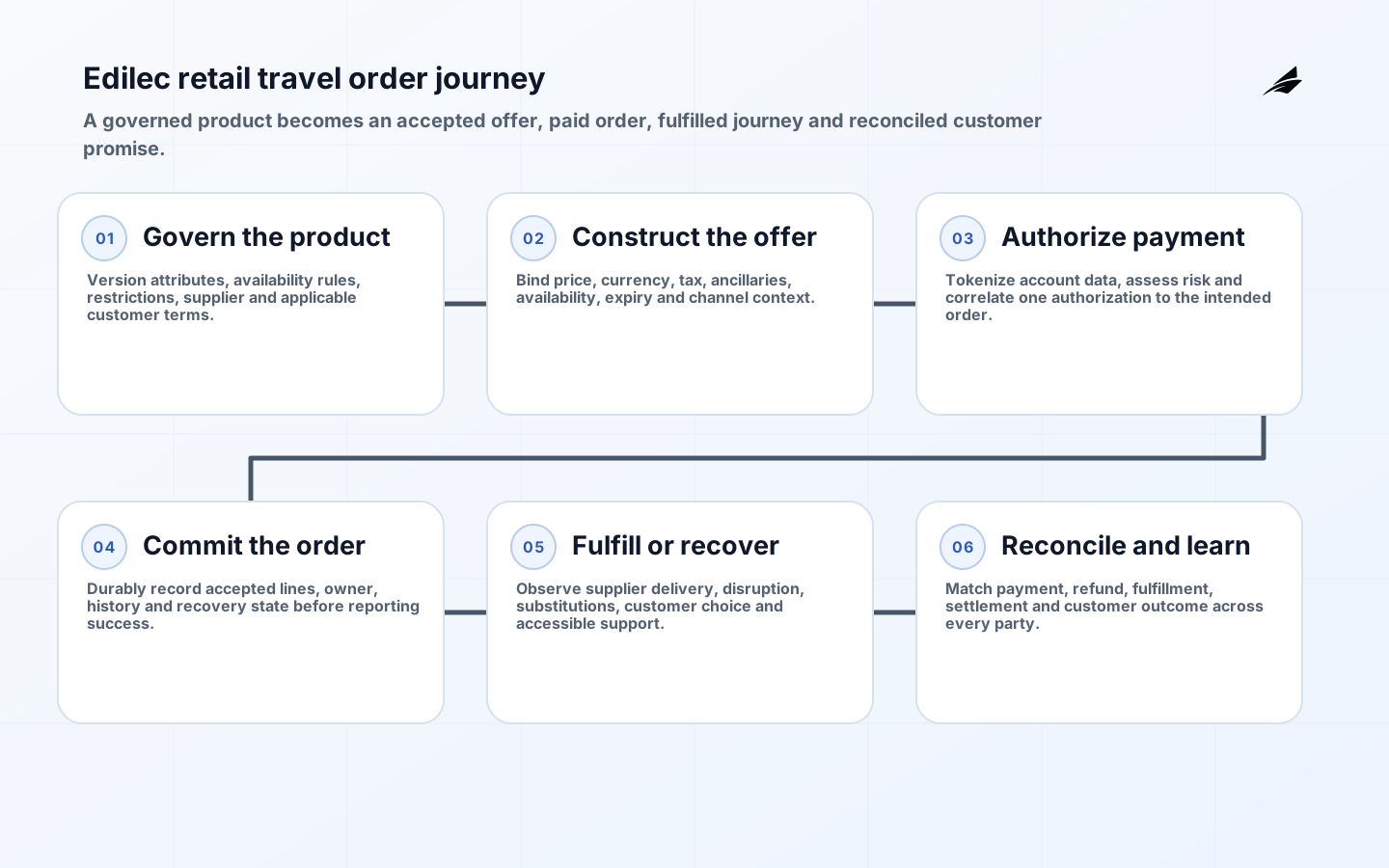
Use events for durable lifecycle facts and synchronous calls where a current decision is required, such as confirming inventory before purchase. Define idempotency because payment, order and supplier calls will be retried. Never report success until the commitment is durably recorded. When one component fails, show whether the whole order failed, partially completed or requires recovery. The six-stage Edilec retail travel order journey at this heading follows a governed product through offer, payment authorization, order creation, multi-party fulfillment and reconciliation, including exceptions rather than depicting a frictionless checkout only.
Control payments, fraud, refunds and settlement
Minimize payment account data in enterprise systems and use tokenization and hosted components where they reduce scope appropriately. The PCI Data Security Standard establishes technical and operational requirements for entities that store, process, transmit or can affect payment account data. Map the cardholder-data environment, third parties and administrative paths rather than assuming a payment provider removes all responsibility. Protect account recovery and loyalty balances because they can be monetized even outside card processing.
Fraud controls should combine identity, device, payment, account and transaction signals without making opaque denials the default customer experience. Define manual review, appeal and fallback. Preserve the model or rule version and reason codes for consequential decisions. Refunds must link to the original payment, order lines, delivered value and policy, with idempotency and approval thresholds. Reconcile payment authorization, capture, refund, chargeback, supplier statement and general ledger. Differences need reason categories and owners; aging suspense balances are operational defects, not merely finance cleanup.
Engineer disruption and service recovery as core journeys
Travel disruption, stock failure, missed delivery and supplier cancellation are expected states. Detect affected orders, determine customer options, reserve replacement capacity and communicate through a permitted channel. Keep one recovery case with decisions, offers, acceptance and unresolved amounts. Agents need the same current order state the customer sees. Avoid asking a customer to repeat identity and history at each transfer. For air journeys, the European Commission maintains an official overview of EU air passenger rights; applicable scope and remedies require current legal interpretation.
Design for mass disruption, when normal case-by-case handling and supplier interfaces may be overwhelmed. Prioritize vulnerable and time-critical customers, bound automated rebooking or substitution authority and expose honest queue state. Preserve the original contractual position and every alternative accepted or declined. Test communications for stale links, duplicate messages and channel outage. After recovery, reconcile fulfillment, refunds, loyalty adjustments and partner settlement. Measure time to viable option, not only time to first notification, and review outcomes by itinerary, product and customer needs.
| Failure | Safe customer state | Operational control |
|---|---|---|
| Price changes before payment | Offer expires or is explicitly reconfirmed | No silent price substitution |
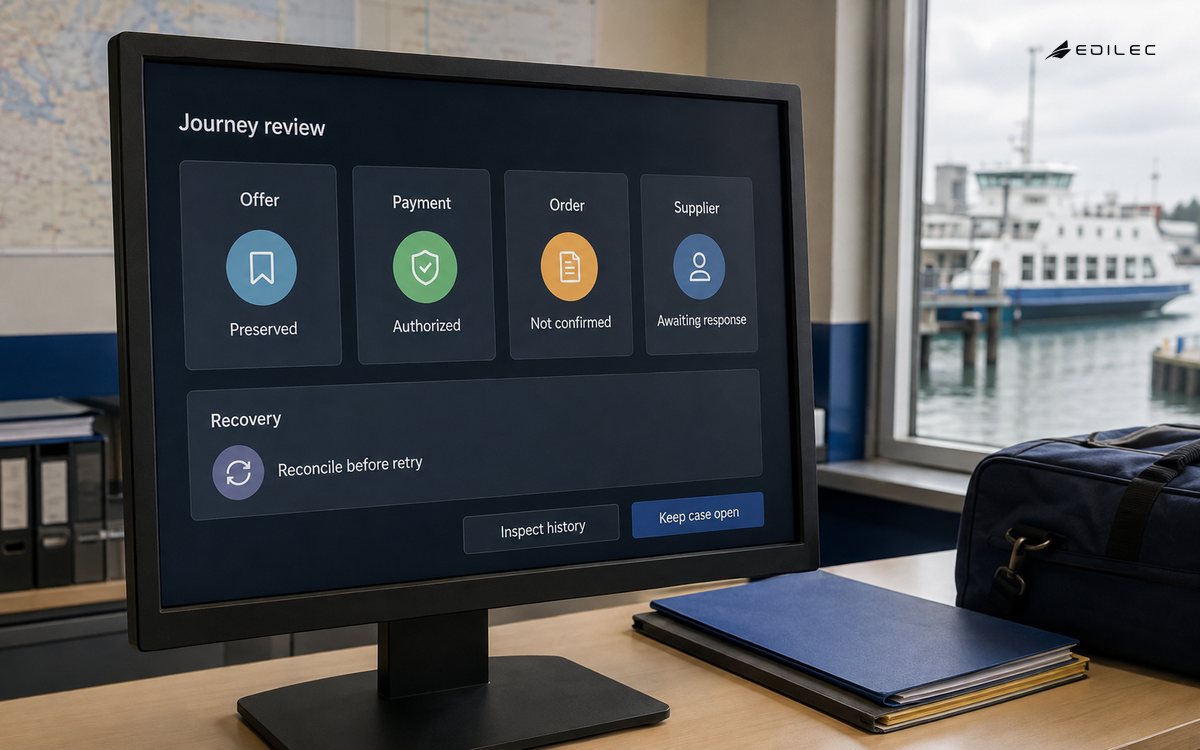
| Payment succeeds, order fails | Pending recovery with no duplicate charge | Correlation, idempotency and timed reconciliation |
| Supplier rejects fulfillment | Known exception with alternatives and owner | Durable event and escalation route |
| Mass disruption | Prioritized options and accurate communication | Capacity controls and bounded automation |
| Refund delayed | Visible amount, method, status and expected action | Ledger reconciliation and aging ownership |
Protect customer data and make the journey accessible
Travel and retail profiles can reveal identity, location, companions, preferences, payment behavior and accessibility needs. Define purpose, lawful basis, retention, sharing and deletion for each data use. Loyalty, personalization and fraud do not automatically justify unlimited reuse. The NIST Privacy Framework helps organizations manage privacy risk as an enterprise concern. Separate operationally required data from optional enrichment, enforce consent and preference where applicable, and let customers correct meaningful errors without destroying transaction records that must remain.
Accessibility is part of journey completion, especially under time pressure. Follow the current WCAG 2.2 Recommendation for web content and test complete tasks with keyboard, screen readers, zoom, contrast and error recovery. Do not place essential disruption information only in color, images or inaccessible documents. Support names, addresses and scripts across markets. Preserve context when customers move between digital and assisted channels. An accessible interface attached to an inaccessible identity, payment or support step is not an accessible service.
Operate the ecosystem with shared evidence and metrics
Instrument the order across channels and partners with correlation that does not expose sensitive data. Monitor offer latency, order success, payment recovery, fulfillment exceptions, stale inventory, communication delivery, refunds and settlement differences. Define service objectives around completed customer tasks. Supplier contracts need interface availability, data quality, change notice, incident cooperation, reconciliation and exit terms. Exercise degraded modes when a partner or identity service is unavailable. One healthy API does not prove the multi-party journey completed correctly.
Use a cross-functional operating review for customer outcomes, commercial performance, risk and technical health. Segment measures by product, channel, market and accessibility need. Track conversion with cancellations, service contact, refund time and complaint outcome so growth does not hide poor fulfillment. Assign product ownership for journey capabilities and retire duplicate records and interfaces after modernization. Preserve audit evidence proportionately. Improvements should reduce customer uncertainty and reconciliation work, not merely move a manual step from one company or team to another.
Retail and travel systems takeaways
- Define the customer promise and legal or commercial roles before selecting platforms.
- Preserve accepted offers, order history, fulfillment events and settlement as linked evidence.
- Design idempotent recovery for payment, supplier and order failures across system boundaries.
- Treat disruption, substitution, refund and customer communication as primary journeys.
- Apply privacy and accessibility to complete tasks across digital and assisted channels.
- Measure customer completion and financial reconciliation across the whole partner ecosystem.
Frequently asked questions
Should retail and travel use one order platform? A shared order model can reduce fragmentation, but product, fulfillment and regulatory differences may require specialized engines. Establish a coherent business contract and ownership before deciding physical platform consolidation.
Can personalization improve the journey without a large customer profile? Yes. Use current context and minimum relevant preferences first. Measure incremental value, explain consequential choices and limit retention. More data can increase privacy, security and quality risk without improving the offer.
What should be modernized first? Choose a journey where fragmented order state creates customer harm, revenue leakage or costly manual recovery. Improve the authoritative record and exception path before replacing every customer-facing channel.
Conclusion
Retail and travel systems create trust by keeping the customer promise coherent across many parties and moments. A strong design preserves the offer, controls payment, records order change, observes fulfillment and recovers openly from disruption. When privacy, accessibility and reconciliation are built into that lifecycle, business teams can improve commercial experience without losing the operational evidence needed to serve customers and partners fairly.