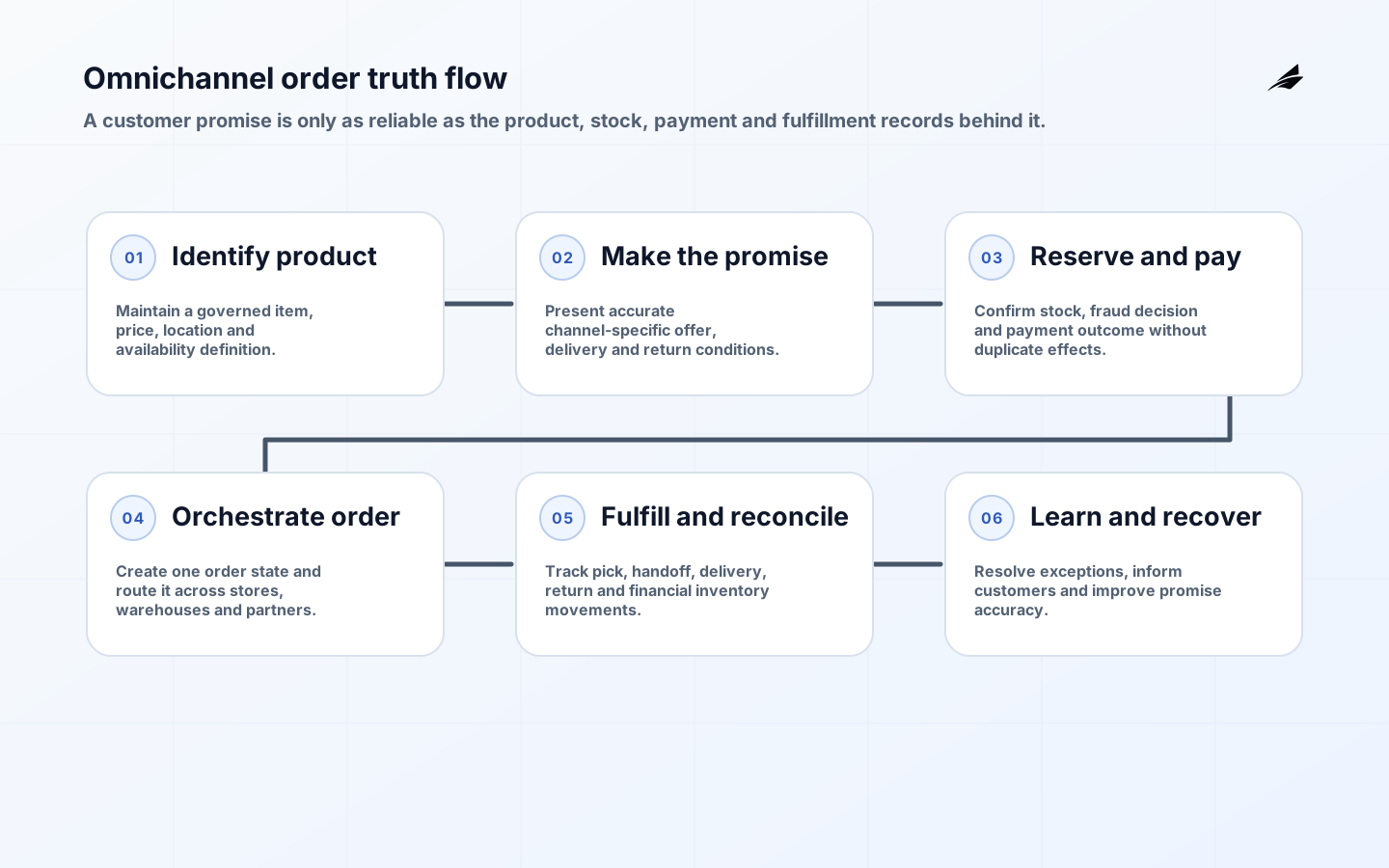
Retail and consumer systems connect merchandising, product information, pricing, inventory, commerce, stores, payments, fulfillment, service and finance around a customer promise. The hard part is rarely a single screen. It is preserving one understandable order state while data and physical goods move across channels, locations and partners. Business teams should therefore scope modernization around journeys and records, not around a shopping list of platforms.
This guide focuses on the decisions needed before selection and delivery. Pair it with the omnichannel retail implementation checklist and retail and consumer FAQ. Public organizations operating retail-like services can compare the public-sector retail systems guide.
Start with a customer journey and commercial outcome
Choose one journey such as click-and-collect, ship-from-store, subscription replenishment or cross-channel return. Map customer steps, colleague work, systems, records, money movement and exceptions. Establish baselines for conversion, promise accuracy, cancellations, substitutions, fulfillment cost, return cycle time, customer contact and stock adjustments. A narrower end-to-end scope produces better evidence than deploying a broad platform with no coherent operational change.
Define which promises the first release will make: price, availability, delivery window, pickup readiness, refund timing and return eligibility. Every promise needs an authoritative source, freshness expectation and owner. State what the customer sees when confidence is low. It is better to offer a realistic window than to display precise but untrustworthy availability.
| Journey decision | Authoritative record | Failure response |
|---|---|---|
| Which item is this? | Product master and governed identifier | Suppress or quarantine conflicting product data |
| Can it be promised? | Available-to-promise calculation | Offer a later window or alternate location |
| Was payment accepted? | Payment provider result and order ledger | Reconcile before retrying or releasing stock |
| Who owns fulfillment? | Order orchestration state | Reroute by policy and notify the customer |
| Is the refund complete? | Return, payment and finance reconciliation | Open an owned exception with a deadline |
Create stable product, location and inventory data
Use identifiers that remain stable across systems and trading partners. GS1 standards provide common approaches for identifying products, locations and logistic units, capturing identifiers in carriers, and sharing master, transaction and event data. The GS1 standards overview explains the identify, capture and share pattern. The barcode usually identifies an item; descriptive and price information belongs in governed systems.
Define the product hierarchy, variant rules, units, bundles, lifecycle states and ownership of attributes. For inventory, distinguish on-hand, reserved, damaged, in-transit and safety stock. Document whether each event is a fact, estimate or adjustment. Preserve correlation IDs through sale, cancellation, pick, shipment and return so discrepancies can be reconstructed. Reconciliation is a designed business process, not a nightly technical afterthought.
Design a retail system architecture around clear responsibilities
A typical architecture separates experience channels, identity and consent, product information, pricing and promotion, inventory, cart and checkout, payment, order management, fulfillment, customer service and analytics. Assign one service authority for each business state and use versioned APIs or events at boundaries. Avoid letting every channel calculate promotions or order status independently; duplicated rules create inconsistent promises and expensive dispute handling.

Design idempotency for checkout and fulfillment commands. A network retry must not create a second order, capture payment twice or reserve stock again. Store the business request key, outcome and downstream references. Use a durable order state model with valid transitions and compensating actions. When a warehouse rejects a line, the system should know whether to reroute, split, substitute, cancel or request human review.
Reduce payment, identity and fraud exposure
Keep payment account data out of unnecessary systems through approved hosted fields or tokenization, and establish exact scope with a qualified adviser. The PCI Security Standards Council document library provides PCI DSS 4.0.1 and current supporting documents. Compliance is not a substitute for threat modeling; protect administration, scripts, APIs, refunds, loyalty balances and customer-service workflows that attackers can abuse without directly stealing card data.
Use proportionate identity assurance. Guest checkout can reduce friction, while account recovery, stored value, address change or high-risk refund may need stronger authentication. NIST SP 800-63-4 covers identity proofing, authentication and federation and adds considerations for security, privacy and customer experience. Separate customer identity, colleague identity and workload identity; each has different lifecycle and assurance needs.
| Control area | Business control | Operational evidence |
|---|---|---|
| Price and promotion | Versioned rule, eligibility and effective dates | Reproducible basket calculation and override log |
| Inventory | Reservation expiry and adjustment authorization | Stock variance by item and location |
| Payment | Tokenized capture with idempotent reference | Daily order-to-settlement reconciliation |
| Refund | Role and value limits with second approval where needed | Refund age, reason and exception trend |
| Privileged access | Least privilege, strong authentication and expiry | Access review and unusual-action alerts |
Make the entire consumer journey accessible
Apply the WCAG 2.2 Recommendation to product discovery, account, checkout, payment, pickup and returns, then test complete tasks with people using assistive technologies. Include kiosk and colleague-assisted paths where relevant. Product imagery needs useful alternatives; errors must be associated with fields; focus must remain visible; authentication cannot depend on inaccessible cognitive tests. Third-party payment or consent components remain part of the customer journey.
Design truthful exception communication. Give the customer the current state, what has happened, what they need to do, what the retailer will do and by when. Preserve that same information for colleagues so a customer is not forced to repeat the story. Accessibility, localization and plain-language review should cover notifications and support tools as well as the storefront.
Deliver by journey and rehearse operational exceptions
Build a thin slice through real systems for a limited assortment, region or location. Test normal and exception paths with stores, fulfillment, finance and service colleagues. Rehearse duplicate payment responses, stale stock, partial pick, carrier delay, failed notification, return without receipt and offline store operation. Run reconciliation in shadow before relying on it financially. Cut over with a rollback rule based on customer and ledger impact, not only technical uptime.
Treat supplier readiness as part of release. Confirm support hours, incident paths, change windows, data export, capacity assumptions, recovery evidence and exit arrangements. Track full transaction cost, including licenses, integration, fraud, payment fees, infrastructure, operational labor and exceptions. A nominally cheaper platform can cost more when colleagues manually repair fragmented orders.
Measure promise quality and unit economics
Use a balanced scorecard: customer task completion, promise accuracy, conversion, cancellation, fulfillment time, return and refund cycle, service contact, inventory variance, payment exceptions, fraud loss, availability and cost per fulfilled order. Segment by channel, location, fulfillment method and meaningful customer needs. Review the whole journey because a local optimization, such as faster checkout, can increase downstream cancellations if stock confidence is weak.
Monitor leading indicators such as event lag, failed reservations, unprocessed state transitions and reconciliation breaks. Assign every exception queue an owner, service target and aging measure. Publish a shared operational view for commerce, stores, fulfillment, service and finance, while preserving role-based access to sensitive customer and payment information.
Establish release governance that reflects retail trading periods. Maintain a calendar of promotions, assortment changes, store events, payment-provider windows and fulfillment peaks. Freeze or limit high-risk changes when recovery capacity is constrained, but keep emergency fixes possible through a tested path. Progressive rollout by store, region, customer cohort or fulfillment mode can reveal defects before they affect the whole network. Define automatic stop thresholds for payment errors, promise failures and reconciliation breaks.
Plan data migration and coexistence explicitly. Product, customer, order and loyalty records often contain duplicates, legacy states and locally interpreted fields. Profile before mapping, preserve source identifiers, reconcile financial and stock totals, and route ambiguous records to business owners. During dual running, choose which system may accept each write and how changes synchronize. A technically complete migration can still fail if colleagues cannot explain historical orders or customers lose valid preferences and entitlements.
Include store and contact-center colleagues in design and acceptance. They see substitutions, damaged goods, identity disputes and policy exceptions that central teams may miss. Measure clicks, rekeying and time to recover an order, and provide role-appropriate training in the live workflow. A customer-facing improvement that creates hidden colleague work often shifts cost instead of removing it.
Key takeaways
- Scope modernization around one customer promise and its full operational journey.
- Use stable identifiers and explicit authoritative records for product, stock, order, payment and return states.
- Design idempotency, reconciliation and compensating actions before scaling volume.
- Include payment security, identity assurance and accessibility in the architecture.
- Measure promise quality, exception workload and unit economics across channels.
Frequently asked questions
Should one platform own every retail capability?
Usually not. A suite can reduce integration work, but no boundary should be accepted blindly. Keep business states and contracts explicit, assess extension and exit costs, and avoid duplicating the same rule across suite and external components.
Does inventory need to be real time?
It needs to be fresh enough for the promise and risk. High-demand pickup may require reservation-level updates; long-lead delivery may tolerate more delay. Measure event latency and promise error, then choose architecture and safety stock accordingly.
Where is AI useful in retail systems?
Forecasting, search, recommendations, fraud triage and service assistance can help when trained and evaluated for the context. Keep price, eligibility, payment and fulfillment authority in controlled workflows, test subgroup and feedback effects, and provide fallback when confidence is poor.
Conclusion
Successful retail and consumer systems make a reliable promise and preserve its truth through physical and financial operations. Stable data, clear service boundaries, secure payments, accessible journeys, rehearsed exceptions and reconciled records matter more than the number of installed modules. Prove one omnichannel journey end to end, then expand products, locations and fulfillment modes using the same evidence.