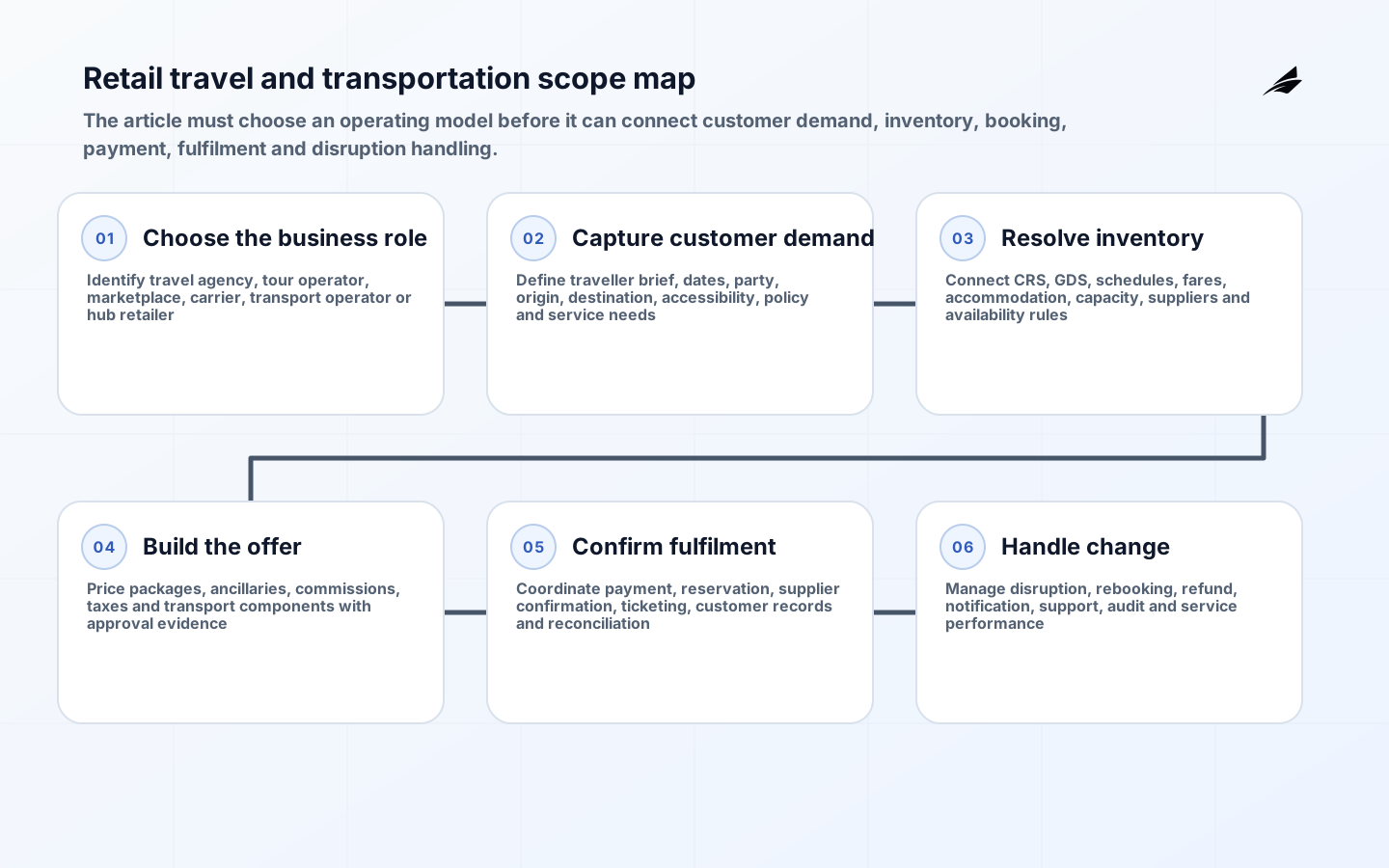
Retail, travel and transportation systems share a demanding operating pattern: customers discover an offer, commit money or entitlement, expect limited capacity to be reserved, receive a product or journey, and may need service when plans change. The similarities make reusable commerce, identity, payment and data capabilities attractive. The differences remain decisive. A retail substitution, flight reaccommodation and transit disruption have distinct rules, safety implications and partner networks. Business teams should modernize around a clear transaction lifecycle while preserving the domain controls that make fulfilment trustworthy.
This guide complements Edilec's implementation checklist and sector FAQ. It focuses on decisions business, operations, technology, finance, security and customer-service leaders must make together. The goal is not one universal platform. It is a connected operating model in which offers are accurate, orders are attributable, inventory is not oversold, fulfilment is visible, payments reconcile and disruptions preserve customer choices.
Map the customer and operational value stream
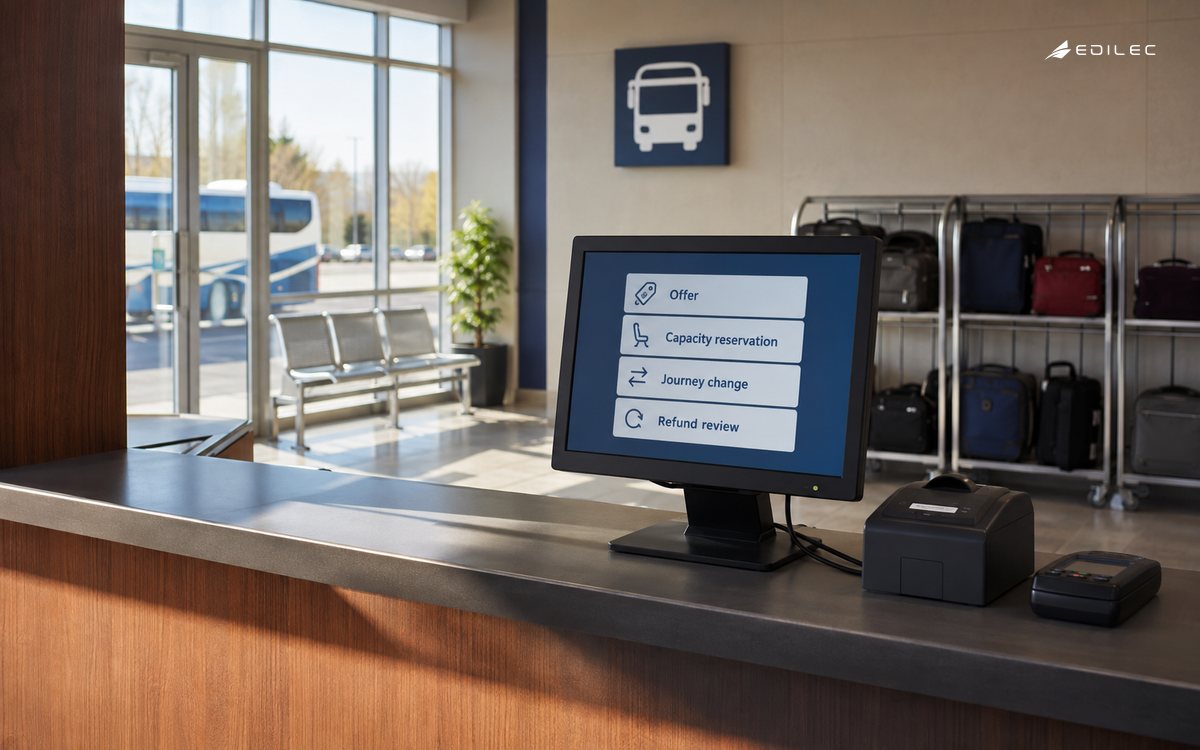
Follow representative journeys from search through offer, order, payment, fulfilment, change, refund and settlement. Include anonymous and known customers, loyalty, partner channels, assisted service and accessibility needs. For transportation, add check-in, boarding or validation, movement status, connections and irregular operations. For retail, include allocation, pick, pack, ship, collect, return and substitution. Record the customer promise, authoritative record, responsible team, timing and exception at each step. This exposes where a channel presents an offer that operations or inventory cannot fulfil.
Baseline conversion, abandonment, payment failure, oversell, fulfilment time, on-time performance, contact, change, refund, fraud and reconciliation. Segment by channel, market, product and journey type. Aggregate metrics can hide a broken partner path or inaccessible workflow. Identify hard constraints such as capacity, dangerous goods, fare or tax rules, customs, accessibility assistance, perishability and delivery windows. Product leaders should own the end-to-end outcome while domain teams retain authority over safety, operations, finance and regulatory decisions.
| Lifecycle stage | Authoritative question | Failure to design for | Useful measure |
|---|---|---|---|
| Offer | What exactly is available, eligible and priced now? | Stale or inconsistent channel promise | Offer accuracy and search-to-order conversion |
| Order | What did the customer commit to and under which terms? | Duplicate, fragmented or unauditable order | Order creation success and duplicate rate |
| Payment | What was authorized, captured, refunded and settled? | Money and service records diverge | Payment success and unreconciled value |
| Fulfilment | Was each item, segment or entitlement delivered? | Customer sees success while operations failed | Complete and on-time fulfilment |
| Change | Which options, costs and duties apply now? | Channels produce contradictory recovery | Self-service completion and repeat contact |
Create a consistent offer, order and inventory model
An offer combines product or itinerary, price, availability, eligibility, terms and an expiry. Give it an identifier and retain the inputs needed to explain the accepted promise. Separate catalog facts from dynamic availability and price. The order should become the durable commercial record, with versioned items, customer parties, payment state, fulfilment state and changes. Do not overload one status field to represent every subsystem. Each component should expose pending, confirmed, failed, cancelled and unknown conditions so partial success can be recovered rather than hidden.
Inventory needs a clear unit and authority: physical stock, seats, rooms, vehicle capacity, appointment windows or service entitlements. Define hold duration, release, overbooking, substitution and partner synchronization. Use idempotent reservation and order operations. In airline distribution, IATA describes NDC as an open data exchange standard supporting offer and order processes across airlines and sellers. Standards improve interoperability, but each organization still must govern schema versions, commercial semantics, certification and exception recovery.
Connect channels, partners and customer identity
Define a channel contract for web, app, store, kiosk, call center, agency, marketplace and machine interfaces. Common capabilities should include offer retrieval, order creation, servicing, payment, notifications and identity, but channels may have different connectivity and accessibility. Preserve correlation identifiers and original partner messages. Use versioned APIs and event schemas, bounded retries and reconciliation. Rate limits should protect services while allowing recovery after an outage. Give partners sandbox data, conformance tests, change notice and a support path.
Resolve customer identity without forcing every transaction into a single profile. Anonymous purchase, household accounts, corporate travel, delegated booking and loyalty relationships need distinct consent and authority. Minimize data and separate identity proof from personalization. A support agent or travel arranger should see only the order information required for their role. Record communication permissions and accessibility preferences with provenance. Account takeover defenses must cover profile changes, stored value, refunds and loyalty redemption, not only sign-in. Provide recovery that does not expose one traveler's or shopper's records to another.
Design fulfilment and disruption as first-class workflows
Model fulfilment events from operational sources: item picked, parcel handed over, traveler boarded, vehicle departed, room ready, entitlement consumed or service completed. Translate those into customer-facing state without claiming more certainty than the source supports. Use event time and processing time, tolerate late and duplicate messages, and reconcile missing sequences. Static schedules and real-time feeds need version and freshness. The GTFS overview illustrates the distinction between schedule and real-time transit information, a useful pattern for customer journey systems beyond public transit.
Disruption is not merely a notification. Detect the event, identify affected orders and dependencies, determine eligible options, protect scarce recovery capacity, communicate clearly, capture customer choice and update payment and fulfilment records. Provide assisted paths for complex, vulnerable or inaccessible cases. Avoid sending messages before operational alternatives are ready unless immediate safety communication is needed. Test cascading events such as missed connections, supplier cancellation or warehouse outage. Measure time to a viable option, successful self-service, repeated contact and unresolved customers, not notification volume alone.
| Disruption control | Business rule | System capability | Acceptance scenario |
|---|---|---|---|
| Affected set | Identify orders truly impacted and related segments. | Event correlation and dependency graph | Cancellation selects correct customers without leakage. |
| Options | Offer only operationally and commercially valid choices. | Real-time inventory and eligibility engine | Concurrent recovery does not oversell capacity. |
| Communication | State facts, uncertainty, action and deadline clearly. | Preference-aware notification with delivery state | Failed channel moves to an allowed fallback. |
| Money | Keep refund, credit, fee and settlement traceable. | Idempotent payment and finance events | Partial fulfilment reconciles to the correct value. |
| Assistance | Prioritize safety, accessibility and high-impact exceptions. | Case routing with full order context | Agent can act without rebuilding the journey. |
Control payments, fraud and financial reconciliation
Separate authorization, authentication, capture, void, refund, chargeback and settlement. Use payment-provider tokens rather than storing account data where possible, apply least privilege and segment payment components. Make every request idempotent and preserve references across channel, order, processor and ledger. A timeout creates an unknown state, not an automatic failure; query or reconcile before retrying capture or refund. Support split tender, partial fulfilment, currency, tax, fees and partner settlement according to the product. Finance acceptance requires totals and exceptions that reconcile to orders and bank or processor evidence.
Fraud controls should consider account, device, payment, promotion, refund, loyalty and operational abuse. Define when to allow, challenge, review or block and measure false positives by customer segment. Keep high-impact denial and manual-review authority accountable. Do not expose sensitive fraud reasons to attackers, but provide lawful customer support and appeal. Monitor employees and partners with proportionate controls because insider access to orders, refunds and inventory can be abused. During disruption, tune controls carefully: unusual behavior may be legitimate while attackers may exploit operational pressure.
Modernize data and integration without stopping operations
Assign authoritative ownership for product, offer, inventory, order, customer, fulfilment and finance data. Publish schemas and event meaning with owners, versions, quality rules and retention. Avoid a central data lake becoming an ungoverned second operational truth. Analytics can integrate history, but operational decisions need freshness and reconciliation. Use change-data or events where timing and decoupling require them; use synchronous APIs for decisions that must complete now; use batch for bounded reporting. Every pattern needs timeouts, replay, dead-letter handling and observability.
Modernize by value stream and bounded capability rather than replacing every core system at once. Introduce a channel API, order layer or event backbone only with clear authority and migration states. Use strangler patterns where old and new transactions can be routed deterministically, and avoid uncontrolled dual write. Reconcile records at each stage and keep a forward recovery path. The IATA airline retailing program describes an industry move toward offers and orders; businesses should treat such transitions as operating-model and finance change, not only message-format adoption.
Establish a cross-functional operating model
Create product ownership across search-to-service, with domain owners for inventory, operations, payment, data, security and customer care. Review customer outcomes, operational exceptions, financial reconciliation, partner health, incidents, change and cost. Define service objectives around offer, order, fulfilment and servicing transactions. During incidents, use one timeline and command authority across technology and operations. Preserve safety and legal decision rights. Exercise peak sale, holiday, weather, network loss, partner failure and mass cancellation scenarios with customer communication and finance included.
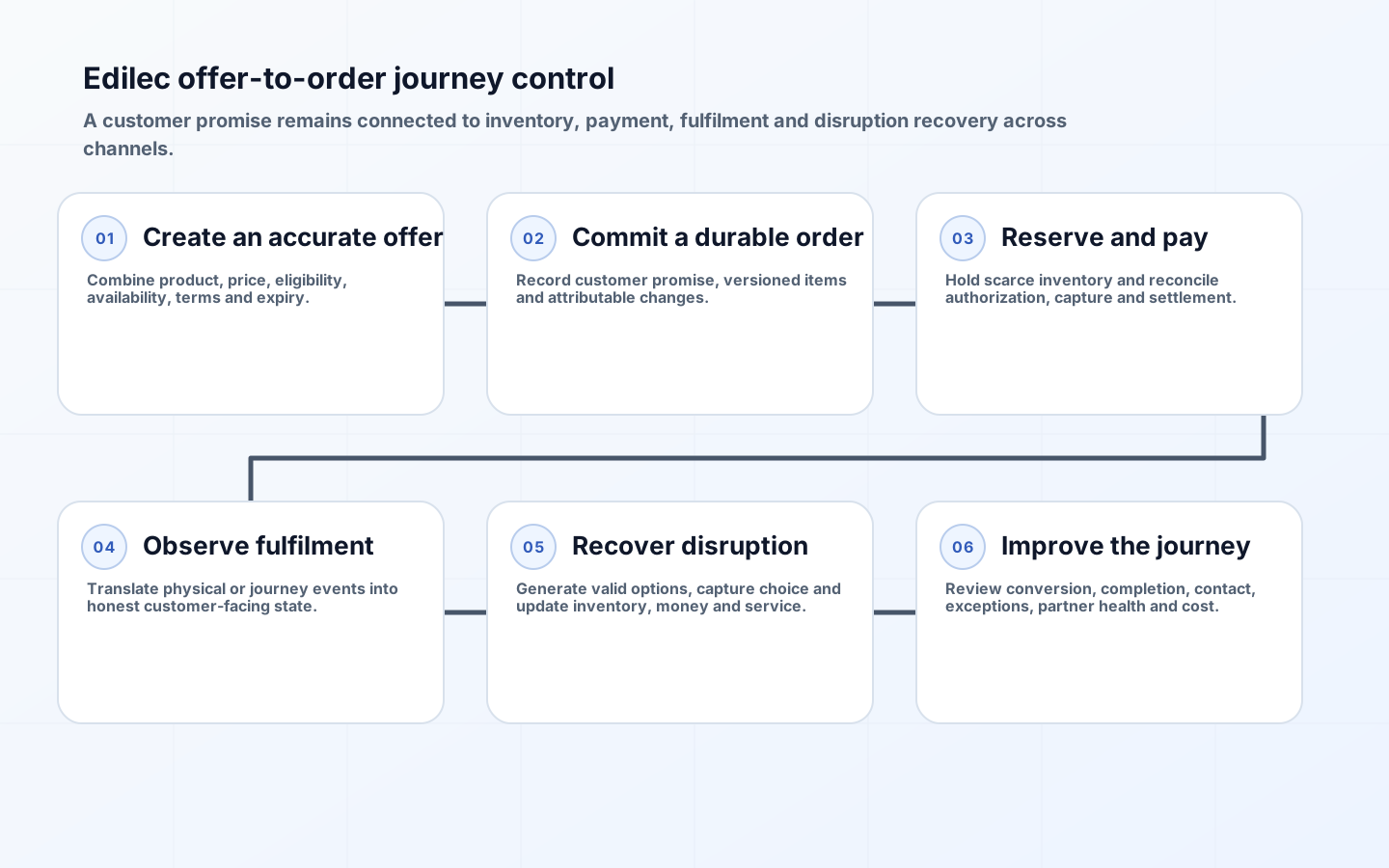
Use IATA Dynamic Offers guidance as evidence that more responsive offers also require robust order processing. Dynamic pricing or personalization should have inventory, customer, fairness, policy and rollback controls. Maintain current standards obligations; the IATA Passenger Services Conference Resolution Manual demonstrates how operational and interline practices continue alongside digital retailing. Innovation should simplify the customer and operator journey rather than create untraceable decisions.
Retail, travel and transportation takeaways
- Map offer-to-settlement journeys with operational exceptions and accountable records.
- Separate offer, order, payment and fulfilment states so partial failure remains recoverable.
- Manage scarce inventory with idempotent holds, expiry, synchronization and clear authority.
- Treat disruption as option generation, customer choice, financial update and assisted recovery.
- Modernize by bounded value stream with schema ownership and reconciliation at every transition.
- Operate customer, safety, finance and technical evidence in one cross-functional cadence.
Frequently asked questions
Can retail and travel use the same order platform? They can share patterns and components, but fit depends on inventory, servicing, settlement, regulation and partner needs. Preserve domain semantics and test complex changes before forcing them into a generic commerce model.
Should real-time data replace all batch processing? No. Real-time interfaces support decisions and customer state that must be current; batch remains suitable for bounded reconciliation and reporting. Select timing by business requirement and design replay, freshness and ownership for either pattern.
What should a modernization pilot prove? It should prove one complete value stream, including transaction integrity, operational fulfilment, exception handling, payment reconciliation, support and observability under representative volume. A new user interface over unchanged failure paths is not sufficient.
Conclusion
Retail, travel and transportation modernization works when digital offers remain connected to physical and financial reality. Clear authority for inventory, durable orders, observable fulfilment, recoverable disruption, reconciled payments and domain-aware standards give customers consistent choices across channels. This model lets business teams modernize in phases without losing the operational controls that make promises credible.