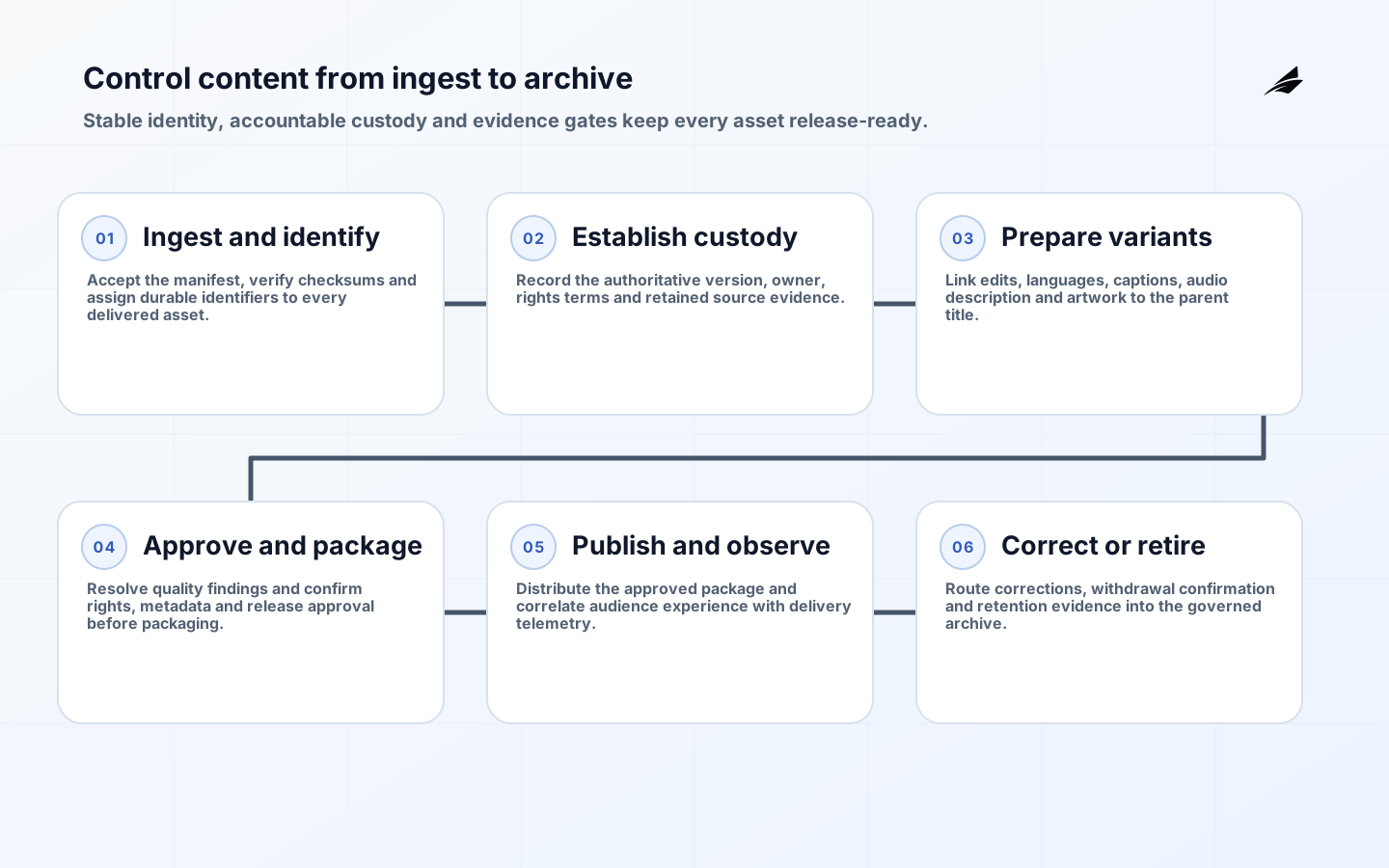
A media and entertainment technology program succeeds when it improves the journey from an approved asset to a dependable audience experience. That journey can include ingest, metadata, rights, editing, localization, quality control, packaging, distribution, playback, advertising, reporting and archive. Treating it as a single “video platform” purchase hides the handoffs where delay, rework and rights mistakes occur. Business teams should begin with the content lifecycle, the promises made to viewers and partners, and the evidence needed to operate each release.
The right scope depends on the business model. A broadcaster managing live schedules has different failure modes from an on-demand library, a publisher distributing short-form clips or an internal studio producing branded content. The practical guide below is deliberately technology-neutral: it shows how to define the operating model before selecting media asset management, transcoding, content delivery, playback or analytics products.
Map the content lifecycle before choosing systems
Follow representative content from commission or acquisition through publication and withdrawal. Record who owns the asset, which version is authoritative, what rights apply, which transformations occur, where metadata changes and what approval proves readiness. Include subtitles, captions, audio description, artwork, promos and contracts; these supporting assets often have different owners and deadlines from the main program.
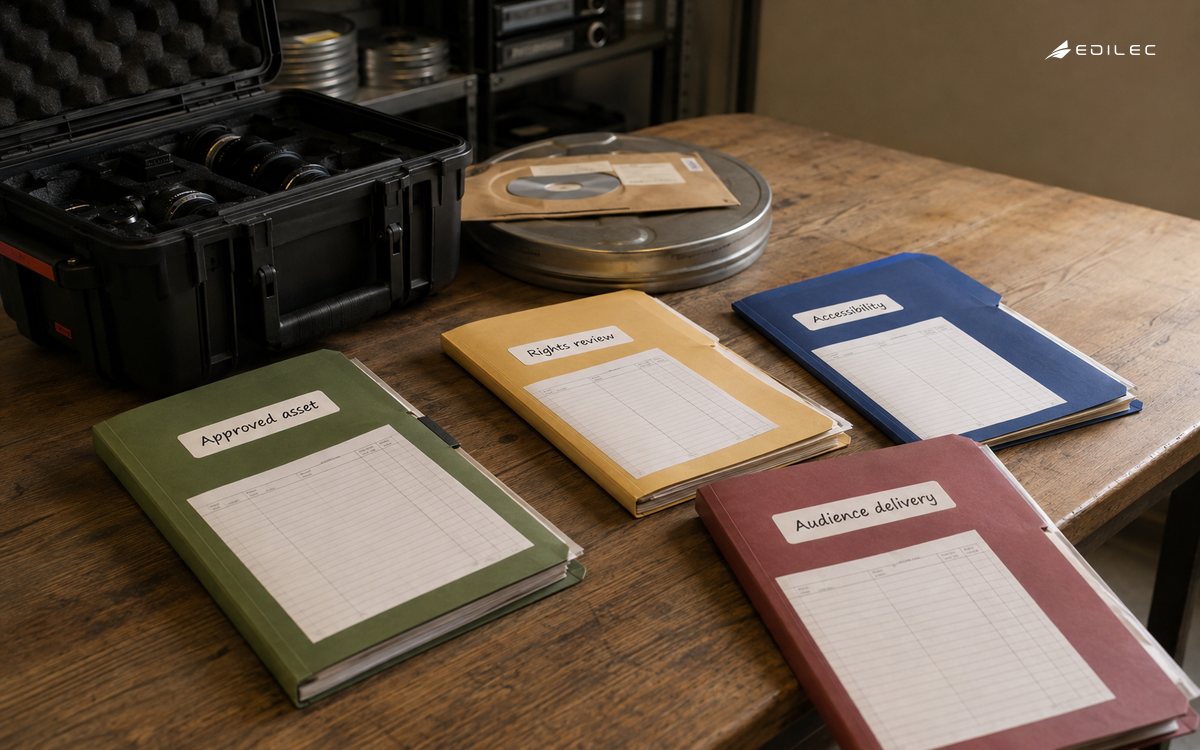
Create stable identifiers for title, season, episode, rendition and distribution package. An identifier should survive file moves and vendor changes. Separate editorial metadata from technical characteristics and rights terms, then define which system is authoritative for each field. Otherwise, a corrected title, territory window or caption file can diverge across scheduling, storefront and delivery systems without a clear reconciliation path.
| Lifecycle stage | Decision to make | Evidence to retain |
|---|---|---|
| Ingest | What constitutes a complete, accepted delivery? | Manifest, checksum, source metadata and acceptance result |
| Prepare | Which edit, language and accessibility assets belong together? | Version links, approvals and quality-control findings |
| Publish | Where and when may the title appear? | Rights rule, schedule, package version and release approval |
| Observe | How is audience impact separated from technical failure? | Playback events, delivery telemetry and business definitions |
| Withdraw or archive | What must disappear, remain discoverable or be retained? | Takedown confirmation, retention basis and archive inventory |
Design around a measurable viewer experience
Define experience targets by journey: start playback, seek, change language, resume, join a live event, recover from a network change and receive an understandable error. Aggregate uptime alone cannot reveal a title that will not start on one device family. Use content identifiers, player version, device class, delivery region and session correlation to connect client symptoms with packaging, authorization and delivery events while respecting privacy obligations.
Adaptive streaming requires compatible encoding ladders, segment boundaries, manifests, players and delivery behavior. W3C Media Source Extensions describes how browsers append segmented media; DASH-IF publishes interoperability guidance. Standards reduce ambiguity, but they do not replace testing on representative devices and constrained networks. Keep a small set of reference assets that exercise long duration, rapid motion, multiple audio tracks, subtitles, ad markers and protected playback.
Protected playback needs separate decisions about account authorization, content keys, license policy and browser integration. W3C Encrypted Media Extensions supplies a common API, not a complete digital-rights-management system. Define failure messages and support evidence before launch. Accessibility tracks should remain usable throughout packaging and protection; the EME specification explicitly discusses the availability of captions, described audio and transcripts.
Treat metadata, accessibility and trust as product capabilities
Captions are not a late file attachment. Set ownership for transcription, timing, speaker identification, language review, corrections and downstream format conversion. WebVTT is a standard timed-text format for the web, but source and delivery formats may differ. Test reading order, overlapping cues, styling, live delay and language selection with people and assistive technology, not only automated validators.
Audio consistency also affects trust. ITU-R BS.1770 defines algorithms for measuring programme loudness and true-peak audio level, while outlets may apply additional delivery profiles. Choose the applicable specification for each destination, measure at defined points and retain the result with the package. Avoid applying one normalization target indiscriminately when partners or jurisdictions require different deliverables.
For provenance-sensitive material, C2PA Content Credentials can bind tamper-evident assertions about an asset’s history. They do not decide whether content is true. A useful implementation therefore defines who may sign, which transformations preserve or add provenance, what happens when credentials are absent, and how viewers or downstream partners see the information. Privacy and potential misuse belong in that design review.
Choose architecture around failure and change
| Capability | Useful boundary | Main failure to design for |
|---|---|---|
| Asset repository | Authoritative media, versions and related files | Duplicate identity, incomplete transfer or lost lineage |
| Workflow and orchestration | State changes, approvals and retryable work | A stalled job with no owner or unsafe duplicate execution |
| Transform and package | Reproducible renditions and manifests | Codec, timing, subtitle or encryption incompatibility |
| Rights and entitlement | Publication and per-request access decisions | Stale rules, clock errors or unavailable policy service |
| Playback and observability | Viewer interaction and session evidence | Client errors that cannot be correlated upstream |
| Archive | Durable preservation and retrieval | Unreadable formats, missing metadata or untested restore |
Prefer explicit contracts between capabilities. A publish event should carry a stable asset and package version, not an undocumented file path. Make long-running operations idempotent so a retry does not create duplicate packages or releases. Use checksums at transfer boundaries, validate manifests before distribution and quarantine invalid inputs. Decide which metadata changes require repackaging and which can propagate independently.
Roll out one representative content path
- Select one content class with meaningful rights, accessibility and device requirements, but a manageable release calendar.
- Baseline current lead time, manual handoffs, correction rate, playback-start failures and support evidence quality.
- Model identifiers, metadata ownership, states, exceptions and retention before automating the happy path.
- Integrate a thin path from accepted ingest through a limited publication destination with reconciliation and rollback.
- Test representative devices, networks, languages, entitlements, expiry boundaries and inaccessible dependencies.
- Expand by content class or destination only after operators can diagnose, replay and reconcile the pilot path.
- Retire old jobs and duplicate metadata stores only when consumers, records and recovery procedures have moved.
A concrete pilot might publish a prerecorded program with two audio languages, captions, artwork and a seven-day territory window to one web destination. The release gate checks asset completeness, rights, caption presence, loudness, package validation and playback on the supported browser set. Deliberately test a late caption correction, an expired entitlement and a failed transcode retry. The value of the pilot is the operating evidence it exposes, not a polished demo.
Manage risks with operational measures
| Risk | Control | Measure |
|---|---|---|
| Rights leakage | Central rule ownership, boundary tests and prompt takedown path | Blocked invalid publishes and takedown completion time |
| Poor playback | Reference assets, device matrix and session correlation | Start failure, rebuffering and fatal error by segment |
| Metadata drift | Field ownership, versioned events and reconciliation | Conflicts and unresolved mismatches |
| Accessibility regression | Release gates plus human and assistive-technology review | Missing or rejected accessibility assets |
| Cost surprise | Per-title processing, storage, egress and retention visibility | Unit consumption by content class and destination |
| Vendor lock-in | Exportable metadata, documented contracts and restore exercises | Successful package and metadata portability tests |
Interpret measures together. A lower start time is not a win if picture quality collapses; faster publication is not a win if corrections rise. Establish business definitions for a play, completion and unique viewer before dashboards are built. Keep raw technical telemetry separate from commercial reporting where their retention, access and accuracy requirements differ.
Procurement and architecture review should use scenario-based evidence for media technology, content workflows, streaming platforms. Ask each proposed solution to perform the representative case, reject an unauthorized action, survive an unavailable dependency, expose an understandable status, produce investigation evidence and export the owned data. Record configuration and integration work needed to achieve the demonstration. A feature visible in a product list is not proof that the complete control or journey will operate in the organization’s environment.
Acceptance should connect design claims to repeatable evidence. For ingest, retain tests or records that show manifest, checksum, source metadata and acceptance result. For the risk of rights leakage, assign the response before launch and review blocked invalid publishes and takedown completion time. Add load, recovery, permission and accessibility evidence in proportion to impact. The release decision should identify residual risks, their owners and the conditions that would pause further rollout.
Key takeaways
- Start with the end-to-end content lifecycle and assign an authoritative owner to every important record.
- Make rights, accessibility and release approvals testable parts of the workflow.
- Measure viewer journeys by content, player and device context rather than relying on aggregate uptime.
- Design retries, reconciliation, correction and withdrawal before scaling publication volume.
- Prove one representative path, then expand by content class or destination with clear exit gates.
FAQ
Should we buy a media platform before mapping the workflow?
No. A short lifecycle and ownership map makes product evaluation more accurate. It reveals whether the immediate constraint is asset control, workflow, rights, transformation, distribution, playback or reporting, and it provides realistic scenarios for demonstrations and proofs of concept.
What should be built rather than bought?
Buy standards-based commodity capabilities when they meet the operating need; build where proprietary rights logic, editorial experience or differentiated audience behavior matters. Evaluate the complete ownership cost, including integrations, data portability, support, upgrades and the effort to leave.
How much device testing is enough?
Use a risk-based matrix drawn from supported audiences, device families, browser or app versions, network conditions and content features. Combine automated conformance tests with real playback and accessibility review. Revisit the matrix when telemetry or support data shows a material gap.
Where does generative AI fit?
Possible uses include search enrichment, transcription assistance, summarization and production support, but human review, rights, disclosure, privacy and provenance remain design requirements. Do not assume generated metadata is accurate or that a model’s input and output rights match the intended distribution.
Conclusion
Media and entertainment systems are best treated as a controlled content supply chain connected to a human viewing experience. Clear identity, metadata ownership, executable rights, accessible assets, observable playback and rehearsed correction paths create a durable foundation. With those decisions made, teams can compare products and architecture choices against real work, run a representative release, and scale without losing custody of the content or the audience promise.