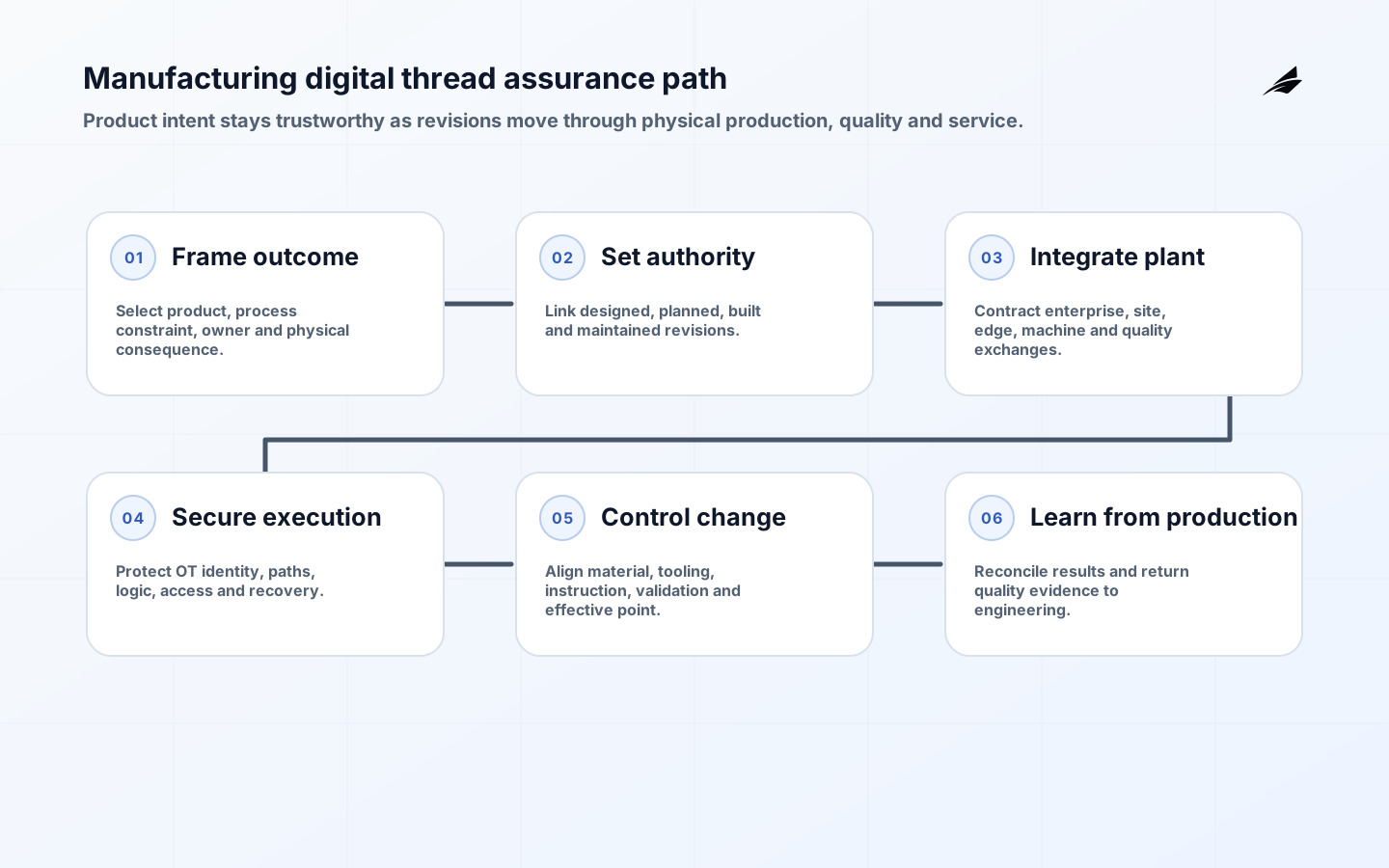
Engineering and manufacturing systems connect product intent with the physical process that produces, verifies, ships, services and eventually retires an item. The portfolio may include requirements and lifecycle management, computer-aided engineering, enterprise planning, manufacturing execution, quality, warehouse, maintenance, historians and industrial control. This guide explains how to integrate that portfolio without treating a factory like an ordinary office application environment.
Teams can convert the guide into action with the engineering and manufacturing implementation checklist and explore operating questions in the manufacturing systems FAQ. For model-enabled production work, the manufacturing AI workflow plan adds evaluation controls. Start with one product and production decision path.
Frame an engineering and manufacturing outcome
Select a measurable constraint such as engineering-change delay, first-pass yield, unplanned downtime, genealogy completeness, schedule adherence or energy per conforming unit. Map the current baseline and variation by product, line and shift. Name the decision owner and physical consequence of error. A predictive maintenance alert that stops a constrained line has a different acceptance threshold from an advisory used during planned maintenance. Preserve safety and product-quality authority outside a technology project.
Trace the lifecycle from requirement and design release through bill of material, process plan, work order, machine instruction, inspection, nonconformance, shipment and field feedback. NIST's smart manufacturing program emphasizes cyber-physical infrastructure, measurement, standards and analysis across the extended enterprise. Use that as a systems view: local optimization of one machine or dashboard may worsen flow, inventory or quality elsewhere.
Assign system and data authority
Create an authority matrix for product definition, manufacturing bill, routing, work order, machine state, material lot, inspection result, nonconformance, maintenance record and shipment. Define identifiers, units, revisions, effective dates, plant context and correction behavior. A design revision can be approved but not yet effective for a work order; overwriting the prior value destroys traceability. Maintain relationships between as-designed, as-planned, as-built and as-maintained states rather than forcing one current record to represent all four.
Use versioned interfaces and event contracts with sequence, timestamp, source and quality. Store raw equipment observations where investigation requires them and derive governed features separately. Handle clock drift, duplicate events, buffered delivery and device replacement. Reconcile quantities and state transitions across planning, execution, warehouse and financial systems. An integration is not accepted when messages arrive; it is accepted when the physical and digital state agree within defined tolerances and exceptions are owned.
| Lifecycle record | Likely authority | Reconciliation evidence |
|---|---|---|
| Released design | PLM or controlled engineering repository | Revision and approval match work order |
| Production demand | ERP or planning service | Order quantity and due state align |
| Execution state | MES or governed plant service | Counts, scrap and route transitions reconcile |
| Process observation | Historian or edge data service | Time, unit and equipment identity are valid |
| Quality result | QMS or controlled inspection record | Result links to lot, method and calibration |
| Maintenance action | EAM or CMMS | Asset, part, technician and return-to-service recorded |
Design integration around plant constraints
Separate enterprise coordination, site operations, cell or line control and safety functions. Use an industrial demilitarized zone and controlled brokers or gateways for necessary exchanges. Keep deterministic control and safety independent of cloud or wide-area availability unless a validated design explicitly supports dependence. Buffer noncritical data locally and define behavior when enterprise services are stale. Remote engineering access requires strong identity, approved devices, time bounds, monitoring and a local owner.
Do not deploy every calculation centrally. Place processing at device, edge, site or cloud according to latency, bandwidth, intellectual property, resilience, support and data needs. Standardize deployment, observability and model records across placements. Use simulation and a representative test cell before production, but confirm on actual equipment under controlled conditions. Digital twins need a named decision, synchronization method, validity range and uncertainty; a detailed visualization alone is not a validated twin.
Engineer OT security with safety and availability
NIST SP 800-82 Revision 3 addresses OT security while recognizing performance, reliability and safety requirements. Inventory controllers, interfaces, firmware, logic, workstations, network paths, vendors and physical dependencies. Segment by function and consequence; allow only necessary flows; protect engineering tools; back up logic and configuration; manage removable media; and monitor safely. Patch decisions must consider exploitability, vendor support, process window and tested compensating controls.
NIST's smart manufacturing cybersecurity work examines the performance impact of controls. Validate authentication, encryption and monitoring against cycle time and fail-safe behavior. The NIST manufacturing integrity practice guide demonstrates capabilities such as allowlisting, anomaly detection, integrity checking and access control. Apply risk assessment; a reference architecture is not a drop-in plant design.
Control engineering change from design to line
Define change classes and evidence: requirement, affected parts and plants, hazard and quality analysis, inventory disposition, software or logic version, work instructions, training, validation, rollback and effective point. Simulate when useful, then test the real execution chain with authorized representatives. Prevent a new design, recipe or model from reaching production before material, tooling, inspection and operator readiness align. Preserve electronic approvals and the exact package released to each site.
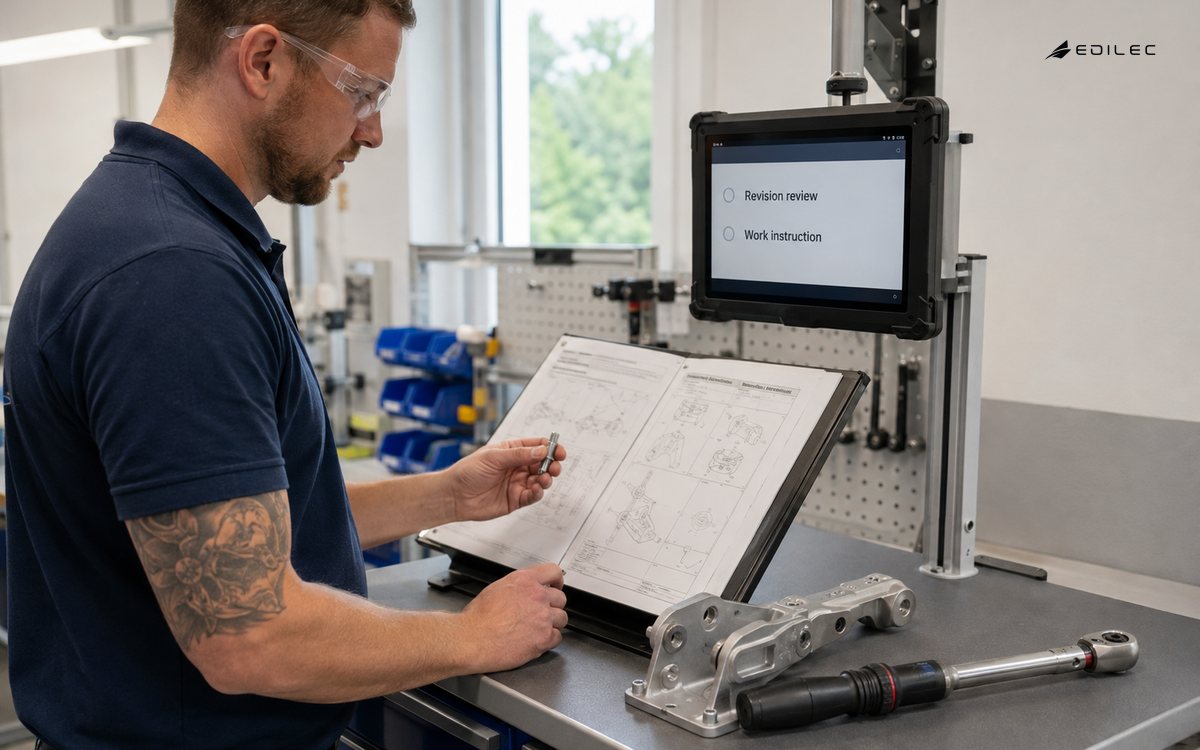
Release by product, line or shift with stop authority. Reconcile work in progress and isolate units whose revision status is uncertain. Monitor throughput, quality, alarms, interventions and safety signals together. Avoid forcing rollback when physical material has irreversibly entered a process; define forward correction and containment. After stabilization, remove obsolete instructions, access and interfaces while retaining required history. Conduct a short learning review with engineering, production, quality, maintenance, safety and security.
| Acceptance scenario | Evidence required | Unsafe shortcut |
|---|---|---|
| Network loss | Line reaches defined safe or independent mode | Assume cloud availability |
| Bad master data | Invalid unit or revision is rejected | Coerce value silently |
| Controller change | Authorized signed version and restore pass | Unrecorded technician edit |
| Quality failure | Lot genealogy enables containment | Rely on aggregate yield |
| Remote support | Bound identity, session recording and local approval | Shared vendor account |
| Recovery | Logic, recipes, data, keys and dependencies restore | Backup completion report |
Pilot a complete production thread
Choose one meaningful product family and line, including normal production, changeover, rework and failure. Baseline the outcome, map authority and dependencies, instrument only needed signals, and build the thinnest end-to-end thread. Test stale enterprise data, duplicate material scans, sensor failure, unplanned equipment state, rejected inspection, lost connectivity and unauthorized change. Train operators in the actual interface and collect workload and trust feedback.
Accept the pilot when physical counts and genealogy reconcile, decisions improve against baseline, control does not harm safety or cycle performance, recovery passes and operators can manage exceptions. Scale by common process pattern, not device count. Plants may need local variants for equipment and regulation; govern those as explicit configurations. Create support coverage for production time, spare and license dependencies, vendor escalation and safe maintenance windows before expanding.
Measure flow, quality, reliability and risk together
Use throughput, schedule attainment, work in progress, first-pass yield, scrap, changeover, downtime with cause quality, maintenance performance, genealogy completeness, energy or material per conforming unit, security exceptions and recovery results. Define calculations and contexts. Overall equipment effectiveness can be useful locally but should not become the sole target; maximizing one asset can build excess inventory. Connect engineering-change and field-quality measures so upstream decisions learn from production and service.
Review control health using CISA's cross-sector Cybersecurity Performance Goals as a prioritized input, tailored to the plant and current guidance. Measure unsupported assets, remote access, backup restoration, segmentation tests, detected unauthorized change and incident exercises. Calculate complete cost including integration, edge infrastructure, downtime for change, validation, support and lifecycle replacement. Retire sensors and feeds that no longer support a governed decision.
Example: close the engineering-change loop
A manufacturer changing a fastener specification should trace one approved revision from engineering to production and service. The release package identifies affected assemblies, plants, effective serial or lot, inventory disposition, torque instruction, tooling, inspection and field action. Integration creates the revised manufacturing bill and work instruction only after all prerequisites are approved. At the line, the operator sees the applicable revision for the scanned order; the tool receives bounded parameters; inspection records actual result and calibration context; genealogy links the unit to the revision.
Test an old component arriving after the effective point, network interruption during instruction retrieval and a failed torque result. The line must contain uncertain units without losing prior records or bypassing safety. Reconcile material, execution, quality and enterprise totals before closing the change. Feed production exceptions back to engineering and update service documentation. This narrow example exercises semantics, physical state, human work, OT security and lifecycle evidence far more effectively than demonstrating that PLM and MES can exchange a message.
Repeat the scenario on another shift with maintenance and quality staff who did not build the integration. Their ability to identify the active revision, diagnose a missing instruction and restore the approved package tests whether knowledge has transferred into operations. Record cycle impact and unsafe workarounds before approving the pattern for another line or plant.
Key takeaways
- Integrate one product and production decision thread at a time.
- Preserve authority and revision across as-designed, planned, built and maintained states.
- Place functions according to physical latency, safety and resilience constraints.
- Validate cybersecurity controls without compromising process performance.
- Scale after reconciliation, exception, recovery and operator evidence pass.
Frequently asked questions
Should plant control run in the cloud?
Only if latency, safety, reliability and validated degraded behavior permit it. Many analytics and coordination tasks fit cloud delivery while deterministic control remains local.
Does every asset need a digital twin?
No. Build a twin when a defined decision benefits from a maintained model whose validity can be measured. Simpler telemetry and rules may be more supportable for many assets.
Conclusion
Connected engineering and manufacturing depends on a trustworthy thread of definitions, revisions, physical state and decisions. Establish authority, design for plant realities, secure OT, govern change, and prove one production thread under failure before scaling. The result is not merely connected equipment but a safer system that can learn across the product lifecycle.