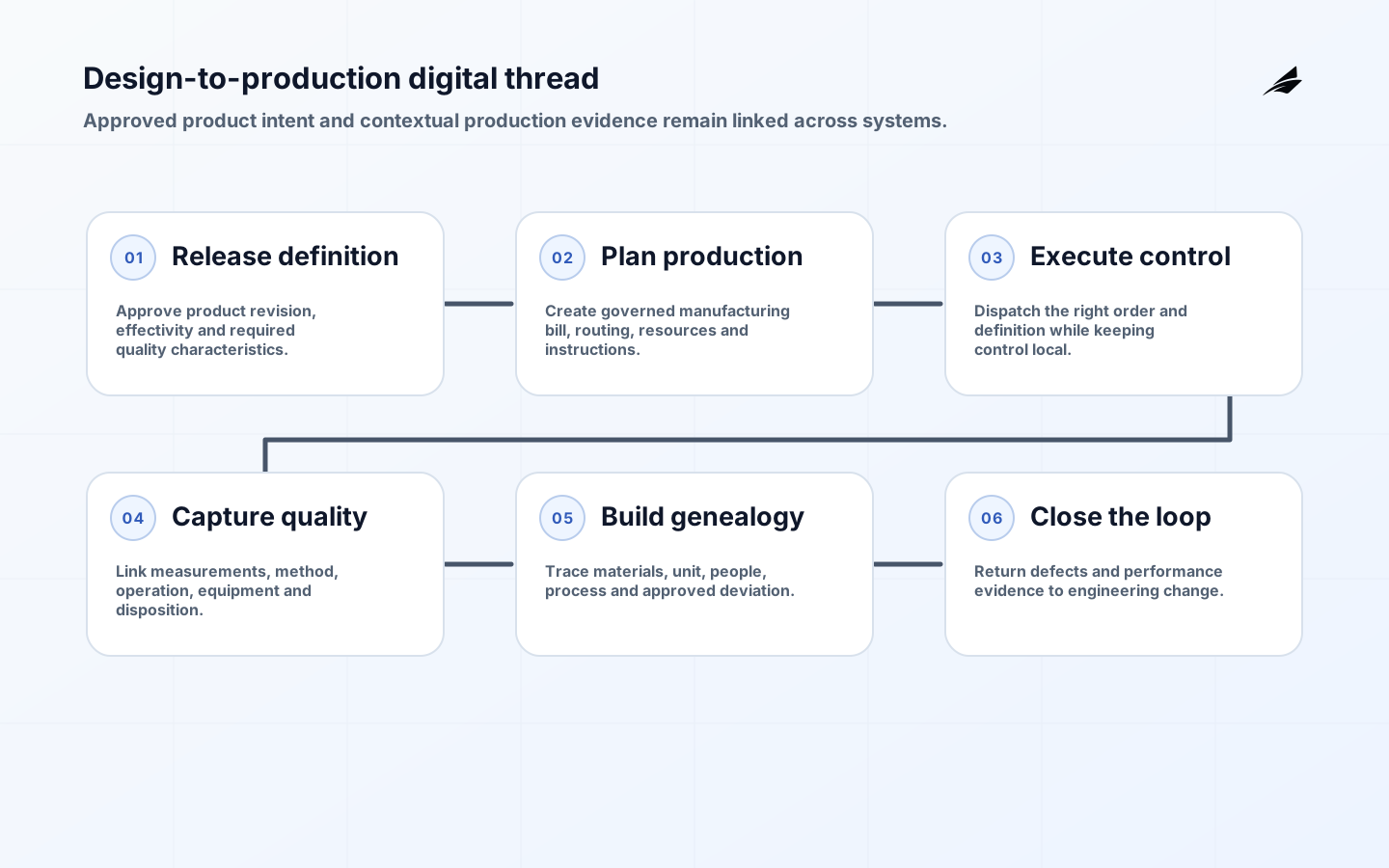
Engineering and manufacturing systems should carry an approved product definition into repeatable production and return trustworthy quality and performance evidence. The implementation is not simply a PLM, ERP or MES installation. It must align product identifiers, revisions, bills of material, process plans, resources, work orders, machine context, inspection results and nonconformance decisions across systems that operate at different speeds and risk levels.
This checklist is for operations, engineering, quality, IT and OT leaders building that connection. Use the engineering and manufacturing practical guide for business alignment and the engineering and manufacturing FAQ for architecture questions. Programs introducing AI into production workflows should separately apply the manufacturing AI implementation checklist.
1. Select a production outcome and boundary
Choose a value stream, plant area and product family where the current problem is measurable. Examples include reducing time from engineering release to executable work instruction, improving first-pass yield, proving material genealogy, or shortening containment after a defect. Define baseline, target, guardrails and economic owner. Do not begin with a universal data lake or plant-wide connection goal; connectivity without a decision or workflow creates maintenance and exposure.
| Outcome | Leading evidence | Guardrail |
|---|---|---|
| Faster release to production | Approved change reaches work center correctly | No unapproved revision can execute |
| Better first-pass yield | Defect by operation and process condition | Inspection coverage is not reduced |
| Complete genealogy | Material, equipment, operator and revision linked | Sensitive employee data is minimized |
| Lower unplanned downtime | Actionable condition and maintenance response | Control-loop availability remains local |
| Faster containment | Affected units and processes identified | Trace queries are complete and reproducible |
Record what remains outside the first release: plants, legacy equipment, suppliers, engineering disciplines, manual operations and regulatory records. Include shift and maintenance windows. Production systems cannot be treated like an office application with unlimited cutover time. A narrowly bounded pilot should still execute a complete path from approved definition to business-verified result.
2. Assign record authority and identifiers
Create a matrix for every shared object: product, revision, engineering and manufacturing bills, routing, resource, tool, material lot, work order, serial number, quality characteristic, result and nonconformance. Name the authoritative system, approval state, key, update direction, effective time and retention. A digital thread does not require one database; it requires durable identity, contextual relationships and governed transitions between records.
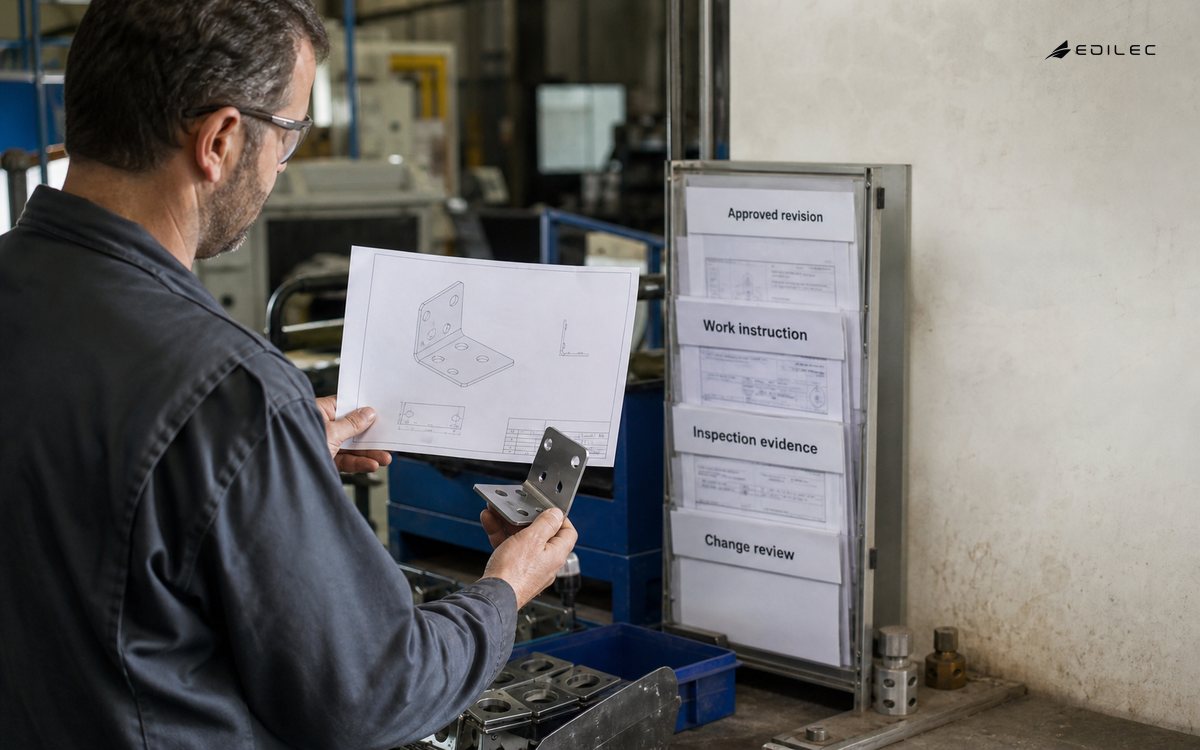
| Record | Likely authority | Critical handoff |
|---|---|---|
| Product definition and revision | PLM or controlled engineering repository | Release effectivity to manufacturing planning |
| Manufacturing bill and routing | MES or manufacturing planning system | Executable version to work order |
| Order and demand | ERP | Quantity, due date and commercial context |
| Machine state and process values | OT system, historian or equipment | Contextualized values to operation and unit |
| Inspection and nonconformance | QMS or governed quality service | Disposition and feedback to engineering |
Define semantic rules, not just field mappings. Quantity and unit, revision effectivity, substitute material, split lots, rework and as-built deviation often carry business meaning that integration middleware cannot infer. Maintain a canonical glossary with examples and owners. Reject impossible or ambiguous messages into an exception process rather than coercing them into apparently valid production data.
3. Design interfaces across IT and OT zones
NIST describes the digital thread as standards-based communication of product definition through manufacturing and quality, with feedback to engineering. Use interfaces that preserve that context while respecting OT safety, reliability and timing. Keep deterministic machine control local. Enterprise services can deliver approved schedules, recipes and definitions through controlled intermediaries and receive contextual telemetry or results without opening direct database access into control systems.
OPC UA offers platform-independent communication, information modeling, authentication, encryption and auditing; companion specifications add domain information models. A standard protocol does not automatically create semantic interoperability. Select the profiles, objects, security policies and conformance behavior needed for the use case, then test implementations across vendors. For batch and enterprise exchanges, APIs, files or events may be more appropriate. Choose each interface from timing, volume, reliability, ownership and support.
| Interface type | Good fit | Control |
|---|---|---|
| Synchronous API | Validated request with immediate outcome | Timeout, authorization and idempotency |
| Event | State change consumed by several systems | Schema version, durable delivery and replay |
| Managed file | Supplier or batch exchange with agreed window | Manifest, integrity, quarantine and reconciliation |
| OPC UA | Structured equipment and industrial data exchange | Certificates, profile and information-model conformance |
| Historian query | Time-series analysis without control action | Read boundary, context and retention |
4. Prove data quality and traceability
Profile real records across product families, shifts and exception states. Check duplicate and missing identifiers, revision mismatch, unit conversion, clock synchronization, orphan results and out-of-order events. Define quality rules with the people who use the data for release, production and disposition. A dashboard can tolerate delayed telemetry that would be unacceptable for genealogy or an interlock decision.
- Create golden examples for standard production, rework, scrap, split and merged lots, substitution and deviation.
- Trace each quality characteristic to product definition, operation, equipment method and result.
- Carry source, event time, receipt time, revision and confidence where the context requires it.
- Reconcile order quantity, completed units, consumed material and disposition at the workflow boundary.
- Expose exceptions to an owned queue with reason, evidence and permitted correction.
- Test backward trace from affected unit and forward trace from suspect material or process condition.
Protect the evidentiary value of records. Define who can amend a result, how the original is preserved, what approval is required and how time and identity are established. Reports should be reproducible from governed data and versioned logic. If a local spreadsheet remains part of a regulated or customer-critical decision, include it in scope until its role is removed.
5. Apply OT-aware security and resilience
NIST SP 800-82 Rev. 3 emphasizes that operational technology security must address unique performance, reliability and safety requirements. Inventory assets and communications, segment zones, control remote access, use individual identities, protect engineering workstations, manage removable media, monitor suitable events and coordinate changes with operations. Do not deploy an IT security control to a production line without testing its timing and failure behavior.
| Scenario | Preventive design | Recovery evidence |
|---|---|---|
| Enterprise link outage | Local safe operation and bounded buffer | Backlog reconciles after reconnect |
| Compromised remote access | Brokered, approved and time-bound session | Rapid revocation and complete session record |
| Bad recipe or definition | Signature, revision and effectivity validation | Block execution and restore approved version |
| Ransomware suspicion | Segmentation, protected backups and clean access | Isolated recovery exercise |
| Clock or sensor fault | Quality and plausibility checks | Affected evidence flagged and contained |
Define restoration order for identity, network, control, historian, MES and enterprise dependencies. Back up configurations, logic and certificates as well as databases. Test recovery on representative hardware and verify that restored production state matches physical reality. A technically restored work order that omits material already consumed can create duplicate production and false genealogy.
6. Pilot on a representative production slice
Choose a line with meaningful exceptions and engaged operators, not only the newest equipment. Build the entire thread for one product family: engineering release, manufacturing planning, work dispatch, execution evidence, quality result and feedback. Run it in shadow where necessary, compare with current records, and let operators challenge usability. Measure work added as well as work removed; a digital process that requires duplicate entry shifts cost rather than eliminating it.
- Rehearse deployment and rollback inside the agreed production window.
- Train by role using real scenarios, including exception and degraded operation.
- Provide floor support with authority to fix workflow and data issues quickly.
- Set stop conditions for safety, traceability, throughput and quality regression.
- Capture configuration and lessons as reusable plant templates, not hard-coded clones.
- Expand only after the pilot operates through representative volume and change.
7. Govern change and scale by template
Create joint governance for engineering, quality, operations, IT and OT. Review interface versions, master-data changes, security exceptions, recurring data defects, support burden and outcome measures. Plant templates should define common identity, connectivity, semantic models, observability and controls, while allowing documented equipment and process variation. Forcing every plant into one unexamined configuration creates local workarounds.
Track release-to-production lead time, first-pass yield, exception age, trace completeness, integration failure, manual entry, downtime, recovery performance, security exposure and total support effort. Attribute changes carefully; production outcomes depend on material, equipment and people as well as software. Use the measures to choose the next constraint and retire duplicate interfaces, not to claim that connection count equals transformation.
Key takeaways
- Begin with a bounded production outcome and a complete design-to-quality path.
- Assign authoritative systems, durable identifiers and semantic owners for shared records.
- Preserve local control while exchanging governed context across IT and OT boundaries.
- Test genealogy, exceptions, security and recovery against physical production reality.
- Scale reusable controls and information models while respecting plant variation.
Frequently asked questions
Do we need one platform for PLM, ERP, MES and quality?
No. A suite can reduce some interfaces, but record authority, lifecycle and plant needs still differ. Select systems by capability and make contracts, identity and traceability explicit.
Does OPC UA replace an MES integration layer?
Usually not. OPC UA can provide secure, modeled industrial communication. Workflow orchestration, order semantics, reconciliation, enterprise APIs and exception ownership remain separate concerns.
Can manufacturing data be processed in the cloud?
Yes when latency, safety, connectivity, data rights and resilience permit it. Keep time-critical control local and define bounded offline behavior. Assess data transfer, regional and supplier constraints.
When should AI enter the implementation?
After the decision, data context, failure consequence and human authority are defined. Start with advisory use cases such as anomaly triage, evaluate by equipment and operating condition, and preserve deterministic safety controls.
Conclusion
A manufacturing digital thread is valuable when approved engineering intent reaches the correct operation and trustworthy production evidence returns. Governed identity, semantic contracts, OT-aware architecture, representative pilots and verified recovery make that flow dependable. Build one complete thread, learn on the floor, and scale the standards and controls that survive real production.