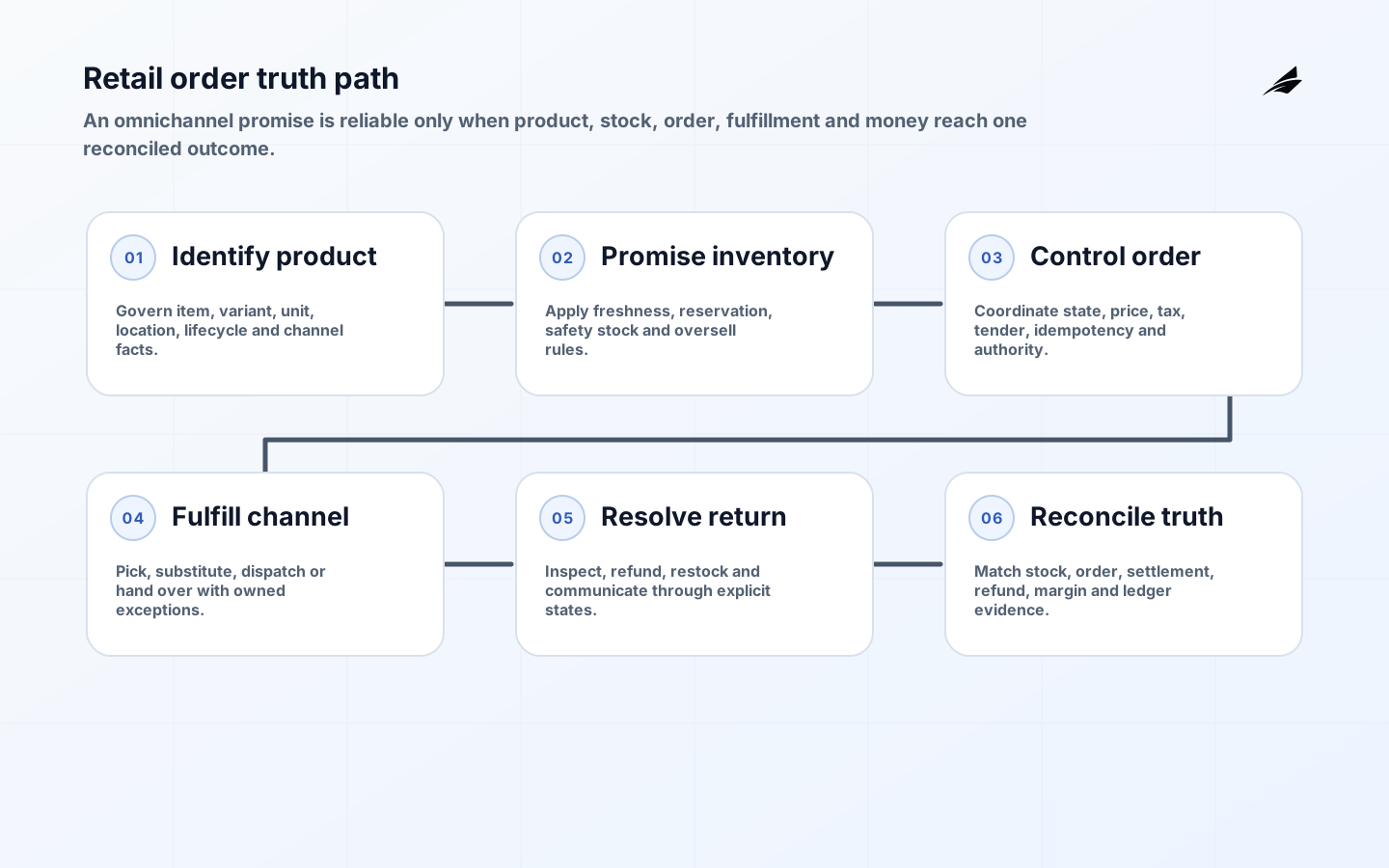
A retail and consumer implementation connects promises made in search, product, price, promotion, inventory, checkout, fulfillment, returns and service. Customers experience one retailer even when stores, commerce, marketplace, warehouse, payment and loyalty systems disagree. The implementation must therefore preserve order and financial truth across channels, protect consumer data and give frontline teams a workable exception path. Launch traffic is not success if cancellations, substitutions, refunds or support effort rise.
Use this checklist with the retail and consumer practical guide, the retail systems FAQ and the public-sector retail guide. Adapt it to product type, markets, payment model and applicable consumer, tax, privacy and accessibility requirements.
1. Scope customer journeys and operational cohorts
List journeys by channel and fulfillment promise: browse, store stock check, home delivery, pickup, ship from store, marketplace, cancellation, return, exchange, refund and service. Define included countries, brands, stores, products, customer types and devices. Record special cohorts such as age-restricted goods, weighted items, hazardous materials, gift cards, subscriptions and tax exemptions. Baseline conversion, order completion, cancellation, promise accuracy, return cycle, support contact and gross-margin effects.
- Name one owner for each customer promise and end-to-end journey.
- Define first-release cohorts, exclusions and fallback service.
- Map legal, tax, payment, accessibility, privacy and product obligations by market.
- Set outcome targets plus inventory, margin, fraud, complaint and service guardrails.
- Choose a rollout unit such as store cluster, region, brand or customer cohort.
2. Establish product, location and inventory truth
Assign authority for product identity, description, hierarchy, variant, price, promotion, location, stock and availability-to-promise. GS1 standards provide a common language for identifying, capturing and sharing information about products, locations and logistics units. Use stable identifiers and validate uniqueness, check digits, packaging levels and unit of measure. Keep product facts distinct from channel presentation so a content change cannot silently alter order or tax semantics.
Model inventory as events and states with source, time and reservation. Define how receipts, sales, picks, substitutions, cancellations, returns, damage, transfers and adjustments affect available quantity. Set freshness and oversell rules by product and channel. Reconcile system inventory with physical counts and investigate cause, not only variance. During outages, bound offline selling and replay events idempotently. Customers should see a promise that the fulfillment network can actually honor.
| Retail record | Authority | Critical control | Reconciliation |
|---|---|---|---|
| Product and variant | Product master or merchant system | Stable identifier, unit and lifecycle status | Duplicate, missing and channel mismatch report |
| Price and promotion | Pricing service | Effective time, eligibility, stacking and approval | Displayed, ordered, paid and refunded amount |
| Inventory | Declared inventory ledger | Event identity, reservation and adjustment reason | Ledger to physical and channel availability |
| Order and payment | Order system plus payment processor | State transition, idempotency and financial reference | Order, tender, tax, settlement and refund totals |
3. Design order, payment and refund state machines
Define allowed order transitions and which system may initiate each. Separate cart, order acceptance, inventory reservation, payment authorization, capture, fulfillment, cancellation, return and refund. Use idempotency for retried mutations and retain causation between events. Handle partial fulfillment, multiple tenders, delayed capture, substitutions, tax changes and chargebacks. Never infer financial success from a user-interface response; reconcile provider references and settlement.

Reduce card-data exposure through approved payment components and tokenization. PCI SSC identifies PCI DSS v4.0.1 as the active standard in its document library; determine merchant scope and validation with qualified expertise. Segment payment environments, protect administrative access, monitor scripts and third parties, and maintain incident procedures. Test terminal, gateway and network failure, duplicate callbacks and delayed settlement. Refund authority should be role-based, limited and monitored.
4. Protect consumer choice, privacy and accessibility
Inventory customer data by purpose across accounts, orders, loyalty, marketing, fraud, analytics, support and in-store systems. Collect only what is needed, define retention and deletion, and constrain sharing. The FTC's guidance emphasizes knowing what sensitive data is held, limiting access, protecting it and disposing of it securely. Use the NIST Privacy Framework to map privacy risk, governance and controls. Test consent changes, preference propagation, account deletion and data-subject workflows end to end.
Design accessible product discovery, forms, authentication, errors, checkout and service. Use WCAG 2.2 as a web baseline and test keyboard, screen reader, zoom, contrast, focus, timeout and error recovery on supported devices. Avoid making fraud controls impossible for people with disabilities or limited digital access; provide a secure assisted path. Store and contact-center tooling also need clear status, large touch targets and workflows that do not force staff to invent shortcuts.
5. Contract integrations and degraded behavior
For product, price, inventory, order, tax, payment, warehouse, carrier, loyalty and finance interfaces, define schema, owner, freshness, authentication, ordering, retry, duplicate handling and reconciliation. Version contracts and test consumer compatibility before provider changes. Use queues for asynchronous work with visible age and dead-letter ownership. Protect against supplier payloads that are too large, malformed or malicious. Do not pass raw upstream errors or secrets to customers.
Specify customer and store behavior during each dependency outage. Can stores sell offline, can customers place an order with a delayed promise, and who reconciles on recovery? Bound queues, stock exposure and payment retries. Display truthful status rather than optimistic success. Practice regional failure, carrier outage, payment degradation and peak backlog. Prioritize safety and financial integrity over continuing every feature.
6. Test journeys and reconcile every economic event
| Test family | Scenario | Proof | Release blocker |
|---|---|---|---|
| Customer journey | Guest and account checkout, cancellation and return | Accessible completion and correct communication | Blocked user or false promise |
| Commercial | Promotion stack, tax, partial fulfill and refund | Line-level expected-versus-actual totals | Unexplained margin or customer amount |
| Operational | Stock shortage, substitution, pickup expiry and carrier exception | Owned exception path and updated customer state | Work lost or no frontline action |
| Resilience | Duplicate event, supplier timeout and offline store replay | Idempotent result and reconciled recovery | Duplicate charge, order or stock movement |
Build a production-shaped catalog with variants, bundles, regulated items, promotions, loyalty and problematic addresses. Test load with browse and checkout mix, not only endpoint throughput. Run security and fraud cases with valid low-privilege accounts. Reconcile product counts, inventory movements, order lines, discounts, tax, tender, settlement, returns, refunds and ledger postings. Sign-off should identify tolerances and exception owners, never simply state that totals look reasonable.
7. Prepare stores, fulfillment and customer service
Map role-specific changes for associates, pickers, managers, contact center, merchandising, finance and loss prevention. Provide realistic practice with shortages, damaged goods, customer identity, tender failure and accessibility needs. Ensure devices, printers, scanners, labels, networks and spare equipment are ready. Publish concise operating and emergency procedures. Staff must know which system status is authoritative and how to escalate without sending customers between channels.
Plan peak capacity and staffing from demand scenarios. Verify carrier collection, packing supplies, pickup space, return routing and customer communication. Monitor queue age and exception workload during pilot, not only digital conversion. A workflow that saves customer clicks but adds several minutes of store handling may destroy the economics. Use frontline feedback as operational evidence and correct product design, master data and training separately.
8. Roll out by cohort with stop criteria
Launch to employee orders, a small store cluster or bounded customer cohort with feature controls and rollback. Establish a command center spanning product, store, fulfillment, payment, finance, security and support. Review conversion, promise accuracy, cancellations, stock variance, payment errors, refunds, complaints, support and margin daily. Segment by channel, store and customer cohort. Pause when financial reconciliation, consumer harm or frontline overload crosses an agreed threshold.
After stability, move from hypercare to named service ownership. Remove temporary permissions and manual data fixes, close or accept defects and document residual work. Review supplier service, security, cost and exit readiness. Continue synthetic journey tests and financial reconciliation. Retire old channel or store paths only after dependencies, retention and customer obligations are addressed. Measure adoption through completed, profitable and supportable journeys.
Key takeaways
- Scope complete customer journeys and the operational cohorts behind each promise.
- Establish stable product, location, inventory, order and financial authority.
- Design explicit payment, fulfillment, cancellation, return and refund states.
- Test privacy, accessibility and frontline exception handling as core quality.
- Scale only after customer, inventory, financial and operational guardrails reconcile.
Frequently asked questions
Should a retailer replace commerce, order and point of sale together?
Usually that creates unnecessary simultaneous risk. Define target records and contracts, then release coherent journeys in stages. Some tightly coupled estates may require a larger cutover, but repeated rehearsal and explicit rollback become essential.
How accurate must inventory be for omnichannel selling?
The required confidence depends on product, promise and consequence. Use safety stock, freshness and channel rules by cohort, then measure promise accuracy and cancellations. One enterprise percentage does not describe whether a specific offer is safe.
What makes a useful retail pilot?
It includes realistic catalog, demand, store work, payment, fulfillment and exceptions, plus measurable customer and financial outcomes. A staff demo without stock pressure, refunds or reconciliation proves interface behavior, not retail operation.
Prepare a trading-calendar release policy. Freeze high-risk changes around peaks only after confirming security and urgent-fix paths; schedule rehearsals, supplier changes, certificate renewals and capacity commitments early. Use prior event data to model browse, order, store and support demand, then test the entire chain. During a peak, prioritize truthful availability, payment integrity and recoverable orders over optional personalization or rich content. Reconcile every degraded-mode transaction after recovery.
Retain a daily exception ledger during launch with order, customer impact, financial amount, owner and resolution. Group recurring exceptions by root cause and feed them into product, data, training or supplier work. Close the ledger only after financial and customer state agree, not when a support ticket is reassigned.
Conclusion
Retail implementation is the disciplined preservation of a customer promise through physical and financial operations. Stable identity, explicit state, protected payments, inclusive journeys, resilient integrations and daily reconciliation let teams scale omnichannel experiences without losing trust or margin.