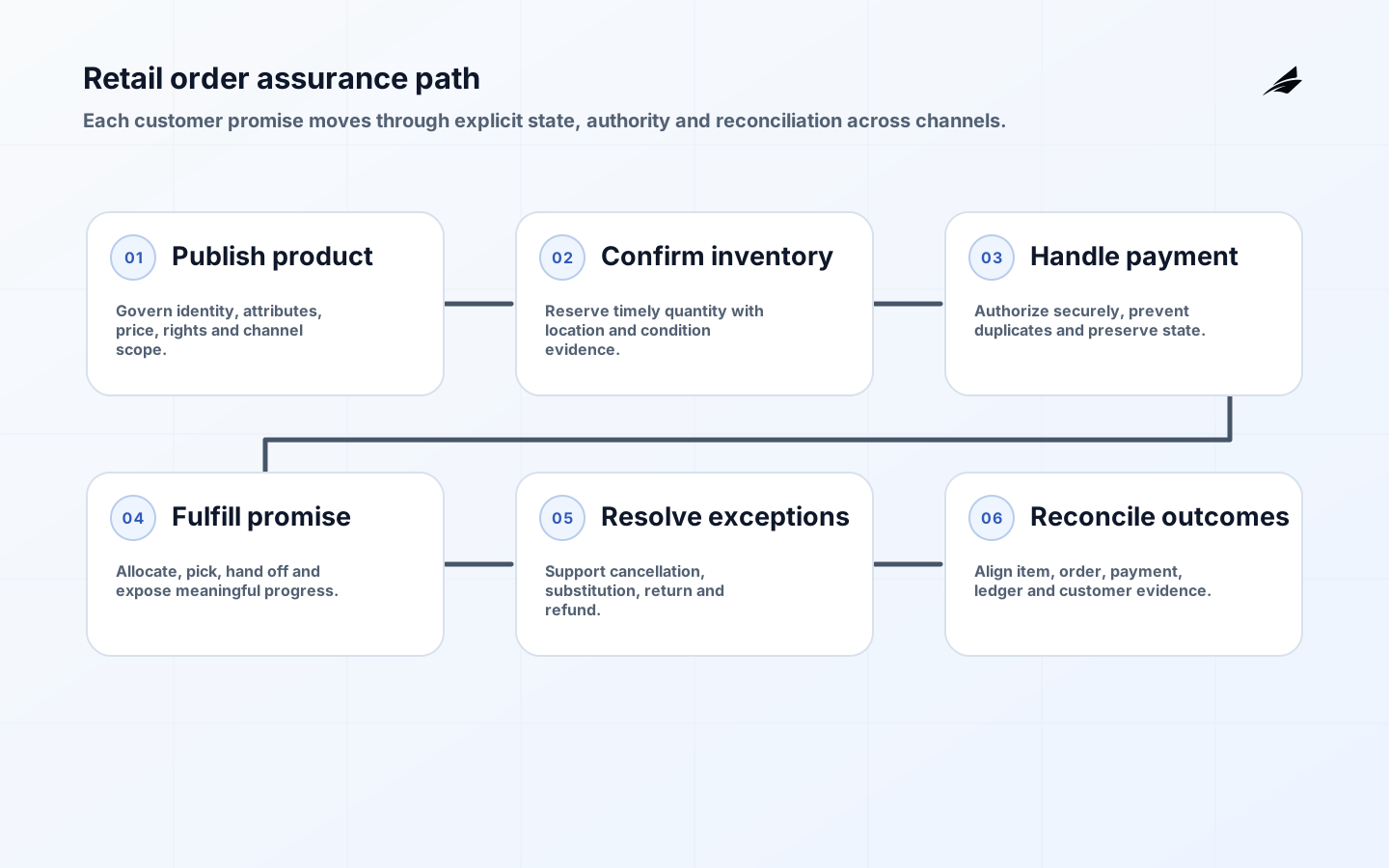
This retail and consumer FAQ explains how commerce systems coordinate product, price, inventory, customer, payment, order and fulfillment without pretending every channel is identical. Customers expect a coherent promise, while stores, warehouses, marketplaces, carriers and service teams operate with different timing and constraints. Reliable retail architecture makes authority and state explicit, protects consumer data and preserves a recoverable path when dependencies fail.
Use the retail and consumer practical guide for operating design and the omnichannel implementation checklist for rollout gates. Teams with public obligations can compare the public-sector retail checklist. Start with a specific journey such as buy online, pick up in store; then test every promise, state transition and exception.
What does omnichannel retail actually require?
Omnichannel means a customer can move between relevant channels while product facts, identity, consent, price, availability, order state and service context remain coherent. It does not require one application or identical behavior everywhere. Define channel capabilities and policy explicitly. A store may accept an exchange that a marketplace cannot, but staff and customers need a clear reason and a complete record of the resulting inventory and financial changes.
Map journeys as state machines: cart, reservation, authorization, order, allocation, pick, handoff, delivery, return and refund. Assign one authority for each state and make commands idempotent so retries do not duplicate charges or shipments. Use events for propagation where appropriate, but preserve ordering and reconciliation. A channel should show uncertainty honestly; saying limited availability or awaiting confirmation is better than promising stock from a stale cache.
| Domain | Authoritative decision | Important exception |
|---|---|---|
| Product | Sellable identity and attributes | Regional or channel restriction |
| Price | Applicable price, tax and promotion | Stacking or effective-date conflict |
| Inventory | Available-to-promise quantity | Damage, reservation or delayed event |
| Order | Current state and allowed transition | Duplicate, cancellation or split shipment |
| Customer | Identity, preference and consent | Guest, household merge or correction |
How should product and inventory data work?
Establish global and local identifiers, units, pack hierarchy, attributes, media, restrictions and effective dates. Product information needs owners and validation before syndication. Inventory needs location, condition, ownership, reservation and event time, not one undifferentiated number. Reconcile physical counts, warehouse systems, store systems and order reservations. Define how oversell is prevented and how customers are compensated when the promise fails.
GS1 EPCIS 2.0 provides a common event-sharing standard for supply-chain visibility, expressing what happened, when, where and why. A retailer need not implement every standard feature, but interoperable identity and event semantics reduce partner ambiguity. Preserve source and correction history. Monitor event lag, impossible transitions, negative availability and reconciliation variance by location and item class rather than trusting a single estate-wide average.
How are payments and fraud responsibilities divided?
Reduce payment-card scope through validated provider integrations and tokenization, but document the actual data flow and responsibilities. PCI SSC published PCI DSS v4.0.1 as a limited revision to the standard; applicable requirements and assessment method depend on the merchant environment. Protect checkout pages, scripts, administrative access, keys, logs and provider changes. Outsourcing payment processing does not outsource merchant oversight.
Separate payment authorization from order acceptance and handle asynchronous outcomes deliberately. Design for duplicate callbacks, timeouts, partial capture, cancellation, return, refund and chargeback. Fraud controls should combine transaction, account, device and fulfillment signals within an approved policy. Measure false decline and customer friction as well as fraud loss. Give reviewers evidence and authority. Do not let a risk score silently become an irreversible decision without a challenge or support route.
What privacy and accessibility controls matter?
Inventory customer, household, employee, location and behavioral data across commerce, loyalty, marketing, stores, service and partners. Record purpose, consent or other basis, access, retention and sharing. NIST's Privacy Framework helps assess privacy risks from processing. Minimize collection, separate service messages from marketing preferences, and propagate correction and deletion where required. Identity resolution should expose confidence and avoid merging people on weak signals.
Build web, mobile, kiosk and staff-assisted journeys to WCAG 2.2 where applicable. Test product discovery, authentication, cart, checkout, pickup, return and support with keyboard and assistive technologies. Include focus, target size, labels, error recovery, status messages and accessible authentication. Store devices and payment terminals need physical and interaction accessibility too. An accessible storefront with an unusable checkout does not provide equal access.
| Retail risk | Control | Measure |
|---|---|---|
| Oversell | Reservation policy and reconciliation | Promise failures per order |
| Duplicate charge | Idempotent payment and callback handling | Duplicate attempts and reversals |
| Account takeover | Risk-based authentication and support verification | Confirmed takeover and recovery time |
| Privacy overreach | Purpose, minimization and retention controls | Unauthorized use or overdue deletion |
| Channel exclusion | Accessible components and journey testing | Completion and defects by access need |
How should fulfillment and returns be designed?
Select fulfillment source using availability, cutoffs, capacity, distance, cost, service level and item restrictions. Preserve the reason for allocation and allow controlled reallocation. Stores need pick queues, substitution policy, staging locations and handoff verification. Carriers need versioned contracts and status mapping. Notify customers when the promise changes, not on every internal event. Provide service teams with current evidence and permitted remedies rather than forcing them to inspect multiple systems.
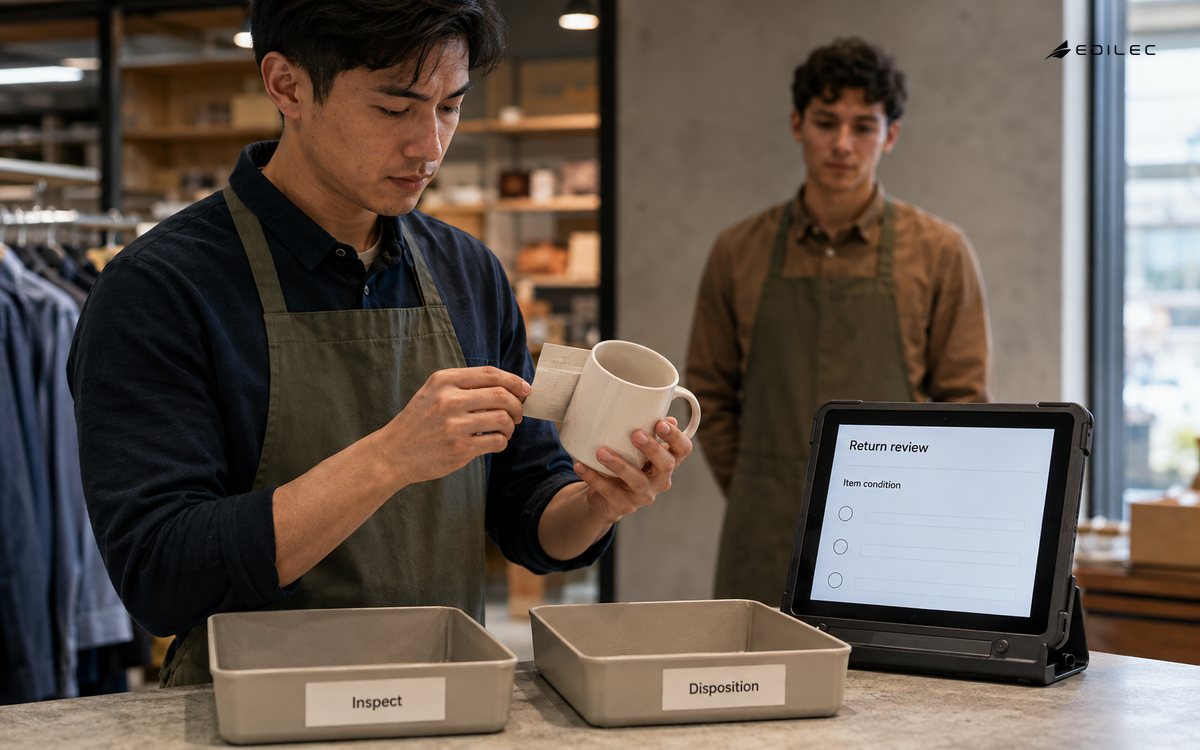
Treat returns as a first-class reverse flow. Validate order and item, reason, condition, channel rules, refund path, inventory disposition and fraud signals. Do not add returned stock to available inventory before inspection when condition matters. Reconcile item, payment, tax and ledger effects. Track avoidable return reasons back to product content, sizing, quality or fulfillment. A fast refund can improve trust, but thresholds and abuse controls must be explicit and monitored.
How are retail systems secured and kept resilient?
Segment stores, corporate systems, ecommerce, suppliers and management paths according to risk. Use strong identity, least privilege, managed endpoints, encrypted communication, secure configuration and vendor access controls. The FTC's Start with Security distills lessons such as knowing data, limiting retention and controlling access. Patch internet-facing services and protect APIs against account, inventory, promotion and checkout abuse.
Design degraded modes for payment-provider outage, stale inventory, carrier failure, store disconnection and promotion-service overload. Decide what can continue safely and how delayed actions reconcile. Test peak demand, regional failure, bad catalog release and credential compromise before seasonal events. Protect backups and rehearse restoration. Scale testing must include downstream limits; a storefront that accepts orders faster than allocation or service can process them creates a business incident despite good page availability.
Which measures show retail system value?
Measure complete journeys: product findability, availability accuracy, conversion, authorization, fulfillment promise, on-time handoff, cancellation, return, refund, contact and recovery. Segment by channel, location, item class, customer journey and access need. Pair commercial outcomes with guardrails for fraud, privacy complaints, accessibility, staff effort and inventory variance. A conversion increase caused by an inaccurate promise is borrowed value that appears later as cancellation and support cost.
Operate a cross-functional review with merchandising, stores, supply chain, digital, payments, service, security and data owners. Inspect exceptions and recurrence, not just averages. Connect releases to changed measures. Retire unused promotions, integrations and data feeds. Review vendor portability, data export and peak capacity before renewal. Continuous reconciliation and customer feedback should update product data, policy and architecture rather than remain isolated operational reports.
Practical example: buy online and pick up in store
A retailer launches pickup for a subset of stores and durable products. Product records define pickup eligibility, pack size and restricted items. Store inventory events feed available-to-promise after subtracting reservations and safety stock. Checkout creates an expiring reservation before payment authorization, then converts it to an order through an idempotent command. If confirmation times out, the channel queries authoritative order and payment state before retrying, preventing duplicate charges and reservations.
Stores receive prioritized pick work with item image, location, substitution rule and customer promise. Staff record found, missing, staged and handed-off events. Customers get accessible status messages and can nominate an authorized collector under policy. When an item is missing, the system offers a delayed transfer, approved substitute or refund rather than silently changing the order. Returns reconcile item condition, inventory, payment, tax and loyalty effects.
The pilot compares inventory accuracy, ready-on-time, cancellations, duplicate attempts, staff effort, pickup wait, contacts and customer accessibility feedback by store. One location shows high false availability because damaged stock lacks a condition event; the retailer repairs receiving practice before adding stores. A payment outage exercise proves pending-order reconciliation. Finance confirms that refunds and tax adjustments match ledger entries after partial pickup. Expansion follows promise accuracy and operational capacity, not only checkout conversion, so the new channel does not transfer hidden cost to stores and service.
Store leaders can pause pickup capacity when staffing or staging space crosses an agreed threshold. The digital channel receives that state immediately and offers delivery or another store, preserving a realistic promise instead of maximizing order intake.
Key takeaways
- Model retail journeys as explicit states with one authority per decision.
- Use governed product identity and timely, reconcilable inventory events.
- Minimize payment scope while retaining merchant oversight.
- Protect privacy and accessibility across complete customer journeys.
- Design fulfillment, return and degraded modes before peak demand.
- Measure promise accuracy and customer outcomes alongside conversion.
Frequently asked questions
Does omnichannel retail require one central platform?
No. It requires clear authority, shared identity and dependable contracts between systems. A modular architecture can work well when state, failure and reconciliation are explicit. One suite can still contain inconsistent modules and data.
Does all retail data need to be real time?
No. Latency should match the decision. Checkout inventory and fraud may need seconds, while assortment analysis may tolerate daily updates. Publish freshness and define safe behavior when data exceeds its threshold.
Conclusion
Retail and consumer systems earn trust by making a promise the operation can keep. Clarify authority across product, inventory, payment and order state; protect people and data; and test exceptions under realistic demand. When channels share evidence and reconcile outcomes, the customer experiences one dependable retailer without requiring one monolithic system.