Cognitive edge services place AI inference, rules or decision support near the machines, sensors, branches and users that generate data. They can reduce round-trip latency, continue limited operation during network loss and avoid transmitting every raw signal to a central cloud. They also create a distributed fleet of software, models and hardware that must be secured, updated and observed. A successful enterprise edge AI implementation therefore starts with an operational decision and an explicit safe fallback, not with a device demonstration.
This checklist uses cognitive edge in that practical sense. NIST describes edge AI as several levels, from edge nodes running models created elsewhere to collaborative learning from local data, and notes constraints in resources, communications, privacy and security. Use the related scope and delivery plan to frame investment and the enterprise service FAQ for procurement questions.
Define the decision and deployment boundary
Name the person or control system receiving the result, the decision deadline, the consequence of a false positive and false negative, and the action the edge node may take. A camera-based defect alert that asks an operator to inspect is a different risk class from a model that stops production equipment. Record whether the service advises, gates or autonomously acts. For consequential actions, define a deterministic interlock outside the model and an accessible human override.
Map where data originates, what must remain local, what may be summarized centrally and what is prohibited from collection. Include intermittent links, power cycles, clock drift, temperature, physical access and site maintenance. Establish the useful latency and availability target from the process rather than assuming that lower latency always creates value. If a cloud-hosted service already meets the decision deadline and resilience need, edge deployment may add cost without improving the outcome.
| Decision factor | Edge is justified when | Evidence to collect |
|---|---|---|
| Latency | The action deadline is below dependable network round trip | End-to-end timing at representative sites |
| Continuity | A bounded function must continue during disconnection | Offline duration and fallback test |
| Data locality | Raw data must stay near its source | Approved data-flow and retention map |
| Bandwidth | Local reduction materially limits transfer | Raw versus transmitted volume |
| Safety | Local control can fail to a known state | Hazard analysis and interlock test |
Design a fleet architecture, not an isolated appliance
Define a standard node profile: hardware identity, operating system or runtime, model package, configuration, local data store, health agent and management channel. Central services should hold the fleet inventory, signed release artifacts, deployment policy, aggregate telemetry and audit evidence. Keep model and application versions independently traceable but validate them as a tested combination. The inventory must answer which sites run each combination and which data policy applies there.
ETSI's current MEC security study covers application and platform security, zero-trust networking and federation, including risks during package onboarding and lifecycle management. Translate those concerns into controls: device identity anchored in hardware where feasible, authenticated encrypted management, signed packages, measured boot or attestation for high-risk uses, least-privilege workloads and a deny-by-default path from edge nodes to enterprise systems.
Control data and model lineage end to end
Create a data contract for each input: sensor identity, units, sampling behavior, expected range, missing-value meaning and calibration evidence. Record transformations from raw observation to model feature. At inference time, retain enough metadata to reproduce and investigate a result without collecting prohibited content. This often includes model version, feature schema, confidence or score, rule thresholds, node time, action and override. Apply retention by purpose and protect local stores against both remote compromise and physical removal.
Model release evidence should include training-data provenance, intended population and conditions, benchmark set, known limitations and comparison with the currently deployed version. The NIST AI RMF organizes AI risk activity around Govern, Map, Measure and Manage and calls for testing before deployment and during operation. For edge systems, measurement must cover site variation: lighting, vibration, sensor age, network quality and operator practice can shift performance even when the model file is unchanged.
| Release gate | Required proof | Rollback trigger |
|---|---|---|
| Package integrity | Signature, dependency record and approved build | Verification or attestation failure |
| Functional fitness | Site-representative benchmark and threshold review | Guardrail or critical-class regression |
| Resource fit | CPU, memory, storage, thermal and energy test | Sustained resource saturation |
| Operational safety | Offline, restart, stale-input and override rehearsal | Unknown or unsafe fallback |
| Fleet control | Canary targeting, health telemetry and version inventory | Health or outcome guardrail breach |
Make security and safety independent layers
Threat-model the node, local network, management plane, update path, model interfaces and physical environment. Protect secrets in a device-specific store, rotate credentials and avoid shared fleet passwords. Limit outbound destinations and inbound services. Separate the business workload from management and safety functions. Follow NIST's Secure Software Development Framework for protected source, build integrity, verification and vulnerability response; include firmware, containers, models and third-party drivers in the component inventory.
Safety cannot depend on model confidence alone. Define input validity checks, timeout behavior, rate limits, geofencing or operating envelopes where relevant, and a safe state when inputs are stale or contradictory. Make overrides conspicuous and log them without discouraging legitimate use. A local rule can block an unsafe command even if inference succeeds. Review the complete sociotechnical process, including operator training and maintenance, because a technically correct alert can still fail if it is ambiguous or impossible to act on.
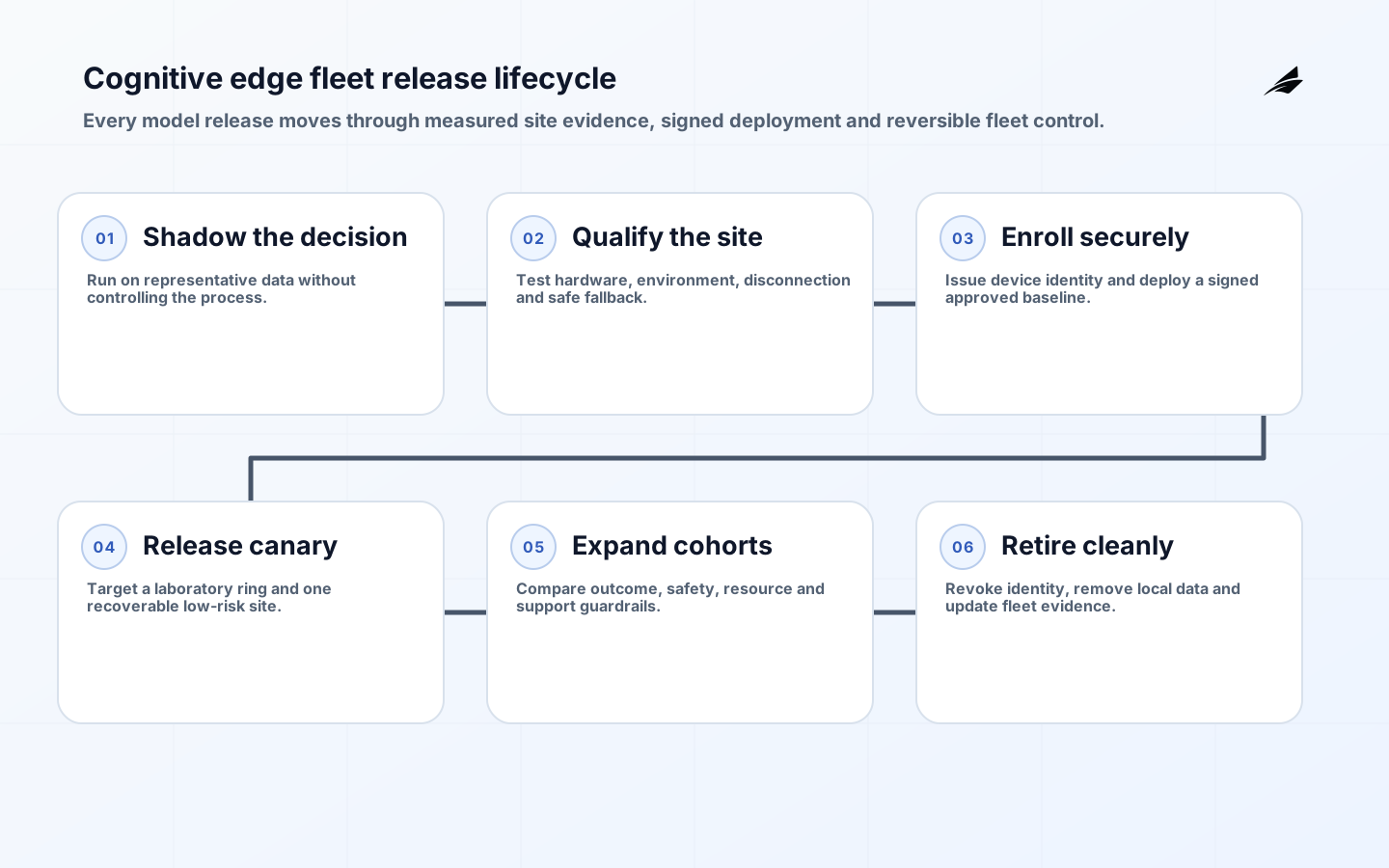
Roll out through a reversible fleet lifecycle
- Prove the operational decision with recorded data and a human-reviewed shadow mode.
- Qualify representative hardware, environmental limits and disconnected behavior.
- Register device identities and deploy a signed baseline through the management plane.
- Release model and application changes to a laboratory ring, then one low-risk site.
- Expand by cohorts while comparing outcome, safety, resource and support guardrails.
- Retire old versions and devices with evidence that secrets and local data were removed.

Operate by fleet health and decision quality
Monitor management reachability, version distribution, update success, storage pressure, thermal throttling, input validity and inference latency. Keep high-cardinality device detail in a queryable fleet store rather than attaching every device identifier to every time-series metric. Alert on actionable cohorts, such as a release ring exceeding failure thresholds. Provide support with a timeline that connects package deployment, configuration, device health, inference and operator override.
Outcome monitoring must join technical health with process results. Track reviewed false alerts, missed events discovered downstream, override reasons, abstention frequency and performance by relevant site conditions. Set review periods and a kill or rollback authority. A model may remain technically available while its decision quality decays. The service intelligence implementation checklist provides a useful companion for routing operational evidence into enterprise review workflows.
Prepare field support for conditions that central engineering cannot reproduce. Give technicians a safe diagnostic bundle containing device identity, approved versions, recent health, clock state and redacted failure codes, with a controlled export path when connectivity is unavailable. Define replacement, re-enrollment and return-to-service procedures so a swapped node cannot inherit the wrong site identity or secrets. Keep spare-device policy, firmware support windows and supplier end-of-life dates in the fleet inventory. Review whether a site can continue safely while hardware is removed, and test that central records distinguish decommissioned, quarantined, lost and temporarily offline devices. This operational discipline prevents hardware incidents from becoming silent model or data-quality incidents.
Control configuration with the same care as software. Define which settings are global, cohort-specific or site-owned; validate ranges and dependencies; sign sensitive policy bundles; and preserve prior versions for rollback. Avoid one-off remote changes that disappear from central inventory. A site-specific threshold may be legitimate, but it needs an owner, reason, effective period and evaluation evidence. Periodically compare desired and observed configuration, and quarantine nodes that cannot prove an approved state. This closes a common gap in which the fleet reports a current model version while local thresholds quietly produce materially different behavior.
Key takeaways
- Justify edge placement with a measured latency, continuity, locality or bandwidth need.
- Treat every deployment as a centrally governed fleet of versioned components.
- Preserve lineage from sensor and feature schema to model, decision and override.
- Keep deterministic security and safety controls outside probabilistic inference.
- Release by rings, monitor decision quality and make rollback routine.
Frequently asked questions
Does edge AI replace cloud AI?
Usually not. Edge nodes commonly perform time-sensitive inference or local filtering, while central services manage fleet identity, training, release policy, aggregate evaluation and long-term records. The boundary should follow decision deadlines, connectivity, privacy and cost rather than an all-edge or all-cloud preference.
Should models learn continuously on each device?
Only with a validated reason and much stronger controls. Unreviewed local learning complicates reproducibility, security and fleet consistency. Most enterprises should begin with centrally approved immutable model releases, collect representative feedback and retrain through a governed pipeline. Collaborative learning needs explicit privacy, poisoning-resistance and aggregation design.
What makes an edge pilot production-relevant?
Use representative sites and hardware, run through network loss and power restart, test signed updates and rollback, involve actual operators, and measure both model errors and process outcomes. A laptop demonstration with curated data proves the model can run; it does not prove the enterprise can operate a distributed service.
Conclusion
Cognitive edge services become dependable when the enterprise governs the whole loop: decision boundary, local data, package integrity, model evidence, fleet rollout, safe fallback and retirement. Start in shadow mode, prove the operational value and expand only through reversible cohorts. The result is not merely fast inference near a sensor; it is an explainable service the organization can secure, update and stop.