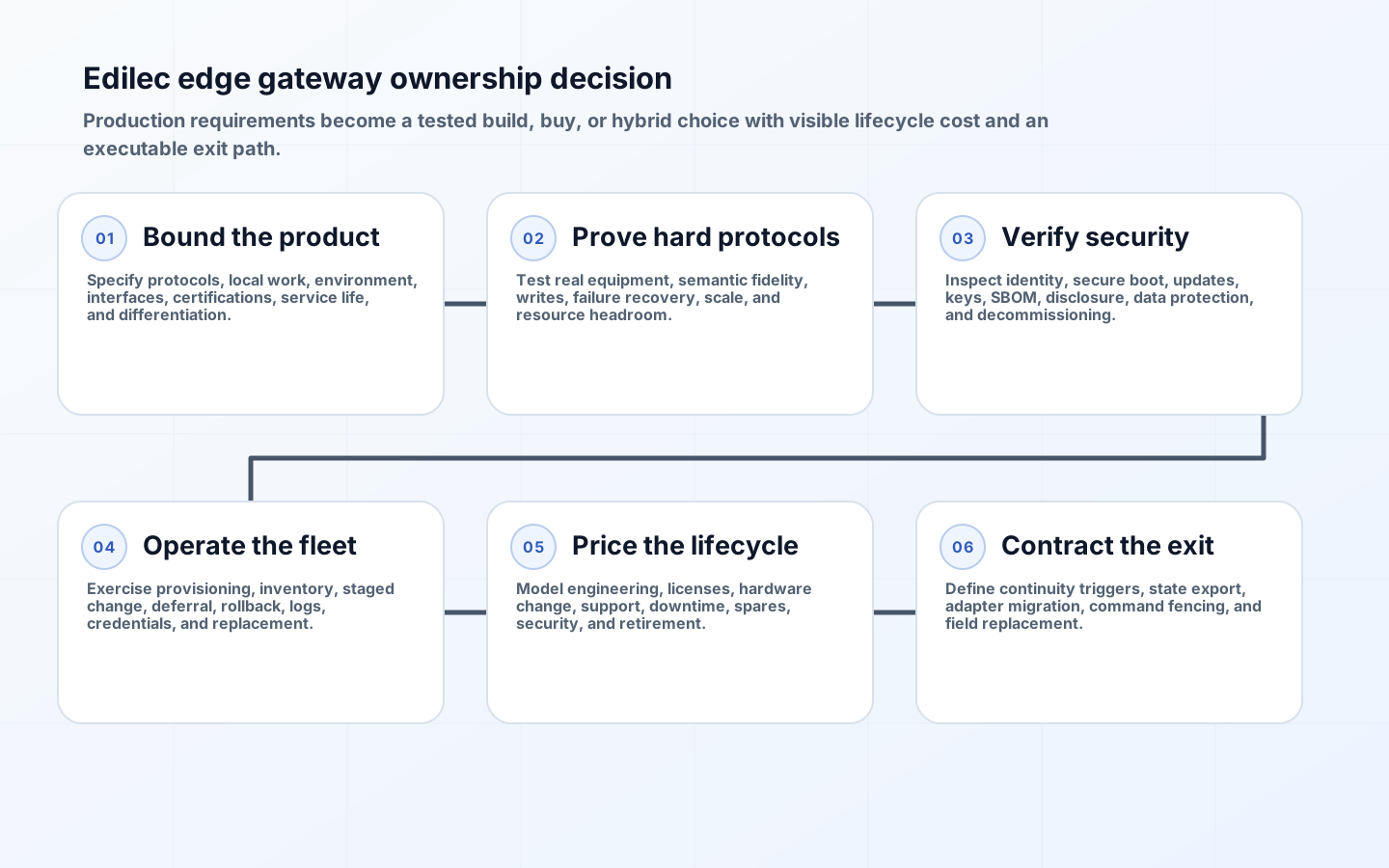
Edge gateway build vs buy is an ownership decision lasting far beyond the hardware purchase. A gateway sits between long-lived equipment and changing applications, so it accumulates protocol exceptions, certificates, operating-system updates, storage wear, remote diagnostics, site constraints, and replacement obligations. A low prototype bill of materials can become expensive when thousands of inaccessible sites need coordinated care.
Evaluate a product capability, operating service, and exit path together. Building can create differentiated protocol behavior and hardware fit. Buying can transfer commodity engineering and certification work to a supplier. Neither transfers accountability for plant safety, data meaning, access control, or service continuity. The right choice depends on where proprietary value lives and which party can credibly maintain the fleet for the promised lifetime.
Define the gateway product boundary and workload
Inventory southbound devices and exact protocol functions, not logos: register maps, polling rates, browse behavior, subscriptions, alarms, quality, timestamps, writes, redundancy, vendor extensions, and firmware variants. Define northbound contracts, local applications, store-and-forward duration, control latency, compute acceleration, storage, network interfaces, environmental envelope, power, mounting, certifications, and service life. Separate required at launch from plausible future expansion.
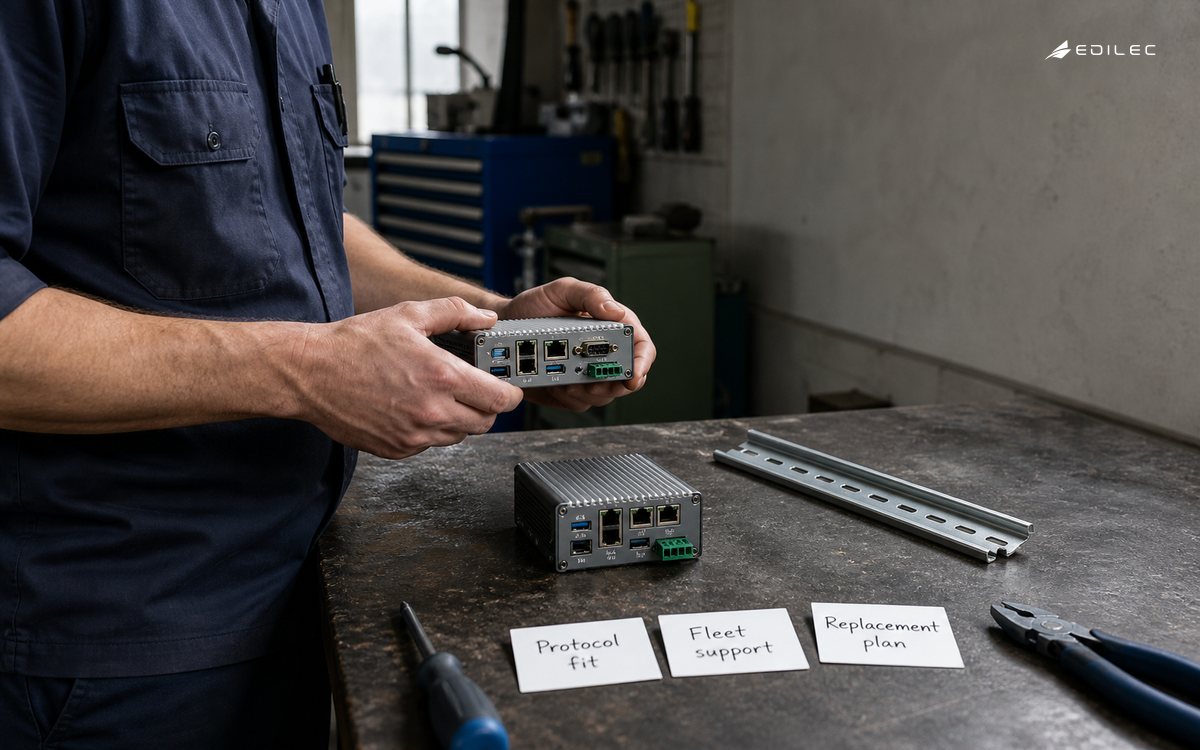
Decide whether the gateway is a translation appliance, application host, security boundary, local controller, or combination. Adding containers and third-party workloads changes patching, resource isolation, and support. AWS documents Greengrass as a runtime for local processing, filtering, aggregation, components, fleet deployment, and OTA updates in How Greengrass works. Use such capabilities as requirements to verify, not as proof that any product meets site needs.
| Dimension | Build favors | Buy favors | Evidence required |
|---|---|---|---|
| Differentiation | Proprietary protocol, deterministic behavior, or hardware integration creates product value | Gateway function is a common integration layer | Hard production slice on real equipment |
| Scale and variety | One controlled hardware profile and capable platform team | Many regions, certifications, and replacement profiles | Five-year fleet and geography forecast |
| Lifecycle skill | Organization owns embedded Linux, security, manufacturing, and remote operations | Supplier has credible release, vulnerability, and RMA service | Named owners, SLAs, support history |
| Time to field | Existing platform and supply chain are reusable | Certified product and tooling meet requirements now | Pilot lead time including integration |
| Exit flexibility | Design files, keys, tooling, and manufacturers are controlled | Open interfaces and exportable fleet state limit dependency | Replacement and migration rehearsal |
Prove protocol coverage and semantic fidelity
A supported-protocol checkbox can mean a basic read demo. Build a fixture suite from real PLCs, meters, sensors, and failure modes. Test discovery, authentication, subscriptions, reconnect, quality, timestamp origin, endian and scaling, string encoding, writes, command confirmation, alarms, redundant controllers, malformed frames, and high device counts. Measure CPU, memory, latency, network load, and recovery under simultaneous southbound failure and cloud outage.
Keep protocol adapters isolated behind a canonical contract so a supplier or in-house driver can be replaced. Record semantic transformations and unsupported functions. Price vendor-driver licenses, per-device limits, custom development, regression testing, and field upgrades. For writable protocols, use explicit allowlists, typed commands, preconditions, local authorization, and audit. Translation must never create an unreviewed path from cloud message to physical actuation.
Evaluate security and fleet operations as core product features
Require unique device identity, secure boot, signed update, protected keys, least-privilege services, network segmentation, encrypted local data, vulnerability intake, software bill of materials, audit export, and secure reset or decommissioning. NIST IR 8259 Rev. 1 describes foundational manufacturer activities, while ETSI EN 303 645 includes outcome-oriented consumer IoT provisions and support-period transparency. Industrial risk may require stronger controls, but both expose lifecycle questions buyers should ask.
Fleet operations must inventory hardware, OS, applications, configuration, certificates, connectivity, health, and support state. Test staged deployment, maintenance deferral, rollback, offline catch-up, remote logs, bounded shell access, credential rotation, backup restore, and replacement. AWS Greengrass deployment guidance includes rollout rates, stop criteria, timeout, and rollback policies; equivalent operational controls matter regardless of platform.
| Cost group | Often omitted items | Build owner | Buy diligence |
|---|---|---|---|
| Engineering | Bootloader, BSP, drivers, hardening, test fixtures, factory tools | Embedded and platform teams | Roadmap, customization, integration effort |
| Operations | Provisioning, monitoring, updates, logs, certificates, on-call | Fleet service team | Console/API limits, tenancy, export, service SLA |
| Hardware | Certification, yield, spares, redesign, storage wear, power | Supply-chain and hardware teams | Component notices, warranty, RMA, replacement model |
| Security | SBOM, scanning, disclosure, patch creation, incident response | Product security | CVE response evidence and support window |
| Exit | Data export, key transfer, adapter migration, site replacement | Product owner | Contract rights, standard interfaces, transition support |
Model lifecycle TCO with failure and change scenarios
Calculate present cost across design, procurement, integration, certification, cloud services, licenses, connectivity, deployment labor, spares, support, security updates, truck rolls, downtime, redesign, and retirement. Segment by site type. Model component end-of-life, supplier acquisition, 15 percent annual fleet growth, certificate migration, a critical vulnerability, storage failure, and loss of the management service. Expected cost should include probability and impact, but high-consequence safety or compliance scenarios remain guardrails rather than averages.
Compare hybrid options. A standard industrial computer with an owned software image can avoid custom hardware while preserving software control. A purchased gateway with organization-owned adapters may accelerate certification while retaining differentiated logic. A managed runtime can handle deployment while the hardware remains multi-sourced. Contract for vulnerability notification, patch timelines, support dates, data export, component-change notice, escrow or continuity where justified, and ownership of custom drivers.
Run a production-shaped selection pilot
Pilot at difficult sites, not a clean bench. Include old equipment, noisy links, intermittent WAN, constrained power, high temperature, storage pressure, and local operators. Run for enough time to experience certificate renewal, update, reboot, and support. Inject corrupt messages, disk exhaustion, broker outage, clock loss, process crash, and failed update. Measure installation time, data completeness, semantic errors, reconnect, backlog drain, update success, resource headroom, support resolution, and operator burden.
Set decision gates and an accountable owner before the pilot. Reject a choice that only works with supplier engineers permanently present unless that service is priced and contracted. Document exceptions and their lifetime cost. Revisit the choice when protocol scope, regulation, fleet scale, hardware availability, or support dates change. Build versus buy is not a cultural identity; it is a periodically reviewed allocation of engineering and operational responsibility.
Key takeaways
- Specify exact protocol and failure behavior, workload, environment, and support life before comparing products.
- Test semantic fidelity and writable paths on real equipment, not protocol-logo coverage.
- Treat secure update, identity, inventory, rollback, diagnostics, and replacement as required gateway features.
- Model engineering, operations, security, hardware change, downtime, and exit cost over the fleet lifetime.
- Consider hybrid ownership when differentiation is concentrated in software or adapters.
FAQ
Is buying an edge gateway usually cheaper?
It can be when requirements are common and the supplier spreads certification, runtime, and fleet tooling costs across customers. Custom drivers, licenses, support gaps, and replacement constraints can reverse the result. Compare lifecycle scenarios, not unit price.
Does standard Linux hardware eliminate vendor lock-in?
It reduces some hardware and runtime dependency, but management APIs, image tooling, proprietary drivers, secure elements, and fleet data can still lock the system. Test rebuild and migration with exported state.
How long should a gateway be supported?
At least as long as the product and site obligation requires, including a transition period. Align OS, hardware, protocol driver, management service, and certificate support dates; the shortest dependency defines the practical horizon.
Contract supply continuity, support, and exit
For purchased hardware, require notice periods for component substitutions, firmware branches, certification impact, last-time buys, and end-of-support. Approve substitutions only after protocol, thermal, power, storage, security, and update regression tests. Maintain serialized spares by site criticality and rehearse replacement provisioning without copying long-lived private keys. If cellular service or a management cloud is bundled, document ownership and portability of SIMs, certificates, domains, device records, and historical telemetry.
For an internal build, establish the equivalent supplier discipline: approved bill of materials, reproducible images, factory acceptance, vulnerability disclosure, patch service levels, release signing, and an engineering sustainment budget. Avoid a platform that only its original developers can recover. Field support needs replaceable modules, labeled ports, safe reset, local status, encrypted diagnostic export, and an escalation package that links hardware lot, software versions, site conditions, and recent changes.
Define exit triggers such as missed critical patches, unsupported operating system, unacceptable failure rate, supplier financial change, protocol roadmap gap, or unit economics threshold. Keep a replacement adapter and bulk export proof current. Migration planning should include parallel operation, identity transfer, command fencing, buffered-data reconciliation, technician visits, environmental disposal, and customer communication. An exit option is real only when asset state and authority can move without two gateways controlling the same equipment.
Include sustainability and disposal in the design. Track battery, storage media, cellular module, and secure-element handling; provide verified data erasure; and choose replaceable components where site economics permit. A gateway replacement program should recover reusable equipment without allowing retired credentials, customer data, or undelivered records to re-enter service.
Conclusion
The defensible gateway choice assigns every protocol, security, fleet, hardware, and exit obligation to a capable owner. A production-shaped pilot and lifecycle model expose where value and risk truly sit, enabling teams to build differentiated capability and buy mature commodity work with clear eyes.