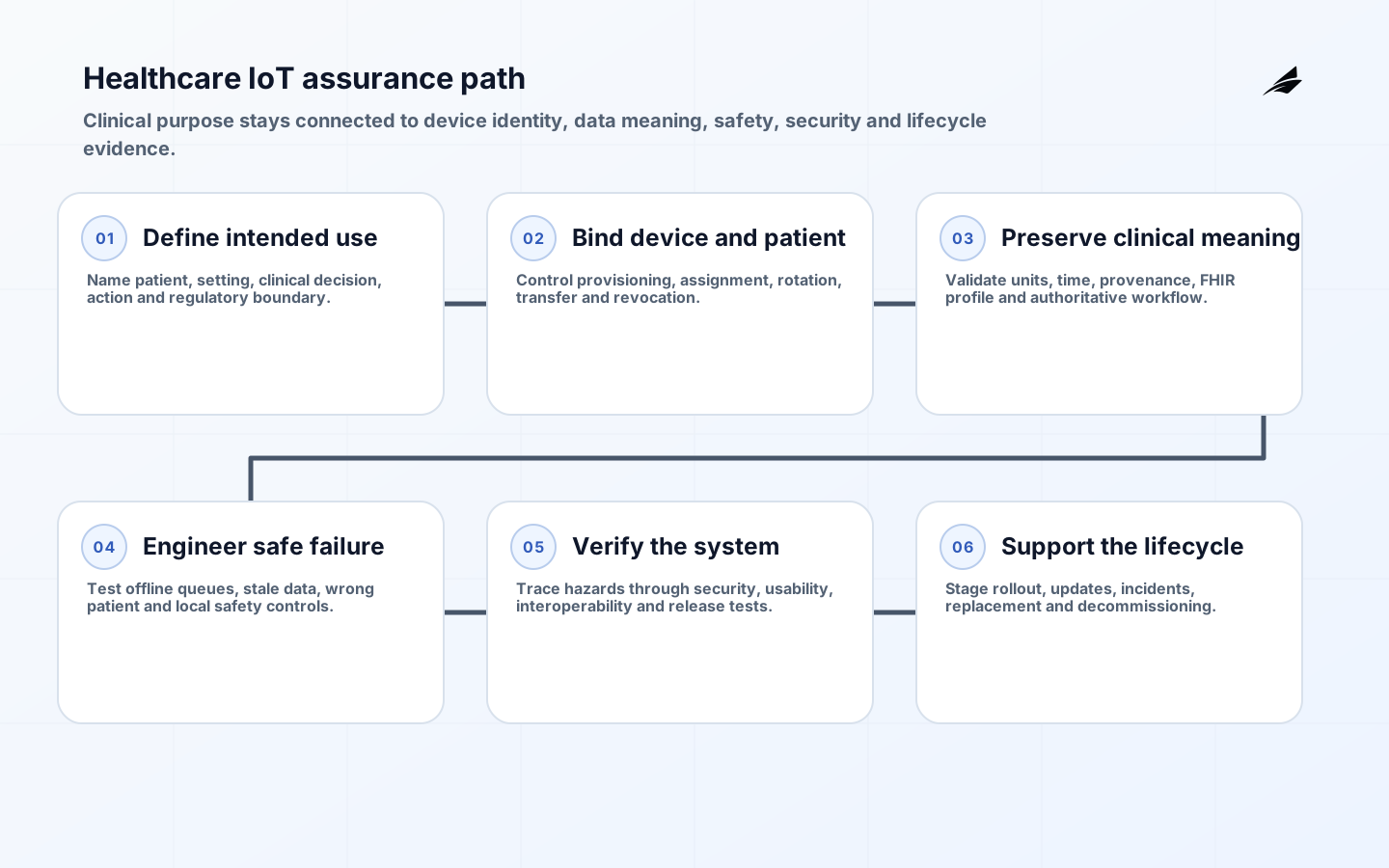
Healthcare IoT software development connects devices, patients, clinicians, care organizations and cloud services. That connection can improve remote monitoring and timely care, but it also creates safety, privacy and cybersecurity obligations that a generic IoT platform does not address. A delayed value, wrong patient association, silent battery failure or unauthorized command can have clinical consequences. The implementation checklist must begin with intended use and clinical workflow, then carry traceability through device identity, data quality, security, integration and support.
NIST SP 1800-30 models remote patient monitoring as an ecosystem with responsibilities shared among healthcare organizations, platform providers and patients. The FDA’s February 2026 medical-device cybersecurity guidance treats cybersecurity as part of device safety and quality management for applicable products. HL7 FHIR defines healthcare data-exchange resources and security building blocks but is not itself a security protocol. Product teams need regulatory counsel for classification and jurisdiction; this guide focuses on engineering and delivery evidence.
1. Define intended use, clinical decision and regulatory boundary
State who uses the system, for which patient population, in what setting, with which device and what action follows the result. Distinguish wellness, administrative, monitoring and diagnostic or treatment functions. Describe whether software only displays data, prioritizes review, generates a recommendation or controls a device. The same sensor stream can create different risk depending on the claim and workflow. Confirm applicable device, privacy, health-record and quality requirements before architecture and marketing language solidify.
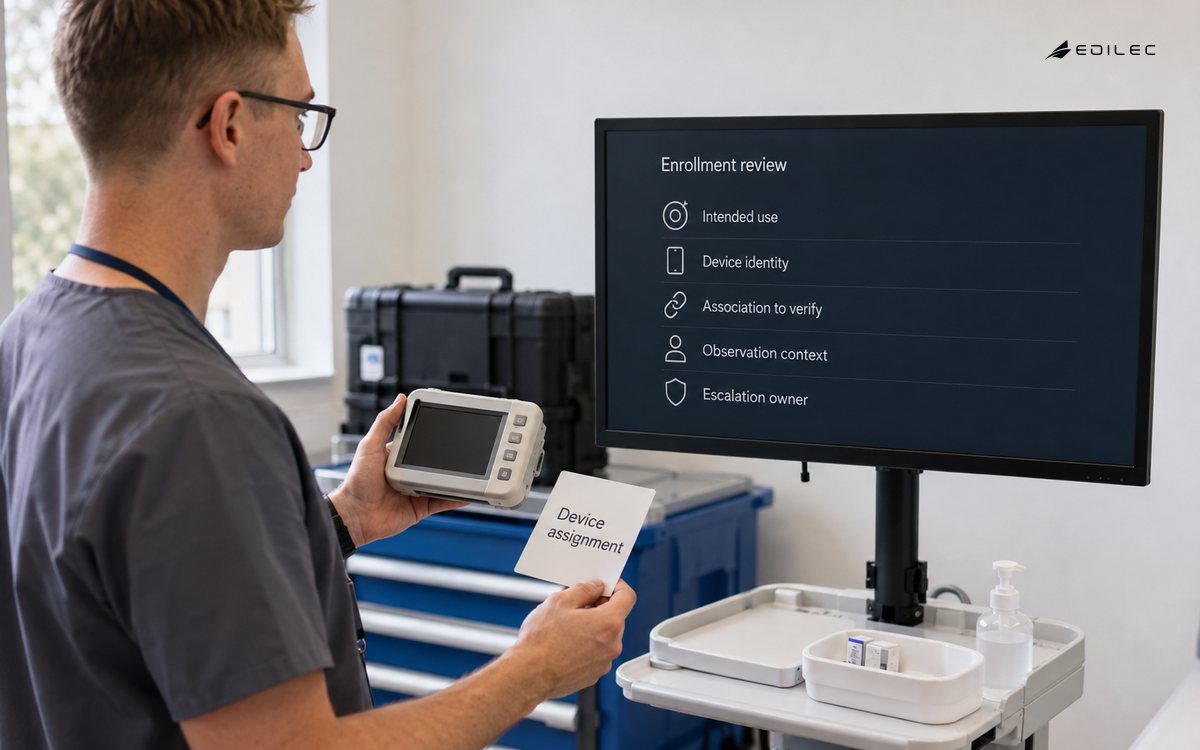
Map the clinical workflow including enrollment, device assignment, measurement, transmission, review, escalation, documentation, correction and discharge. Identify expected response time and what happens outside staffed hours. Define who can acknowledge, suppress or amend a result. Preserve the original observation and the reason for correction. Build a hazard analysis for delayed, missing, duplicate, out-of-range, misattributed and misleading data. Connect each control and test back to the hazard and product requirement.
| Workflow question | Engineering consequence | Acceptance evidence |
|---|---|---|
| Which patient and device? | Strong binding and reassignment controls | Wrong-patient test is blocked and audited |
| How fresh must data be? | Latency, queue and offline design | Delayed reading is visibly marked |
| What action follows? | Alert priority and clinical ownership | Escalation completes within tested window |
| Can software command? | Safety, authorization and local interlocks | Unsafe or stale command is rejected |
| Who corrects data? | Provenance and amendment model | Original and correction remain traceable |
2. Design device identity, edge behavior and connectivity
Give every device or gateway a unique lifecycle identity tied to model, software, owner, patient assignment where applicable and status. Provision credentials securely; avoid shared factory secrets. Support rotation, revocation, replacement and transfer without losing history. Validate messages against device identity and expected assignment. Keep administrative access separate from patient sessions. Record last contact, software version, battery or health state and time quality so clinicians can judge whether absence of data is meaningful.
Define offline behavior for device, phone, home network and cloud loss. Buffer only the data and duration justified by workflow and privacy risk. Preserve event time and ingestion time, deduplicate retries and bound queue growth. Show users when synchronization is incomplete. Critical safety functions and limits should remain in appropriate local device controls rather than depend on cloud reachability. Test poor bandwidth, clock drift, power loss, app termination and a device that reconnects after a long gap.
3. Build interoperable data with clinical context
Map device measurements to a governed clinical model with identifier, unit, reference, method, timestamp, subject and provenance. FHIR can represent observations, devices, patients, consent, provenance and audit events, but implementers must select an implementation guide and terminology appropriate to the jurisdiction and exchange. Validate codes, units and profiles. Do not store a vendor’s display label as the only semantic definition. Preserve source payloads where needed for investigation without exposing them broadly.
Use explicit API and event contracts with versioning, idempotency and error handling. Confirm the health record’s create, update and correction behavior; a technically successful POST does not prove the observation appears in the intended clinician view. Reconcile patient and encounter identity before writing. Handle redaction, consent and restricted data according to policy. Test duplicate, late, corrected and canceled observations with the actual EHR or integration engine and clinical workflow.
4. Treat cybersecurity and privacy as safety controls
Threat-model device, mobile app, gateway, cloud, APIs, support tools, update service and clinical integrations. FDA guidance for cyber devices emphasizes secure product development, threat modeling, architecture, testing, transparency and postmarket management. Apply least privilege, strong authentication, encrypted communication, protected secrets, secure boot or integrity controls where applicable, signed updates, logging and vulnerability response. Design controls at the system level because a secure device connected to an overprivileged cloud API remains unsafe.
Collect the minimum data needed for intended use and define retention, access, export and deletion. HIPAA applicability depends on actors and context; other laws may also apply. Separate clinical records, operational telemetry and product analytics. Do not place protected health information in logs, crash reports or notification text without authorization and safeguards. FHIR security guidance recommends secured communications, authentication, authorization, audit and input validation, but implementers must provide the surrounding security system and policy.
| Release gate | Required test | Evidence |
|---|---|---|
| Safety | Missing, stale, wrong and extreme data scenarios | Hazard controls and residual-risk review |
| Identity | Provision, assign, transfer, revoke and recover | Complete device-patient audit trail |
| Security | Threat tests, update, credential and API abuse | Verified controls and remediation |
| Interoperability | FHIR profile, terminology and EHR workflow | Conformance plus end-user validation |
| Resilience | Offline buffer, replay and dependency failure | Bounded recovery with visible state |
| Operations | Alert, support, incident and field update | Runbooks completed by assigned teams |
5. Validate with representative users, devices and environments
Use representative hardware revisions, phones, networks, patient abilities and care settings. Test usability for setup, pairing, measurement, error recovery and accessibility. A patient should understand connection and submission state without interpreting engineering codes. Clinicians need data freshness, device context and a manageable alert burden. Simulate high volume, delayed data and unavailable downstream systems. Validate performance over the intended monitoring duration, not only a short laboratory session.
Maintain traceability from intended use and hazards through requirements, design, code, tests and release. Control software of unknown provenance and third-party components. Define verification for algorithms and thresholds using representative data, and separate model or rule changes from ordinary configuration. Preserve release, device and deployment versions so an event can be reconstructed. Acceptance requires clinical, security, privacy, quality and operational owners; engineering completion alone is insufficient.
6. Roll out in cohorts and support the full device lifecycle
Pilot with a bounded population and explicit clinical coverage. Train patients, caregivers, clinicians, support and biomedical or device teams. Monitor enrollment completion, connectivity, data latency, alert response, false or unhelpful alerts, support contacts and dropout. Use safety and quality thresholds to pause rollout. Keep the existing care pathway until the new process is accepted. Do not interpret engagement metrics as clinical benefit without an appropriate study design.
Plan manufacture or onboarding, distribution, assignment, update, service, vulnerability communication, replacement, return and decommissioning. Know how to reach affected organizations and users. Stage updates, verify compatibility and provide rollback or safe recovery. The FDA’s Quality Management System Regulation became effective in February 2026 and incorporates ISO 13485:2016 by reference for regulated manufacturers. Align product change, complaint, corrective action and cybersecurity processes with the applicable quality system.
Worked example: remote blood-pressure monitoring
A care program enrolls patients with hypertension and assigns a validated connected monitor. The mobile application binds device and patient through a verified workflow, displays measurement and upload state, and stores a bounded encrypted queue offline. The cloud validates device identity, assignment, unit, plausible range and timestamp before creating a FHIR Observation. A rules service creates a review task according to the approved protocol; it does not diagnose or alter treatment independently.
Validation includes wrong-patient pairing, duplicate readings, clock drift, seven days offline, a revoked device credential, delayed EHR availability and an unstaffed alert window. Clinicians see freshness and source context, while patients receive clear instructions for urgent symptoms that do not depend on the app. Audit connects enrollment, measurement, rule result, review and correction. Rollout pauses if missing-data or support thresholds exceed the approved range, turning monitoring into a controlled care process rather than a stream of unexplained values.
Key takeaways
- Define intended use and clinical action before selecting an IoT platform.
- Bind device, patient, time and provenance across the lifecycle.
- Test offline, delayed, duplicate and wrong-patient conditions explicitly.
- Implement FHIR with a security system, policy and real EHR workflow validation.
- Treat cybersecurity, updates and postmarket support as safety and quality work.
Frequently asked questions
Does using FHIR make a platform compliant?
No. FHIR supports interoperable exchange and provides security-related resources, but the implementation still needs authorization, consent, privacy, audit, quality, workflow and applicable regulatory controls.
Can connected health data be stored in public cloud services?
Potentially, when architecture, contracts, configuration, data location, access, encryption, monitoring and applicable legal requirements are satisfied. Cloud use does not transfer the organization’s responsibilities.
Is every healthcare IoT application a medical device?
No. Classification depends on intended use, claims, function and jurisdiction. Obtain qualified regulatory advice early because design and evidence obligations can change materially.
Conclusion
Healthcare IoT software is ready when the care workflow, device identity, data meaning, security controls and failure behavior form one traceable system. Build for patients and clinicians in real environments, prove safe degraded operation and maintain the product through updates and vulnerabilities. That standard is more demanding than moving sensor values to a dashboard, and it is what makes connected care dependable.