Cognitive Edge enterprise services refers to the consulting, methods, learning and SenseMaker work associated with the organization now trading as the Cynefin Company. It is not an edge-computing or edge-AI service. The company's history states that the Cynefin Company was formerly known as Cognitive Edge and was founded in 2005. This FAQ helps enterprise buyers frame the decision accurately and works with Edilec's service scope plan, implementation checklist and workflow exceptions checklist.
What are Cognitive Edge enterprise services?
They are context-dependent services and tools for sense-making in complex human systems, strategy, culture, risk, engagement and decision support. An engagement may involve facilitated workshops, capability building, Cynefin methods, distributed narrative collection through SenseMaker, or a combination. Define the desired decision and internal capability rather than buying an abstract promise to “manage complexity.” Deliverables should identify participants, method, evidence, decisions, ownership and learning.
The Cynefin framework is described as a decision-support framework based on bounded applicability. It distinguishes ordered, complex and chaotic contexts and helps users consider what approach fits. It is not a project method that emits one prescribed answer. An enterprise still needs domain evidence, governance, ethics and accountable decisions. The framework should improve how people diagnose context and act, not become vocabulary that ends debate.
When is this approach a good fit?
It is useful where many interacting people shape outcomes, causality is uncertain, perspectives differ and interventions can change the system: organizational culture, trust, policy, strategy, safety climate, customer experience or transformation. It may help leaders notice patterns and run bounded experiments rather than imposing a linear target. It is less useful when a clear technical defect, statutory calculation or well-understood process simply needs competent execution.
Start with a decision that current methods handle poorly. Describe affected groups, uncertainty, power, constraints, existing evidence and what action is possible. Compare a Cynefin-based engagement with interviews, surveys, operational analysis, experiments and ordinary facilitation. Cynefin principles emphasize bounded applicability; procurement should apply that principle to the method itself.
| Need | Possible approach | Useful output | Fit warning |
|---|---|---|---|
| Context diagnosis | Cynefin framing workshop | Shared view of problem spaces | Treating domains as fixed labels |
| Distributed experience | SenseMaker engagement | Patterns linked to narratives | Poor or unrepresentative participation |
| Intervention portfolio | Constraint or vector work | Small options and monitoring | Predetermined solution disguised as discovery |
| Capability transfer | Mentored real engagement | Internal practitioners and artifacts | Permanent consultant dependency |
| Routine process defect | Direct analysis and correction | Fixed control or workflow | Adding complexity language unnecessarily |
What does SenseMaker do?
SenseMaker gathers experiences in participants' own words and asks participants to interpret their contributions through structured signification. The platform then supports pattern exploration while retaining access to underlying narratives. It combines qualitative context and quantitative pattern views; it does not automatically establish why a pattern exists or what intervention will work.
The company's SenseMaker usage guide describes Frameworks, Engagements, Collectors, dashboards, reports and visualizations, and recommends learning through a real engagement. Buyers should inspect platform capabilities, licensing, data hosting, identity, exports, accessibility, language support and support arrangements for the exact offer. Product marketing is a starting point for diligence, not acceptance evidence.
How should an engagement be designed?
Write an intent statement connecting the inquiry to decisions and possible action. Identify populations whose experience matters, including less powerful or harder-to-reach groups. Co-design prompts and signifiers with representative review, pilot them, and document recruitment, channels, consent and limitations. Avoid leading language and questions that collect sensitive stories without a clear purpose or support route. Decide what participation level is necessary to interpret patterns responsibly.

Plan sense-making sessions before data collection. Determine who can inspect narratives, how outliers will be explored, how interpretations are challenged and how actions are selected. Preserve participant voice without exposing identity. A colorful pattern map is not a conclusion. Connect each proposed intervention to the evidence, assumptions, responsible owner, monitoring signal and condition for stopping or adapting.
What evidence should the buyer require?
| Stage | Evidence | Decision enabled | Accountable role |
|---|---|---|---|
| Discovery | Intent, scope and alternatives | Proceed or choose another method | Sponsor |
| Design | Prompts, sampling and ethics review | Approve collection | Research owner |
| Pilot | Comprehension and participation findings | Revise or launch | Engagement lead |
| Sense-making | Patterns, narratives and dissent | Select bounded actions | Decision owner |
| Follow-up | Signals and changed narratives | Adapt, scale or stop | Service owner |
Ask for facilitator competence, method rationale, relevant examples, assumptions, subcontractors, platform security, data flow, quality approach, handover and exit. Require limitations in the final report. Avoid procurement scoring based only on a branded framework diagram or number of responses. A strong provider should explain when its approach is not suitable and how internal teams will gain capability.
How should privacy and ethics be handled?
Narratives can contain identifiable, sensitive or distressing information even when names are not requested. Define lawful basis or consent as applicable, purpose, minimization, access, retention, withdrawal, safeguarding and incident handling with qualified privacy and ethics owners. Explain confidentiality limits to participants. Redact exports carefully, restrict free-text search and prevent small-group filters from enabling re-identification.
Consider power and consequence. Employees or citizens may believe participation is mandatory or fear that critical stories will be traced back. Use independent channels where appropriate, avoid manager access to identifiable raw data and provide a route for concerns. Do not infer individual traits from aggregate pattern tools. The sponsor should agree how uncomfortable findings will be handled before collection begins.
How do insights become action without overclaiming?
Use small, coherent interventions where outcomes are uncertain, with observable signals and containment. Constraint mapping focuses attention on constraints that shape what is possible and can support distributed action. State what is being changed, expected direction, possible adverse effects, monitoring cadence and who can stop. Multiple parallel probes may be more informative than one large transformation bet.
Distinguish pattern, interpretation, hypothesis, decision and observed result. Preserve dissent and outliers rather than averaging them away. Re-sample or collect follow-up narratives to see whether system disposition changes, but avoid claiming causal impact from an attractive before-and-after graphic alone. Combine narrative evidence with operational, financial, safety or service data appropriate to the decision.
How should Cognitive Edge services be procured?
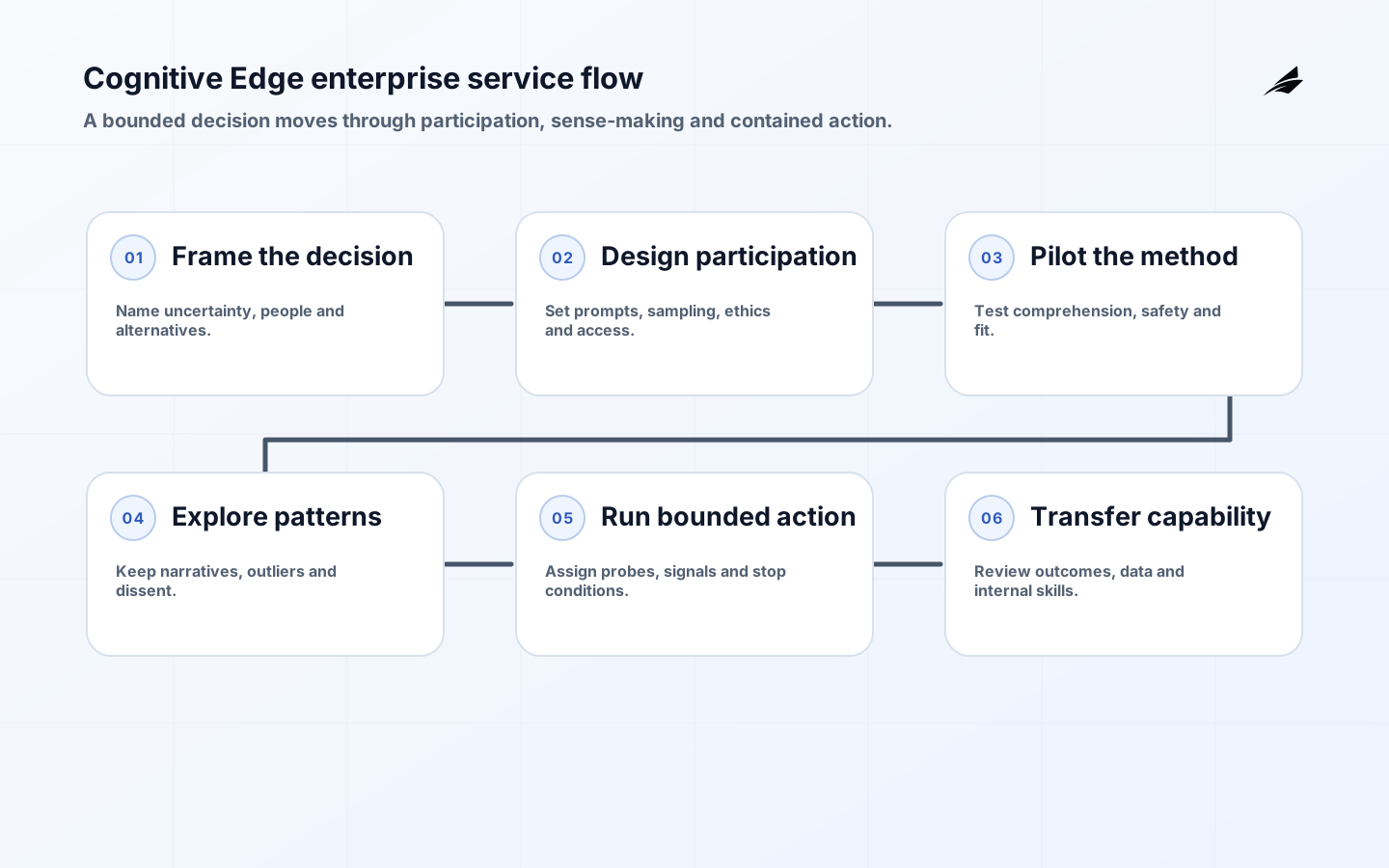
- Define the enterprise decision, populations, alternatives and bounded applicability.
- Agree method, ethical review, data flow, roles, deliverables and limitations.
- Pilot instruments and facilitation with representative participants.
- Run distributed collection and collective sense-making with protected access.
- Select contained actions with owners, signals and stop conditions.
- Review outcomes, transfer capability and export or dispose of data as agreed.
Commercial terms should separate facilitation, training, software subscription, customization, travel, support and follow-up. Clarify intellectual property in instruments and outputs, use of anonymized data, publication, data location, export formats and deletion. Define acceptance around usable evidence and capability transfer, not a guaranteed strategic outcome that no responsible complexity engagement can promise.
Review engagement quality and transfer
At the end of an engagement, return to the original decision and ask what changed. Distinguish a richer description of the system, new hypotheses, selected interventions, changed action and observed outcome. Record where the evidence remains ambiguous. A workshop that participants enjoyed may still fail if leaders cannot explain what they will do differently or how they will detect unintended effects.
Audit participation against the intended population. Identify missing voices, language and channel barriers, drop-off, repeated contributors and groups too small to report safely. Review whether prompts were understood consistently and whether facilitation gave status or expertise disproportionate weight. Document what conclusions cannot be generalized. More narratives improve exploration only when collection and interpretation remain appropriate.
Select several patterns and trace them to source narratives and participant signification. Invite alternative interpretations, especially from people affected by proposed action. Check whether outliers were explored or dismissed. Preserve the link between quantitative display and qualitative context in the handover. Screenshots detached from narratives can turn an exploratory tool into an unjustified scorecard.
Review every intervention as a portfolio item with owner, affected people, constraint changed, expected direction, monitoring, containment, time box and stop condition. Look for large programs smuggled into a “probe” label. A safe-to-learn action is not harmless; it is designed so adverse effects can be detected and contained. Escalate ethical, employment, safety or legal consequences through the organization's ordinary governance.
Confirm capability transfer. Internal practitioners should be able to explain method choice, configure or commission future work, protect data, facilitate sense-making and challenge overclaiming. Export agreed artifacts and data, document licenses and support, and dispose of temporary access. A good engagement leaves judgment and stewardship inside the organization rather than making every future uncertainty dependent on the same facilitator.
Set an evidence review after interventions have had enough time to interact with the system. Revisit original narratives, collect new observations where justified and compare operational signals. Look for displacement, adaptation and effects outside the sponsor's preferred boundary. Decide whether to amplify, dampen, redesign or stop each intervention. Avoid turning an exploratory engagement into a permanent measurement regime without renewed purpose, participant information and governance; data collection should end when it no longer supports a proportionate decision.
- Reconnect outputs to the original decision.
- Audit missing voices and reporting safety.
- Trace patterns back to narratives.
- Bound every intervention and stop condition.
- Prove internal capability and data handover.
Key takeaways
- Cognitive Edge is the former name of the Cynefin Company, not an edge-AI category.
- Use Cynefin as decision support with bounded applicability.
- Treat SenseMaker patterns as evidence for inquiry, not automatic causal proof.
- Design participation, privacy and power safeguards before collection.
- Translate insights into contained actions with monitoring and capability transfer.
Frequently asked questions
Does a team need certification to use Cynefin?
Teams can learn and apply public concepts, but consequential facilitation and SenseMaker design benefit from demonstrated competence. Evaluate the person, method and engagement evidence rather than assuming a credential guarantees fit.
Is SenseMaker just a survey platform?
No. It combines narrative contribution, participant signification and pattern exploration within a broader sense-making process. Ordinary survey tools may be better for fixed questions and representative estimates; choose according to the decision.
Can the engagement guarantee ROI?
No responsible provider can guarantee the outcome of action in a complex human system. Define value through improved decision quality, surfaced risks, participation, capability and monitored interventions, then assess actual operational outcomes.
Conclusion
Cognitive Edge enterprise services are best understood as Cynefin-based sense-making and SenseMaker-enabled engagement from the company now known as the Cynefin Company. A good buyer begins with a difficult decision, tests method fit, protects participants and demands a trace from narratives to bounded action. That clarity prevents both category confusion and framework theater.