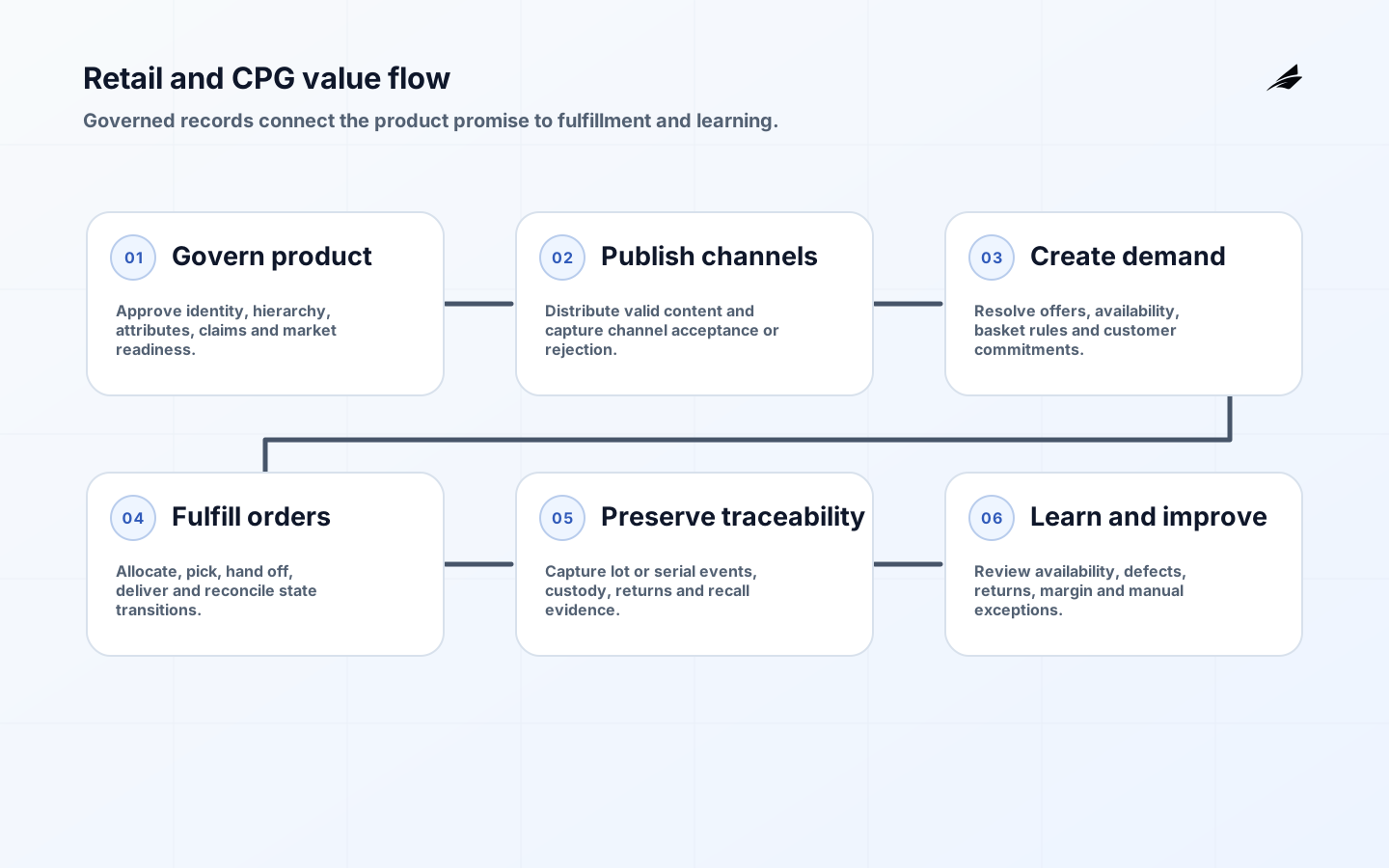
Retail and CPG systems connect the product promise to physical execution: product setup, prices and promotions, inventory, orders, fulfillment, consumer information, traceability and financial settlement. Problems emerge when each channel or partner carries a different version of the product, stock position or promotion rule. This retail and CPG FAQ explains the architecture and operating decisions that make omnichannel delivery dependable.
For implementation sequencing, use the retail and CPG business guide and retail and CPG implementation checklist. Public operators can also compare the public-sector retail systems guide. Start with the commercial flow and record authority, not a shopping list of platforms.
What belongs in a retail and CPG systems scope?
The scope should follow a sellable item through its lifecycle. A brand or category team creates product and market attributes; pricing and promotion services create offers; channel systems publish content; order management promises stock; stores, warehouses or partners fulfill; payment and finance systems settle; service teams manage returns; and analytics feeds decisions back. Include suppliers, marketplaces, logistics providers and data pools where they exchange records or trigger obligations.
Define which business unit, market, category and channel is in the first release. “Single view of inventory” may mean on-hand units to a store colleague, available-to-promise stock to ecommerce and projected supply to a planner. Those are related measures, not one interchangeable number. Name the decision each view supports, its freshness requirement and what happens when an upstream feed is late.
| Domain | Authoritative record | Critical integration question |
|---|---|---|
| Product | GTIN, hierarchy, dimensions, ingredients, claims, media and market attributes | Who approves a sellable item for each market and channel? |
| Offer | Base price, tax treatment, promotion conditions and effective dates | Which engine resolves overlapping offers and returns an explainable price? |
| Inventory | On hand, reservations, safety stock and availability rules by location | When is stock sellable, and how are late events reconciled? |
| Order | Customer commitment, allocation, fulfillment state, payment and return | Which system owns state transitions across channels and partners? |
| Traceability | Lot or serial identity and event history | Can affected items and locations be found within the required time? |
How should product data be governed?
Treat product information as a governed commercial record. Assign owners for global identity, category attributes, regulated statements, market localization, digital media and channel publication. The GS1 Global Data Model defines foundational attributes used to list, order, store, move and sell products. It is a useful common language, but each organization still needs validation rules, approval states and market-specific requirements.
Model a product hierarchy explicitly: consumer unit, inner pack, case, pallet, assortment and bundle may have different identifiers and dimensions. Keep effective dates and provenance so a later correction does not silently rewrite historical orders. Validate units, enumerations and dependencies at entry. A product should not be publishable if a required allergen statement, net content, market language or channel image is missing. Route rejected records to a named steward rather than leaving them in an integration queue.
How do channels stay consistent without one giant system?
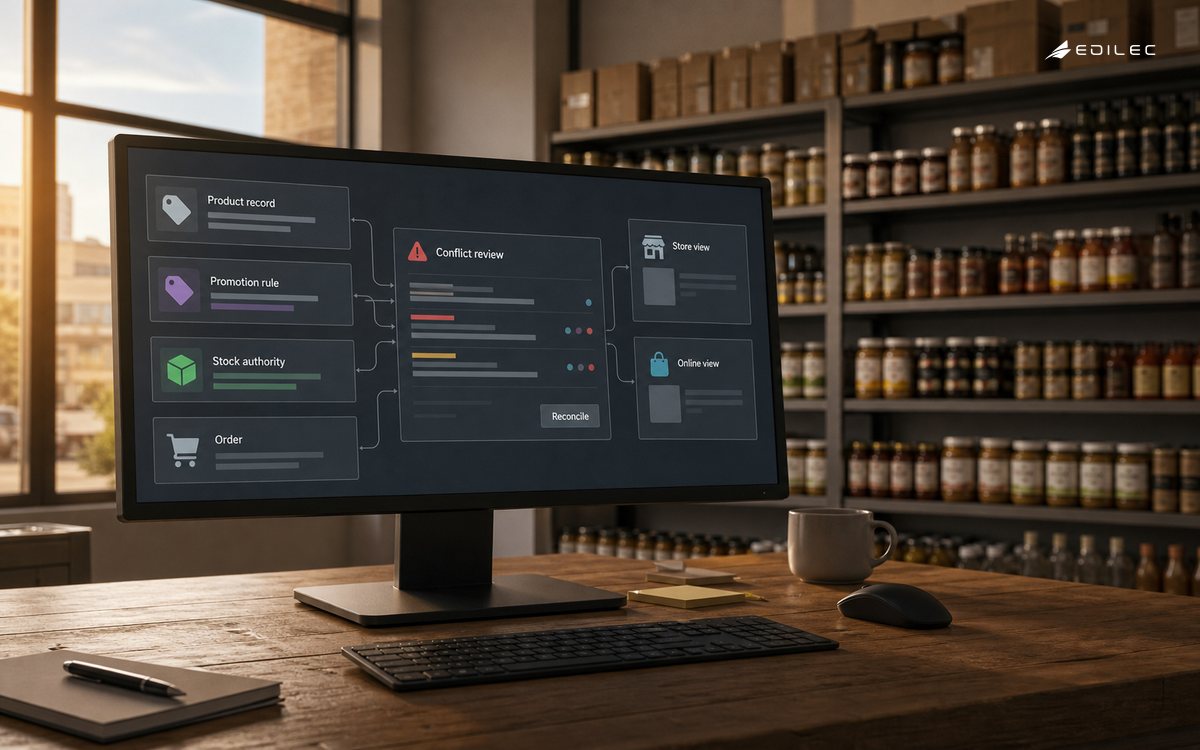
Consistency comes from authority and contracts, not forcing every function into one database. Publish versioned product, offer, inventory and order events with stable identifiers. Expose query APIs for current state and events for changes. Consumers should be able to reject invalid messages, replay from a known point and reconcile totals. Avoid direct database sharing between platforms; it bypasses business rules and makes change ownership unclear.
A channel should receive the attributes it needs and report publication status back. When an item is blocked on one marketplace but live elsewhere, operations need the exact failed field, rule and owner. For customer-facing 2D codes, GS1 Digital Link provides a standardized way to connect identifiers such as GTINs to online information. Plan resolver ownership, destination governance and continuity; the code on packaging may outlive a campaign or website.
What makes inventory and order promises trustworthy?
Separate physical on-hand stock from available-to-promise. Availability may deduct reservations, quarantine, display stock, safety buffers and expected shrink while adding eligible inbound supply. Document the formula by channel and location. Every reservation needs an expiry or state transition. Periodic reconciliation between warehouse, store and order records should identify both quantity differences and event lag.
Order orchestration should make state explicit: accepted, paid or authorized, allocated, picked, handed off, delivered, cancelled, returned and refunded. Define who may move each state and how duplicates are handled. An idempotency key prevents a retried request from creating a second order or refund. Compensating actions should be designed for partial failure, such as payment succeeding after allocation expires. Store colleagues and service agents need one explainable timeline, not five conflicting portals.
| Scenario | Control | Operational measure |
|---|---|---|
| Oversell during a promotion | Reservation expiry, safety stock and event-lag monitoring | Cancellation rate caused by unavailable stock |
| Wrong channel price | Effective-dated offer rules and prepublication comparison | Price exceptions per published item |
| Incomplete product page | Market-specific completeness gate and rejection workflow | First-pass publication success |
| Duplicate order or refund | Idempotent commands and immutable financial references | Duplicate prevention and manual reversal count |
| Slow recall search | Lot-linked event capture and tested query procedure | Time to identify affected items and locations |
How should traceability be designed?
Traceability should answer what moved, when, where, why and under whose custody at the needed level of granularity. The GS1 Global Traceability Standard distinguishes class, batch or lot, and instance identification. Choose granularity based on risk and business need; collecting serial-level data without reliable capture can create an expensive illusion of precision.
EPCIS and Core Business Vocabulary provide a common model for supply-chain visibility events and support sensor data, JSON/JSON-LD and REST interfaces. For covered foods in the United States, the FDA Food Traceability Rule centers records on Critical Tracking Events and Key Data Elements. The FDA page currently states that enforcement is not intended before July 20, 2028; affected firms should verify current obligations and use the time to test partner exchange and retrieval.
Run recall simulations with imperfect conditions: a supplier identifier changed, a file arrived late, a case was split in store or a partner uses a different location code. Measure time to establish scope, confidence in the result and unresolved records. Retain the source event and correction history. Traceability that works only after a database specialist manually repairs records is not operationally ready.
How should promotions and returns be controlled?
Promotion rules need a deterministic precedence model. Define eligibility, channel, market, item set, customer conditions, stacking, limits, effective times and tax treatment. Test boundaries such as midnight, time zones, returns after an offer ends and baskets that cross thresholds. Store the explanation used at checkout so service and finance teams can reproduce the price later.
Returns reverse several flows at once: customer entitlement, inventory disposition, payment, loyalty value, tax and sometimes supplier recovery. Distinguish sellable, repairable, quarantined and disposal outcomes. High-risk returns may need item or serial verification and human review. Track return reasons as governed data; a free-text reason list cannot reliably reveal product defects, misleading content or fulfillment damage.
How should a retail and CPG rollout be phased?
Choose a bounded slice with meaningful complexity, such as one category in one market across ecommerce and a small store group. Baseline product completeness, publication failures, stock accuracy, cancellation, fulfillment time, returns and manual touches. Clean only the data needed for the slice, while fixing the source process that created defects. Parallel-run critical financial and inventory totals before cutover.
- Map the item-to-cash and return flows, including partner handoffs and exception queues.
- Assign record authority and steward ownership for product, offer, inventory, order and traceability data.
- Define API and event contracts, identifiers, idempotency, ordering assumptions and reconciliation.
- Test real channel, store, warehouse, payment and recall scenarios with business users.
- Release gradually with observable acceptance thresholds and a practiced rollback or containment path.
- Review commercial outcomes and data defects together; fixing only interface symptoms leaves the system fragile.
Peak trading needs its own readiness gate. Load-test price lookup, reservation, checkout, store picking and partner feeds at a realistic mix rather than multiplying average traffic. Freeze risky changes for the agreed window, confirm on-call coverage and predefine degraded modes such as limiting delivery promises when carrier or inventory feeds are stale. After the event, reconcile orders, payments, loyalty and inventory before treating the commercial result as final.
Key takeaways
- Design retail and CPG systems around the product and order lifecycle, not around platform boundaries.
- Give each record and state transition one accountable authority while using contracts to distribute data.
- Treat available-to-promise as a governed calculation rather than a synonym for physical stock.
- Use standardized identity and event models where partners must exchange product and traceability data.
- Prove the operating model through promotion, partial-failure, return and recall scenarios before scaling.
Frequently asked questions
Can an ERP be the only retail and CPG platform?
Usually no. An ERP may own finance, procurement or stock accounting, while specialized systems manage product content, offers, point of sale, ecommerce, order orchestration, warehouses and customer engagement. The goal is not one platform; it is clear authority, stable integration and reconciled business outcomes.
Does every inventory update need to be real time?
No. Freshness should match the decision. A flash sale may need seconds-level reservation updates, while a planning view can tolerate scheduled loads. State the maximum age, expected volume and degraded behavior for each use. “Real time” without a measurable bound is not a service level.
Do GS1 standards replace data governance?
No. They provide interoperable identifiers, attributes and event vocabularies. Organizations still decide ownership, applicability, validation, access, retention, correction and market rules. Standards reduce translation cost; governance keeps their implementation reliable.
Conclusion
A dependable retail and CPG architecture keeps product meaning, offer logic, stock promises and order states explainable across channels. Establish record authority, use partner-ready standards, build reconciliation and test exceptions that happen in real operations. The result is not merely connected software; it is a commercial flow that colleagues and customers can trust.