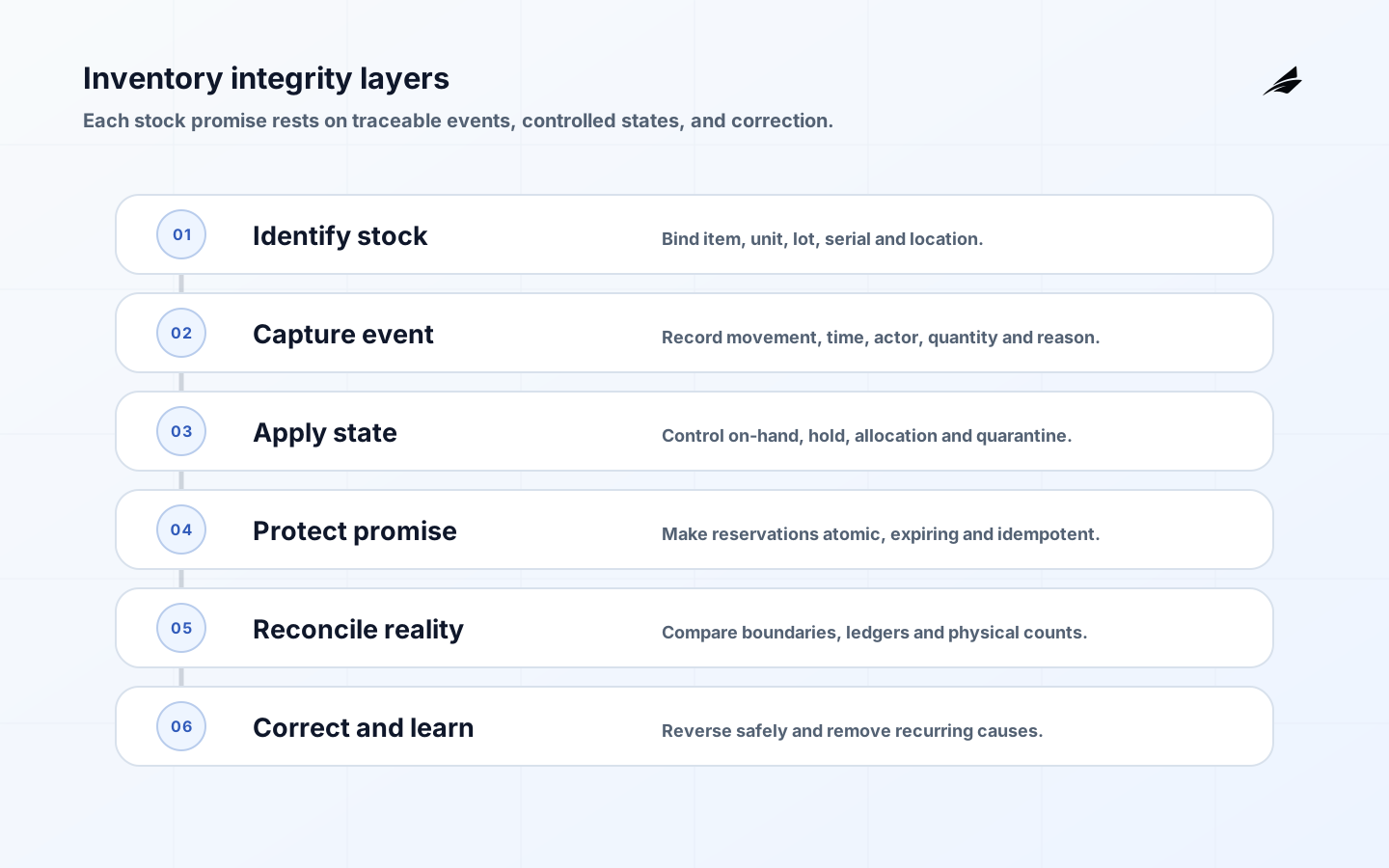
Inventory systems do not create stock accuracy by themselves. They preserve a disciplined account of physical events: what item moved, in which quantity and unit, from where to where, under whose authority, and at what time. Reliability breaks when a scan is skipped, a reservation has no expiry, a unit conversion is ambiguous, or an integration retries a receipt as a second event. The system must make those failures visible and repairable.
This inventory systems checklist is for teams connecting purchasing, warehouses, stores, fulfilment, finance, and customer promises. Pair it with Edilec's inventory cost and scaling guide, CTO architecture guide, and production operations guide when planning platform scope and rollout.
Key takeaways
- Model immutable stock events and derive balances; never treat a mutable quantity as the only evidence.
- Separate on-hand, available, reserved, allocated, in-transit, damaged, quarantined, and expected stock.
- Use stable item, location, lot, serial, and unit identifiers across every integration boundary.
- Design idempotency, reconciliation, correction, and offline capture before increasing automation.
- Measure record-to-physical agreement and exception age, not transaction volume alone.
Define the inventory operating boundary
Start by naming the promises the inventory record supports. Customer checkout may need available-to-promise by fulfilment node; purchasing needs expected receipts; finance needs valuation and period boundaries; regulated operations may need lot or serial traceability. Those views overlap but are not interchangeable. Write a scope statement for each channel, facility, stock state, and item type. Explicitly exclude consignment, returns awaiting inspection, samples, or vendor-managed stock until their ownership and event rules are agreed.
Inventory is a distributed business process. A warehouse management system may own bin movements while an order service owns reservations and an ERP owns financial postings. For each fact, declare one authoritative writer and the systems allowed to cache or derive it. NIST defines data governance in terms of decision rights and accountability; apply that principle concretely to who may create items, release quarantine, backdate adjustments, and approve write-offs.
| Stock concept | Meaning | Typical authority |
|---|---|---|
| On hand | Physically present at a location | Warehouse or store execution |
| Reserved | Temporarily held for demand | Order service |
| Allocated | Assigned to a fulfilment task | Warehouse execution |
| Available | Eligible on hand minus valid holds | Inventory promise service |
| In transit | Dispatched but not accepted at destination | Transfer workflow |
| Quarantined | Present but unavailable pending disposition | Quality authority |
Build a traceable event ledger
Record receipts, moves, picks, packs, shipments, returns, counts, adjustments, transformations, and disposals as events with unique identifiers. Store the business time and processing time separately so late messages can be understood without rewriting history. Include source document, actor or device, item, quantity, unit, from-state, to-state, location, reason, and correlation identifier. Corrections should reverse or supersede an event, preserving the original evidence rather than deleting it.
The GS1 traceability overview describes Critical Tracking Events and the Key Data Elements that explain them. Its identifiers for trade items and locations are useful even when a company is not implementing every GS1 exchange standard. The Global Traceability Standard also reinforces that traceability spans identification, event capture, and information sharing. Translate that into a testable event contract for every internal and partner boundary.
Make reservations and concurrency explicit
Overselling is usually a concurrency problem disguised as a reporting problem. Define when a cart, order, or work order creates a hold; how long the hold lasts; whether partial allocation is allowed; and what releases it. Use an atomic conditional update, serialised command, or other concurrency mechanism appropriate to the store. A read followed by an unprotected write is not a reservation. Require an idempotency key on commands so a network retry cannot reserve or receive twice.
Consider two channels requesting the last five units. Both may read available quantity as five. The correct design lets one reservation commit and makes the other fail, back-order, or route to another node according to policy. The event stream should retain both attempts and the decision. A nightly reconciliation cannot undo a customer promise already made, so protect the write path where scarcity is decided.
Design integration and reconciliation together
Publish versioned event contracts and define delivery semantics. At-least-once transport is common, which makes consumer deduplication and idempotent posting essential. Quarantine malformed events with a visible owner; do not silently drop them or let one poison message stop an entire partition. Preserve correlation from purchase order through receipt and from sales order through dispatch so operations can trace a discrepancy without joining on free text.
| Boundary | Control | Reconciliation question |
|---|---|---|
| Supplier to receiving | Purchase order and item identity validation | Were all accepted lines posted once? |
| Order to reservation | Atomic hold with expiry | Do open holds match eligible demand? |
| Warehouse to shipment | Pick-pack-ship state machine | Did each dispatch reduce the correct location? |
| Inventory to finance | Valuation mapping and period control | Do quantity and value movements reconcile? |
| Offline device to platform | Device identity, sequence, and deduplication | Are sequences complete after reconnect? |
Run three reconciliations at different tempos. Near-real-time checks catch impossible transitions and duplicate identifiers. Daily boundary reconciliations compare event counts and quantities across systems. Periodic physical counts compare the record with reality. Use cycle counting based on value, movement, and risk rather than closing the whole facility for one annual surprise. Every variance needs a reason code, approver where material, and evidence of the resulting correction.
Protect high-impact inventory actions
Apply least privilege to adjustments, item-master changes, quarantine release, and backdated transactions. Separate request from approval for material write-offs and monitor unusual patterns by user, item, location, and time. Follow the NIST Cybersecurity Framework to connect governance, protection, detection, response, and recovery rather than treating access control as the whole security design. Keep scanner and integration credentials scoped, rotated, and attributable to a device or workload.
Configuration changes can alter stock just as surely as application code. Unit conversions, negative-stock policy, reservation timeout, location hierarchy, and reason-code mappings need review, effective dates, testing, and rollback. Test with representative roles, including users who must be denied. Retain audit records long enough for financial, safety, contractual, and regulatory needs, but avoid collecting personal data that has no operational purpose.
Rehearse a count-to-correction scenario
A cycle count finds 98 units where the system shows 105. The counter should not simply overwrite the balance. Freeze or control relevant moves, perform an independent recount when policy requires it, inspect recent receipts and picks, and classify the variance. Suppose a disconnected scanner uploaded one pick twice after reconnect. The duplicate event is reversed, the device sequence repaired, and affected downstream messages replayed. The count remains evidence, while the correction explains why the derived balance changed.

- Confirm item, lot or serial, unit, location, and count scope.
- Check open tasks, in-flight transfers, and transactions posted after the count time.
- Require a reason and proportionate approval for any adjustment.
- Reconcile downstream availability, orders, and valuation after correction.
- Open a problem record when the same cause recurs across counts or locations.
Monitor inventory integrity and service health
Monitor signals that point to action: record-to-physical accuracy by item class, negative balances, expired reservations, duplicate event attempts, unprocessed messages, reconciliation variance, count adjustment value, and exception age. Also watch latency on reservation and promise paths, because a technically correct answer that arrives after checkout is not useful. Google's monitoring guidance recommends focusing on user-visible symptoms and actionable alerts; page on risks to promises or integrity, and use dashboards for slower improvement work.
Review leading and lagging measures together. A falling adjustment value looks good until cycle-count coverage is examined. High fulfilment speed may hide frequent substitutions or manual overrides. Segment by channel, facility, item class, and integration source, but protect small or sensitive populations. Assign every recurring exception a service owner and a deadline for either prevention or an accepted operating procedure.
Use an inventory go-live gate
A go-live decision should include physical and digital evidence. Count a representative set of fast-moving, high-value, serialised, lot-controlled, damaged, and low-volume items. Run a receipt, transfer, reservation, cancellation, partial pick, shipment, return, quarantine, adjustment, and offline-device reconnect end to end. Reconcile quantities and event identifiers at every boundary, then verify finance or customer-facing projections where they depend on the result.
Set opening tolerances and stop conditions. A launch may proceed with a small documented variance in low-risk stock, but not with unexplained duplicates, missing serial history, or a reservation race. Staff the first operating window with warehouse, application, integration, master-data, and finance owners. Freeze nonessential configuration, publish the manual fallback, and decide who can pause a channel when inventory integrity degrades. That preparation protects real orders while the new event path settles.
Frequently asked questions
What should be the inventory source of truth?
There may be several authoritative components, but only one writer for each fact. Warehouse execution can own physical events, an order service reservations, and a derived inventory service availability. Document the boundaries and make the event ledger traceable; declaring one giant database the source of truth does not resolve conflicting ownership.
Should an inventory system allow negative stock?
Only as an explicit, narrow exception. Blocking can halt legitimate work when event capture is delayed, while unrestricted negatives conceal process failure. Define eligible locations and roles, require a reason, alert on duration and magnitude, and reconcile to physical evidence quickly.
Is 100% inventory accuracy a useful target?
It is an aspiration, not a sufficient operating measure. Define accuracy by item, location, unit, and tolerance; then pair it with count coverage, variance value, exception age, and customer impact. A rounded percentage can hide severe errors in scarce or high-value items.
Conclusion
Reliable inventory systems preserve the meaning of physical movement. Establish ownership, model stock states, record immutable events, control scarce reservations, reconcile every boundary, and practise correction. When the digital account can explain both the current balance and how it got there, teams can make credible customer and financial promises.