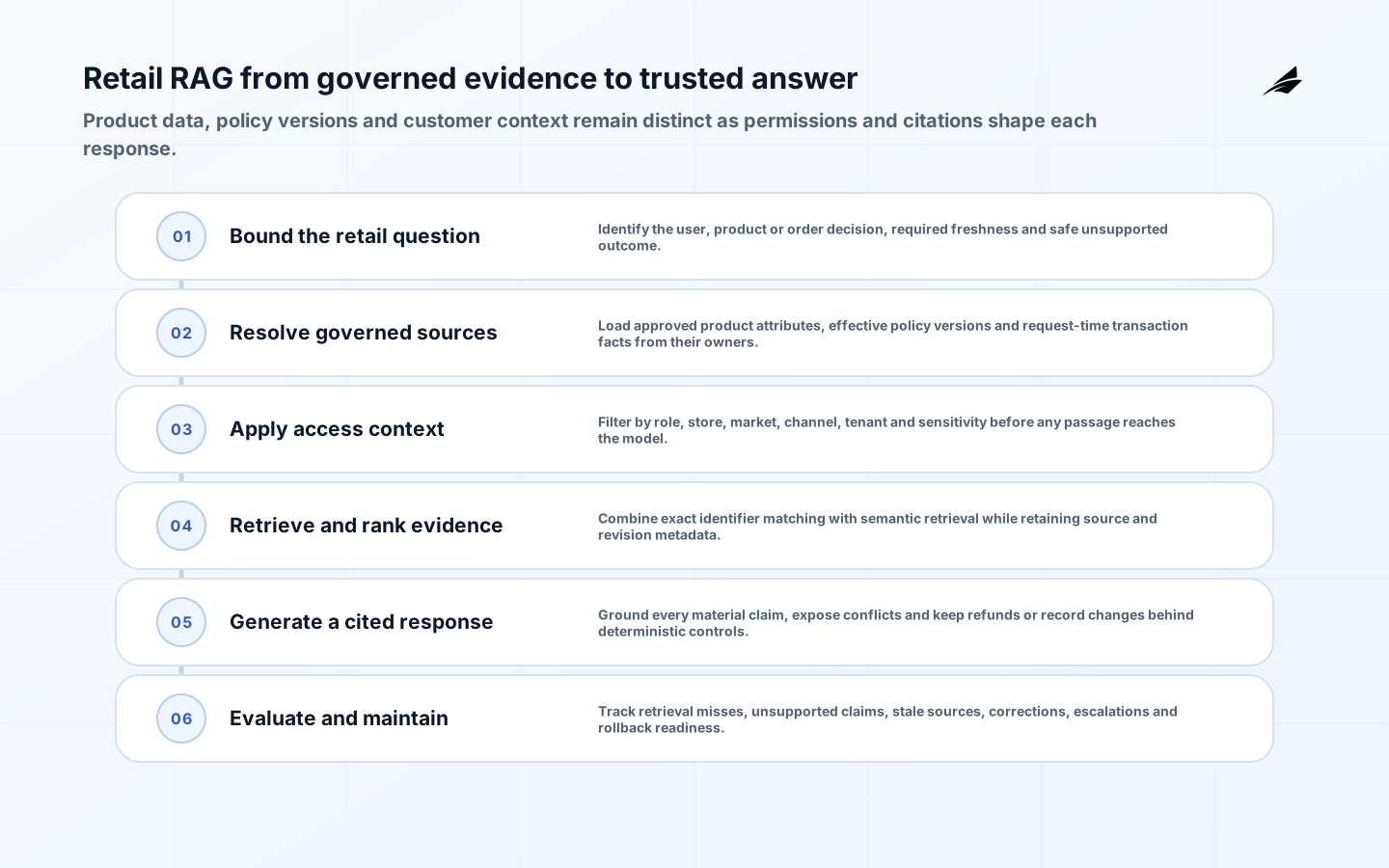
A retail RAG knowledge base succeeds when it gives a store associate, support agent, merchandiser, or customer the right answer from the right source at the right moment. The language model is only one component. Product information, inventory status, policy documents, access controls, retrieval logic, citations, evaluation, and content operations determine whether the system can be trusted in daily work.
This checklist treats retrieval-augmented generation as a governed information product. It is designed for teams moving beyond a demonstration toward a production service that answers questions about products, orders, returns, warranties, promotions, and operating procedures. If the wider initiative also includes transactional workflows, pair this work with a controlled enterprise systems architecture and an explicit AI automation delivery model.
1. Define the retail decision the knowledge base must improve
Begin with a bounded user decision, not a general instruction to answer retail questions. A store associate may need to compare two products using approved specifications. A support agent may need to determine whether a return qualifies under the policy that applied on the purchase date. A merchandiser may need an explanation of an attribute conflict before publishing a listing. These are different workflows with different evidence, latency, and permission requirements.
Write a one-sentence service contract for each use case: who asks, what decision follows, which source is authoritative, how fresh the evidence must be, and what the system must do when evidence is incomplete. This makes acceptance tests possible. It also prevents a pilot that looks fluent but quietly mixes public catalog copy, internal procedures, and customer data.
| Use case | Authoritative evidence | Required behavior | Unsafe behavior |
|---|---|---|---|
| Product comparison | Approved product information and technical specifications | Compare named attributes and cite each product record | Invent a missing specification or infer compatibility |
| Return eligibility | Order facts plus versioned return policy | Explain the applicable rule and route exceptions | Approve a refund without transactional authorization |
| Store procedure | Current operating procedure for the user's location and role | Return the relevant steps and document version | Expose another region's restricted procedure |
| Order support | Order management status and approved support guidance | Summarize status and offer permitted next steps | Reveal another customer's order or promise an unsupported outcome |
2. Establish source ownership before indexing content
Retail information is fragmented by design. A product information management system may own attributes; an order management system owns order state; a commerce platform publishes customer-facing copy; a policy repository holds procedures; and a supplier network contributes product data. GS1's Global Data Model and product identification standards are useful reminders that product data has defined identifiers, attributes, and business purposes. A RAG index must not flatten those ownership boundaries into an undifferentiated text collection.
Create a source register with a business owner, technical owner, canonical identifier, permitted audience, refresh method, retention rule, and conflict policy. Preserve effective dates for policies and promotions. Keep product identifiers, locale, channel, and market as metadata rather than hoping the model recovers them from prose. When two records disagree, the retrieval layer should apply a documented precedence rule or withhold the answer for review.
| Source class | Key metadata | Typical freshness target | Control owner |
|---|---|---|---|
| Product information | GTIN or SKU, locale, market, approval state, effective date | On approved publication or scheduled delta | Merchandising or product data owner |
| Inventory and availability | SKU, location, available-to-promise state, timestamp | Near real time where the answer affects a sale | Inventory operations |
| Policies and procedures | Version, jurisdiction, channel, effective period, audience | On every approved policy change | Legal, compliance, or operations |
| Customer and order context | Customer or order identifier, purpose, retention class | Request-time lookup rather than broad indexing | Commerce operations and privacy owner |
Do not embed sensitive customer records into a general vector store merely because retrieval is convenient. Request-time tools can fetch the minimum order context after authorization. This separates reusable knowledge from personal or transactional data and makes deletion, retention, and access reviews more manageable.
3. Build permission-aware ingestion and indexing
The ingestion pipeline should parse supported formats, remove navigation noise, retain document structure, attach source metadata, and reject records that fail quality checks. Chunking should follow semantic units such as a policy clause, product feature group, troubleshooting step, or question-and-answer pair. Arbitrary fixed-length chunks often separate a rule from its conditions or a specification from its product identifier.
Access control belongs in the retrieval path, not only in the user interface. Apply tenant, market, location, role, and sensitivity filters before candidate passages reach the model. NIST's Zero Trust Architecture frames access as a decision based on identities, resources, and policy rather than network location. The same principle is useful here: the index may contain a passage, but that does not mean every authenticated user may retrieve it.
- Keep source identifiers and revision timestamps on every chunk.
- Record the parser, embedding model, chunking policy, and index version used for each ingestion run.
- Quarantine malformed, duplicate, unapproved, or access-ambiguous documents instead of silently indexing them.
- Test permission filters with positive and negative cases, including users who change store, role, or region.
- Provide a controlled deletion and re-index path for expired policies and corrected product records.
4. Design retrieval and answer controls as separate layers

A production architecture normally has distinct layers for query interpretation, authorization, retrieval, ranking, answer generation, and response validation. Hybrid retrieval can combine keyword matching for exact identifiers with semantic retrieval for natural-language intent. Reranking can improve the order of candidate passages, but it does not repair missing data or an incorrect permission filter.
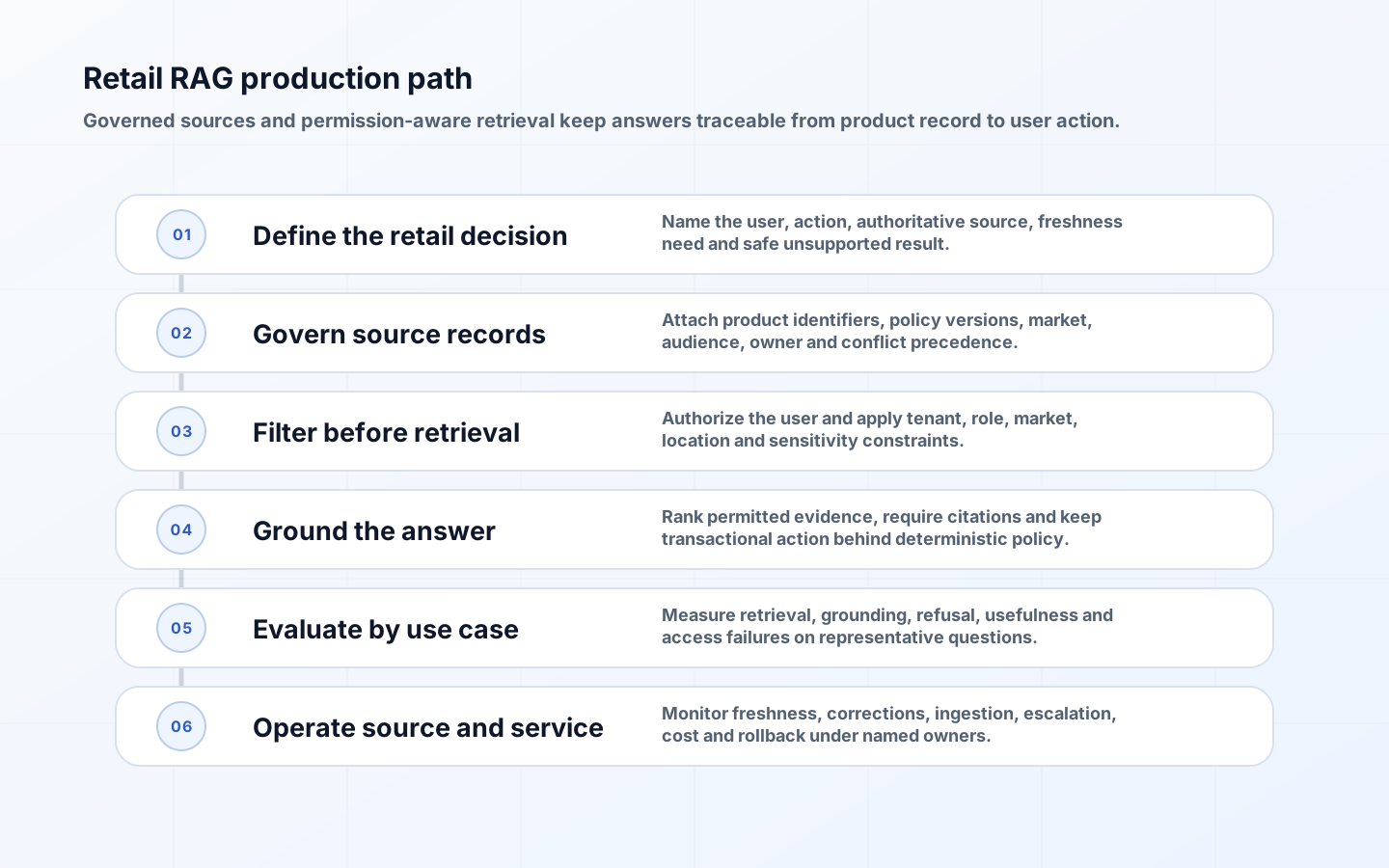
The answer contract should require citations to retrieved evidence, distinguish facts from recommended next steps, and state when the evidence is insufficient. For high-consequence actions, the model should prepare an explanation or proposal while deterministic software enforces eligibility, limits, and approvals. OWASP's guidance on excessive agency supports minimizing tool permissions and avoiding unnecessary autonomous actions.
Prompt injection is also a data-boundary problem. Treat retrieved content, supplier descriptions, customer messages, and web pages as untrusted input. Do not allow instructions inside those sources to override system policy, expand tool permissions, or reveal hidden context. Log which passages and tools contributed to each material answer so incidents can be reconstructed.
5. Evaluate retrieval, answers, and business outcomes independently
A single accuracy score hides too much. Build an evaluation set from real, de-identified questions across products, markets, channels, and difficulty levels. Include stale policies, ambiguous identifiers, conflicting sources, restricted documents, prompt-injection attempts, and questions that should be refused. A subject-matter owner should approve the expected evidence and acceptable answer, not merely the wording.
| Evaluation layer | Question | Evidence to retain |
|---|---|---|
| Retrieval | Did the system find the authoritative passage within the permitted corpus? | Retrieved identifiers, ranks, scores, filters, and index version |
| Grounding | Does every material claim follow from cited evidence? | Claim-to-passage review and unsupported-claim count |
| Safety | Did the service refuse restricted, injected, or unsupported requests? | Adversarial test result and policy decision |
| Usefulness | Did the answer help the user complete the defined decision? | Task completion, escalation reason, correction, and user feedback |
| Operations | Can the team detect stale sources and regressions? | Freshness lag, failed ingestion, evaluation trend, and incident record |
Set release thresholds by use case. Product discovery may tolerate a cautious clarification request; refund eligibility requires stronger determinism and review. The NIST AI RMF Generative AI Profile recommends evaluating risks across the system lifecycle, which is more useful than treating launch as the end of validation.
6. Pilot with a controlled cohort and explicit fallback
Start with one audience, one market, and a narrow source set. Run the service in shadow mode or as an agent-assist tool before exposing it directly to customers. Compare suggested answers with actual resolutions, record why users reject suggestions, and inspect whether poor results came from retrieval, source quality, policy ambiguity, or generation.
The fallback must be useful: ask for a product identifier, show the source record, route to a specialist queue, or return the approved manual procedure. A vague apology is not an operating control. Define who can disable a source, roll back an index, suspend an action tool, and notify affected teams when a policy or model defect is discovered.
7. Operate the knowledge base as a product
After launch, ownership moves from a project team to a durable operating group. Content owners resolve source defects; platform owners maintain ingestion and retrieval; security reviews access and abuse signals; product owners prioritize use cases; and support teams feed corrections back into evaluation. The CISA and NCSC secure AI development guidance emphasizes secure design, development, deployment, and operation rather than a one-time review.
Track source freshness, unanswered question clusters, citation coverage, permission denials, escalations, corrections, latency, and unit cost. Review these metrics by use case and audience. Falling escalation volume is not automatically positive if users have stopped trusting the tool; combine operational measures with sampled quality review and task outcomes.
Key takeaways
- Define one decision and one authoritative evidence chain for each initial use case.
- Keep product knowledge, policies, and customer transactions in appropriately governed data paths.
- Filter by identity and policy before retrieval results reach the model.
- Measure retrieval, grounding, safety, usefulness, and operations separately.
- Launch with a real fallback, rollback authority, and named content owners.
- Treat evaluation and source maintenance as permanent production work.
Frequently asked questions
Does a retail RAG knowledge base require a vector database?
Not always. Exact product identifiers, policy codes, and structured filters often work best with keyword or database retrieval. Many systems use hybrid retrieval, adding vectors where semantic matching improves recall. The choice should follow an evaluation set, data volume, access model, latency target, and operational capability.
Should real-time inventory be stored in the RAG index?
Usually not as the sole source. Rapidly changing availability is safer as an authorized request-time lookup against the inventory or order platform. The knowledge base can explain availability concepts, while the transactional system supplies the current state and timestamp.
What is the clearest sign that the pilot is production-ready?
The team can show repeatable performance on a representative evaluation set, enforce access boundaries, trace answers to source versions, recover from failed ingestion or model changes, and route uncertain cases without blocking the user. A polished demo without these controls is not production readiness.
Conclusion
Retail RAG implementation is fundamentally a source-governance and decision-design problem. A useful system preserves product identity, policy versions, audience permissions, and evidence from ingestion through the final answer. When the team also measures retrieval quality, limits tool authority, and operates a dependable fallback, the knowledge base can improve retail work without asking users to trust fluency alone.