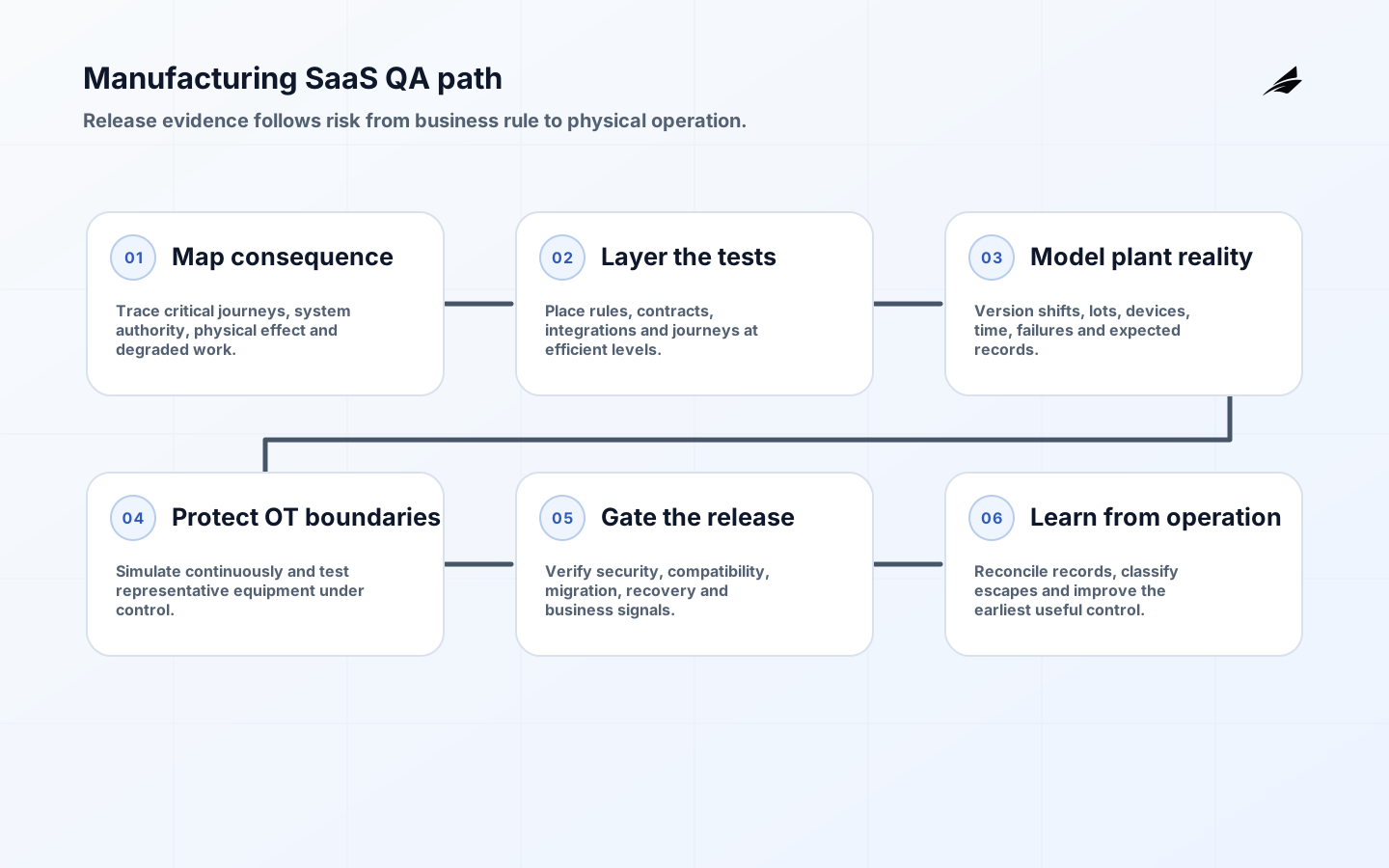
QA automation for SaaS for manufacturing must verify software behavior without ignoring the physical processes, devices and operational constraints around it. A passing browser suite cannot prove that a work order, machine state or quality hold remains correct through network loss and retries. This FAQ helps buyers and QA leaders design automation that supports frequent release while respecting manufacturing consequence.
Use it with Edilec's manufacturing SaaS validation guide, manufacturing SaaS implementation checklist and manufacturing AI workflow delivery plan. Scope tests from production risk and release architecture, not from an arbitrary automation percentage.
Key takeaways
- Model business and physical consequences before choosing test layers.
- Keep most checks fast and deterministic; reserve end-to-end tests for critical cross-system journeys.
- Simulate OT interfaces safely and run controlled conformance tests against representative equipment.
- Treat flaky tests as defects with owners, evidence and deadlines rather than hiding them with retries.
- Use production incidents, overrides and data reconciliation to improve the suite after release.
What makes manufacturing SaaS QA different?
The application may interact with MES, ERP, quality systems, scanners, printers, historians, gateways and operational technology. It must handle shifts, local time, intermittent links, long-running jobs, duplicate events and equipment versions. Some defects affect traceability, release status or physical action, so reversibility and safe degraded behavior matter as much as user-interface correctness.
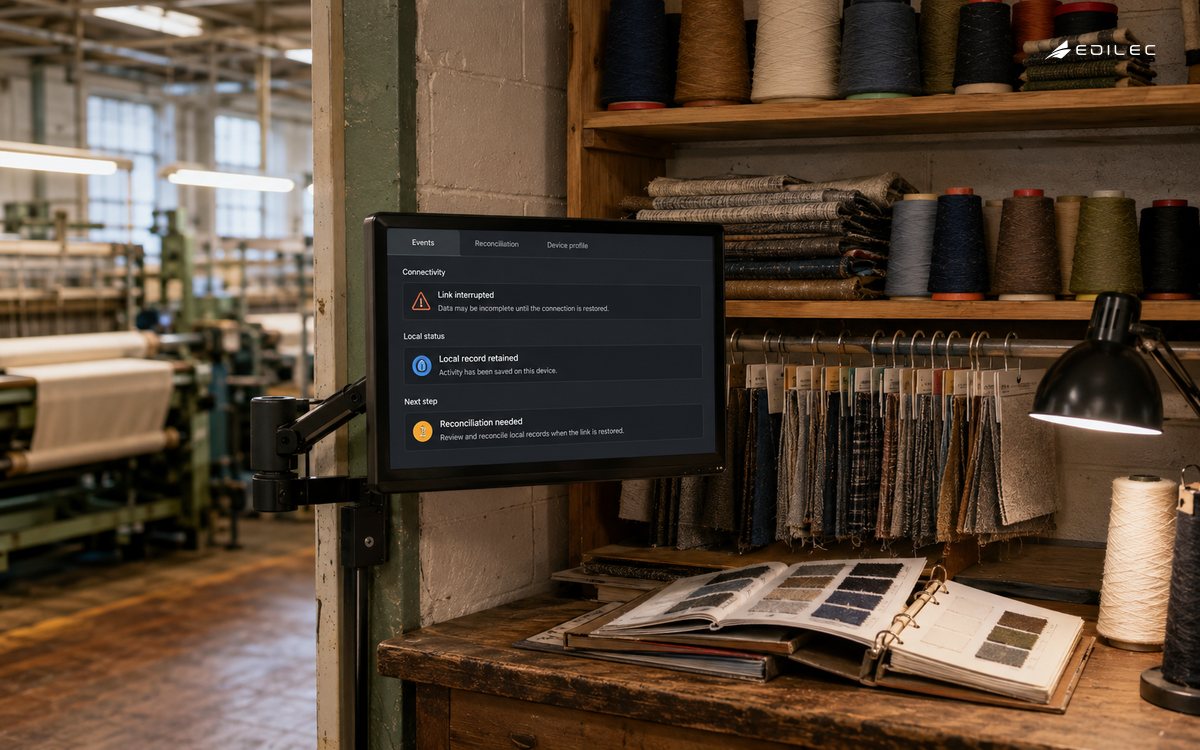
Map critical journeys with manufacturing and quality owners: receive material, issue work, capture consumption, record inspection, place hold, release product and reconcile inventory. Record authoritative system, identities, timing, side effects and fallback. NIST SP 800-82 Rev. 3 is useful context because OT security must account for performance, reliability and safety.
| Risk tier | Example | Automation expectation |
|---|---|---|
| Critical | Incorrect release, genealogy or machine command | Deterministic controls, independent verification and safe failure |
| High | Lost production event or wrong inventory movement | Contract, integration, reconciliation and recovery tests |
| Moderate | Planner workflow or report error | Unit, API and focused browser journeys |
| Low | Cosmetic or nonmaterial preference | Component checks or targeted manual exploration |
How should the test portfolio be structured?
Put business rules, transformations and state transitions under unit and property-based tests. Test API and event contracts at service boundaries. Use integration tests for databases, queues and external adapters. Keep a small set of end-to-end journeys for high-value workflows and add performance, resilience, accessibility and security checks where risk requires them.
The DORA test automation guidance advocates fast feedback throughout delivery and notes the value of many unit tests with fewer broad tests. Run quick checks on every change, broader integration tests on release candidates and equipment-dependent suites in scheduled or controlled environments. Record which risk each test covers so redundant slow tests can be removed responsibly.
How should test data and environments work?
Create synthetic but realistic plants, products, bills of material, routes, shifts, lots, units and equipment states. Include invalid, late, duplicated and contradictory records. Masked production data may help reproduce defects, but use it only with approved privacy and retention controls. Version seed data and expected outcomes with the tests.
Production-like does not mean a full clone. Match the properties relevant to the risk: database engine, queue semantics, identity policy, time zones, interface versions and representative scale. Keep test tenants isolated and prevent automated suites from reaching physical production controls. Reset state deterministically and preserve a trace when cleanup fails.
How can OT and device integrations be tested safely?
Define versioned contracts for equipment state, commands, acknowledgements, units, timestamps and quality. Build simulators that model normal and failure behavior, then verify adapters against representative hardware in a lab or planned window. Test disconnect, stale state, out-of-order events, duplicate command, partial acknowledgement and manual override.
Separate the SaaS release from plant enablement where possible. Use flags or configuration cohorts and require local authorization for functions that can affect equipment. Confirm that cloud unavailability leads to the approved degraded process. Capture a compatibility matrix across site, gateway, protocol, firmware and application release.
| Layer | Example checks | Failure evidence |
|---|---|---|
| Unit | State rules, calculations and permissions | Input, expected and actual result |
| Contract | API and event schema compatibility | Producer, consumer and schema version |
| Integration | Queue, database and adapter behavior | Correlation trace and side effects |
| Journey | Work order through quality and inventory | Screens, events and reconciliation |
| Nonfunctional | Load, resilience, security and accessibility | Threshold, environment and resource profile |
| Field conformance | Representative device and gateway behavior | Hardware, firmware and operator observation |
What security verification belongs in QA?
Integrate secret detection, dependency analysis, static checks and targeted dynamic verification. Use the NIST SSDF to cover organizational preparation, software protection, secure production and vulnerability response. The OWASP ASVS provides verifiable web-application security requirements that can be selected by risk and contract.
Test tenant isolation, role boundaries, service identities, administrative actions, export controls and audit integrity. Include manufacturing roles such as operator, supervisor, quality approver, maintenance and integrator. Verify that an authorization change affects existing sessions as intended and that privileged emergency access is logged and reviewed.
How should flaky tests be handled?
A test that sometimes passes the same code weakens release evidence. Classify the cause: product race, test race, shared data, unstable dependency, timing assumption or infrastructure. Quarantine only with an owner, issue, expiry and compensating coverage. Track first-run pass rate and quarantine age.
Retries can gather diagnostic evidence but must not redefine a failure as success. Playwright best practices recommend traces for CI debugging; preserve network, DOM and timing context on failure. Fix selectors and isolation, control clocks where possible and avoid arbitrary sleeps. Delete low-value tests that cannot be made trustworthy.
What evidence should gate a release?
Require traceable source and artifact, passed risk-based suites, reviewed exceptions, compatible migrations, rollback or roll-forward plan, feature configuration, observability and owner approval for critical changes. Run smoke checks after deployment and verify business signals such as event intake and reconciliation, not only service health.
Use canaries or plant cohorts to limit exposure. Monitor error, latency, queue lag, failed integrations, data corrections, operator overrides and support contacts by release. Feed incidents and escaped defects back to the risk model. An incident review should identify the earliest practical test or control that could have detected the condition.
Maintain a manufacturing scenario catalog
Build a catalog that ties each scenario to process, risk, data, systems, equipment profile and expected evidence. Include shift boundaries, daylight-saving transitions, partial quantities, rework, scrap, lot split and merge, quality hold, changed specification, offline station and duplicate scanner input. Review the catalog with production, quality and support after incidents and process changes.
Use deterministic clocks and event identifiers so timing behavior can be reproduced. Verify the difference between event time, system receipt time and business posting time. Test late events across closed periods and released orders. For genealogy and inventory, reconcile totals and relationships rather than checking only that an API returned success.
Maintain golden records for a small number of critical journeys and compare all affected systems after execution. Preserve the application release, schema, configuration, simulator and hardware versions used. This turns a disputed field defect into a reproducible scenario and prevents the suite from passing while downstream manufacturing records diverge.
Periodically observe tests with operators. A technically correct flow may not match glove use, scanner position, shift handover or required confirmation. Convert stable findings into automated checks where valuable, and keep exploratory charters for physical and usability conditions that automation cannot represent faithfully.
Test upgrade and backward compatibility across long-lived plant clients. Browser, mobile, gateway or desktop components may update on different schedules. Define the supported version window and verify old clients against new APIs, new clients against old site components where applicable, and forced-upgrade behavior. Make unsupported combinations visible before a release reaches a shift.
Performance tests should model shift start, batch import, label generation, scanner bursts, report close and recovery after disconnection. Measure tail latency, queue depth, lock contention and downstream rate limits. Validate that backpressure preserves critical transactions and that nonessential reporting cannot starve production workflows.
Recovery tests need data reconciliation. Restore a backup or replay a queue, then compare work orders, material movements, inspections, genealogy and audit events across system boundaries. A service can return healthy while the manufacturing record remains incomplete. Define who accepts reconciliation and how discrepancies are corrected without hiding the original history.
Track escaped defects by the control that should have detected them: requirement review, unit test, contract test, integration environment, journey, release check or monitoring. Look for clusters rather than assigning blame. This creates a rational test-investment backlog and prevents every incident from producing another slow end-to-end test regardless of root cause. Review closure evidence with manufacturing and quality owners so the corrected control reflects the process consequence, not only the software symptom.
Frequently asked questions
What automation coverage target is appropriate?
There is no universal percentage. Measure coverage of critical rules, interfaces and failure modes, plus mutation or defect-detection evidence where useful. Line coverage can reveal untested code but cannot prove meaningful assertions or workflow correctness.
Is manual testing still needed?
Yes. Use manual exploration for new behavior, usability, physical setup and uncertain risk. Automate repeatable regression and evidence collection. Operators and quality specialists contribute observations that test engineers may miss, especially around shift practice and exception handling.
Should CI tests run against live factory equipment?
Not as a default. Use simulators and lab hardware for continuous checks, with controlled conformance tests against representative equipment. Any production interaction needs explicit authorization, bounded commands, scheduling and a safe stop. Never let a general CI credential control operational equipment.
Conclusion
QA automation for manufacturing SaaS becomes valuable when it links software changes to physical and business consequence. Build fast layered tests, model failure, isolate OT, govern security verification and learn from production. The objective is credible release evidence and safer operations, not the largest possible test count.