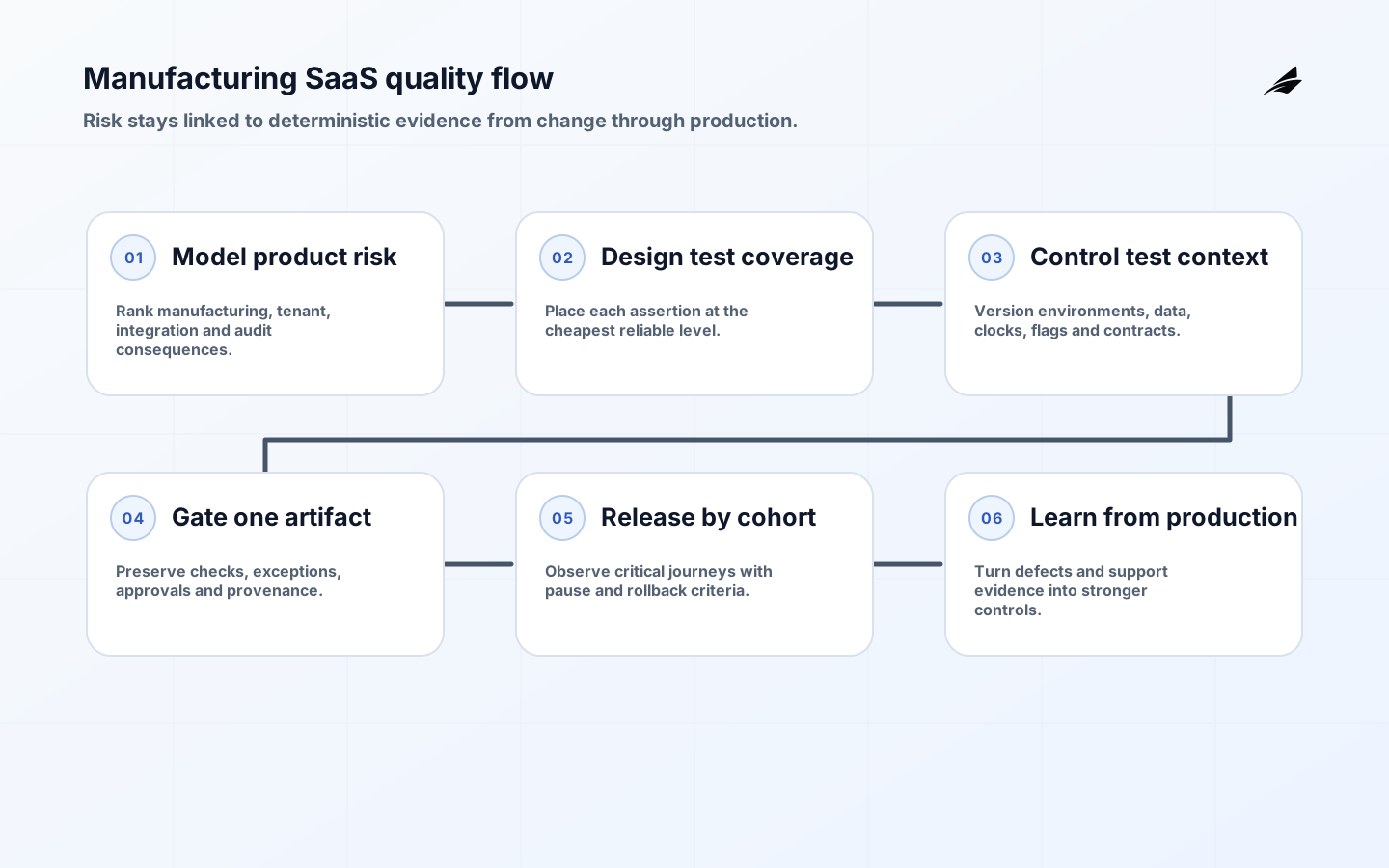
Manufacturing SaaS QA automation must protect production work, tenant isolation and traceable records while keeping releases fast enough to improve the product. It should test more than browser screens. Orders, bills of material, routings, work instructions, machine or quality events, inventory movements, approvals, integrations and audit history can interact across time and sites. This checklist creates a risk-based automation system that gives release owners credible evidence without pretending every defect can be prevented by adding more end-to-end tests.
Use Edilec's manufacturing SaaS validation guide to frame business risk and the QA automation FAQ for tool and team questions. The manufacturing AI implementation checklist applies when probabilistic features join the release surface.
1. Model manufacturing and tenant risk
Map critical journeys from configuration and master data through planning, execution, quality, inventory and reporting. For each, identify tenants, roles, sites, time zones, units, devices, integrations, data volume, approvals and failure impact. Rank tests by consequence and change frequency. A cosmetic report defect should not consume the same release attention as cross-tenant data exposure, incorrect material consumption or lost quality records. Name the business owner who accepts residual risk for each critical journey.
Create a traceability record from requirement or risk to test, result, defect and release decision. The NIST Secure Software Development Framework recommends integrating secure development practices into the lifecycle and tracking security requirements, risks and design decisions. Use the model to choose test depth rather than translating every manual case into fragile UI automation. Keep exploratory testing for new behavior and complex human workflows.
| Risk surface | Representative assertion | Best test level |
|---|---|---|
| Tenant isolation | A user cannot infer another tenant's data | Authorization, API and UI security tests |
| Manufacturing state | Invalid transitions are rejected and logged | Domain and integration tests |
| Units and time | Conversions and production dates remain correct | Property and boundary tests |
| Integration delivery | Retries do not duplicate business action | Contract and failure tests |
| Auditability | Actor, time, reason and change are reconstructable | API, database and workflow tests |
2. Build a balanced automation portfolio
Put deterministic rules in fast unit and property tests. Verify service boundaries with component and contract tests. Use integration tests for databases, queues, identity and external adapters. Reserve browser journeys for a small number of critical user outcomes and accessibility behavior. Add performance, resilience and security tests at appropriate stages. The OWASP ASVS provides testable web-application security requirements; select a risk-appropriate set and record the version used.
Define ownership and failure behavior for every suite. A test should identify the risk it covers, data fixture, expected result and diagnostic output. Quarantine only with an owner, reason and expiry. Retries can reveal intermittency but should not turn a failing check green. Playwright's retry documentation distinguishes first-run, flaky and failed outcomes; treat a flaky result as maintenance evidence and investigate environment, synchronization and product causes.
3. Make environments and test data reproducible
Create environments from versioned configuration and seed them with synthetic factories, tenants, products, routings, users and events. Pin service and schema versions. Virtualize unstable external systems where contract behavior is known, then maintain a smaller set of real integration checks. Avoid copying production databases into test by default. If production-derived data is necessary, minimize, authorize and transform it, and verify that tenant and personal identifiers cannot be reconstructed.
Control clocks, time zones, locale, units and random seeds. Manufacturing scenarios depend on shifts, daylight-saving changes, lot expiry and effective dates. Give tests unique tenant and object identifiers and clean up through supported APIs. Parallel suites must not share mutable state. Capture environment version, migrations, feature flags and fixture revision with each run so a failure can be reproduced. A green test in an unknown environment is weak evidence.
4. Verify data, API and device contracts
Version APIs and events, then test provider and consumer expectations in delivery. Cover required fields, enum expansion, nullability, units, ordering, duplicates, lateness and idempotency. Test database migrations against representative volume and the previous application version. For devices and shop-floor gateways, simulate disconnects, delayed events, clock drift and malformed payloads. Confirm that the system records quality and provenance rather than silently accepting implausible values.
For multi-tenant boundaries, generate negative tests across tenant IDs, indirect object references, search, exports, caches, background jobs and support impersonation. Verify both authorization and non-disclosure through timing or metadata where material. Test role changes and revoked sessions. Audit records should capture the acting identity, tenant, operation and result without exposing secrets. Run these controls independently from UI journeys because a hidden button is not an authorization boundary.
5. Place evidence at the right delivery gate
Run formatting, unit, component and focused security checks on each change. Build one immutable artifact and execute integration, migration and critical-journey tests before promotion. Schedule broader compatibility, resilience and performance suites where they can still block a release. CISA's safe deployment guidance emphasizes staged phases and robust testing before software reaches customers. Define which failures block automatically and who may accept a bounded exception.
Keep pipeline credentials short-lived and scoped, protect test artifacts and redact sensitive output. Record source revision, artifact digest, dependency and test versions, results, approvals and deployed cohort. Do not rerun a red pipeline until it becomes green without preserving the original failure. Measure queue and execution time so slow checks can be redesigned or moved without removing coverage. Release evidence should remain queryable after deployment for incident investigation.
| Gate | Required evidence | Release response |
|---|---|---|
| Change | Fast logic, policy and component checks | Fix before merge |
| Artifact | Provenance, dependency and security results | Reject or accept bounded exception |
| Integration | Contracts, migration and tenant boundaries | Stop promotion |
| Pre-production | Critical journeys, performance and recovery | Approve controlled cohort |
| Canary | User outcomes and error budget | Continue, pause or rollback |
| Post-release | Business and support evidence | Close, remediate or revert |
6. Release progressively and learn from production
Expose by internal tenant, site, customer cohort or feature flag with a defined observation window. Test rollback before launch and design database changes for compatibility across versions. Compare technical health with manufacturing outcomes such as transaction completeness, queue age, inventory exceptions and support contacts. Instrument traces across APIs, queues and integrations; the OpenTelemetry trace model links spans into an execution path. Redact sensitive attributes and preserve tenant boundaries in observability access.
Convert escaped defects into the cheapest reliable prevention at the appropriate layer. Review false alarms, flaky tests, slow suites, missed regressions and manual release work. Do not measure QA by test count. Track escaped-defect severity, change failure, detection time, flaky rate, critical coverage, pipeline delay and remediation age. Retire tests whose risk no longer exists, and add controls when architecture or customer commitments change. Quality automation is a maintained product, not a finished project.
A practical 90-day implementation sequence
In the first month, baseline defects and release flow, map ten critical risks, stabilize environments and add fast tests for frequently changed rules. In the second, establish contracts, tenant isolation checks, deterministic data and one critical browser journey; publish suite ownership and quarantine policy. In the third, add migration, resilience and progressive-release evidence, then have a team outside QA execute a release and rollback. Adjust duration to system risk and team capacity; completion means the operating loop works, not that a calendar elapsed.
Govern evidence, exceptions and suite health
Maintain a release assurance view that links critical risks to the latest valid evidence, not just the latest pipeline. Some tests expire when an environment, model, dependency or regulation changes. Define how long performance, penetration and recovery evidence remains acceptable. Every exception should identify affected tenants or workflows, compensating controls, approver and expiry. Review exception accumulation before each major release; individually small waivers can combine into a material exposure.
Budget maintenance capacity for fixtures, browser changes, external sandboxes and diagnostic tooling. Track time spent triaging false failures separately from product defects. When a suite is slow, identify the expensive risk and redesign setup, parallelism or test level before deleting coverage. Provide developers with local or preview-environment paths for focused checks. Fast feedback is a quality control because it reduces large change batches and discourages bypass.
Include customer-specific configuration in compatibility testing without exposing customer data. Model supported feature combinations, integrations and release rings, then select representative pairs rather than attempting every permutation. Use support and telemetry to update that sample as adoption changes.
Key takeaways
- Prioritize QA automation by manufacturing consequence, tenant risk and change frequency.
- Use fast domain and contract tests for breadth and a small set of critical UI journeys for confidence.
- Make data, clocks, versions and feature flags reproducible across environments.
- Preserve release evidence and treat flaky outcomes as defects in the test system or product.
- Use production incidents and support evidence to improve the cheapest relevant test layer.
Frequently asked questions
What percentage of tests should be automated? There is no useful universal target; automate repeatable assertions where speed and consistency reduce risk. Should failed tests be retried? A bounded retry can classify intermittency, but the flaky outcome must remain visible and owned. Can production data be used? Only with a justified purpose, authorization, minimization and strong transformation or isolation. How many end-to-end tests are enough? Cover the critical journeys and boundaries that lower layers cannot prove, while keeping the suite diagnosable. Who owns QA automation? Product engineering owns quality; specialists may lead strategy and tooling, while each suite and risk needs a named owner.
Conclusion
Manufacturing SaaS QA automation is valuable when every check protects a known product, tenant or operational risk. Build deterministic foundations, verify contracts and authorization close to the code, preserve evidence through the pipeline and release progressively. A compact, maintained portfolio that improves from production failures provides more confidence than a large suite whose green status nobody can explain.