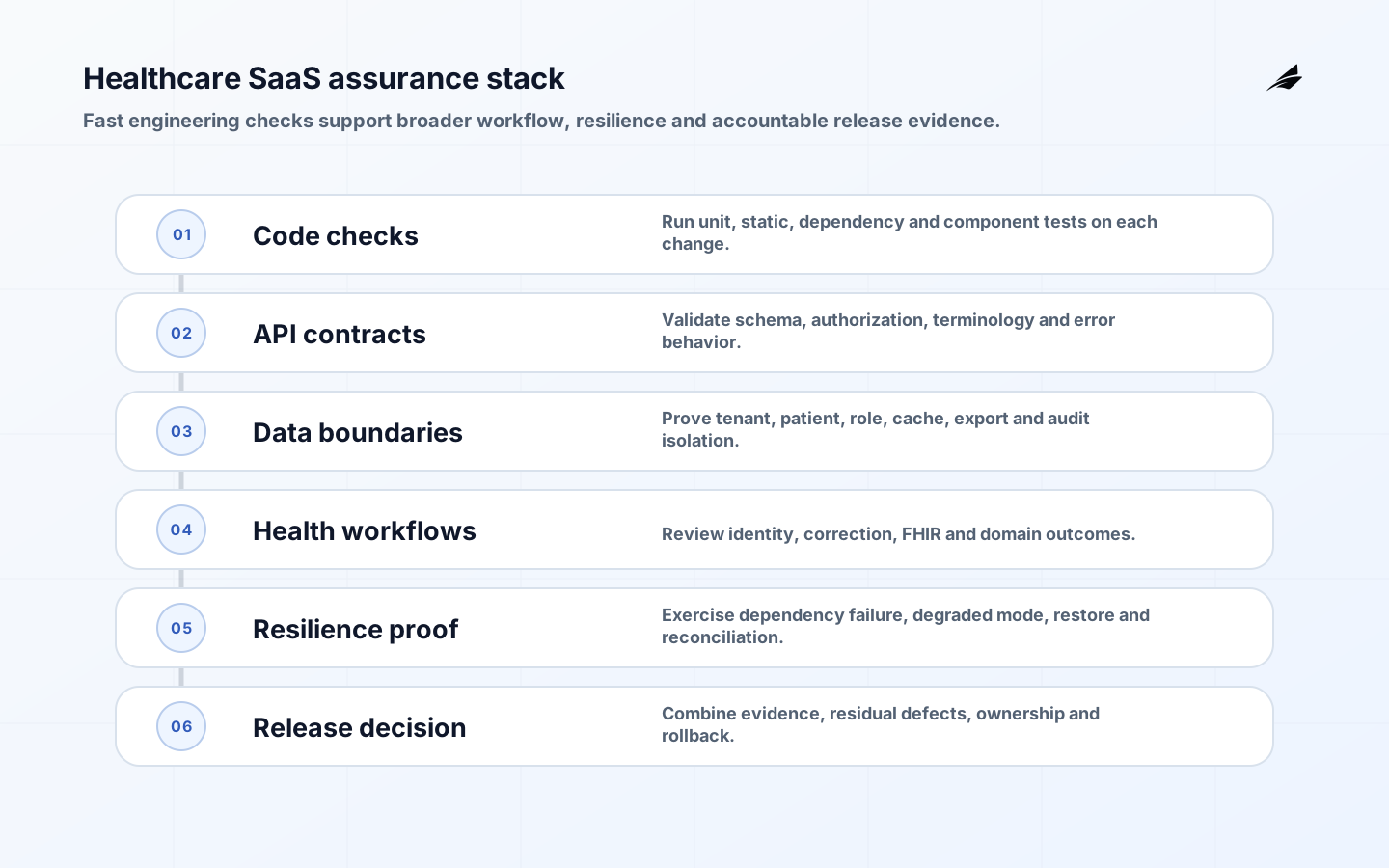
This QA automation for healthcare SaaS implementation checklist focuses on decision evidence across patient, clinician, administrative and integration workflows without turning production health data into test fixtures. The test strategy must reflect consequence: a cosmetic preference failure is not equivalent to a mismatched patient identity, missing allergy, incorrect authorization or delayed result. Automation should cover deterministic, repeatable checks while preserving human review for clinical usability, policy interpretation, accessibility and novel risk.
The HIPAA Security Rule currently in effect requires regulated entities to use appropriate administrative, physical and technical safeguards for electronic protected health information. HHS has proposed changes, but its official page states the current rule remains in effect during rulemaking. A SaaS provider must determine with qualified counsel whether it is a business associate and what agreements and obligations apply. Testing supports assurance; it does not itself certify HIPAA compliance or the safety of a clinical use.
Create a risk model from healthcare work and data
Map user roles, care and administrative decisions, data flows, external organizations, devices, jobs and downtime paths. Identify harm from wrong patient, wrong record, delayed information, unauthorized disclosure, incorrect calculation and unavailable service. Add privacy, billing, operational and regulatory consequence. Give each capability an owner and test depth based on severity, likelihood, detectability and reversibility. Do not label every feature critical; prioritization must remain credible.
Write scenarios in domain language. A useful test may state that a clinician opening a result for patient A cannot receive patient B’s cached data, or that a corrected encounter propagates through an interface without duplicating billing. Include concurrency, amendment, merge, consent, proxy access, break-glass and deletion or retention constraints. Review scenarios with healthcare subject-matter experts. Automation engineers should not invent clinical truth from database fields.
| Risk area | Representative automated evidence | Human or domain review |
|---|---|---|
| Patient identity | Tenant and patient boundary tests | Workflow for ambiguous matches and merges |
| Authorization | Role, relationship and purpose test matrix | Policy and minimum-necessary interpretation |
| Interoperability | FHIR conformance and semantic assertions | Clinical meaning and partner workflow |
| Data integrity | Round-trip, ordering and reconciliation tests | Acceptable correction and provenance |
| Resilience | Dependency fault and recovery tests | Downtime usability and operational safety |
Use safe, representative and traceable test data
Prefer synthetic data designed to exercise realistic relationships and edge cases. Removing names from copied production data may not make it safe; health records can remain identifiable through combinations and free text. If production-derived data is justified, apply approved de-identification, access, environment, retention and deletion controls and obtain privacy review. Keep secrets and ePHI out of test logs, screenshots, videos, defect systems and third-party observability.
Build deterministic data factories for patients, practitioners, organizations, coverage, encounters, observations and permissions. Version fixtures with the tests and label expected provenance. Include multilingual names, address formats, time zones, units, absent data and historical corrections. Reset or isolate state so parallel tests do not alter each other. Monitor synthetic-data coverage against real schema and workflow change without importing real records.
Automate tenant, identity and ePHI security checks
Test isolation at API, query, cache, file, search, analytics, export, backup and support-tool boundaries. Create adversarial tests that substitute tenant and patient identifiers, reuse stale tokens and request bulk resources. Verify authorization on the server for every object and action. Include delegated, proxy, emergency and service accounts. Test account provisioning, role change, revocation and session invalidation. Avoid tests that prove only that a menu item is hidden.
Use OWASP ASVS and the NIST Secure Software Development Framework as structured inputs for application and development assurance, tailored to the system’s risk. Automate dependency, secret and infrastructure checks in the delivery path. Validate encryption and key configuration without exposing key material. Confirm audit events for access and consequential change contain actor, subject, action, time and outcome and are protected from unauthorized alteration. Test that audit failure is visible.
Test FHIR and partner integrations beyond schema validity
FHIR conformance testing should validate resource profiles, cardinality, terminology, search, authorization and error behavior for the supported implementation. ASTP/ONC’s Inferno includes standardized API tests for relevant certification criteria; use the applicable official suite where certification is in scope, while adding product-specific workflow tests. Passing a conformance test does not prove that the correct patient, code, unit, provenance or business event reaches the receiving workflow.
Test duplicates, retries, out-of-order messages, partial failure, corrections, deletions, paging, rate limits and partner downtime. Record source IDs and idempotency keys. Reconcile counts and clinically important values across the boundary. Contract tests should run in CI against controlled endpoints; production-like end-to-end tests should run at release gates with approved data. Maintain partner simulators, but periodically validate them against current partner behavior and published versions.
| Pipeline layer | Fast checks | Release-gate checks | Production assurance |
|---|---|---|---|
| Code | Unit, static and component tests | Threat and domain review | Defect and incident feedback |
| API/data | Contract, schema and authorization | Representative end-to-end reconciliation | Interface errors and drift |
| UI/workflow | Component and accessibility checks | Role-based task and usability review | Support and completion evidence |
| Platform | Policy and configuration tests | Failure, backup and restore exercise | SLOs, capacity and security signals |
| Migration | Transformation assertions | Rehearsed cutover and rollback | Post-cutover reconciliation |
Exercise resilience, recovery and safe degradation
Inject failure in identity, FHIR partners, queues, databases, storage, notification and third-party services. Verify timeout, retry, circuit breaking and idempotency without message storms or duplicate clinical action. Define which functions stop, degrade or become read-only. Test user-visible status and support escalation. A technically available screen that displays stale or incomplete information can be unsafe; freshness and provenance should be apparent where decisions depend on them.
Restore backups into an isolated environment and validate record counts, relationships, audit history and key workflows. Measure recovery time and data loss against business needs. Reconcile transactions that occurred during downtime and verify interfaces resume without duplication. Exercise ransomware and credential-compromise assumptions with security and operations. HHS guidance requires contingency planning within the Security Rule; each regulated entity must determine appropriate safeguards based on its risk analysis.
Build a risk-tiered automation pipeline
Run fast deterministic checks on each change and broader contract, security and workflow suites on appropriate gates. Avoid one enormous end-to-end suite that is slow and flaky. Quarantine is temporary and owned; a permanently skipped high-risk test is an accepted risk and should be visible. Record artifact, environment, data set and result so release evidence is reproducible. Require independent review for changes to safety- or privacy-critical rules and to the tests that assert them.

Use production-like environments without uncontrolled ePHI. Keep configuration and infrastructure differences explicit. Test migration and rollback with representative volume. A release decision should consider failed tests, unresolved defects, security findings, accessibility, performance, recovery and operational readiness. Automate evidence collection, but preserve accountable approval. The objective is a defensible decision, not a green dashboard produced by muting unstable checks.
Measure escaped risk and improve the suite
Track defects by consequence and discovery stage, flaky-test rate, suite duration, high-risk workflow coverage, authorization matrix coverage, interface reconciliation, recovery results and production incidents that should have been caught. Test counts and code coverage are weak outcome measures alone. Review every material defect for the missing model, data, environment or assertion and add the smallest durable control that would have detected it.
Maintain ownership across product, clinical or domain experts, privacy, security, engineering, QA and operations. Review the risk model when workflows, regulations, integrations or patient populations change. Periodically test the test system: confirm alerts, evidence retention, test-data deletion and access. Retire obsolete tests and consolidate duplicates so signal remains trustworthy. A healthy automation program makes safe change faster; it does not merely make the suite larger.
Validate the automation program itself
Select known defects and confirm the intended layers detect them: cross-tenant object access, stale clinical data, duplicate interface delivery, wrong unit, missing audit event and failed restore. Seed faults safely in controlled environments and inspect whether alerts and release gates provide an understandable diagnosis. A test that fails for incidental timing rather than the seeded risk is not strong evidence. Review false passes as seriously as flaky failures because they create misplaced confidence.
Audit test code, fixtures, runner identities and third-party services. Runners often receive broad database, cloud and deployment access; isolate them, use short-lived credentials and prevent untrusted changes from reaching protected environments. Keep test results and screenshots within approved data boundaries. Establish retention and deletion. Exercise continuity for the test platform so an unavailable vendor does not force the organization to release without its high-risk checks.
Create a cross-functional quality ownership model
Engineering owns implementation quality, but domain, privacy, security, operations and product owners contribute different acceptance judgments. Name who approves clinical or administrative rules, who accepts residual risk and who can stop release. Keep a shared quality backlog that connects escaped defects to platform and process improvements. Dedicated QA expertise is valuable; making one QA team solely accountable for quality encourages late handoffs and leaves architecture decisions untested.
Key takeaways
- Prioritize tests by patient, privacy, operational and financial consequence.
- Use synthetic, representative data and keep ePHI out of test artifacts.
- Test authorization and tenant isolation at every data boundary.
- Validate FHIR semantics, retries and reconciliation beyond schema conformance.
- Include degraded operation, restore and post-recovery reconciliation in release evidence.
Frequently asked questions
Does test automation make a healthcare SaaS product HIPAA compliant?
No. Compliance depends on the regulated entity’s applicable administrative, physical and technical safeguards, agreements, risk analysis and operations. Testing provides evidence about selected controls and behavior. Obtain qualified legal and compliance advice.
Can production health data be copied into a test environment?
Do not assume so. Prefer synthetic data. Any production-derived use requires a documented necessity and approved privacy, security, access, de-identification, retention and deletion controls appropriate to the organization and law.
Is passing an official FHIR test suite sufficient?
No. It can prove defined conformance requirements. Product-specific authorization, clinical semantics, partner workflows, performance, failure and reconciliation still need testing. Use the official suite when applicable and add risk-based assurance.
Conclusion
Healthcare SaaS quality automation is effective when it helps a team release with explicit evidence about patient identity, authorization, data integrity, interoperability and recovery. Build from real healthcare decisions, use safe data, keep tests traceable to risks and review what automation cannot judge. The strongest suite is not the one with the most cases; it is the one that makes consequential failure less likely and easier to detect and repair.