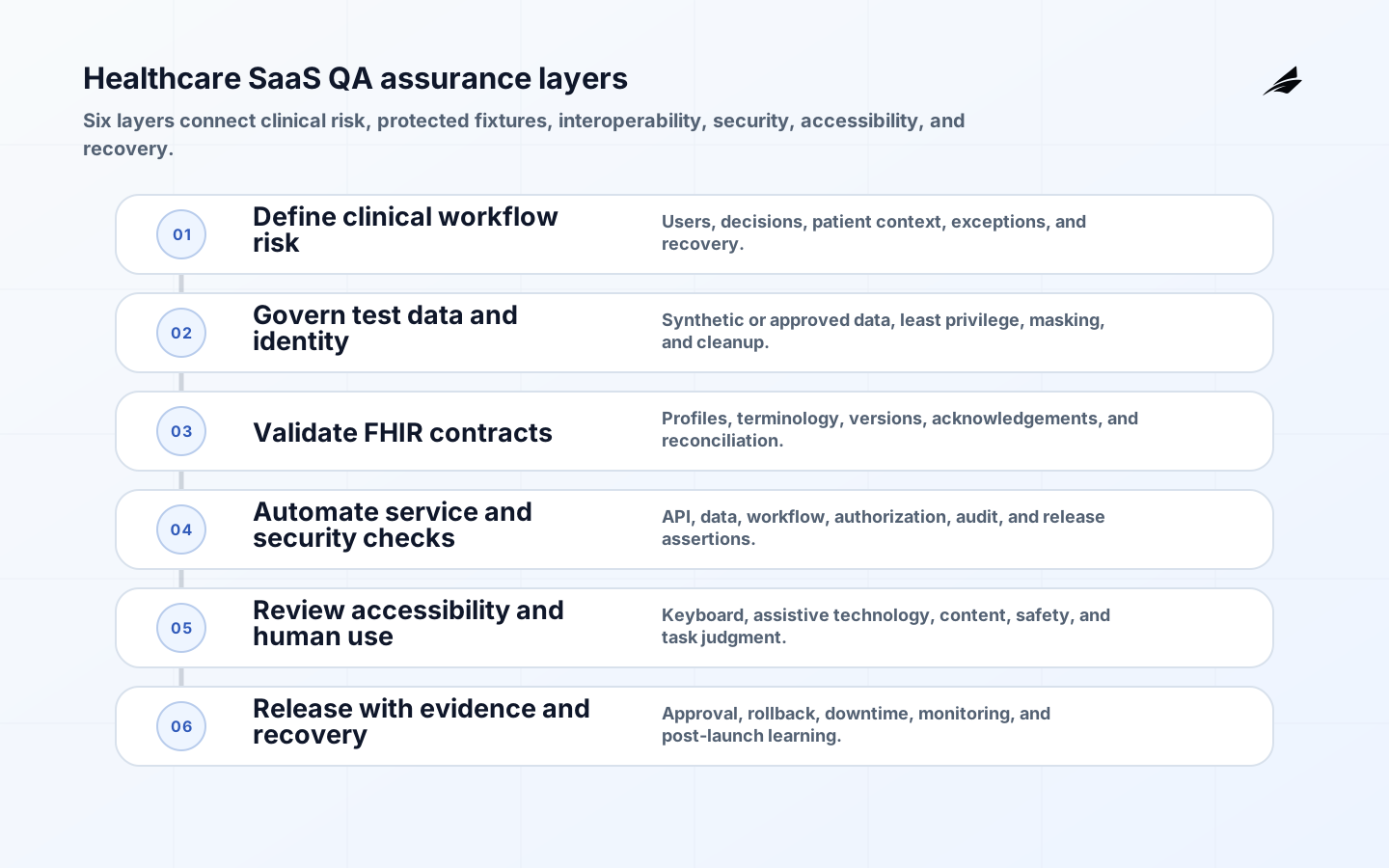
Healthcare SaaS quality cannot be represented by a large count of automated UI tests. A defect may misassociate a patient, expose electronic protected health information, reject a valid FHIR resource, or leave clinicians with stale status while every button still works. QA automation for healthcare SaaS should be risk-based: automate repeatable evidence at API, data, security, interoperability, and workflow layers, then involve qualified people where clinical meaning, accessibility, and usability require judgment.
HHS describes the HIPAA Security Rule as requiring appropriate administrative, physical, and technical safeguards for the confidentiality, integrity, and availability of ePHI. That is a risk and responsibility context, not a claim that a test suite makes a product compliant. This FAQ pairs the risk-based healthcare SaaS testing guide with practical questions about coverage, fixtures, conformance, release evidence, and post-launch ownership.
Define the service boundary and clinical risk
Start by naming the product’s users, data flows, decisions, integrations, and failure consequences. A scheduling service, clinical documentation tool, patient portal, and analytics workspace do not share the same risk profile. Record who initiates an action, which system owns each fact, who may approve it, what makes it irreversible, and how staff recover during a partner outage or downtime period. This boundary prevents a generic automation program from hiding the cases that matter most.
Translate the boundary into traceable test objectives. A referral journey might require patient matching, authorization, required clinical data, FHIR profile and terminology versions, acknowledgement states, audit events, duplicate handling, and safe correction. A result that is technically valid but associated with the wrong patient is a critical failure. The healthcare SaaS implementation checklist can support delivery sequencing; this article focuses on the evidence that should survive each release.
| Risk area | Test question | Evidence | Decision owner |
|---|---|---|---|
| Clinical workflow | Does the right role see and complete the right state transition? | Positive, exception, reversal, timeout, and downtime scenarios | Clinical or product owner |
| Patient identity | Can records be matched, corrected, and kept separate? | Synthetic identity variants, duplicate cases, and reconciliation results | Data and safety owner |
| Interoperability | Does each partner receive and acknowledge the expected contract? | Profile, terminology, version, error, retry, and contract tests | Integration owner |
| Security and privacy | Are access, disclosure, audit, and recovery boundaries enforced? | Authorization matrix, audit events, incident response, and restore test | Security and compliance owner |
| Experience | Can intended users complete the work safely and accessibly? | Keyboard, assistive technology, content, error, and human workflow review | UX and operations owner |
Protect test data, identities, and environments
Use governed synthetic data or data de-identified through an approved process. Treat test data as a lifecycle: create fixtures, restrict access, isolate environments, rotate credentials, capture only necessary logs, reset state, and securely dispose of extracts. Do not assume that masking a name removes risk when dates, rare conditions, identifiers, free text, images, or combinations of fields can re-identify a person. Test data should exercise realistic edge cases without becoming an uncontrolled copy of production.
HHS cloud guidance says a cloud service provider that creates, receives, maintains, or transmits ePHI for a covered entity or business associate may be a business associate and that a business associate agreement does not replace risk analysis. Make the data boundary explicit for test vendors, hosted runners, observability tools, screenshots, support tickets, backups, and temporary exports. Use separate test identities with least privilege and make every privileged action attributable.
| Fixture strategy | Appropriate use | Control to verify |
|---|---|---|
| Synthetic patient and encounter data | Workflow, validation, load, and negative-path automation | Generated provenance, stable identifiers, reset, and no production linkage |
| Approved de-identified data | Distribution and edge-case realism that synthetic data cannot reproduce | Method, access approval, re-identification review, and retention limit |
| Partner sandbox data | Interoperability and acknowledgement behavior | Sandbox terms, data minimization, credentials, and cleanup |
| Production observation | Read-only monitoring or carefully approved verification | No mutation, least privilege, masking, audit, and incident owner |
Test interoperability as a contract, not a happy-path payload
FHIR is a standard for healthcare data exchange, but a product does not become interoperable by serializing a resource-shaped JSON object. Test the chosen FHIR release, profiles, extensions, cardinality, terminology bindings, references, search behavior, provenance, consent constraints, and error responses. Include incomplete, duplicated, out-of-order, corrected, and rejected messages. The contract must say which system is authoritative and what a consumer should do when an acknowledgement is delayed.

Use official conformance tools where the product and certification context makes them applicable, then add organization-specific workflow and safety assertions. ONC’s test-tool guidance includes Inferno and FHIR-related certification bases, but passing a conformance suite does not prove every local workflow or partner implementation. Record the test version, profile and terminology package, partner configuration, result, and known exception. Pin versions deliberately and rehearse upgrades before they become forced changes.
Automate the right test layers for repeatable evidence
Automation is strongest where inputs, expected states, and failure boundaries can be made explicit. Keep fast checks close to the code and contract, then reserve slower integrated journeys for high-risk paths. A test that fails because a label moved is less valuable than one that catches an unauthorized export, wrong patient association, missing audit event, invalid FHIR profile, or unreconciled retry.
- Unit and component tests verify validation, transformations, calculations, permissions, and state rules.
- API and contract tests verify schemas, status, error semantics, idempotency, authentication, and version compatibility.
- Workflow tests verify roles, approvals, patient context, reversals, queues, notifications, and reconciliation.
- Data tests verify tenant or organization boundaries, provenance, masking, retention, and restore behavior.
- Security tests verify access decisions, session controls, audit coverage, secret handling, and common abuse paths.
- A focused browser suite verifies critical interaction and accessibility states without carrying the whole regression burden.
Make security, privacy, and accessibility executable
Use a role-and-resource matrix that reflects real organizations, break-glass behavior, delegated access, support roles, service accounts, and terminated users. Assert both allow and deny outcomes, including what an unauthorized user can infer from errors, search results, exports, caches, notifications, and logs. Verify that security events are attributable, time-synchronized, retained according to policy, and available to incident responders. NIST’s SSDF provides a useful vocabulary for integrating secure practices into the development lifecycle and supplier conversations.
Automated accessibility checks catch useful classes of defects but cannot judge every clinical or operational interaction. WCAG 2.2 uses testable success criteria and recommends applying automation with human evaluation. Test keyboard order, focus, status messages, zoom and reflow, contrast, labels, error recovery, timeouts, authentication, and screen-reader announcements. Include real users or trained reviewers for high-impact workflows; accessibility evidence should be tied to a task, not just a tool score.
Release with evidence, approvals, and recovery
A release gate should state which risks were tested, which were not, the evidence version, open defects, accepted exceptions, and the owner who can approve deployment. Keep the evidence close to the build or change record: code revision, test data version, environment, profile and terminology versions, dependency versions, automation result, human review, and approval. A green pipeline is one input; it is not a substitute for clinical, security, operational, or contractual judgment.
Exercise rollback and degraded operation, not only forward deployment. Test a failed migration, delayed integration, duplicate message, unavailable identity provider, stale cache, failed backup restore, and partial release. Define whether work is queued, rejected, held for review, or safely retried. Retain the original business event and correlation identifier so support can reconcile the outcome without asking a user to repeat a clinical action.
| Release gate | Minimum evidence | If it fails | Approver |
|---|---|---|---|
| Workflow safety | Critical paths, exceptions, reversals, and human review complete | Hold release or narrow the workflow until risk is resolved | Clinical or product owner |
| Data protection | Fixture controls, authorization, audit, export, backup, and restore checks | Contain access and remediate before processing sensitive data | Security owner |
| Interoperability | Profile, terminology, version, partner, error, retry, and acknowledgement results | Keep the old contract or route the case for manual reconciliation | Integration owner |
| Accessibility | Automated checks plus keyboard, assistive technology, and human review | Fix blocking barriers or document a time-bound exception | UX and product owner |
| Recovery | Rollback, downtime, queue drain, incident, and support runbook evidence | Do not expand exposure until recovery is rehearsed | Operations owner |
Operate coverage after go-live
Coverage decays when workflows, partners, profiles, terminology, browsers, cloud services, and permissions change. Review failed tests by risk rather than treating every failure as equal. Monitor production signals for unauthorized access attempts, rejected or delayed messages, queue age, data-quality drift, accessibility feedback, incident recurrence, and support workarounds. Convert meaningful incidents into fixtures and assertions so the test suite learns from actual operations.
Set review triggers: a new integration, data class, user role, FHIR release, terminology package, authentication path, hosting service, retention rule, or clinical workflow should reopen the risk analysis. The application managed services transition checklist can help formalize ownership after handoff, while the Cloud DevOps services checklist is useful for deployment and operational controls. Keep healthcare-specific decisions with healthcare owners.
Key takeaways
- Rank automation by clinical, privacy, interoperability, security, accessibility, and operational risk.
- Use governed synthetic or approved de-identified data with controlled identities and cleanup.
- Test FHIR profiles, terminology, versions, acknowledgements, errors, retries, and reconciliation.
- Keep fast contract checks, integrated workflows, security assertions, and human review connected.
- Treat accessibility as task evidence that combines automation with keyboard, assistive technology, and people.
- Gate releases on recovery, ownership, open risk, and evidence version, not only pipeline status.
Frequently asked questions
Does test automation make a healthcare SaaS product HIPAA compliant?
No. Automation can produce evidence for safeguards and risk decisions, but compliance depends on the applicable organization, contracts, policies, technical and physical controls, workforce practices, incident handling, and ongoing risk analysis. A test suite should state its coverage and limitations.
Should healthcare QA use production data?
Prefer governed synthetic data. Use approved de-identified or tightly controlled production observation only when the risk, purpose, access, retention, masking, and disposal controls are explicit. Test vendors, logs, screenshots, backups, and hosted runners belong in the same data-boundary review.
Is a FHIR conformance test enough?
No. Conformance evidence should be combined with the product’s chosen release, profiles, terminology, partner behavior, workflow rules, error handling, audit, security, and reconciliation tests. A valid resource can still be wrong for a local clinical or operational process.
How much accessibility testing should be automated?
Automate repeatable checks for structure, names, contrast, focus, keyboard reachability, and status where tools can assess them. Add manual keyboard, assistive-technology, zoom, reflow, content, and workflow review for critical tasks. Automation should reduce repetition, not remove human evaluation.
What should be measured after launch?
Track critical-journey success, escaped defects by risk, rejected and delayed integrations, reconciliation age, authorization failures, audit coverage, restore results, accessibility feedback, flaky-test rate, and time to resolve a failed gate. Review whether the measures change safer release or operating decisions.
Conclusion
Reliable QA automation for healthcare SaaS connects test layers to real patient, clinician, privacy, interoperability, accessibility, and operational consequences. Protect the fixtures, model the boundary, validate the contract, automate repeatable evidence, keep human judgment where it belongs, and rehearse recovery. The result is a quality program that can explain what was tested, what remains uncertain, and who owns the next decision.