QA automation for healthcare SaaS is valuable when it protects a named patient, clinician, operations or privacy outcome. A large UI test count can still miss a patient-matching error, a stale clinical status, a cross-tenant read, a rejected FHIR resource or an unrecoverable queue. The right approach is risk-based: automate repeatable checks at data, API, security, interoperability and workflow layers, then involve qualified people where clinical meaning, usability and policy judgment matter. Pair this guide with the healthcare SaaS QA implementation checklist, healthcare SaaS QA FAQ and healthcare workflow automation checklist for adjacent delivery decisions.
The HHS HIPAA Security Rule summary describes administrative, physical and technical safeguards and treats risk analysis as foundational. ONC publishes current standards and conformance resources, while HL7 FHIR defines resources, APIs and conformance concepts rather than a complete clinical workflow. The practical implication is important: a passing automation suite is evidence about the tested boundary, not a blanket claim about compliance, safety or every customer configuration.
Begin with the service boundary, data authority, user roles, irreversible actions and recovery path. Record which system owns each fact, which identity may change it, how a correction propagates and what a user sees when a dependency is late. Synthetic fixtures should include ordinary cases and uncomfortable ones: missing identifiers, similar patients, invalid codes, consent restrictions, duplicate events, delayed acknowledgements and a revoked credential.
Define the healthcare workflow and risk boundary
Classify journeys by consequence before selecting a framework. Patient matching, medication or referral routing, clinical documentation, eligibility, prior authorization, billing and support administration may share a screen but not a risk profile. For each journey, name the initiating role, authoritative record, required context, allowed side effect, reviewer, service clock and safe fallback. Include exception and correction paths in the acceptance criteria so the suite does not encode a polished happy path while operators rely on private workarounds.
| Risk area | Example failure | First automated assertion | Human review needed |
|---|---|---|---|
| Patient identity | A message is attached to the wrong patient | Matching rejects ambiguity and preserves an auditable reason | Domain review of matching policy and edge cases |
| Clinical state | A delayed or corrected result appears current | Freshness, status and correction rules are enforced | Workflow review of clinical meaning and escalation |
| Privacy and access | A user sees another tenant or role's information | Server-side authorization denies each invalid context | Privacy and security review of role design |
| Interoperability | A valid partner resource is rejected or misinterpreted | Profile, terminology and response contract tests pass | Partner and implementation-guide review |
| Availability and recovery | A queue or dependency failure loses a business effect | Retry, idempotency, reconciliation and restore are verified | Operations rehearsal and incident decision |
Pin FHIR, API and terminology contracts
Healthcare SaaS testing must pin the exact FHIR release, implementation guide, profiles, terminology bindings, authentication flow, supported operations and error semantics. ONC's Standards Bulletin provides current health IT standards context, while the FHIR specification defines resources, capabilities, profiles and APIs. Do not test against an unqualified phrase such as “FHIR compliant.” Record the version and package used by the service, the partner and the test fixture.
Build contract tests for valid and invalid resources, required fields, cardinality, terminology, references, pagination, search, conditional operations, version negotiation and response codes. Include authorization scopes and the behavior of an unknown or retired code. If the service transforms a resource, compare the clinically relevant meaning rather than only JSON shape. Test a rejected message, a late correction and a duplicate retry through the complete workflow so conformance does not become detached from business effect.
| Contract layer | What to pin | Useful evidence |
|---|---|---|
| FHIR release | Release, package, profile and supported capability statement | Versioned fixture and capability comparison |
| Terminology | Code systems, value sets, bindings and retired-code behavior | Valid, invalid and unmapped-code results |
| API behavior | Authentication, scopes, operations, pagination and status codes | Contract tests plus denied and malformed requests |
| Workflow state | Acknowledgement, correction, retry, duplicate and reconciliation rules | End-to-end state trace and business assertion |
| Partner boundary | Implementation guide version, timing and dependency failure behavior | Partner sandbox result and recovery runbook |
Design the automation layers around risk
Use the lowest reliable layer for each assertion. Unit tests can protect parsing, policy and transformation logic. API and contract tests can exercise identity, FHIR profiles, terminology and error semantics. Data tests can verify tenant scoping, idempotency, audit events and reconciliation. A small browser suite can cover the human decisions that depend on visibility, keyboard behavior, warning text and recoverable errors. End-to-end tests should be few but representative, because they consume environments and are harder to diagnose.

Keep security and accessibility in the same delivery conversation. The NIST Secure Software Development Framework provides practices that can be integrated into a software lifecycle, including protecting code, producing well-secured software and responding to vulnerabilities. In a healthcare workflow, that means testing authorization on the server, protecting test credentials, scanning dependencies, reviewing logs for sensitive data and ensuring that a user can understand and recover from a denied or delayed action.
Protect test data, identity and tenant isolation
Use governed synthetic records by default, with provenance, scenario purpose, retention and cleanup. Fixtures should support realistic relationships and edge cases without copying unnecessary ePHI. If a documented need requires production-derived data, apply approved de-identification or other safeguards, restrict access, record the decision and test that data does not leak into logs, screenshots, traces or failure reports. HHS explains that the Security Rule is technology neutral and risk-based; a test environment still needs an appropriate security decision, not an assumption that it is harmless.
Treat tenant identity and patient identity as separate but correlated contexts. Verify that a user, service account, integration, organization and patient reference are authorized for the exact operation. Probe direct-object references, filtered searches, exports, background jobs, caches and support tools. Exercise account suspension, role change, expired session, revoked credential and cross-tenant access from both the UI and the API. A hidden field or disabled button is not an authorization control.
| Control surface | Negative case | Evidence to retain |
|---|---|---|
| Identity | Expired, mismatched, revoked or over-privileged identity | Denied response, reason, audit event and alert |
| Tenant boundary | Valid user requests another tenant's object or export | Server-side denial and isolation probe result |
| Test data | Sensitive value reaches logs, traces, screenshots or fixtures | Scan result, remediation and retention record |
| Cloud dependency | Provider or integration becomes unavailable | BAA or contract context, fallback and recovery evidence |
| Auditability | A state change cannot be attributed or reconstructed | Actor, time, object, rule version and correlation trace |
Exercise exceptions, recovery and human handoffs
A representative rehearsal follows one case from intake to final evidence while the team interrupts each transition. Ask which record is authoritative, whether the acting identity is allowed, whether the rule is current, whether a retry creates a duplicate effect and what the user should do next. Repeat the case with a missing field, delayed dependency, unavailable reviewer, rejected code and corrected patient reference. This exposes assumptions that isolated unit tests and polished demonstrations often miss.
Test restoration and reconciliation, not only service restart. Create a referral or result for two similar patients, delay the downstream acknowledgement, expire the clinician session, revoke an integration credential and submit an unsupported code. The system should preserve identity, reject invalid state, log the relevant event, present an honest status and offer a recoverable path. Restore the affected tenant from a known backup, replay safely and compare the business record with the integration record. Retain elapsed time, manual workarounds and unresolved questions.
Measure evidence, consequence and correction
A useful dashboard connects technical behavior to the intended operating result. Track risk-weighted requirements with automated evidence, escaped defects by patient, privacy, interoperability and operational consequence, FHIR contract failures, authorization denials, cross-tenant probes, flake rate, time to detect and time to verify a correction. Segment by workflow and release rather than hiding poor tails inside a global pass rate. Review samples of accepted, corrected, escalated and failed cases so a favorable average cannot conceal an unsafe edge case.
Keep traceability from requirement to fixture, test, result, defect, decision and approver. Record the exact build, environment, data package, FHIR and terminology versions, identity matrix and unresolved deviation. ONC's conformance test tools can support standards testing, including Inferno resources, but an ONC-oriented test result does not replace customer workflow, privacy, security or operational evidence.
Deliver automation as an evidence-bearing program
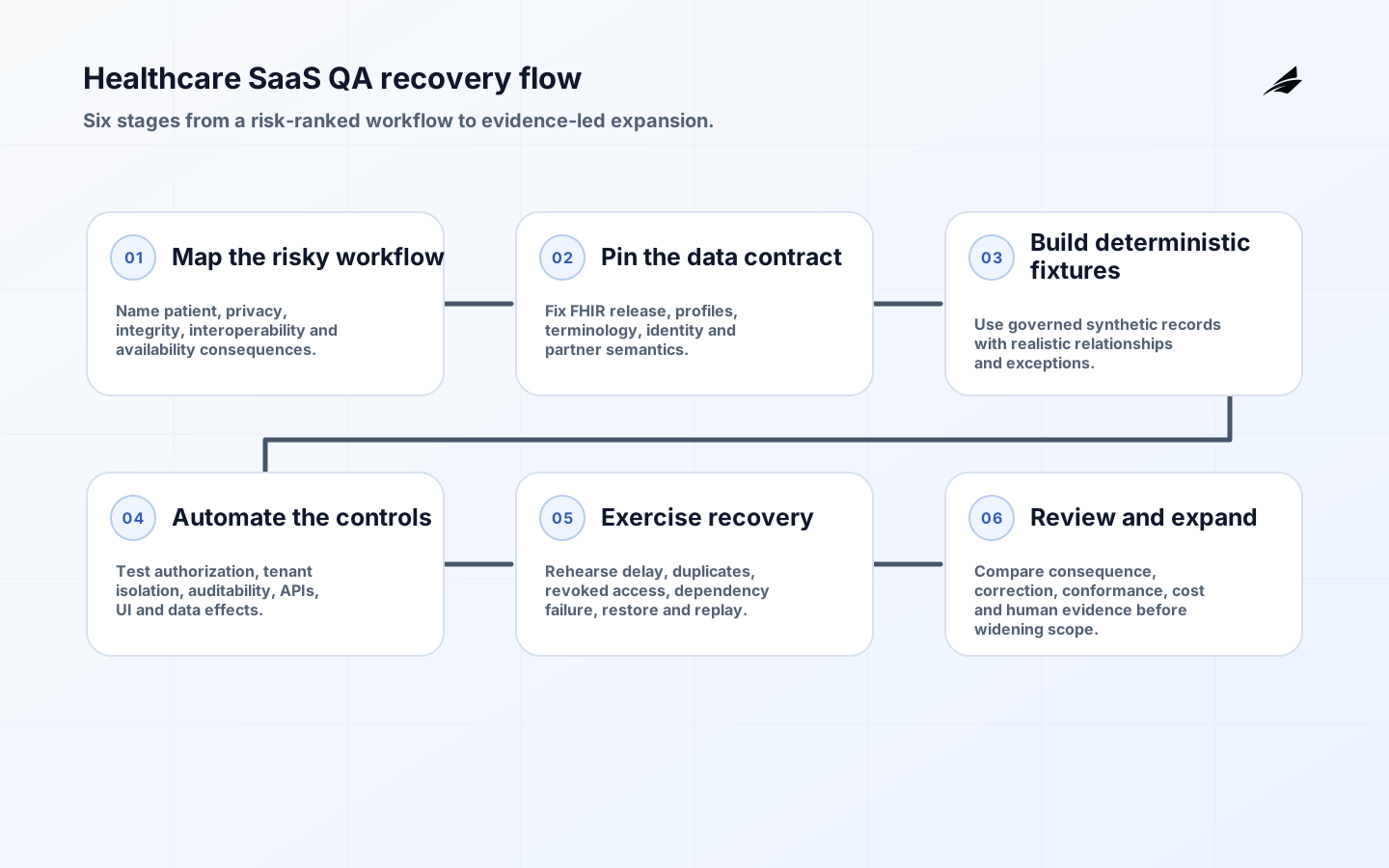
Budget for representative environments, synthetic-data engineering, interface simulators, security testing, clinical or operational review, observability and maintenance of the suite. Express the timeline as evidence-bearing stages: discovery and risk mapping, a thin vertical slice, controlled pilot, recovery rehearsal and measured expansion. Procurement should require documentation, source or configuration access appropriate to the arrangement, data export, incident support, test-environment separation and transition assistance. A large platform purchase before the service boundary is clear lets product features define the workflow instead of the other way around.
- Choose one consequential workflow, its owner, authoritative records and explicit exclusions.
- Pin FHIR, API, terminology, identity and tenant contracts with representative synthetic fixtures.
- Automate data, API, authorization, conformance and recovery assertions before expanding browser coverage.
- Run a controlled pilot with ordinary cases, realistic exceptions and qualified workflow review.
- Measure escaped consequence, correction speed, reliability, cost and human workload, not only test count.
- Expand the suite and customer cohort only when the release is supportable, observable and recoverable.
Practical takeaways
- Anchor QA automation for healthcare SaaS to a named workflow, outcome and accountable owner.
- Risk-rank journeys by patient, privacy, integrity, interoperability and operational consequence.
- Pin exact FHIR, implementation-guide, terminology and API versions instead of testing an undefined standard.
- Use governed synthetic data and test server-side tenant isolation, authorization and auditability.
- Automate deterministic evidence while preserving qualified human review for clinical meaning and policy decisions.
- Exercise delayed delivery, duplicates, revoked access, restore and reconciliation before expansion.
- Measure escaped harm and correction speed alongside conformance, reliability and suite stability.
Frequently asked questions
What should QA automation cover first in healthcare SaaS?
Start with risk-ranked clinical and administrative journeys, data integrity, authorization, tenant isolation, FHIR contracts and recovery. A thin end-to-end path with realistic exceptions provides more useful evidence than a broad suite of low-consequence screen checks.
Does a passing FHIR test prove interoperability?
No. It proves only the tested release, profile, terminology, operation and fixture under the stated conditions. Interoperability also needs workflow, authorization, timing, negative-path, partner and correction testing, with a clear interpretation of the data exchanged.
Can production ePHI be copied into a test environment?
Do not treat copying as the default. Use governed synthetic records. If a documented need exists for production-derived data, apply approved safeguards, minimize the fields, restrict access, define retention and deletion, and record the accountable risk decision.
How should a healthcare SaaS team measure automation quality?
Combine risk-weighted requirement evidence, escaped defects, FHIR and terminology failures, authorization and isolation probes, flake rate, recovery time, correction verification and qualified reviewer assessment. Test count and aggregate pass rate are useful activity signals, not a complete quality measure.
Conclusion
QA automation for healthcare SaaS should create repeatable evidence without pretending that automation replaces clinical, privacy or operational judgment. Define the workflow boundary, pin interoperability contracts, protect identities and test data, exercise failure and recovery, and retain traceability from requirement to decision. When each result has a named owner, version, environment and consequence, the suite can accelerate delivery while respecting the integrity, confidentiality and availability demands of healthcare.