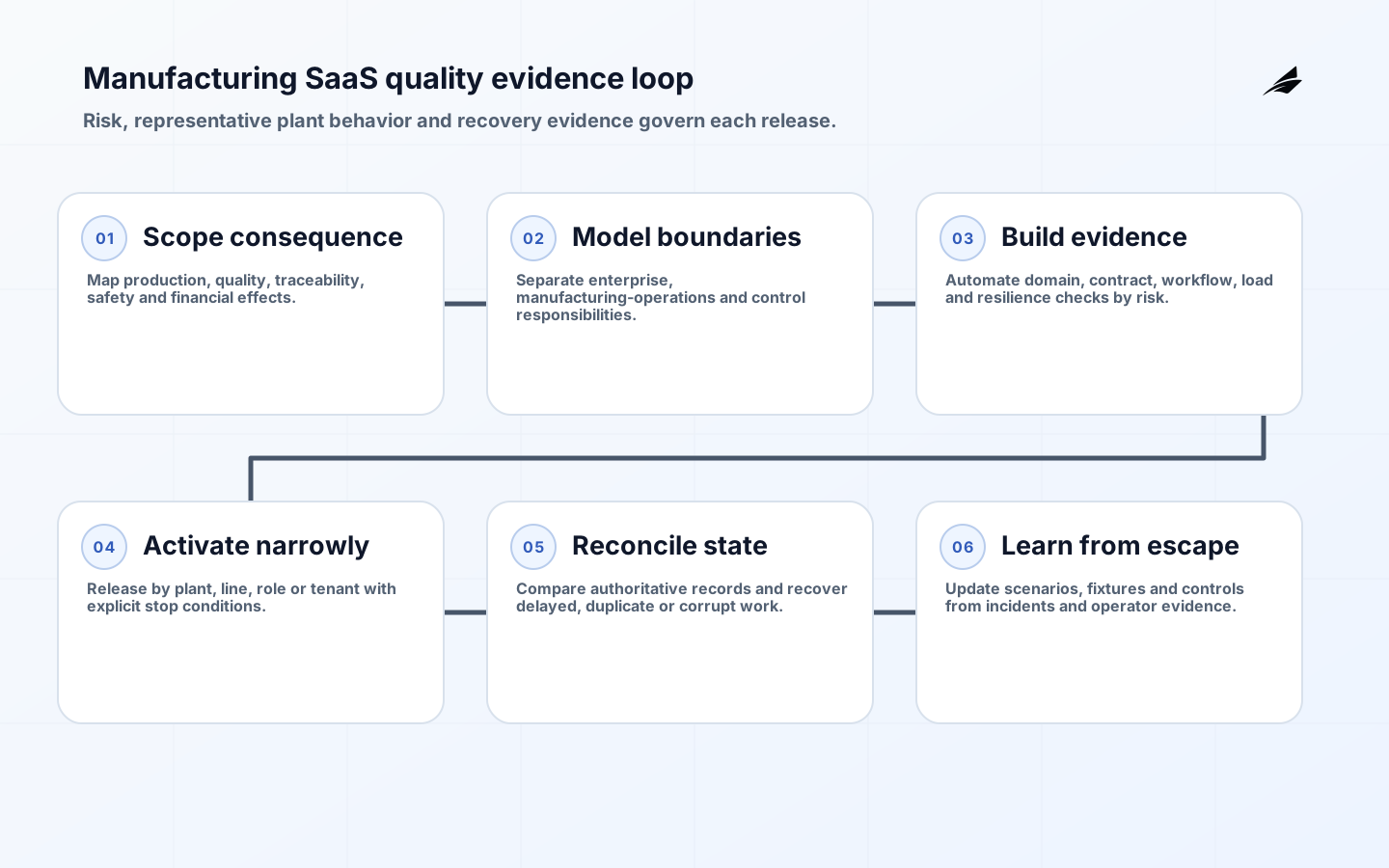
QA automation for manufacturing SaaS must prove that software supports production without creating unsafe, inaccurate or unrecoverable behavior. A passing browser test is insufficient when a change can alter a work order, genealogy record, quality disposition, machine instruction or inventory movement. The strategy should connect each automated check to a business risk, an interface contract and evidence manufacturing owners can understand.
This guide is for manufacturing leaders, product owners and engineers preparing SaaS connected to ERP, MES, quality, maintenance or plant systems. It treats automation as one part of software assurance: scripted checks where repetition creates confidence, exploratory work where judgment matters, and production controls where no laboratory reproduces the full plant. The objective is faster change with evidence, not a larger test count.
Define the production and quality assurance scope
Map workflows that affect production, quality, traceability, safety, shipment and financial records. Name the authoritative system, initiating event, allowed transition and exception owner for each workflow. Distinguish software that recommends an action from software that sends a control instruction. Acceptance evidence should identify the responsible owner, the source record, the expected result and the decision required when the result is missing.
Classify failures by consequence and detectability. A cosmetic label defect differs from duplicated consumption or an unrecorded quality hold. FDA's 2026 computer software assurance guidance supports risk-based confidence for production and quality software, a useful principle even where that guidance is not directly applicable. Test the normal path, boundary conditions and a realistic failure path; a successful demonstration alone does not prove the manufacturing quality service is ready.
| Workflow | Material failure | Evidence |
|---|---|---|
| Order dispatch | Wrong routing, quantity or revision reaches a line | Contract test, order replay and operator confirmation |
| Quality hold | Held material remains available | Authorization and negative state-transition tests |
| Genealogy | Lot or serial relationship is incomplete | Source reconciliation and immutable history |
| Equipment intake | Late, duplicate or mis-scaled values change a decision | Timestamp, unit, deduplication and degraded-mode tests |
Respect enterprise, operations and control boundaries
Use ISA-95 concepts to separate enterprise planning, manufacturing operations and control responsibilities. The separation clarifies what can be simulated and what needs a controlled integration environment. Create adapters around ERP, MES and equipment interfaces so contracts can be tested independently. Keep the definition and its effective date with the implementation so later teams can explain why historical and current behavior differ.
For OPC UA, verify namespaces, data types, engineering units, status codes, timestamps, subscriptions and reconnection—not merely a successful session. Preserve protocol captures or normalized events when they are required to reproduce a defect, while protecting plant information and credentials. Make exceptions visible in the same operating workflow instead of routing them to private spreadsheets or undocumented support messages.
Build a risk-based automation portfolio
Automate deterministic rules, calculations, permissions, transformations, state transitions and interface contracts first. Add end-to-end tests for a limited number of critical production threads. Broad UI suites are expensive and fragile, while domain and contract checks isolate defects closer to the change. Use progressive exposure and explicit stop conditions so the team can learn from production without placing the entire estate at risk.
Retain human exploratory sessions for operator comprehension, unusual recovery choices and physical context. Link each test to the capability and consequence it protects. A thousand low-value passes must not obscure one unresolved genealogy, authorization or quality-release failure. Measure the business completion time and error consequence, not only component uptime or the number of tasks closed.
Test data integrity, timing and correction
Define identifiers, units, timestamps, time zones, rounding and ordering at every boundary. Test late, missing, duplicate and out-of-order events. State whether a message appends, replaces or corrects a record and how downstream consumers learn about the correction. Preserve identifiers, timestamps and version information across handoffs so reconciliation can distinguish delay, duplication and correction.
Reconcile counts and control totals between source and destination for representative periods. Version fixtures with code and configuration. Backfills and reprocessing require separate tests because they can silently rewrite reports, billing or traceability evidence long after the original event. Document the recovery sequence and exercise it with representative state before relying on it during a live incident.
Turn evidence into release and activation gates
Create gates for critical defects, unresolved risk, interface compatibility, migration proof, rollback readiness and named owner approval. State who may accept an exception, the compensating control and its expiry. Do not make every warning blocking, but never normalize a known integrity risk. Apply least privilege to people and services, and record material administrative actions with enough context for later review.

Separate deployment from activation. Enable changes by plant, line, role or tenant, verify telemetry and define stop conditions such as reconciliation variance, queue age, error consequence or operator workaround. Database and configuration changes need forward and recovery plans beyond a code rollback. Review this control when scope, integrations, users or obligations change; a launch-time decision should not become a permanent assumption.
| Gate | Proof | Stop condition |
|---|---|---|
| Contract compatibility | Producer and consumer version matrix | Critical message cannot be processed safely |
| Data integrity | Counts, totals and representative chain reconciliation | Unexplained loss, duplication or correction |
| Operational readiness | Runbook, support path and trained owner | No accountable response for a critical failure |
| Recovery | Restored and reconciled representative state | Infrastructure returns but business state remains inconsistent |
Exercise load, security and recoverability
Test shift changes, planning peaks, batch completion and synchronization after an outage. Measure business completion time and queue age, not only server response. Confirm backpressure protects critical work and retries are bounded and idempotent. Separate a commercial promise from the operational mechanism and evidence that will make the promise dependable.
Apply least privilege to users, services and support identities. NIST OT guidance emphasizes performance, reliability and safety constraints, so coordinate disruptive testing with plant owners. Exercise backup restoration, offline procedures and reconciliation when connectivity returns. Give users a clear degraded state and next action instead of allowing partial data or failed automation to appear complete.
Keep representative environments and evidence reproducible
Maintain a small set of representative plant configurations: a normal site, a constrained or intermittently connected site and variants with meaningful product or regulatory differences. Synthetic data should preserve relationships among materials, equipment, people and orders without exposing production records. Automate repeatable verification where it shortens feedback, while retaining accountable human judgment for consequential ambiguity.
Virtual equipment and service doubles are useful, but acceptance should exercise approved versions of real gateways, scanners, printers and drivers where behavior matters. Record build, configuration, fixture, environment and test-result identifiers so evidence remains reproducible after staff or vendor changes. Version configuration with code and deployment records so a defect can be reproduced, contained and corrected without guesswork.
Operate QA automation as a quality capability
Assign owners for suites, fixtures, environments and release evidence. Track flaky checks separately and repair or remove them; repeated reruns turn assurance into theater. Review escaped defects by missing scenario, false assumption or weak signal, then improve the smallest useful test layer. Define a small set of leading and lagging measures, then remove metrics that have no owner or operating response.
Measure critical-risk coverage, change failure, escaped defect consequence, detection time, restoration time and manual assurance effort. Avoid raw automation percentage as a goal. Revisit the risk map when a new plant, product, integration, regulation or control-system version changes failure consequences. Review the resulting changes with manufacturing and quality owners so test priorities continue to match production consequence.
Use a release acceptance record that production owners can review
For every material release, assemble a compact record containing intended change, affected plants and products, critical-risk tests, interface versions, unresolved defects, migration or configuration evidence, activation scope, stop conditions and recovery result. Link the record to the exact build and deployment rather than copying screenshots into an untraceable document. A reviewer should be able to determine what changed, why the available evidence is sufficient and which residual risk remains after release.
- Name the manufacturing and quality approvers and their decision authority.
- Record critical scenarios that passed, failed or were deliberately deferred.
- Identify plant, line, product, integration and configuration versions in scope.
- State activation cohort, observation window, stop conditions and fallback owner.
- Retain reconciliation and recovery evidence with the release record.
Review acceptance after the observation window, not only before activation. Compare expected and actual queue behavior, operator workarounds, data corrections and support contacts. Close temporary controls or convert them into owned backlog work with dates. This post-release review prevents an exception accepted for one urgent deployment from becoming an invisible permanent operating condition.
Key takeaways
- Start from production and quality consequences, not a tool inventory.
- Separate enterprise, manufacturing-operations and control boundaries.
- Automate deterministic high-risk behavior and preserve human exploration for context.
- Test lineage, identity, degraded operation and recovery with normal workflows.
- Measure escaped risk and recovery rather than raw test volume.
Frequently asked questions
What is a good automation coverage target?
There is no universal percentage. Coverage should demonstrate dependable evidence for critical rules, interfaces, roles, state transitions and recovery paths. Track uncovered high-consequence scenarios and why they remain manual; a lower percentage with strong risk coverage is more useful than a high percentage dominated by simple screens.
Must every release use real plant equipment?
No. Most checks should run against domain code, contracts and controlled simulators. Use representative real equipment or gateways where protocol timing, drivers or physical interaction materially affects confidence. Schedule those tests by risk and preserve approved configurations so they remain repeatable.
Does automated testing replace business validation?
No. Automation provides repeatable evidence. Validation or acceptance also evaluates intended use, risk, configuration, user understanding and operational readiness. Required formality depends on the product and obligations, and named manufacturing and quality owners should approve evidence appropriate to their context.
Conclusion
QA automation for manufacturing SaaS is an operating capability that connects risk, architecture, data and release decisions. Build it around representative production threads, explicit plant boundaries and recoverable state. Use automation where repetition strengthens evidence and accountable review where intent, usability or physical context remains decisive.
Begin with one critical workflow and write its failure consequences, contracts, test layers and stop conditions. Once the team can release that path with traceable evidence and recover it after a realistic failure, extend the same discipline to the next manufacturing capability.