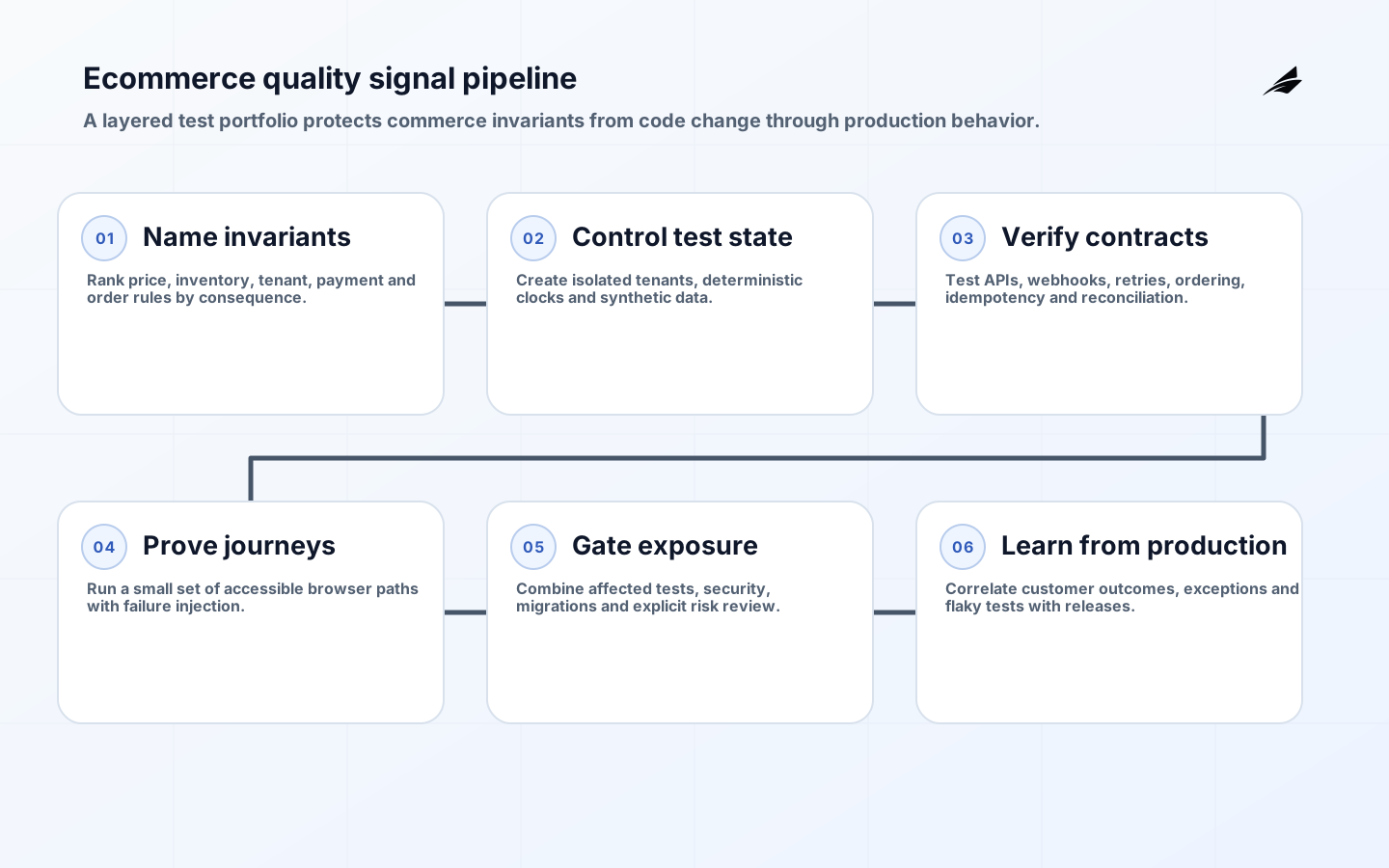
QA automation for SaaS ecommerce must protect business invariants, not only confirm that buttons can be clicked. Catalog, price, promotion, inventory, tax, shipping, identity, payment and order systems change independently. A green browser test can still hide a duplicate charge, stale price, oversold item or inaccessible checkout. The implementation should combine fast component and contract tests with a small set of production-like journeys, failure simulation and observable release criteria.
This checklist is for teams building or operating a multi-tenant commerce product. It complements the practical ecommerce QA guide and ecommerce QA FAQ. The objective is not the largest test suite. It is a trustworthy signal that catches consequential change early, gives failures an owner and supports frequent release without teaching the team to ignore flaky results.
Create a risk model from ecommerce invariants
List the statements that must remain true: a customer sees the price they are charged; inventory does not become negative without an explicit backorder rule; one purchase intent creates at most one charge and order; tax and shipping use the accepted address and time; tenant data remains isolated; refunds follow authorization; and status messages reflect the authoritative provider. Rank each invariant by customer, financial, legal and operational consequence.
Map every invariant to the layer best able to prove it. Price calculations belong in deterministic unit tests. API schemas and event semantics belong in contract tests. Payment retries need integration tests with controlled provider responses. Keyboard navigation and error recovery need browser and human accessibility review. Reserve end-to-end journeys for boundaries that cannot be proved more cheaply. This portfolio makes coverage explainable and keeps slow UI tests from becoming the only confidence mechanism.
| Risk | Best primary test | Required assertion |
|---|---|---|
| Price or promotion error | Domain/unit test | Exact amount and rule version |
| API contract drift | Consumer/provider contract | Schema and semantics remain compatible |
| Duplicate payment | Integration failure test | One charge per purchase intent |
| Checkout regression | Browser journey | Order, payment and confirmation agree |
| Inaccessible control | Automated plus manual review | Operable name, focus and error recovery |
Build deterministic tenants, products and test data
Create isolated test tenants with explicit currencies, tax regions, catalogs, inventory rules, shipping methods and feature flags. Seed records through supported APIs or fixtures that use the same validation as production. Avoid shared mutable accounts that make tests depend on execution order. Generate unique order, customer and idempotency identifiers. Freeze clocks where promotions, subscriptions or settlement windows depend on time, while retaining a smaller set of tests against real clock behavior.
Use synthetic customer and payment data. Production copies create privacy risk and often contain inconsistent history that makes failures hard to explain. Maintain test cases for Unicode names, long addresses, postal variations, zero-value orders, rounding boundaries, expired methods, partial inventory and high cart counts. Version fixture builders with the application. When a schema changes, the compiler or fixture validation should identify affected tests rather than silently filling missing fields.
Test APIs, queues and webhooks as delivery contracts
For each dependency, document request schema, authentication, timeout, retry, idempotency, ordering and outcome lookup. Contract tests should verify both shape and business meaning. A field that remains syntactically valid can still change units or interpretation. Test old clients against new providers where compatibility matters. Record provider fixtures from approved sandboxes only when licensing and sensitivity allow, and review them when provider versions change.

Webhook consumers must authenticate messages, persist a durable receipt before acknowledging, process asynchronously and deduplicate deliveries. Shopify advises queuing work and reconciling missed events rather than assuming one timely delivery. Test duplicates, reordering, stale events, delayed messages, invalid signatures and replay after downtime. A periodic reconciliation job should compare authoritative order or payment state with local state and produce an owned exception, not merely a log line.
Keep browser journeys small, stable and accessible
Use resilient locators based on role, accessible name and stable product intent rather than CSS structure. Playwright auto-waiting reduces timing code, but the test still needs a deterministic state and a precise business assertion. Cover search or navigation, product choice, cart change, checkout, payment result and order confirmation with only the journeys that represent material revenue or support risk. Test logged-out, registered and administrative roles separately.
Automated accessibility checks catch missing names, contrast patterns and structural problems, but WCAG conformance also requires human judgment. Test keyboard order, focus after validation errors, zoom, screen-reader announcements, motion preferences and the ability to review and correct an order. Include authentication and payment-provider surfaces in the journey. A checkout is not accessible if the final embedded control breaks the path even when the storefront passes a scan.
| Journey | Failure injected | Pass condition |
|---|---|---|
| Add to cart | Inventory changes before checkout | Clear revalidation without stale charge |
| Submit payment | Provider times out after acceptance | Outcome queried before any retry |
| Create order | Webhook delivered twice | One order transition and traceable duplicate |
| Apply promotion | Clock crosses expiry | Consistent rule and user explanation |
| Checkout with keyboard | Validation error occurs | Focus and message guide correction |
Test performance against customer and dependency budgets
Set budgets for user-visible metrics and backend stages. Core Web Vitals provide field-oriented page experience signals, while commerce teams also need search latency, cart update time, checkout step time, payment confirmation and order-processing delay. Measure realistic devices, networks, cache states and regional routes. A fast product page does not compensate for a checkout that stalls on tax or inventory dependencies.
Load tests should model browsing, cart and purchase ratios rather than sending uniform requests. Use sandboxed payment and messaging dependencies or controlled simulators to avoid unsafe external load. Test flash-sale inventory contention, queue growth and rate limits. Define degradation: pause recommendations, preserve checkout capacity, queue noncritical messages and show honest status. Verify recovery after the load ends, including queue drain and inventory reconciliation.
Integrate security tests without confusing scans with assurance
Use NIST SSDF practices to protect source, dependencies, build artifacts and release evidence. Test authorization on every server-side object and tenant boundary; a hidden UI control is not access control. Include session handling, account recovery, administrative actions, webhook authentication, secret exposure and dependency review. The OWASP Web Security Testing Guide helps structure investigation, but select tests according to architecture and risk rather than treating one scanner report as complete coverage.
Create negative tests for cross-tenant identifiers, manipulated prices, unauthorized refunds, reused reset links and unexpected upload content. Keep penetration and abuse tests separated from production customer data unless explicitly governed. Security findings need severity, owner, affected version and retest evidence. Release policy should distinguish exploitable high-impact defects from informational results while preventing repeated deferral of the same control gap.
Turn test results into release and production decisions
A release gate should use a small set of owned signals: affected unit and contract tests, critical journeys, accessibility checks, security policy, migration validation and an explicit review of known risk. Quarantine only with an owner and expiry. A flaky test is a product defect in the delivery system; measure rerun rate, time to repair and suites that no longer find faults. Delete redundant tests when a lower layer proves the same behavior more reliably.
After deployment, compare synthetic checks with real business signals: checkout completion, payment declines by reason, duplicate callbacks, order exceptions, refund failures and support contacts. Progressive exposure lets a team stop before every tenant receives a regression. Define rollback or feature-disable rules before release. Some database and payment changes require forward repair, so rehearse the recovery method rather than assuming a deployment rollback reverses external effects.
Implement the quality system in a deliberate sequence
Begin by cataloging critical commerce invariants and current incidents. Stabilize test data and environment creation before expanding browser automation. Add unit and contract coverage around price, inventory and provider boundaries, then automate the few customer journeys that cross those boundaries. Introduce accessibility, security and performance checks with named owners. Finally connect release exposure to production business signals. This order creates fast diagnostic feedback before the team invests in expensive end-to-end suites.
Track whether the system improves engineering decisions. Useful measures include change failure by component, escaped defects by invariant, median failure diagnosis, flaky execution, environment setup time and the share of critical journeys with production monitoring. Do not reward raw test count. Review tests that never fail, duplicate another layer or assert implementation detail. A smaller maintained portfolio that points to the fault is more valuable than thousands of brittle scripts that delay releases and still miss payment ambiguity.
Key takeaways
- Anchor automation in business invariants and consequence.
- Use the lowest reliable test layer for each risk.
- Design webhook and payment tests for duplicates, delays and unknown outcomes.
- Combine automated accessibility checks with human journey testing.
- Connect release gates to production commerce signals and owned recovery actions.
Frequently asked questions
What percentage of ecommerce tests should be end to end?
There is no universal percentage. Keep end-to-end tests for consequential cross-system journeys and prove most rules through faster unit, component and contract tests. The right portfolio minimizes detection time while preserving confidence in payment, order and tenant boundaries.
Can AI generate and maintain the test suite?
AI can suggest cases or help interpret failures, but generated tests still need a defined oracle, deterministic data and human ownership. Do not accept a test because it produces code; confirm that it protects a named business invariant and fails for the intended reason.
When is the suite ready for continuous delivery?
When critical tests are deterministic, failures route to owners, execution fits the delivery window, environments can be reproduced, and production monitoring can stop or reverse exposure. A large suite with routine reruns is not a reliable gate.
Conclusion
Effective ecommerce QA automation is a layered quality system. It proves calculations close to the code, contracts at integration boundaries, customer outcomes in a few stable journeys and real behavior after release. When duplicate events, provider timeouts, accessibility and recovery are part of the normal test plan, teams can ship quickly without turning customers into the final test environment.