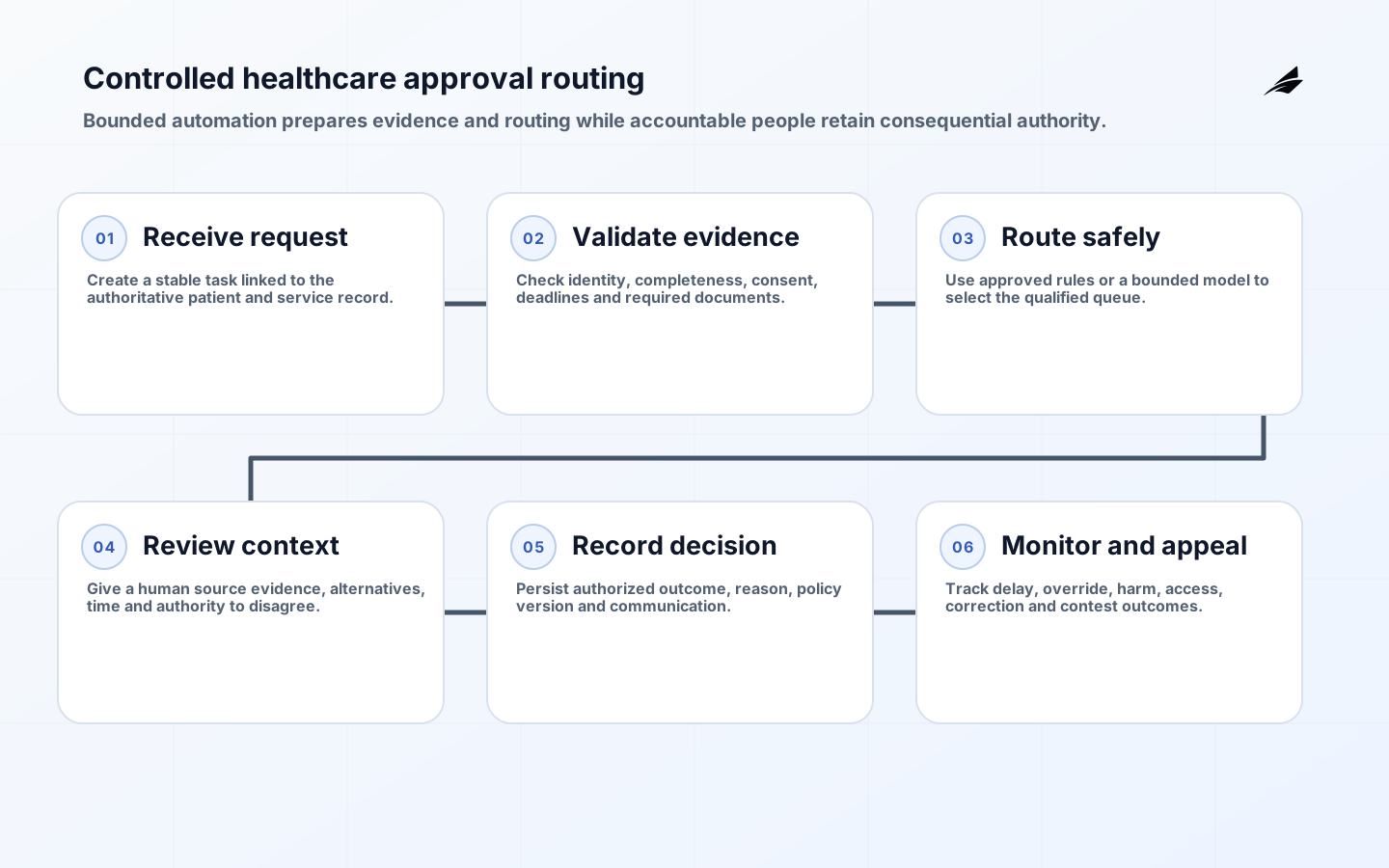
AI approval routing automation for healthcare should move a request to the right authorized reviewer with the right evidence; it should not make an opaque clinical or coverage decision and call that efficiency. Healthcare approvals can involve prior authorization, clinical review, pharmacy, access requests, finance, procurement or internal policy. Each has different authority, deadlines, privacy requirements and appeal paths. The safe system first represents the workflow and decision rights, then uses rules or models to classify, summarize and prioritize within bounded roles.
CMS’s interoperability and prior authorization rule requires certain payers to implement FHIR APIs and streamline processes, while HL7 FHIR Task provides a stateful representation for work that may be completed by people or systems. HHS requires administrative, physical and technical safeguards for electronic protected health information. Together, these sources support a design in which automation accelerates intake and routing but preserves the authoritative record, minimum necessary access, named human responsibility and a traceable explanation of every material transition.
Which parts of approval routing can be automated?
Good candidates include document completeness checks, request classification, specialty or plan routing, duplicate detection, deadline calculation, status notifications and retrieval of approved policy references. A model can summarize a packet for a reviewer, but the interface must link every claim to source evidence. Rules should handle deterministic eligibility or delegation where policy is clear. High-consequence judgments, ambiguous evidence, exceptions and adverse outcomes need appropriately qualified human review and established appeal or escalation.
Define the decision taxonomy before choosing a model. Distinguish routing, recommendation, administrative approval, clinical judgment and final communication. Name who is legally and operationally authorized for each. The system should never promote a routing confidence score into decision authority. When confidence is low or data conflict, it should create a visible exception with a deadline and owner. This makes uncertainty an operating state rather than a hidden model error.
| Workflow function | Suitable automation | Required human authority |
|---|---|---|
| Intake | Validate required fields, formats and duplicate submissions | Resolve identity, consent or material record conflicts |
| Classification | Assign queue, specialty and urgency from approved criteria | Review uncertain or novel classifications |
| Evidence preparation | Retrieve policy and summarize linked records | Judge sufficiency and clinical relevance |
| Decision support | Present rules, alternatives and missing information | Make consequential approval or denial |
| Communication | Generate status and approved-template notices | Approve adverse, exceptional or patient-specific communication |
| Monitoring | Track deadlines, queue age and override patterns | Investigate harm, bias or control failure |
How should the workflow state be represented?
Use an explicit state machine with stable request, patient, organization and encounter identifiers. FHIR Task can represent work status, owner, inputs, outputs and focus, but the implementation must define its profile, permitted transitions and authoritative source. Separate the task from clinical or coverage records it references. Record received, validated, awaiting information, assigned, in review, approved, denied, cancelled and appealed states only where the business process supports them. Do not infer completion merely because a message was sent.

Every transition should state actor, time, reason, evidence version and policy or model version. Make retries idempotent so duplicate messages do not create duplicate approvals. Use queues with visibility timeouts and dead-letter handling for asynchronous integrations. Reconcile acknowledgements from payer, EHR, document and communication systems. If one system is temporarily unavailable, the user should see a degraded state and next action rather than a false success.
How should privacy and data access be controlled?
Apply minimum-necessary access to both people and services. Route based on the least sensitive fields that achieve the purpose, fetch detailed records only for an authorized reviewer, and avoid placing protected health information in prompts, logs or analytics that are not approved for it. Establish business associate agreements and security responsibilities where vendors create, receive, maintain or transmit PHI. Encrypt data, protect service identities, review privileged access and define retention for prompts, outputs and intermediate documents.
Treat retrieved records and free text as untrusted input. Separate instructions from content, restrict model tools server-side and validate outputs before they affect workflow state. Do not let a generated summary replace the designated record. Provide reviewers direct access to the source and show omitted, conflicting or stale data. Patients and providers may need status or appeal information; design these views from the authoritative workflow rather than exposing internal model reasoning.
How should AI quality and human review be tested?
Evaluate the deployed use case, not only a base model. Build representative cases across request type, organization, language, incomplete records, uncommon conditions and operational edge cases. Measure routing accuracy, unsafe false negatives, evidence citation correctness, abstention, override rate and time to the right reviewer. Analyze performance by relevant population and facility segments where lawful and meaningful. A high average can hide systematic delay for a smaller group.
Human review must be effective rather than ceremonial. Reviewers need enough time, evidence and authority to disagree. Track whether they inspect sources, override recommendations and escalate uncertainty. Guard against automation bias by separating model suggestion from authoritative policy and showing confidence carefully. Re-evaluate after policy, model, prompt, workflow or data-source changes. Suspend automated routing if critical data is missing, drift exceeds a threshold or incidents indicate harm.
What evidence is needed for production operation?
Maintain a workflow register with owner, purpose, affected people, data sources, model or rule versions, validation results and rollback path. Monitor queue age, assignment accuracy, turnaround, incomplete requests, overrides, appeals, access exceptions, integration failures and patient or provider complaints. Alerts should route to people who can restore service or stop automation. Keep downtime procedures and a manual queue that preserve ordering, deadlines and subsequent reconciliation.
Incident response should cover privacy exposure, incorrect routing, delayed care, unavailable records, model degradation and unauthorized state changes. Preserve evidence without duplicating PHI unnecessarily. Determine who communicates with clinical leadership, privacy, security, payers and affected parties. Review incidents and near misses for system changes rather than attributing every problem to an operator. Automation should reduce hidden handoffs, not merely make them occur faster.
| Production control | Evidence | Escalation condition |
|---|---|---|
| Authority | Role matrix and approved transition policy | Decision made outside delegated scope |
| Data protection | Access, vendor, retention and audit records | Unauthorized or excessive PHI use |
| Model quality | Versioned evaluation and subgroup results | Unsafe error, drift or unsupported input |
| Workflow reliability | Queue, retry, acknowledgement and reconciliation metrics | Deadline risk or inconsistent state |
| Human oversight | Review, override, appeal and escalation records | Reviewer cannot inspect or contest output |
| Continuity | Downtime drill and backlog reconciliation | Automation unavailable beyond tolerance |
How should a healthcare approval automation be rolled out?
Pilot one low-ambiguity routing function with a named operational owner. Run in shadow mode, compare proposed assignments with actual decisions and correct the workflow taxonomy before allowing state changes. Add bounded automation for high-confidence cases, retain visible exceptions and expand by request type only after service and equity measures hold. Include clinical, administrative, privacy, security, interoperability and patient-experience representatives in acceptance.
- Map the request, authoritative records, decision rights, deadlines and appeal route.
- Profile FHIR and other interfaces with explicit states, identifiers and acknowledgements.
- Minimize PHI and enforce service, reviewer and support access independently.
- Evaluate routing, evidence, abstention and subgroup outcomes in shadow mode.
- Introduce bounded state changes with human review and immediate suspension controls.
- Monitor turnaround, overrides, appeals, incidents and downtime reconciliation.
Approve the service with a multidisciplinary safety review
Before production, walk representative cases through clinicians or qualified reviewers, operations, privacy, security, interoperability, compliance and patient-experience roles. Include normal approval, missing information, conflicting evidence, adverse outcome, urgent request, appeal and downtime. Require each participant to identify the authoritative record, current owner and next safe action. Record unresolved assumptions and prohibit automation for those branches until a responsible policy is approved.
Acceptance should cover more than model accuracy. Verify queue ordering, deadline calculations, access, source citation, state transitions, communications, audit reconstruction, reversal and backlog reconciliation. Confirm that support can see whether a rule, model or person performed each step without exposing unnecessary PHI. Leadership should receive an operational risk statement that names residual limitations and the conditions that suspend automation.
Key takeaways
- Automate intake, evidence preparation and routing before consequential judgment.
- Represent healthcare work with explicit states, owners, evidence and authoritative records.
- Minimum-necessary access applies to models, integrations, logs and support tools.
- Human review needs source evidence, time, authority and a real contest path.
- Production quality includes deadlines, equity, privacy, recovery and appeal outcomes.
Frequently asked questions
Can AI automatically deny a healthcare request?
A denial can have significant clinical, contractual and regulatory consequences. Organizations should define applicable authority and require qualified human review, accessible evidence and appeal handling rather than allowing an opaque model output to become the final action.
Does using FHIR make an approval workflow compliant?
No. FHIR provides interoperable resource structures and APIs; the organization must still define workflow profiles, authorization, privacy safeguards, operating responsibilities, validation and applicable legal requirements.
What is the safest first use case?
Start with document completeness or routing for a well-defined request type. Run the model in shadow mode, measure assignment and deadline outcomes, and keep humans responsible until bounded automation has sufficient evidence.
Conclusion
Healthcare approval automation is trustworthy when it shortens the path to an authorized decision without obscuring evidence or responsibility. Explicit workflow states, minimum-necessary access, effective human review and measured escalation make AI a routing aid rather than an unaccountable decision maker. That operating design is more important than the choice of model.