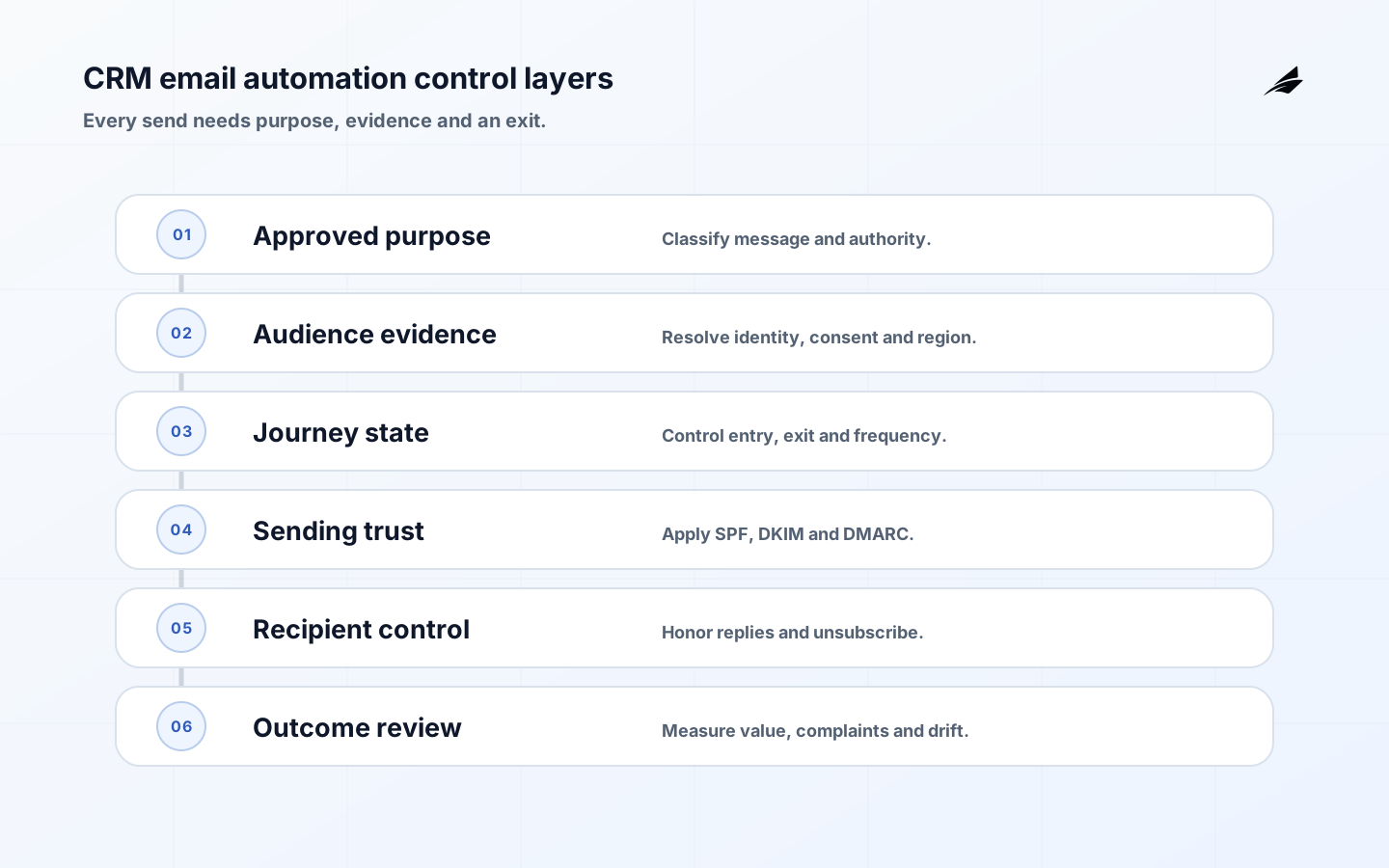
CRM email automation for enterprise teams is a governed decision system, not a campaign scheduler. It decides who may receive which message, from which identity, because of what event, using which data, and what must happen after a reply, bounce, complaint or unsubscribe. Poor automation scales the wrong audience, stale CRM fields and conflicting journeys faster than people can repair them. A strong design joins consent or another valid sending basis, customer state, content approval, frequency policy, authentication, suppression and outcome measurement in one traceable workflow.
This guide addresses marketing and lifecycle email rather than individual sales correspondence or purely transactional notices, although classification boundaries must be documented. The CRM email automation scope guide covers commercial planning, and the implementation readiness checklist supports launch review. Email and privacy rules differ by recipient, jurisdiction, message purpose and relationship; legal and privacy owners should approve rules rather than embedding a single country's assumptions in code.
1. Classify message purpose and sending authority
Define message classes such as service, security, account, sales outreach, product education and promotion. For each, record purpose, audience, sender, legal or policy basis, required content, suppression behavior, approval and retention. Do not add promotion to a service notice merely because it reaches the inbox reliably. In the United States, the FTC CAN-SPAM guide covers commercial messages, including business-to-business email, and requires accurate headers, non-deceptive subjects, identification and opt-out controls among other obligations.
For UK electronic marketing, the ICO's updated electronic-mail guidance explains consent, soft opt-ins and subscriber distinctions under PECR alongside data-protection duties. Other regions differ. Maintain a rule set keyed by recipient context and purpose, with effective dates and approval. When evidence is insufficient, suppress or route for review. Buying a list does not transfer the evidence needed to send lawfully or responsibly.
2. Build a trustworthy audience and consent record
Choose authoritative sources for identity, organization, lifecycle stage, product relationship, region and communication preference. Store the evidence behind a permission: who or what address, what they agreed to, named sender or group, channels, purpose, wording or notice version, source and time. Record objections and unsubscribes in a durable suppression service that every sender checks. Never delete suppression evidence merely to make a CRM look clean; minimize it to what is needed to honor the choice.

Resolve duplicates and shared addresses carefully. Merging contacts can incorrectly transfer permission, while splitting records can re-enable a suppressed address. Define precedence when product, CRM and email-platform states disagree. Import processes should quarantine rows missing source, permission or owner. The enterprise CRM email implementation checklist provides a detailed preflight for consent, data and deliverability.
| Audience field | Authoritative evidence | Automation rule |
|---|---|---|
| Recipient identity | Verified address and contact relationship | Do not infer permission from a similar record |
| Message purpose | Approved class and content policy | Keep service and promotion paths separate |
| Permission | Consent, valid exception or approved basis | Suppress when evidence is absent or expired |
| Region and subscriber type | Reliable contextual source | Apply the approved jurisdiction rule |
| Lifecycle state | System-of-record event and timestamp | Prevent stale triggers and repeat entry |
| Suppression | Global and purpose-specific objection record | Check immediately before every send |
3. Design deterministic journey controls
Represent each automation as states and transitions: eligible, queued, sent, waiting, replied, converted, bounced, complained, unsubscribed, suppressed and expired. Define entry and exit, re-entry policy, frequency cap, quiet period, concurrency and priority. A customer should not receive an acquisition series after purchasing or three messages because separate departments reacted to the same event. Evaluate eligibility at send time, not only when the journey began, because consent and customer state can change while a message waits.
Use idempotency keys so retries do not send duplicates. Make event timestamps and source identifiers visible. Treat replies, complaints and bounces as workflow events with owners, not only metrics. High-risk personalization needs fallback when data is missing or contradictory. Test names, localization, accessibility, links, tracking behavior and plain-text alternatives. Content approval should version the template, audience rule and sender together so the organization can reconstruct what each recipient received and why.
4. Authenticate sending and protect reputation
Inventory every service authorized to send for each domain. Publish and maintain SPF, sign with DKIM and deploy DMARC with reporting and a staged enforcement plan. The IETF's current RFC 9989 replaced RFC 7489 in May 2026 and defines DMARC domain alignment and policy. Authentication helps receivers identify authorized domain use; it does not make unwanted content wanted. Separate transactional and marketing streams where their risk and reputation should not be coupled.
Google's current sender guidelines require SPF or DKIM for all senders to personal Gmail accounts and SPF, DKIM and DMARC for senders over 5,000 messages per day, alongside TLS, alignment and subscription controls. They also advise keeping reported spam below 0.1% and avoiding 0.3% or more. Treat provider thresholds as current operational requirements, not universal law, and monitor updates. Ramp new domains or infrastructure gradually with engaged recipients.
| Deliverability control | Evidence | Operational response |
|---|---|---|
| SPF and DKIM | Authorized senders and passing authentication | Remove stale services and rotate keys |
| DMARC | Aligned traffic and aggregate reports | Fix legitimate sources before stronger policy |
| Unsubscribe | One-click and visible body path works | Suppress promptly across systems |
| Complaint rate | Provider-specific feedback by stream | Pause affected audience and investigate |
| Bounce quality | Hard, soft and policy responses classified | Suppress invalid addresses and slow retries |
| Reputation isolation | Purpose-specific domains or subdomains | Contain a failing program without hiding it |
5. Make exit and response paths immediate
Every marketing journey needs a visible unsubscribe path and a centralized suppression update. For qualifying list email, RFC 8058 specifies one-click unsubscribe headers using an HTTPS POST protected by DKIM. Test the complete path from mailbox action to suppression before launch, including retries and platform outages. Do not require login, a password or a preference survey before honoring the request. Retain only enough evidence to demonstrate and enforce the objection.
Monitor replies to the displayed sender or provide a clear route to a staffed channel. Automations involving quotes, renewals, complaints or vulnerable customers need explicit handoff and service expectations. A 'do not reply' address can conceal a failed customer journey. The CRM email automation FAQ covers consent and workflow edge cases; unresolved replies should still be treated as owned operational work.
6. Pilot, measure and expand without gaming
Pilot one message class and one owned audience. Seed tests cannot expose stale CRM state, cross-journey collisions or suppression latency, so include a small real cohort with monitoring and rollback. Validate rule decisions, render, links, authentication, one-click unsubscribe, reply routing, bounce handling and suppression. Pause on elevated complaints, wrong-purpose sends, duplicate messages or evidence gaps. Expansion should follow stable behavior across representative segments, not a single high open rate.
Measure eligible audience, delivered messages, complaints, unsubscribes, hard bounces, replies, journey completion, conversion with an appropriate comparison and suppression latency. Opens are noisy and can be altered by privacy features; they should not be the sole success signal. Review by sender, message class, audience source and region. Optimize toward useful customer outcomes and low regret, not volume. Record experiments and avoid dark patterns that increase clicks while weakening informed choice.
Enterprise governance should include a sending council with representatives from marketing operations, CRM ownership, security, privacy, customer support and major business units. It need not approve every campaign. It should own shared policies, domain inventory, suppression service, incident thresholds and disputed audience rules. Run prelaunch reviews for new message classes or data sources, and quarterly reviews for provider changes, complaints and dormant automations. Give one role authority to pause a sender immediately when wrong-purpose messages or control failures appear, with a documented route to investigate and resume.
Define an email incident record that captures message version, audience query, sending source, affected count, suppression status, provider response and customer remedy. Preserve enough evidence to correct records and answer inquiries without retaining unnecessary message content forever. After an incident, add a test for the failed audience or journey condition before restarting. Reputation recovery should never take priority over honoring recipient choice.
Key takeaways
- Classify message purpose and approve sending rules for recipient context.
- Keep permission evidence and suppression durable across CRM and sending platforms.
- Model journeys as deterministic states with send-time eligibility and idempotency.
- Authenticate all sending sources and monitor provider requirements and reputation.
- Make unsubscribe, reply, complaint and bounce paths operational workflows.
- Expand from a real cohort using customer outcomes, not volume or opens alone.
CRM email automation FAQ
Can one consent cover every enterprise brand and message? Not automatically. Scope depends on what the person was told, the sender, purpose, channel and applicable rules. Store granular evidence and have privacy owners define valid grouping.
Is DMARC enough for deliverability? No. DMARC addresses domain alignment and policy. Deliverability also depends on wanted mail, list quality, complaints, infrastructure, message behavior and receiver-specific rules.
Should transactional email honor marketing unsubscribe? Keep purpose-specific rules clear. A person may still need essential service or security notices after leaving marketing. Do not add promotional content to bypass a marketing suppression.
How should multiple email platforms be governed? Maintain a sending-source register, common authentication standards, centralized suppression, purpose ownership and consolidated monitoring. Remove a platform from DNS authorization when it is retired.
Conclusion
Enterprise email automation earns trust when every send has a defensible reason, current customer state and an immediate exit. Build from approved purpose rules and durable consent evidence, then add deterministic journeys, authenticated domains, centralized suppression and real response handling. Pilot with a representative cohort and measure complaints, outcomes and control latency. That operating discipline lets teams scale relevant communication without turning the CRM into a machine for repeating stale assumptions.