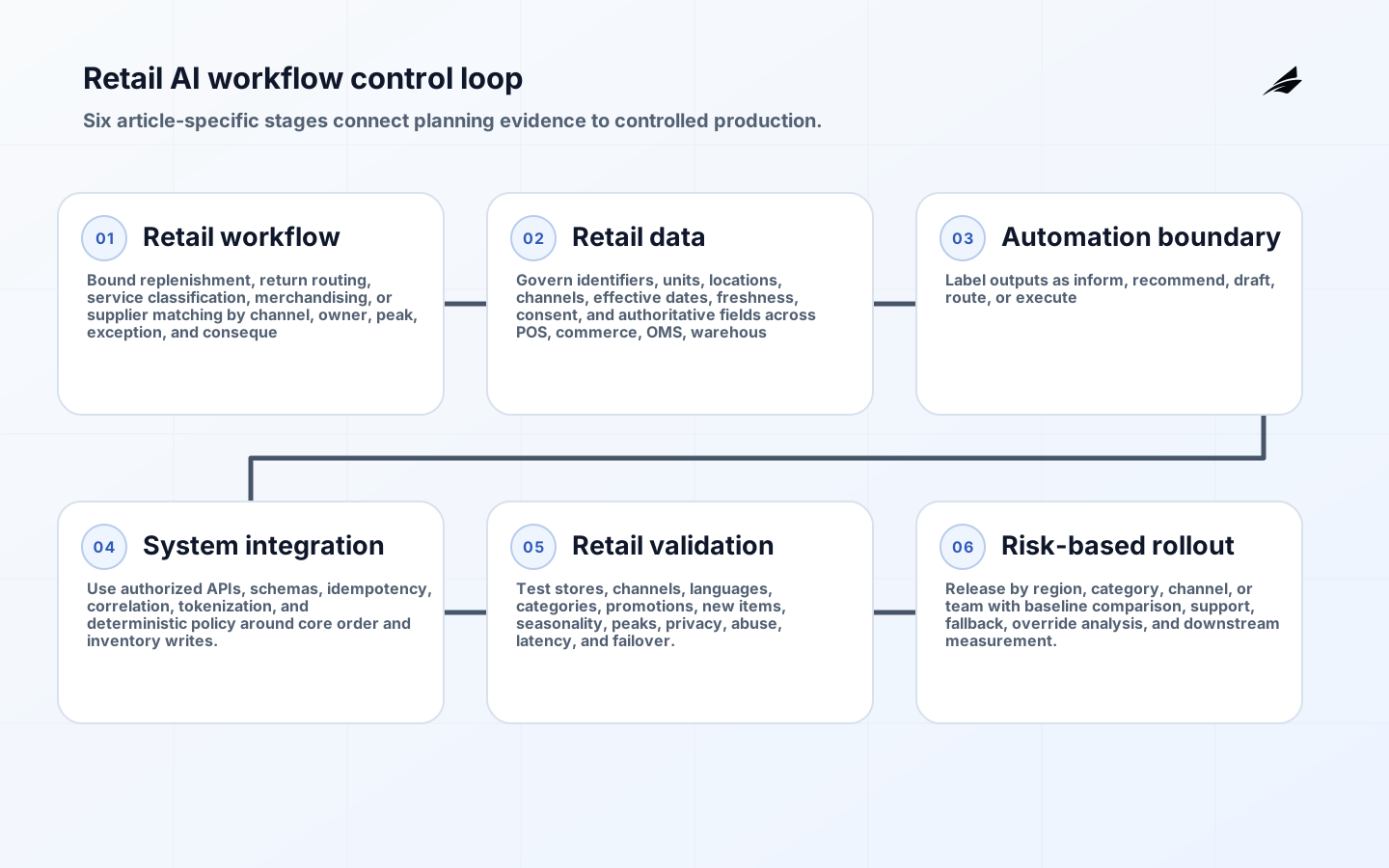
Retail AI Workflow Automation: Production Implementation Checklist requires more than a feature backlog. It needs a named outcome, evidence about current work, explicit trust boundaries, and controls that remain effective after launch. This guide turns retail AI workflow automation into a staged review for product, engineering, security, operations, compliance, finance, and business owners. The aim is a useful, supportable system whose scope, cost, risk, and value can be challenged before production rather than explained after an incident.
Use the checklist as a working review, not a certification shortcut. Adapt legal, contractual, regulatory, and technical analysis to the organization and jurisdiction. Related planning appears in AI Workflow Automation Services for Retail: Scope, Cost, Risks and Delivery Plan, AI Workflow Automation Services for Retail FAQ, AI Workflow Automation Services for Startups: Scope, Cost, Risks and Delivery Plan, AI Workflow Automation Services for Startups Implementation Checklist. This article concentrates on implementation evidence: what should be observed, documented, tested, approved, monitored, and reconsidered when operating conditions change.
Retail workflow
At this stage, bound replenishment, return routing, service classification, merchandising, or supplier matching by channel, owner, peak, exception, and consequence. For this workflow step, name the accountable owner, supporting evidence, exception route, and next measurable check.
Controls should account for this constraint: Autonomous pricing, fraud, credit, and customer-treatment systems are poor first targets without mature evidence and appeal. Within this workflow step, name the accountable owner, supporting evidence, exception route, and next measurable check.
Retail data
At this stage, govern identifiers, units, locations, channels, effective dates, freshness, consent, and authoritative fields across POS, commerce, OMS, warehouse, and suppliers. When implementing this data handoff, name the accountable owner, supporting evidence, exception route, and next measurable check.
Controls should account for this constraint: Models cannot repair unresolved ownership of stock, price, identity, or payment scope. Before releasing this data handoff, name the accountable owner, supporting evidence, exception route, and next measurable check.
| Stage | Decision | Evidence |
|---|---|---|
| Retail workflow | Bound replenishment, return routing, service classification, merchandising, or supplier matching by channel, owner, peak, exception, and consequence. | Autonomous pricing, fraud, credit, or customer treatment is a poor first target without mature evidence and appeal. |
| Retail data | Govern identifiers, units, locations, channels, effective dates, freshness, consent, and authoritative fields across POS, commerce, OMS, warehouse, and suppliers. | Models cannot repair unresolved ownership of stock, price, identity, or payment scope. |
| Automation boundary | Label outputs as inform, recommend, draft, route, or execute; set consequence-based thresholds and design staffed exception queues. | Review becomes a hidden peak bottleneck, while broad autonomy can create irreversible customer outcomes. |
Automation boundary
At this stage, label outputs as inform, recommend, draft, route, or execute; set consequence-based thresholds and design staffed exception queues. While operating this decision boundary, name the accountable owner, supporting evidence, exception route, and next measurable check.

Controls should account for this constraint: Review becomes a hidden peak bottleneck, while broad autonomy can create irreversible customer outcomes. When changing this decision boundary, name the accountable owner, supporting evidence, exception route, and next measurable check.
System integration
At this stage, use authorized APIs, schemas, idempotency, correlation, tokenization, and deterministic policy around core order and inventory writes. During support for this data handoff, name the accountable owner, supporting evidence, exception route, and next measurable check.
Controls should account for this constraint: Stale inventory, duplicate events, offline stores, and provider timeout turn plausible outputs into operational errors. To validate this data handoff, name the accountable owner, supporting evidence, exception route, and next measurable check.
| Stage | Primary risk | Production control |
|---|---|---|
| System integration | Stale inventory, duplicate events, offline stores, and provider timeout turn plausible outputs into operational errors. | |
| Retail validation | Generic accuracy does not establish fill rate, correction burden, customer impact, margin, or queue outcomes. | |
| Risk-based rollout | Scale fails when labor shifts elsewhere, peaks remain untested, or changes lack approval. |
Retail validation
At this stage, test stores, channels, languages, categories, promotions, new items, seasonality, peaks, privacy, abuse, latency, and failover. To govern this part of the system, name the accountable owner, supporting evidence, exception route, and next measurable check.
Controls should account for this constraint: Generic accuracy does not establish fill rate, correction burden, customer impact, margin, or queue outcomes. When explaining this part of the system, name the accountable owner, supporting evidence, exception route, and next measurable check.
Risk-based rollout
At this stage, release by region, category, channel, or team with baseline comparison, support, fallback, override analysis, and downstream measurement. For this control, test one expected case, one ambiguous case, and one failure with a documented recovery action.
Controls should account for this constraint: Scale fails when labor shifts elsewhere, peaks remain untested, or changes lack approval. Within this control, test one expected case, one ambiguous case, and one failure with a documented recovery action.
Build an approval evidence package
The retail automation approval record should define the store, channel, category, user, event, source systems, authoritative product and inventory fields, payment-data boundary, automation level, exception queue, peak-volume assumption, and measurable customer or margin outcome. Merchandising or operations should own policy; data stewards should attest identifiers and freshness; security should approve service scopes; and store or service leaders should confirm that human-review capacity can sustain promotions and seasonal demand.
Review the workflow with store operations, ecommerce, merchandising, supply chain, customer service, fraud or loss prevention where relevant, data engineering, security, and the agents who resolve exceptions. Demonstrate stale stock, duplicate orders, partial fulfillment, changed promotion, offline store, mismatched product identifier, customer appeal, model timeout, and a downstream correction. A recommendation is not production-ready if staff cannot see its evidence, override it safely, or restore the source system after a faulty write.
Validate retail AI workflow automation through a complete operating case
Use this implementation checklist to validate retail AI workflow automation with one complete operating case before widening the scope. Delivery teams should trace one business case across intake, validation, approval, system updates, downstream handoffs, and an operator-visible completion state. Begin with the initiating business record, accountable role, approval state, integration handoff, exception reason, and reconciled outcome, cross each policy and dependency boundary, and finish in a durable state that a customer or operator can recognize. Record the expected state at every handoff, who may change it, and which evidence proves that the next step was justified. This walkthrough gives product, engineering, security, and support a shared acceptance case instead of allowing each team to assume that another layer owns the transition. Use representative roles, realistic timing, and the constraints that exist during an ordinary operating day.
The implementation checklist should also test a second retail AI workflow automation case that deliberately challenges the design. Include a disputed record, unavailable approver, duplicate handoff, policy exception, or mismatch between systems of record. The purpose is not to demonstrate that every dependency always succeeds; it is to prove that the service can stop safely, preserve useful evidence, and expose the next responsible action. Review record version, approval evidence, queue age, exception owner, reconciliation result, and service outcome together so the team can distinguish a policy refusal from bad input, a software defect, a delayed dependency, or an operator decision. A useful result is specific enough for a support or incident owner to act without reconstructing the entire journey from unrelated logs and messages.
Turn both cases into release evidence for retail AI workflow automation. Keep the input conditions, expected states, observed result, decision owner, and unresolved exceptions in one reviewable record. Define the recovery action in advance: protect the authoritative record, isolate the disagreement, assign the exception, reconcile affected systems, and document the resolution. Re-run the same cases after a material policy, interface, data, model, infrastructure, or entitlement change so that improvements do not silently weaken an earlier control. For this implementation checklist, readiness means that the normal path is usable, the failure path is understandable, and ownership remains visible after launch rather than ending when implementation work is declared complete.
- Choose one representative retail AI workflow automation journey and state the customer or operator result in plain language.
- Capture the initiating business record, accountable role, approval state, integration handoff, exception reason, and reconciled outcome as evidence, with a named owner for each consequential handoff.
- Exercise a disputed record, unavailable approver, duplicate handoff, policy exception, or mismatch between systems of record before broader exposure and verify that the safe state is visible.
- Review record version, approval evidence, queue age, exception owner, reconciliation result, and service outcome after release and assign every unresolved exception to a person and date.
Implementation takeaways
- Define the business and operating outcome before selecting technology.
- Assign owners for data, controls, service operation, incidents, changes, and value.
- Test representative exceptions, failure, rollback, and recovery before expanding scope.
- Keep architecture, security, privacy, cost, support, and retirement in one delivery plan.
- Measure downstream outcomes and residual risk, not only technical activity.
Frequently asked questions
| Question | Answer |
|---|---|
| First workflow? | A high-volume, measurable, reversible workflow with reliable data and an owner. |
| Direct writes? | Only through constrained, authorized, validated, idempotent, auditable interfaces. |
| Peak handling? | Load-test integrations and queues, define degraded modes, and preserve fallbacks. |
| Key metrics? | Exceptions, correction, customer impact, fill rate, margin, and review burden. |
Conclusion
Retail AI Workflow Automation: Production Implementation Checklist is strongest when each design choice traces to a user outcome, authoritative source, owned control, or tested constraint. That traceability makes scope and cost easier to challenge before release and incidents easier to diagnose afterward. It also distinguishes readiness from a demonstration that works only with curated inputs and expert supervision.
Release retail AI workflow automation to one bounded category, channel, region, or team and keep deterministic limits around consequential actions. Expansion should depend on override reasons, exception age, correction rate, fill or service outcomes, customer complaints, margin impact, latency, and peak-load evidence. If review work migrates to another queue or automation increases downstream adjustments, include that burden in the value calculation and revise the boundary before scaling.
Before final retail approval, test the deployed workflow with actual POS, commerce, order, inventory, loyalty, and supplier interfaces under production roles. Rehearse delayed feeds, duplicate and reordered events, promotion spikes, provider outage, tokenization failure, unauthorized refund or inventory change, queue overload, rollback, and audit reconstruction. Monitoring should separate data freshness, model behavior, deterministic policy rejection, integration failure, and store execution so the correct team can respond before customers are affected broadly.