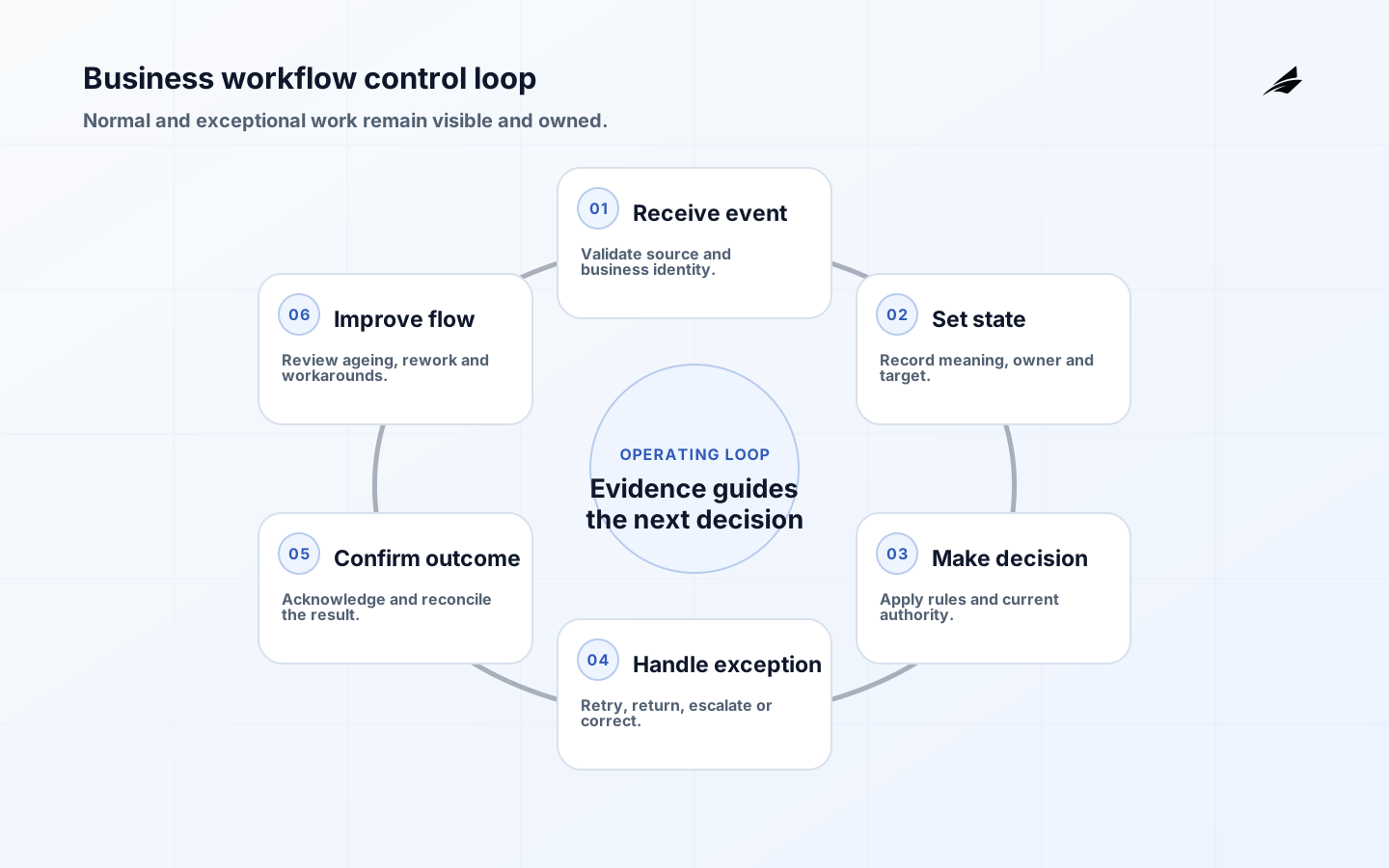
Business workflow automation is the controlled movement of a business record through decisions, actions, exceptions and completion. Operations teams should care less about how many steps disappear and more about whether ownership, authority and evidence become clearer. A fast happy path can make the service worse if rejected records vanish, repeated events create duplicates or nobody can reverse a mistaken approval. Model the current work, including waiting and informal corrections, before choosing a workflow engine, integration platform or AI assistant. The BPMN specification supplies a common notation for events, tasks and gateways, but the operating meaning still has to come from the people doing the work.
Model the work before automating it
Choose one business object such as request, claim, invoice, case or order. Define its states, source, identifier, required evidence and final outcome. Observe real cases across normal and peak periods, including work done in email, spreadsheets and messaging. Distinguish active work from queue time and identify every place a person interprets policy. The production workflow guide provides a practical discovery structure. Do not automate a step merely because it exists; remove duplicate collection and approvals that do not change a decision.
| Design element | Question | Operational evidence |
|---|---|---|
| Trigger | Which event creates valid work? | Source reference and received time |
| State | What does waiting, approved or rejected mean? | State history and effective time |
| Authority | Which role may decide or override? | Current assignment and decision record |
| Handoff | What must the receiver know? | Required fields, evidence and service target |
| Completion | What proves the outcome occurred? | Target acknowledgement and reconciliation |
Make decision rights executable
Represent approval limits, separation of duties, eligibility and escalation as explicit rules close to the transaction. Resolve current role and delegation at decision time rather than copying a manager into the case forever. High-impact overrides need a reason, actor and review route. A workflow should never infer permission from the ability to see a button. NIST SP 800-53 offers control families for access, audit and contingency planning that can be tailored to the system. Keep policy ownership with the business and implementation ownership with engineering.
Design exceptions as first-class states
List missing data, duplicate request, unavailable dependency, policy conflict, timeout, rejected approval, cancellation and correction. Decide which are safe to retry, which return to the source and which require a specialist. Give error queues service targets, named ownership and enough context to act. The exception-handling planning guide explains retry, dead-letter and compensation choices. If operations still need a private spreadsheet to track stuck work, the automation has not made the service observable.
| Exception | Unsafe response | Designed response |
|---|---|---|
| Duplicate event | Create a second business record | Use a stable key and return the existing outcome |
| Dependency timeout | Repeat a consequential write blindly | Check target status before controlled retry |
| Missing evidence | Approve from partial context | Return to source with a specific requirement |
| Policy conflict | Let the oldest rule win silently | Route to named policy owner and retain decision |
| Wrong completion | Overwrite the record | Create a reversal or amendment with provenance |
Preserve identity and provenance across systems
Use a correlation identifier from trigger through every integration and final outcome. Keep the system of record authoritative and treat other stores as copies or projections. The W3C PROV overview models provenance through entities, activities and agents; that is a useful mental model for recording which input, process and person produced a result. Validate contracts, make writes idempotent and reconcile populations and totals rather than relying on matching timestamps. Avoid logging sensitive payloads when identifiers and outcome codes provide sufficient evidence.
Release in bounded workflow slices
Pilot one work class, team or threshold band with a manual fallback. Instrument queue age, touch time, correction, exception, duplicate and completion rates. Run old and new paths carefully enough to compare outcomes without creating two authorities. Exercise dependency failure and rollback before broad release. The workflow planning guide helps define ownership and acceptance before implementation. Expansion should follow stable business outcomes, not the percentage of steps automated.
- Assign a product owner and an operational service owner.
- Publish state meanings and service targets in the interface.
- Give every exception queue a resolver and escalation path.
- Keep an auditable change process for rules and routing.
- Review workarounds with users because they expose missing states or authority.
Improve the operating system, not only throughput
Review demand, ageing, first-pass completion, rework, override, exception and customer-impact trends. Segment by work class and team so a global average does not hide an excluded group. Sample completed cases against source evidence. Link incidents and complaints to the workflow state in which control failed. NIST’s Cybersecurity Framework treats governance, protection, detection, response and recovery as connected functions; operations should do the same. Retire obsolete rules, remove unused access and redesign steps whose exception burden exceeds their value.
Design service levels and capacity
Automation can increase arrival rate downstream by removing an upstream delay. Model queue capacity and service targets for every handoff, including human review. Define priority rules that are visible and do not starve ordinary work. During peaks, decide which work can pause, which requires additional reviewers and which must use a simpler fallback. Monitor oldest-item age and percentile completion rather than averages alone. A workflow that completes easy cases instantly while difficult customers wait longer may look efficient and still fail its service purpose. Capacity planning should include integration limits, batch windows and the time specialists spend on exceptions.
Govern business rule change
Rules encode policy and can alter customer or employee outcomes without a software release. Store them in version control or an equivalent governed repository, with effective dates, owner, tests, approval and rollback. Use representative historical cases to compare old and proposed behavior. Communicate material changes to operators before activation and preserve which rule version decided each record. For time-dependent policy, avoid retroactively applying a new rule unless the business explicitly approves reprocessing. Review inactive and overlapping rules because an old exception can silently override a new standard.
Design for operators and affected users
Observe how people understand state, urgency and authority in the interface. Reduce duplicate entry and show source evidence beside the requested decision. Avoid dark patterns that push reviewers toward approval or hide the consequences of override. Let users save work, request clarification and see why a case returned. Provide accessible status and error messages. For people affected by an automated outcome, establish notification, explanation and challenge routes proportional to consequence. Operational efficiency is not a reason to make a person fight an invisible workflow to correct a record.
Worked scenario: a controlled purchase request
A purchase request begins when an employee selects a cost center, supplier, amount and purpose. The workflow validates required evidence and creates one immutable request identity. Policy resolves approval authority from amount, category and current delegation. A manager can approve, reject or return with a reason; a finance reviewer handles policy exceptions. If the procurement system times out, the workflow checks for an existing order before retrying. Every state shows the current owner and service target. Cancellation remains possible until the committed-order boundary, after which a compensating process is required.
This design is more robust than emailing a generated summary to several approvers. It knows which decision is pending, prevents duplicate commitments, records the rule version and retains source evidence. Operations can measure oldest request age, return reasons, manual overrides, integration failures and completion reconciliation. If a policy changes, historical requests keep their original decision context while new ones use the effective rule. If automation is disabled, queued requests continue through a defined manual route. The scenario demonstrates how state, authority and idempotency create value before any advanced AI is introduced.
Reporting should distinguish demand, work in progress and completed business outcomes. Count unique business records, not task executions, because retries and returns can inflate activity. Show ageing by current state and owner, plus the reason work leaves the normal path. Reconcile the workflow’s completed population with the downstream system of record on a schedule. Give managers enough detail to remove systemic blockers without exposing unnecessary personal information. When a target is missed, investigate input quality, authority, dependency and capacity before pressuring operators to close records faster. Pair every performance target with a quality and exception measure so faster closure cannot conceal correction, abandonment or unauthorized work.
Key takeaways
- Model one record lifecycle and its business outcome before selecting tools.
- Encode authority and delegation explicitly at decision time.
- Design exception, retry, correction and cancellation paths from the start.
- Preserve provenance and reconcile results across integrations.
- Expand automation from observed outcomes and retire weak rules.
Frequently asked questions
Which workflow should operations automate first?
Choose stable, repeated work with a clear owner, measurable outcome and visible exceptions. Avoid the most politically complex or safety-critical process until the team has proved its operating and recovery model.
Does workflow automation require AI?
No. Deterministic rules, forms, APIs and queues often handle the core path more reliably. Add AI where inputs require classification, extraction or assistance, then keep authority and validation outside the model.
Should users be allowed to override automation?
Allow controlled override where the business needs judgment or recovery. Restrict it by role, require a reason and review patterns. Frequent overrides are a product signal that a rule or process boundary is wrong.
Conclusion
Business workflow automation earns trust when ordinary work is simple and abnormal work is visible. Explicit records, authority, provenance and recovery let operations improve speed without sacrificing control.