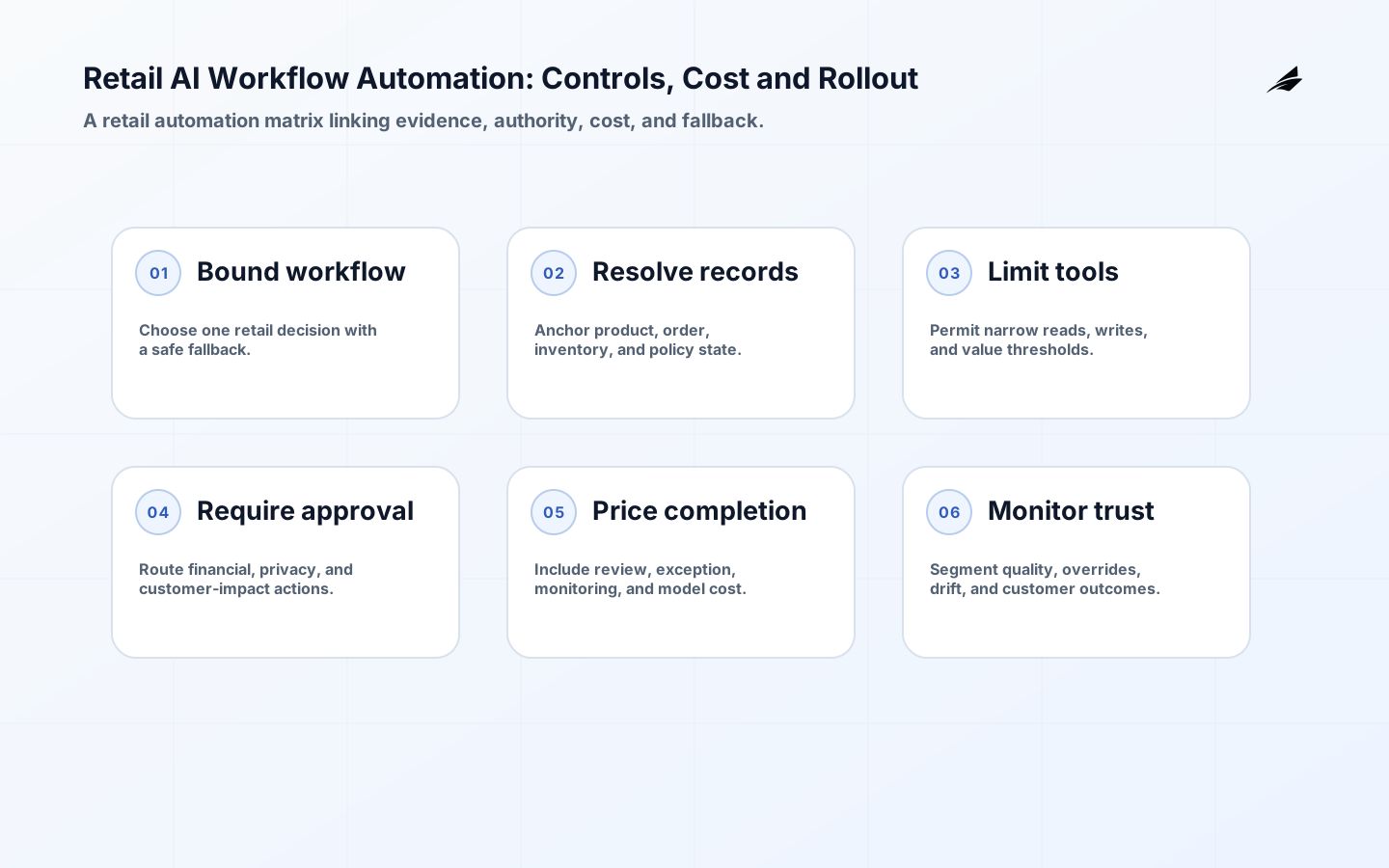
AI workflow automation services for retail should improve a real operating decision across stores, ecommerce, inventory, suppliers and customer service. They fail when a polished assistant is connected to ambiguous product records, stale availability or actions wider than the evidence supports.
Useful targets include product-content enrichment, order-exception triage, returns review, replenishment assistance, promotion checks, and service drafting. Each has different latency, privacy, and financial consequences. This guide explains how to scope an engagement, estimate cost, control AI-specific risks, and release progressively.
Retail automation touches customer communications, payment environments and high-volume operating data. The NIST AI RMF playbook collects current guidance relevant to automated claims and customer treatment. PCI DSS provides a baseline where a workflow stores, processes, transmits or can affect payment account data. For AI decisions, the NIST AI RMF, NIST Privacy Framework and NIST Generative AI Profile support risk, privacy and evaluation work, while OWASP guidance on excessive agency explains why model output should not become an unbounded business action.
Choose a workflow with a measurable decision

Map one workflow from trigger to verified completion. Identify the customer or employee outcome, current queue, decision owner, authoritative records, exceptions and rework. A good first scope has repeated volume, observable results and a safe human path. “Automate customer service” is not a scope; “classify delivery contacts, retrieve order evidence and draft a response for agent approval” is.
Separate assistance from action. Summarizing a case, suggesting a category and changing a refund or inventory record have increasingly serious consequences. List every tool the system may call, the fields it may read or write, the value limits and conditions that require approval. Keep price, payment, identity and irreversible customer actions behind deterministic policy.
| Workflow | Useful AI role | Authoritative evidence | Control |
|---|---|---|---|
| Order exception | Classify and assemble context | Order, carrier and payment state | Agent approves remedy |
| Product content | Draft attributes and descriptions | Supplier and product master data | Validation and merchant review |
| Replenishment | Explain forecast and suggest action | Inventory, lead time and demand | Planner accepts order |
| Returns | Summarize evidence and route | Order, policy and item condition | Value and fraud thresholds |
| Store tasking | Prioritize work | Availability and operational events | Manager can override |
Stabilize product, location and transaction data
Retail AI depends on identity across channels. Use stable product, location, shipment, order and customer identifiers; document units, pack hierarchy and effective dates. GS1 standards can support interoperable identification and traceability, but an identifier does not repair inconsistent ownership. Decide which system is authoritative for description, price, stock, promise and transaction state.
Measure freshness and reconciliation. Available-to-promise can differ from a store count because of reservations, shrink and processing delays. The automation should expose uncertainty rather than invent certainty. Validate inputs before inference, preserve source timestamps and route conflicts to a named queue. Sensitive customer data should be minimized and purpose-bound.
Design bounded tools and workflow state
Place the model inside a conventional workflow service. The service owns state, authentication, policy, retries, audit and idempotency. Retrieval supplies approved product, policy and transaction evidence. Tools expose narrow operations such as fetch order, draft response or propose task. The model should not receive broad database or administrative access.
Treat model output as untrusted input. Validate schema, allowed values, citations and requested action. Bind authorization to the user and current workflow state. OWASP describes excessive agency as a risk when a system has excessive functionality, permissions or autonomy; least privilege and human approval reduce the impact of an incorrect or manipulated output.
Estimate cost across build and operation
Cost includes discovery, data cleanup, integration, evaluation, user experience, security, training and change management. Operating cost includes model and retrieval usage, observability, human review, incident response, prompt or policy updates and periodic evaluation. Volume alone is a weak estimator; long context, repeated retrieval, manual exceptions and fragmented systems often dominate.
Build a unit-economics model per completed case. Compare current handling time and error cost with automated processing, review time, escalations and run cost. Keep adoption and quality assumptions separate. Savings exist only when work is safely removed or capacity is redeployed, not when the same review remains and an additional AI step is added.
| Component | Planning basis | Evidence after launch |
|---|---|---|
| Integration | Systems, contracts and exception paths | Failure and reconciliation effort |
| Inference | Requests × context × model price | Cost per completed workflow |
| Human review | Review rate × handling time | Approval, correction and escalation rate |
| Quality impact | Errors avoided minus false actions | Refund, rework and complaint outcome |
| Adoption | Eligible users and cases | Qualified workflow completion |
Control retail AI and privacy risks
Apply the NIST AI RMF by governing ownership, mapping affected contexts, measuring performance and managing identified risk. Test hallucination, instruction injection, stale knowledge, biased routing, data leakage and tool misuse. Evaluate by category, channel, language and value band. A high average score can hide poor performance for rare but expensive cases.
Use the NIST Privacy Framework to connect data processing with organizational risk. Avoid placing unnecessary personal data in prompts or logs. Define retention and redaction. Give staff a clear way to inspect evidence, correct a result and escalate. Tell customers when automation materially shapes an interaction where transparency is appropriate.
Deliver through evidence gates
Begin with offline evaluation on a representative, carefully handled case set. Move to shadow mode, where the system produces outputs without changing work. Then release suggestions to a small cohort with mandatory approval. Expand only when quality, latency, review burden and business outcomes meet pre-agreed thresholds.
Keep a kill switch and deterministic fallback. Version prompts, policies, retrieval sources, models, and tool contracts. Monitor input validity, groundedness, corrections, overrides, action failures, customer outcomes, and cost. Re-evaluate after product, policy, model, or integration changes.
- Approved workflow and authority map
- Representative evaluation set and acceptance thresholds
- Privacy, security and tool-abuse assessment
- Shadow-mode comparison with current operations
- Named owners for exceptions and incidents
- Fallback, disable and reconciliation test
Example: delivery-exception assistance
A retailer receives “where is my order” and failed-delivery contacts across email and chat. The workflow resolves customer identity, retrieves order and carrier events, applies current remedy policy and drafts an explanation. It may propose a replacement or refund, but the transaction service independently checks eligibility and requires approval above a value threshold.
Evaluation covers correct order grounding, policy selection, unsupported claims, tone, privacy and remedy accuracy. The release begins with one region and agent group. Measures include resolution time, correction rate, repeat contact, unauthorized action attempts, customer satisfaction and cost per resolved contact. Carrier ambiguity routes to an exception rather than a fabricated delivery promise.
Maintain a retail automation operating record
For every production workflow, record the owner, intended users, customer impact, systems and data, model and prompt versions, tools, approval rules, evaluation results and current limitations. Link changes to release evidence. This record lets support, security and product teams understand which component made a decision and whether the same result can be reproduced after a model or policy update.
Review performance on a cadence that reflects business volatility. Promotions, holiday volume, assortment changes and new carrier contracts can alter inputs and exceptions quickly. Sample cases from both successful and failed outcomes. Investigate correction clusters by product, store, language and channel. Retraining is not the default response; stale source data, a broken connector or an unclear policy may be the actual cause.
Create incident categories for data exposure, unauthorized action, systematic misinformation and service degradation. Preserve case and tool evidence, disable the smallest affected capability and reconcile any changed records. Notify customers or authorities according to impact and applicable obligations. Afterward, add the failure to evaluation and update the control that should have prevented or detected it.
Quarterly governance should compare realized savings and customer outcomes with the approved case. Include review labor, repeat contacts, remediation and platform cost. Retire automation that no longer improves the process. A smaller, well-controlled workflow is more valuable than a broad assistant that creates invisible rework.
Store managers and service agents should have a simple feedback path that identifies the case, recommendation and reason for disagreement. Aggregate that feedback by workflow stage instead of treating every correction as model error. A product substitution may fail because inventory was late; a refund proposal may fail because policy was unclear. Assign the corrective action to the data, policy, integration or model owner that can actually resolve it. Close the loop by showing frontline teams what changed, which improves adoption and prevents parallel spreadsheets or unofficial workarounds.
For multi-brand or multi-country operations, treat policy as versioned data. Record the market, channel, effective period and approving owner, then make the workflow select policy deterministically before the model explains it. Test overlapping promotions, regional returns and catalog transitions. This prevents a fluent response based on the wrong commercial context and gives auditors and service leaders a direct path from action to governing rule.
Related reading
See Inventory and Operations Software for record design, Inventory Systems Cost and Scaling for operational economics, and RAG Knowledge Bases for Retail for controlled retrieval.
Frequently asked questions
Which retail workflow should be automated first? Choose repeated work with reliable evidence, measurable outcomes and a safe fallback. Order-exception triage, product-content review and internal task prioritization are usually safer starting points than unrestricted refunds or pricing changes.
How should retail AI automation be priced? Separate discovery, data cleanup, integration, evaluation, controls and adoption from ongoing model, retrieval, review, monitoring and support cost. Measure the cost per correctly completed workflow.
Can an AI agent issue a refund automatically? Only inside deterministic identity, policy, value and fraud controls. The transaction service must enforce those rules and idempotency. Ambiguous or higher-value cases should require human approval.
What should a retailer monitor after launch? Monitor source freshness, groundedness, corrections, overrides, tool failures, unauthorized attempts, latency, customer outcomes and cost. Segment results by channel, market and workflow category.
Key takeaways
- Automate a bounded retail decision, not an undefined department.
- Resolve authoritative product, inventory and transaction state before adding AI.
- Keep models behind narrow tools, policy checks and value-based approvals.
- Price review, exceptions and monitoring into unit economics.
- Release from offline evaluation to shadow and approval-gated operation.
Conclusion
Retail AI workflow automation is valuable when it connects reliable evidence to a controlled action faster and more consistently than the current process. The winning architecture is not unlimited autonomy. It is a visible workflow with stable identifiers, narrow tools, policy enforcement, human authority and outcome measurement. That foundation lets retailers improve service and operations without sacrificing customer trust or record integrity.
Bound the retail workflow and authority
Retail automation starts with the workflow, not the model. Name the event, source records, decision, affected customer or employee, allowed action and accountable reviewer. Inventory, returns, promotions, customer support and supplier operations each have different tolerance for delay and error. A bounded task such as classifying an inbound ticket may be a sensible first step; changing a refund amount or publishing a price needs stronger authorization, evidence and a human decision.
| Decision | Choose first when | Evidence to keep |
|---|---|---|
| Boundary | The outcome has one accountable owner. | Named owner, input and success condition. |
| Fallback | A dependency can be slow, unavailable or wrong. | Visible state, retry rule and escalation path. |
| Change | The system will learn or scale after launch. | Migration, review cadence and stop condition. |
Model unit economics by completed case
Cost should be modelled as a complete service. Include retrieval and storage, model calls, evaluation, monitoring, human review, exception queues, integration maintenance and the cost of a wrong action. Use a smaller model for routing and reserve a more capable model for a narrow drafting task. Set budgets per workflow and alert on volume, latency, confidence distribution, reviewer overrides and unusual tool calls. Cost control is stronger when it is tied to an outcome and a stop rule.
Privacy and payment boundaries need an explicit map. Minimize the fields sent to a model, separate identifiers from free text where possible, retain only what the workflow needs and define deletion and access paths. Payment-card handling should remain within the appropriate compliance design; an AI layer must not quietly expand the environment that handles sensitive payment data. Record which policy version, source set, model version and reviewer produced a consequential result.
Gate automation with evidence
Roll out by workflow and cohort with a reversible fallback. Start in recommendation or draft mode, compare against a human baseline, sample errors by store and customer segment, and require approval for actions with financial, employment or access consequences. The NIST AI Risk Management Framework and OWASP guidance on excessive agency support this bounded approach: grant the system only the tools and authority it needs, then prove that people can inspect, correct, pause and retire it.
| Signal | Healthy question | Action when it drifts |
|---|---|---|
| Outcome | Did the intended business result happen? | Inspect examples and pause unsafe scope. |
| Reliability | Can the path recover from delay or duplication? | Use retry, replay or manual review controls. |
| Ownership | Can a named person explain the current state? | Route the exception and update the runbook. |
Retail automation should be read with the workflow architecture guide for tool boundaries, the zero-trust guide for identity and access, and the cloud-cost guide for operational economics. Follow the link that matches the decision under review rather than treating adjacent material as a generic catalogue.
Retail automation is ready to expand when a named workflow has authoritative inputs, bounded tools, approval rules, representative evaluation, and a deterministic fallback. Let store and service evidence—not model novelty—earn the next workflow.