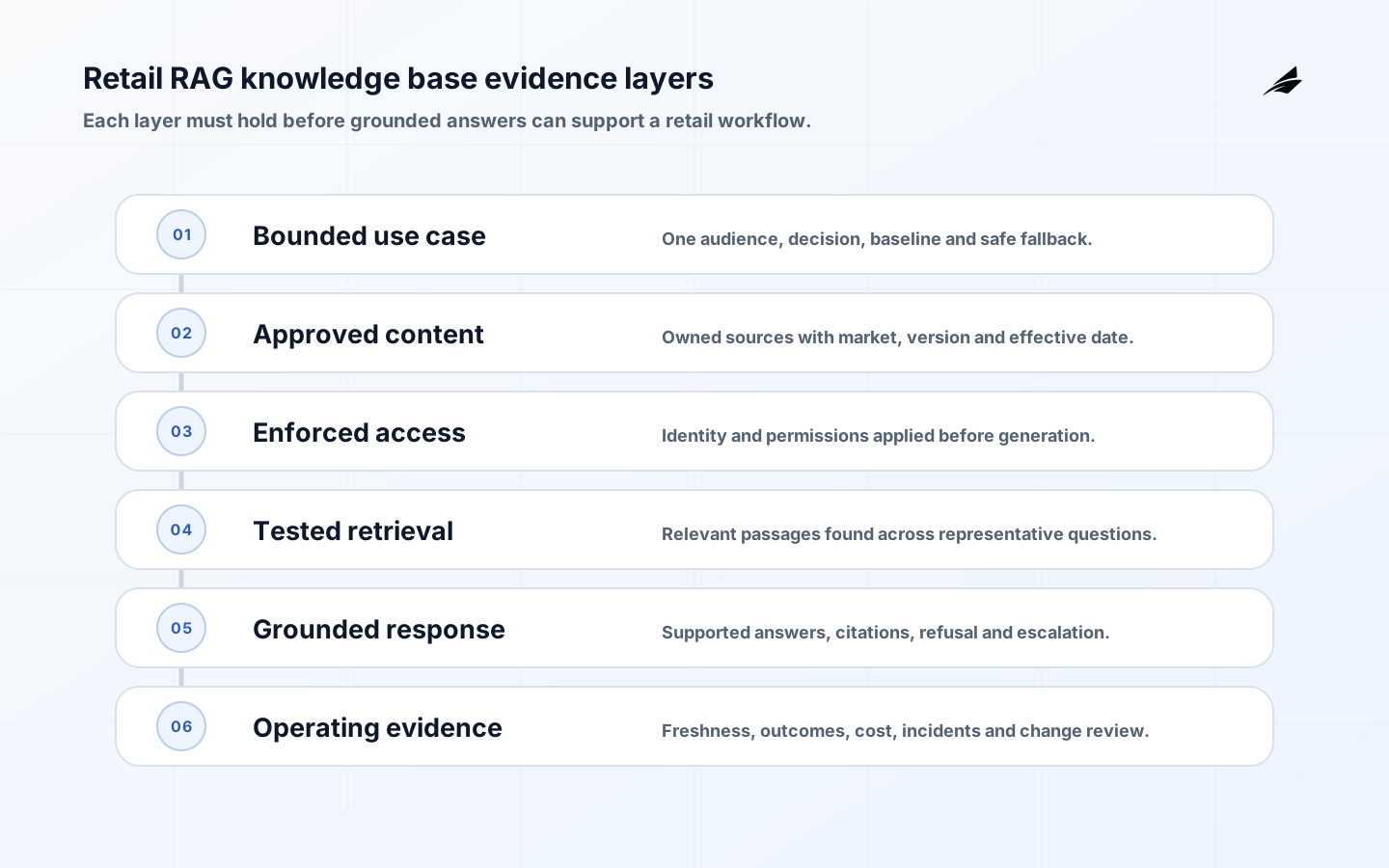
Retail RAG knowledge base implementation should improve a defined employee or customer decision while preserving source authority, access rules and a safe path when the answer is uncertain. Retrieval-augmented generation combines search with a language model so responses can use current retailer content; it does not make weak policies correct or guarantee faithful answers. This plan works alongside Edilec's retail RAG readiness checklist, retail RAG FAQ and retail AI workflow plan.
Microsoft's RAG overview describes retrieval, augmentation and generation, while its advanced RAG guidance adds realistic preprocessing and post-processing. The NIST Generative AI Profile provides a cross-sector risk frame. Use these to structure engineering and evaluation, then apply the retail jurisdictions, contracts and policies that actually govern the service.
Choose one retail RAG use case
Select a bounded journey with authoritative content and a measurable baseline. Store-associate questions about return policy, contact-center product support, and supplier procedure lookup are different products with different users and risk. Record the question population, source owners, languages, response time, current handling effort, escalation route and prohibited advice. Avoid beginning with “all company knowledge.” A narrow corpus makes permission testing, freshness, evaluation and ownership possible.
Define what the assistant may do. It can retrieve passages, summarize them with citations, ask for clarification and route unresolved cases. It should not invent refunds, override policy, promise stock, make regulated product claims or expose another customer's order. For transactional actions, separate the answer system from authorized APIs and require explicit confirmation, validation and audit. A plausible sentence is not an approval.
| Use case | Authoritative content | Primary risk | Safe fallback |
|---|---|---|---|
| Associate policy help | Approved operating procedures | Outdated or location-wrong instruction | Manager or policy desk |
| Product support | Current manuals and approved claims | Unsafe or deceptive advice | Specialist support |
| Order assistance | Customer-specific system of record | Data leakage or wrong action | Authenticated service agent |
| Supplier operations | Contracts and onboarding rules | Cross-supplier disclosure | Procurement owner |
| Store incident help | Safety and response playbooks | Delay during urgent event | Emergency procedure |
Govern content before indexing
Inventory documents, pages, product data, policies, manuals and records with owner, authority, effective date, market, language, audience, confidentiality and supersession status. Remove duplicates and drafts from the approved corpus. Split content along meaningful headings while retaining source, version and permission metadata. Establish a publishing event that re-indexes changed content and withdraws expired material. Retrieval cannot distinguish an authoritative policy from an old slide deck unless the content lifecycle tells it how.
Apply access at retrieval time using a trusted identity and server-side policy. Do not rely on the prompt to tell the model not to reveal restricted text. Test direct questions, paraphrases, multi-turn conversations and malicious instructions embedded in documents. Minimize customer and employee data sent to model, embedding and logging services. The FTC's AI privacy guidance stresses that companies must honor their data-use and confidentiality commitments.
Design retrieval and grounded response behavior
Create representative questions before selecting chunk size, embedding model or ranking method. Compare keyword, vector and hybrid retrieval; tune filters for region, brand, role and effective date. Retrieve enough context to answer without flooding the model with conflicting passages. Require citations to the actual source units and make the interface expose title, date and relevant excerpt. If evidence is missing or conflicting, the response should say so and route the user.

Prompt rules should define task, allowed sources, refusal conditions, output structure and handling of quoted instructions. Validate links and citations after generation rather than trusting the model to format them. Keep model version, prompt version, index snapshot, retrieved document IDs and safety decisions in an appropriately protected trace. That record allows a disputed answer to be reproduced without retaining unnecessary raw conversation forever.
Evaluate retrieval and answers separately
Build a versioned test set from real, anonymized questions plus rare, adversarial and time-sensitive cases. Label expected source, required facts, acceptable variation, refusal and escalation. Measure whether the right evidence appears in the retrieved set before judging prose. Then assess groundedness, factual completeness, citation correctness, instruction following, harmful content, permission leakage and user effort. Segment results by store region, role, language, product type and question difficulty.
| Evaluation layer | Example measure | Release threshold | Failure action |
|---|---|---|---|
| Corpus | Current approved items indexed | Complete for pilot scope | Block release |
| Retrieval | Required source in top results | Set by risk and question class | Tune index or query |
| Answer | Supported required facts | No critical unsupported claims | Refuse or revise |
| Access | Restricted-content leakage tests | Zero in acceptance suite | Stop and remediate |
| Workflow | Resolved without repeat contact | Improves baseline safely | Redesign journey |
Protect commerce, payments and consumer trust
Keep payment account data outside prompts, indexes and general conversation logs unless a formally scoped design requires it. The PCI Security Standards Council explains that PCI DSS protects environments where payment account data is stored, processed or transmitted. Tokenization and payment-provider boundaries can reduce exposure, but the organization must determine its actual scope with qualified expertise.
Customer-facing statements about price, availability, guarantees, health, sustainability or product performance need authoritative evidence and market-specific controls. The FTC advertising guidance states that claims must be truthful, not deceptive or unfair, and evidence-based. Display that the user is interacting with automation where required, provide a human route and prevent the assistant from converting uncertain retrieval into a confident commercial promise.
Model cost across the answer lifecycle
Estimate source cleanup, connectors, content ownership, embedding and re-indexing, search, reranking, model tokens, safety checks, evaluation, observability, support and vendor review. Calculate cost per attempted question and per safely resolved question. Include peak seasonal traffic and cache invalidation when policy or price changes. A cheaper model that creates more escalations or incorrect contacts can increase total cost.
Deliver through controlled stages
- Baseline one journey and approve sources, owners, users and prohibited outcomes.
- Build permission-aware ingestion with version, market and effective-date metadata.
- Tune retrieval against a labeled question set before optimizing generated prose.
- Run offline safety, access, citation and adversarial tests with frozen versions.
- Pilot with a small user group, visible escalation and daily answer review.
- Scale only after outcome, risk, freshness, cost and support gates pass.
Run retail RAG production assurance
Before opening the assistant to more stores or customers, review a sample of complete conversations from question to action. Include correct answers, refusals, escalations, abandoned sessions and complaints. Verify the cited source, source version, retrieved passages, permission decision, generated response and downstream outcome. Reviewers should be able to distinguish a retrieval failure from an answer, interface, content or training failure because each has a different owner.
Test content-change races. Update a return policy, withdraw a product manual, change a regional promotion and revoke a user role while queries are active. Measure the time until indexes, caches and citations reflect the authoritative state. Decide what the assistant says during re-indexing or conflicting effective dates. Retail operations often change quickly; an average daily refresh may be unacceptable for a policy that changes at a precise cutover.
Use red-team scenarios grounded in the actual corpus. Insert malicious instructions in a supplier document, request another store or customer's restricted data, ask the model to ignore policy, and combine harmless facts into a sensitive inference. Test tool calls with invalid identifiers and repeated confirmation. Preserve enough evidence to investigate while limiting who can see customer conversations. Remediate the architecture, not just the exact prompt.
Observe store and contact-center behavior. Check whether users verify citations, over-trust fluent answers, create shadow prompt libraries or bypass escalation because it is slow. Measure repeat contacts and corrections after a seemingly resolved session. Improve interface, policy and staffing together. Training that merely tells people the model can be wrong is weaker than making uncertainty, evidence and escalation usable in the moment.
Approve scale by market and use case rather than by a single global score. Content authority, language quality, consumer law, products and support capacity differ. Maintain a local owner, acceptance set and stop condition for each expansion. Retire old indexes, prompts and permissions after cutover, and retain only the records required for investigation and improvement.
Include accessibility and language in production assurance. Test keyboard and assistive-technology use, reading level, speech channels, source-link clarity and handoff for users who cannot complete the automated path. Evaluate translations against the authoritative local policy rather than translating an answer produced for another market. Record whether the escalation channel preserves conversation context without forcing the customer to repeat sensitive details. An assistant that saves handling time for most users while excluding a smaller group has not demonstrated complete workflow value.
- Trace answers to current approved sources.
- Test policy cutovers and role revocation.
- Red-team documents, retrieval and tools.
- Observe over-reliance in real workflows.
- Approve each market and use case separately.
Key takeaways
- Bound retail RAG around one decision and authoritative corpus.
- Enforce permissions in retrieval and integrations, not with prompt wording.
- Measure retrieval, answer support, access and workflow outcomes separately.
- Keep payment data and unsupported commercial claims out of general answers.
- Scale from safely resolved questions and maintained content ownership.
Frequently asked questions
Does RAG eliminate hallucination?
No. Retrieval can supply current evidence, but it can retrieve the wrong passage or the model can misuse good context. Use source governance, retrieval tests, grounded-answer evaluation, citations, refusal and escalation together.
Should a retailer fine-tune instead?
Fine-tuning and RAG solve different problems. RAG is useful for changing proprietary facts and traceable sources; fine-tuning may shape behavior or specialized patterns. Compare both against the use case, update frequency, evidence needs, cost and risk.
What is the smallest credible launch?
One user group, one journey, an approved corpus, a labeled evaluation set, enforced access, citations and a staffed escalation path. A broad chatbot with no content owner is not a smaller launch; it is an unbounded one.
Conclusion
A retail RAG knowledge base earns trust by returning the right approved evidence to the right person and declining when it cannot. Govern content, enforce access before generation, test retrieval independently, protect transactions and measure safe resolution. Those disciplines turn a demonstration into a maintainable retail service.