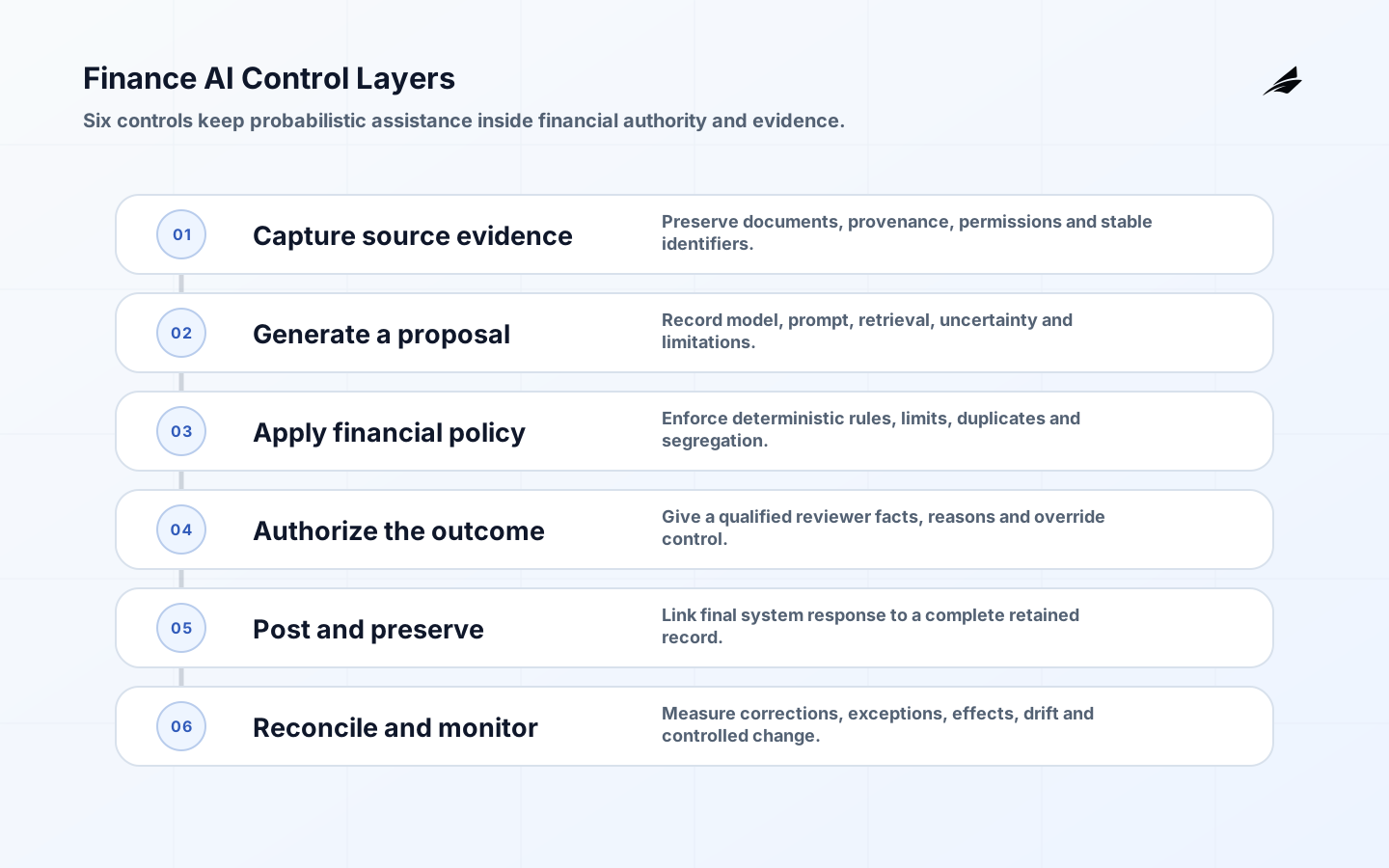
AI workflow automation for finance is most useful when it prepares evidence, classifies work or proposes a bounded action inside an existing control system. It should not erase accountability for approvals, customer outcomes, ledger entries or regulatory records. This FAQ helps finance, risk, engineering and operations teams decide where AI belongs and what must remain deterministic or human-authorized.
Use it with the finance AI workflow delivery plan, finance implementation checklist, startup AI workflow guide and startup automation checklist. Legal, compliance and audit owners should tailor controls to the entity, jurisdiction and activity.
Which finance workflows are suitable?
Good first uses have high manual volume, reviewable inputs, bounded outputs and a safe fallback. Examples include invoice field extraction, expense-policy triage, reconciliation candidate matching, evidence collection and exception summarization. Start by assisting an analyst rather than posting entries or communicating an adverse customer decision. Measure correction rate, exception rate, cycle time, false escalation and downstream rework.
Avoid a pilot where success depends on undocumented judgment or inaccessible ground truth. Map trigger, data, policy, model, deterministic rules, approval authority, posting system, customer communication, record retention and appeal. Define prohibited actions. A language model may summarize a variance; a rules engine should enforce monetary limits; an authorized person or controlled policy should approve material movement.
| Workflow | AI role | Required control |
|---|---|---|
| Invoice intake | Extract fields and flag anomalies | Source image, validation and duplicate check |
| Reconciliation | Rank candidate matches | Tolerance rules and reviewer confirmation |
| Expense review | Classify evidence and explain policy issue | Deterministic policy and appeal |
| Close support | Summarize variances | Ledger-grounded values and sign-off |
| Customer decision | Limited support only | Applicable decision, notice and review controls |
How should AI risk be governed?
The NIST AI Risk Management Framework organizes work through Govern, Map, Measure and Manage and treats risk management as continuous across the lifecycle. Create an inventory of AI components, owners, purpose, affected parties, data, model and prompt versions, evaluation results, limitations and fallback. Classify consequence separately from novelty: a simple model that can block a payment may deserve more control than a complex internal summary tool.
For banking organizations within its applicability, the Federal Reserve's SR 26-2 revised model-risk guidance, issued April 17, 2026, supersedes SR 11-7 and emphasizes a risk-based approach tailored to model profile, size and complexity. Determine with the responsible risk function whether an AI component is a model and what development, validation, inventory, change and monitoring controls apply.
How are authority and segregation preserved?
Give the workflow its own service identity and minimum permissions. Separate input preparation, proposal, approval and posting. Enforce approval limits in deterministic policy outside the model. Prevent the same operator from changing a rule, approving the resulting exception and suppressing the audit event. Emergency override should be time-bound, reasoned, logged and reviewed afterward.

Use the NIST SP 800-53 control catalog to inspect relevant access, audit, configuration, contingency, incident and system-integrity control families. Map controls to evidence: identity assertion, rule version, approval record, posting response and exception disposition. A chat transcript is not a complete control record when downstream state changes separately.
What records and explanations are needed?
Preserve the source record, normalized inputs, model and prompt or feature version, retrieved evidence references, deterministic rule outcomes, proposed action, confidence or uncertainty signal, reviewer decision, final system response and timestamps. Apply the entity's retention schedule and legal requirements. For broker-dealers in scope, the SEC's electronic recordkeeping amendments address preservation, third-party recordkeeping and prompt production of records.
Generate explanations from the facts and policies that actually determined the outcome, not a plausible narrative created afterward. This is particularly important for credit. The CFPB circular on adverse-action notices states that creditors must provide specific principal reasons and cannot rely on sample-form reasons that do not reflect the actual factors. Obtain qualified compliance advice for the workflow.
How should the workflow be tested?
Build a representative, time-separated evaluation set covering ordinary work, rare exceptions, missing and conflicting documents, duplicate records, threshold boundaries and adversarial instructions embedded in documents. Test extraction accuracy by field, decision agreement, unsupported claims, false escalation, subgroup performance where relevant, and downstream accounting effects. Keep production data out of general-purpose evaluation tools unless use and protection are explicitly approved.
| Gate | Evidence | Stop condition |
|---|---|---|
| Data | Provenance, permission, quality and leakage review | Unapproved or untraceable data |
| Model | Representative evaluation and limitations | Material threshold miss |
| Workflow | Role, limit, exception and idempotency tests | Unauthorized or duplicate action |
| Operations | Monitoring, fallback, retention and incident drill | No practical safe fallback |
| Release | Named risk and business acceptance | Unowned residual risk |
Run in shadow mode before influencing work, then use suggestion-only mode with reviewer feedback. Sample both accepted and rejected proposals; reviewers can normalize errors by silently correcting them, hiding model weakness. Reconcile proposed actions to posted entries and cash or customer effects. Test model-provider outage, timeout, malformed response, prompt-injection attempt and rollback to a known version.
What must be monitored after launch?
Monitor input distribution, missing fields, model and rule versions, automation rate, override and correction rates, exception age, unsupported output, downstream rejects, duplicate prevention, latency and cost. Segment by workflow type, entity and material cohort. Set review thresholds before launch and link each alert to an owner and containment action. A higher automation rate is not success if corrections or unresolved exceptions rise.
Treat model, prompt, retrieval source, policy, threshold and provider changes as controlled releases. State expected effect, rerun regression and risk tests, obtain required validation or approval, stage exposure and preserve rollback. Revalidate after material data or process shifts. Maintain an exit plan that can route work to a deterministic or manual path without losing queue state and evidence.
Worked example: invoice exception preparation
A finance team receives invoices through a controlled mailbox and spends time rekeying fields and assembling evidence for mismatches. The AI component extracts supplier, invoice number, purchase order, amount, currency and line descriptions, then summarizes differences against purchase-order and receipt data. Deterministic services validate supplier status, duplicate keys, arithmetic, tax rules and approval limits. The AI cannot create a supplier, alter a purchase order, approve an exception or post to the ledger.
Evaluation uses a time-separated set with scans, credit notes, multiple currencies, missing receipts, duplicate invoices and text that attempts to instruct the model. Field-level accuracy and unsupported claims are measured separately. In suggestion-only mode, reviewers see the source image and matched system records beside the proposal. Corrections are captured by field and reason. A timeout routes the invoice to the ordinary intake queue with its original attachment and receipt timestamp intact.
Release authority expands only for clean extraction into a pending record; every mismatch still requires an authorized reviewer. The evidence package records document hash, extracted values, model and prompt version, rule outcomes, reviewer, final disposition and posting identifier. Operations reconcile pending records to the ledger interface daily. When a model update reduces one field's accuracy for credit notes, monitoring breaches the agreed threshold and traffic returns to the prior version while the affected cohort is reprocessed.
Control evidence before expanding authority
- Approved use-case statement, prohibited actions, affected parties and residual-risk owners.
- Process map linking source evidence, model output, deterministic rules, approval and final posting.
- Model inventory record with purpose, versions, data, validation, limitations, fallback and review date.
- Representative evaluation covering ordinary, rare, incomplete, conflicting and adversarial inputs.
- Field and workflow results segmented by material transaction and customer cohorts.
- Service identity and role tests proving monetary limits and segregation cannot be bypassed.
- Record package that reproduces actual inputs, rules, approvals, system response and timestamps.
- Shadow and suggestion-only results including reviewer corrections to accepted and rejected proposals.
- Ledger, cash or customer-effect reconciliation for every automated or assisted outcome.
- Provider outage, timeout, malformed response, duplicate and rollback exercise results.
- Monitoring thresholds for correction, override, unsupported output, exception age and downstream rejects.
- Change procedure covering model, prompt, retrieval, rule, threshold, supplier and data shifts.
Key takeaways
- Begin with bounded assistance where source evidence and correction are available.
- Keep monetary limits, segregation and final authority outside probabilistic output.
- Preserve the actual facts, policies, versions and decisions behind each action.
- Evaluate exceptions and downstream financial effects, not only model accuracy.
- Monitor corrections and overrides and maintain a tested non-AI fallback.
Frequently asked questions
Can AI post directly to a ledger?
Only in a tightly bounded workflow after deterministic validation, authorization, duplicate prevention, reconciliation and fallback are proven, and only where policy permits. Many teams should begin with a proposed entry that an authorized workflow approves and posts.
Does human review solve AI risk?
Not by itself. Reviewers need source evidence, time, authority, training and usable explanations. Measure whether they catch seeded and real errors, and protect against automation bias. System controls must prevent actions beyond their approval.
What should be required from an AI workflow vendor?
Require data-use terms, security and access controls, model and subcontractor transparency, change notice, evaluation support, logs, incident notification, retention and deletion, portability and continuity. The financial institution remains responsible for its own control and regulatory analysis.
Conclusion
Finance AI automation is defensible when probabilistic assistance sits inside explicit authority, evidence and reconciliation. Bound the use case, preserve actual decision factors, test operational failures and keep a working fallback. That design can reduce manual work while strengthening, rather than obscuring, financial control.