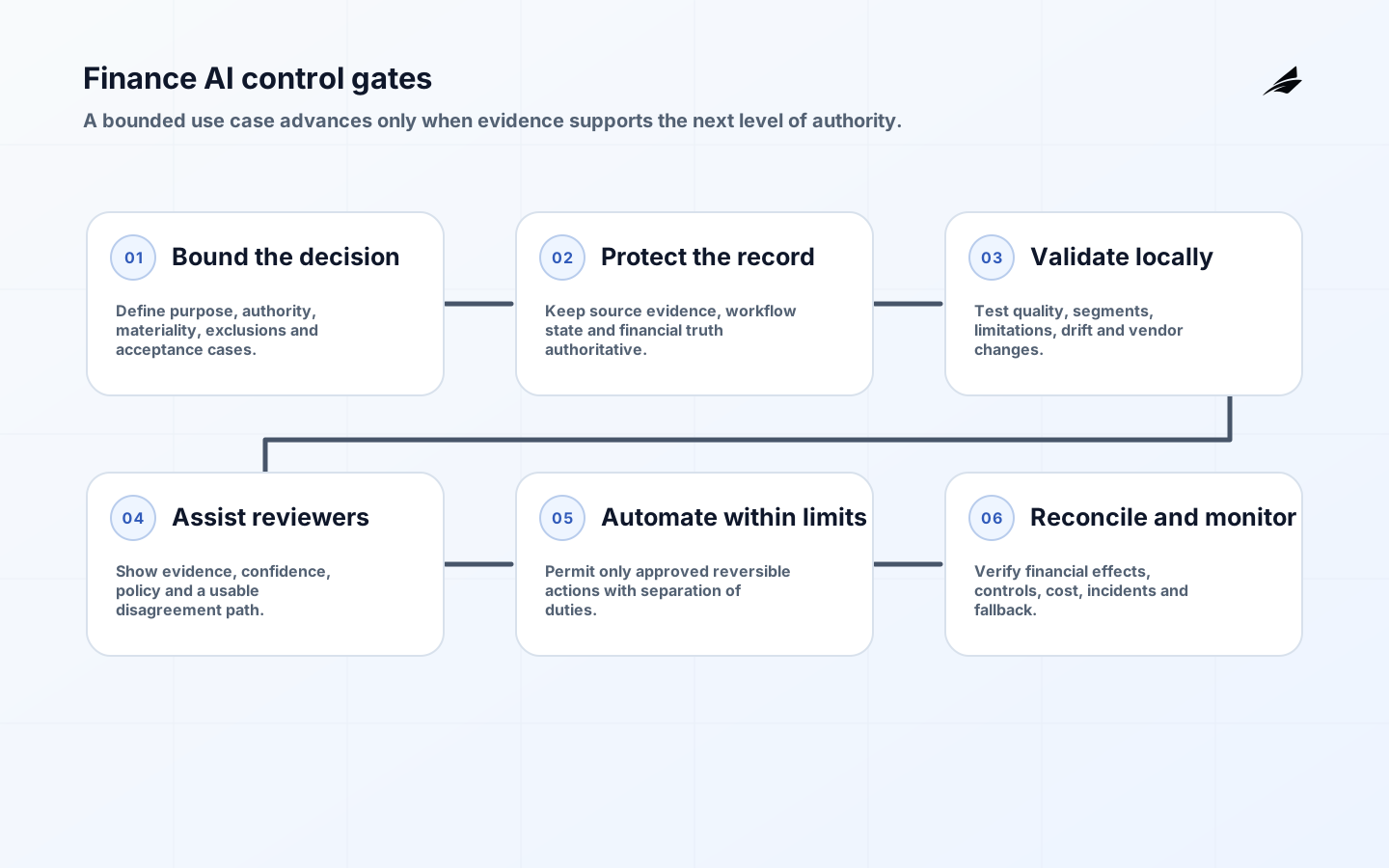
AI workflow automation services for finance can classify documents, route exceptions, reconcile records, prepare narratives, detect anomalies and assist reviews. The valuable product is not a model endpoint; it is a controlled process that preserves financial authority, source evidence and recoverability. Scope must distinguish advice from approval and operational convenience from regulated decisioning. This guide gives finance, risk, compliance and technology teams a delivery plan that starts with a bounded decision and ends with monitored business outcomes.
Use the finance AI workflow implementation checklist during build and the finance automation FAQ during procurement. The startup AI workflow delivery plan offers a lighter operating context. Before vendor selection, name the process owner, financial control owner, model-risk reviewer, data owner and technical service owner.
Scope a decision, not a general AI assistant
Map the current workflow from trigger to booked, paid, reported or closed outcome. Capture normal paths, corrections, period-end pressure, segregation of duties, materiality, evidence and downstream systems. Select one decision such as invoice coding recommendation, cash-application matching, expense exception routing or draft variance explanation. State whether the system proposes, prioritizes, executes or approves. Exclude use cases whose source data, authority or harm cannot yet be bounded.
Define an acceptance set from historical and deliberately difficult cases: duplicates, missing fields, conflicting evidence, new suppliers, unusual currencies, reversals, close-period adjustments and attempted fraud. Agree precision, recall or ranking metrics by case type alongside false-action cost, manual review load, processing time and financial accuracy. The NIST AI Risk Management Framework organizes work through Govern, Map, Measure and Manage; apply all four throughout the workflow lifecycle, not as a launch document.
| Automation level | System may do | Required control |
|---|---|---|
| Summarize | Prepare evidence or narrative | Source citations and reviewer edit |
| Recommend | Suggest code, match or route | Confidence and human decision |
| Execute reversible | Create draft or hold item | Limits, logging and rollback |
| Execute material | Post or release value | Explicit authority and dual control |
| Approve | Complete controlled decision | Usually retained by authorized person |
Design the authoritative workflow record
Give every case a durable identifier and state history. Record input references, source versions, model and prompt version where relevant, retrieved context, output, confidence, rules, human decision, reason, timestamps and downstream result. Keep the general ledger, payment platform or approved system as authoritative for financial state. The AI service should not silently maintain a competing truth. Use idempotency keys and reconciliation so retries cannot create duplicate postings or payments.
Separate deterministic policy from probabilistic judgment. Thresholds, approval limits, period locks, sanctions matches and required fields belong in explicit versioned rules where possible. AI can interpret unstructured evidence or prioritize ambiguous cases, but it should not invent policy. Route low-confidence, conflicting and out-of-distribution cases to trained reviewers with the source context they need. A fallback is a designed operating state with queue ownership and service expectations, not an error message.
Apply model and use-case governance proportionate to risk
For banking organizations within scope, the April 2026 interagency revised model-risk guidance, SR 26-2, supersedes SR 11-7 and emphasizes a risk-based approach tailored to model profile, size and complexity. Other firms can still use its core disciplines as governance prompts: inventory, clear purpose, effective challenge, validation, change control and ongoing monitoring. Determine applicability with the relevant risk and legal functions rather than labeling every AI component a regulated model or excluding it by vendor terminology.

Maintain an inventory linking model, workflow, owner, purpose, data, vendor, version, dependencies, risk tier, validation and retirement. Independent review should challenge conceptual design, data relevance, performance, limitations and implementation. For third-party models, obtain enough information and testing rights to understand fitness for use; a vendor benchmark does not validate local invoices, customers or controls. Document accepted limitations and prevent deployment outside the approved purpose through access and interface design.
Preserve explanation, fairness and financial authority
Requirements depend on the decision. In U.S. credit, the CFPB circular on complex algorithms and adverse action states that creditors must provide accurate, specific principal reasons and cannot use model opacity as a defense. Do not reuse a back-office automation architecture for credit decisions without legal, fair-lending, data and explanation controls. Similar caution applies to fraud holds, customer eligibility and other consequential actions.
Test outcomes across legally and operationally relevant segments, sample sizes permitting, and investigate material differences with domain experts. Proxy removal alone does not establish fairness. Provide reviewers the actual evidence and policy basis, not only a generated rationale. Limit personal and confidential data to the approved purpose, enforce retention and prevent production records from entering unapproved model training. The final authorized actor and the evidence available at that moment must be reconstructable.
| Risk | Production indicator | Response |
|---|---|---|
| Input drift | Field distribution or source changes | Pause affected route and assess |
| Quality decay | Error by case type rises | Increase review and retrain or revise |
| Automation bias | Reviewer override collapses unnaturally | Sample decisions and retrain users |
| Control bypass | Postings lack required authority | Block, reconcile and investigate |
| Vendor change | Undeclared model behavior shifts | Freeze version or revalidate |
| Data leakage | Sensitive content appears in output or logs | Contain, notify and remediate |
Engineer security and resilience across the workflow
Threat-model document ingestion, retrieval, prompts, model APIs, workflow engine, reviewer interface and financial integrations. Untrusted documents can contain instructions designed to influence a generative model; separate document content from system policy and constrain tool use. Apply least privilege, protected secrets, network controls, encryption and tamper-evident logs. The NIST Generative AI Profile identifies risks and actions specific to generative systems; use it when generation is actually part of the design.
Build graceful degradation. If the model, retrieval index or vendor is unavailable, queue cases safely or revert to the documented manual process. Cap retries and spending. Back up workflow state and configuration, and test restoration plus downstream reconciliation. Use the NIST Cybersecurity Framework 2.0 to connect governance, supply-chain risk, protection, detection, response and recovery. AI-specific review does not replace ordinary secure engineering.
Model total cost and expected value
Estimate discovery, process redesign, data access, integration, model or API usage, workflow software, evaluation, security, validation, change management, reviewer time, observability, support and exit. Unit economics should use cost per completed accurate case, not token cost alone. Model volume, document size, exception rate, rework and peak close periods. Include a scenario where more cases require human review than expected. Savings exist only when work or loss is actually reduced without weakening control.
Compare the automation with simpler alternatives: deterministic rules, better forms, system integration, search or queue redesign. AI is justified when variation or unstructured evidence creates material work that simpler methods cannot handle safely. Establish a baseline for cycle time, error, backlog, loss and labor. After launch, report gross benefit, operating cost, remediation cost and control outcomes. Do not count faster draft generation as realized value if reviewers spend the saved time correcting unsupported content.
Deliver through shadow, assist and bounded automation stages
Stage one observes the current process and creates an evaluation set. Stage two runs in shadow without affecting work. Stage three shows suggestions to reviewers and captures decisions. Stage four automates a narrow reversible action under limits. Stage five expands only after monitored evidence. Each gate needs quality by case type, control performance, reviewer load, incidents, cost and rollback readiness. Keep model and workflow changes independently deployable when practical so causes can be isolated.
Train reviewers on limitations, source inspection, escalation and accountability, not merely interface buttons. Watch for automation bias and alert fatigue. Release to one team or transaction class with a staffed manual fallback. Sample accepted and rejected results, reconcile downstream financial effects and hold a post-period review. Procurement should secure data-use restrictions, model-change notice, service levels, audit support, portability and deletion. Exit testing belongs before large historical data volumes accumulate.
Create a production change matrix for model, prompt, retrieval corpus, deterministic rule, workflow configuration and financial integration. Each change type should name required tests, reviewer, deployment window, rollback and whether prior cases must be re-evaluated. A prompt edit can change classification behavior as materially as a code release; an updated policy document can alter retrieved advice without any model change. Link every production output to the effective component versions. During close or another restricted period, freeze high-risk changes and use an emergency path with retrospective review.
Key takeaways
- Bound one financial decision and state exactly what AI may influence.
- Keep authoritative financial state and deterministic policy outside the model.
- Apply risk-based inventory, validation, challenge and ongoing monitoring.
- Preserve specific reasons, human authority and reconstructable evidence for consequential decisions.
- Scale from shadow mode only when quality, controls, cost and fallback agree.
Frequently asked questions
Does a human review make an AI workflow safe?
Not automatically. The reviewer needs authority, time, source evidence, clear criteria and a usable way to disagree. Measure overrides, decision time and error. A rushed person who sees only the model's conclusion can become a nominal control rather than an effective one.
Should we build or buy the model?
Buy when a provider meets data, transparency, performance, change and exit needs; build when the model is differentiating or local data and control demand it. In either case, the organization owns use-case validation and workflow controls. Compare lifecycle governance and integration, not only model accuracy.
How long should a pilot run?
Long enough to cover representative volume, period-end behavior, unusual cases and staff variation. A monthly close use case usually needs at least one full close and preferably more. Set case coverage and acceptance evidence beforehand rather than treating a quiet two-week trial as proof.
Conclusion
Finance AI automation should make decisions more controlled and evidence more usable, not obscure how money moved. Scope a bounded use case, preserve authoritative records and human authority, validate locally, engineer fallback and scale through measured gates. That approach turns AI from an impressive component into a finance service that can withstand close, incident and review.