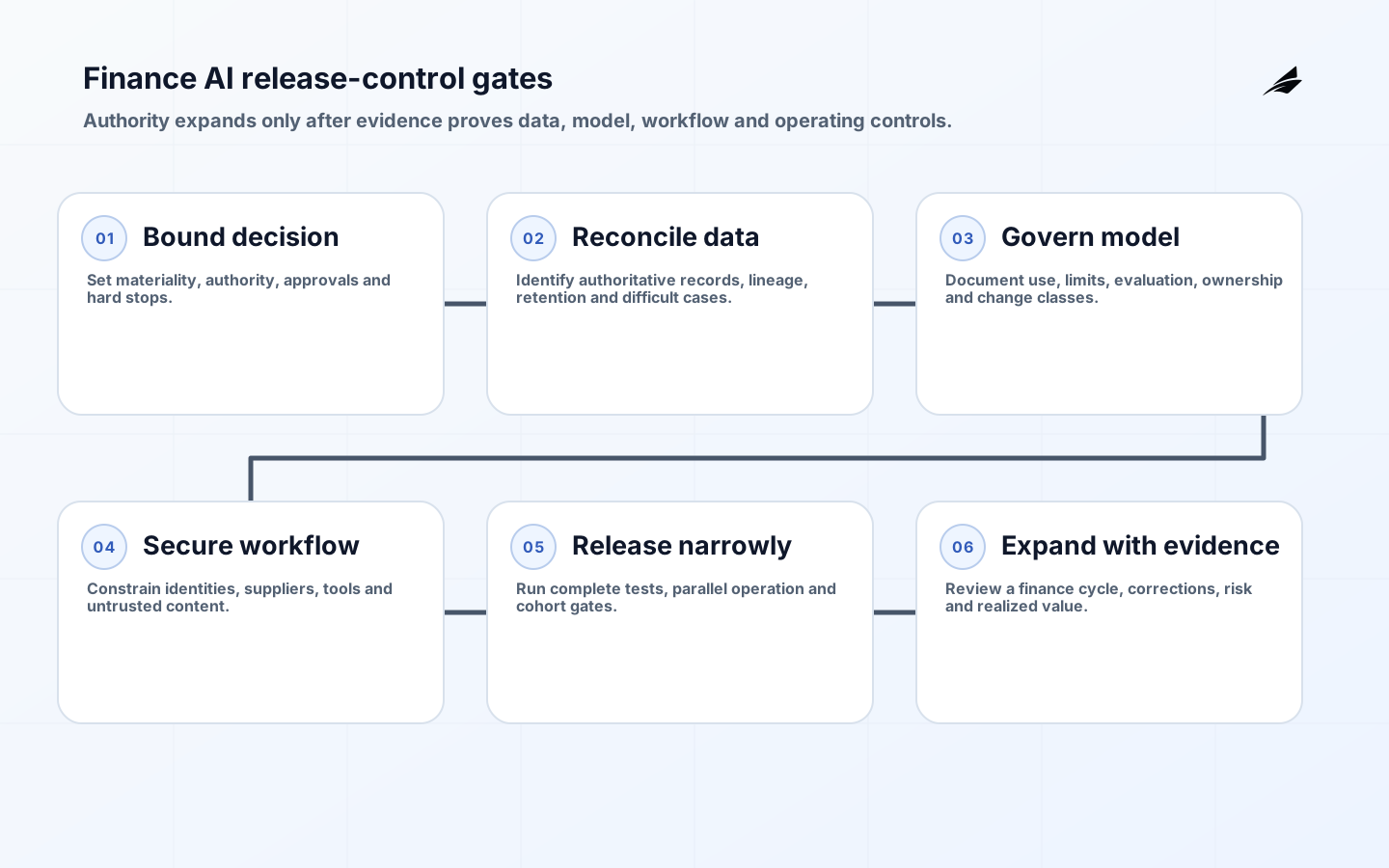
AI workflow automation for finance should begin with a controlled decision, not a model demonstration. Finance work connects evidence, policy, approval authority and accounting records; an automation error can create a duplicate payment, unsupported journal, missed obligation or misleading report. The implementation objective is therefore to reduce handling effort while preserving the ability to explain who authorized an action, which source records supported it, what the system proposed, and how exceptions were resolved. A model can recommend or extract, but software boundaries must decide what it may read, write, approve and release.
This checklist applies to use cases such as invoice intake, expense review, reconciliation support, cash application, close assistance and management reporting. It complements the finance automation scope and risk plan and the finance workflow FAQ. Regulated institutions should map the design to applicable supervisory expectations. In April 2026, US banking agencies issued revised model-risk guidance emphasizing a risk-based approach tailored to model use, profile, size and complexity; older programs should verify which guidance now applies.
1. Bound the finance use case and authority
Describe one work item from receipt to authoritative posting. Name the initiating event, source documents, required checks, decision owner, output record and correction path. Separate assistance from execution. Summarizing an invoice packet, proposing a coding value, matching a remittance and releasing a payment have progressively greater consequences. Define the maximum action the system may take at each confidence and risk level. Prohibit the model from inventing missing values; missing tax, vendor or bank information should create a visible exception rather than a plausible completion.
Record materiality and reversibility. A low-value internal allocation may tolerate a different review path from a new supplier bank-account change. Create deterministic hard stops for new payees, changed payment instructions, unusual amounts, closed accounting periods, segregation-of-duties conflicts and unsupported journals. Human approval must be meaningful: show the original evidence, proposed action, policy checks and uncertainty rather than asking someone to approve a polished summary. Capture the approver's identity and the exact version reviewed.
| Automation level | Permitted behavior | Required control |
|---|---|---|
| Assist | Extract, summarize or suggest without changing records | User verifies against source evidence |
| Prepare | Create a draft transaction or reconciliation item | Deterministic validation and named approval |
| Execute | Post or release a bounded low-risk action | Policy gate, independent monitoring and rapid reversal |
| Escalate | Route missing, conflicting or high-risk evidence | Queue ownership, service target and no silent fallback |
2. Establish data quality, lineage and retention
Inventory every input: documents, ERP records, bank files, procurement data, tax rules and master data. Mark the authoritative system, owner, freshness expectation and permitted use. Normalize identifiers before matching. A model should not resolve vendor identity from a display name when an approved supplier identifier is available. Preserve links to source records so reviewers can reproduce the decision. Where documents are transformed, retain the original or a verifiable reference according to policy. Mask or exclude personal and confidential data that is unnecessary for the task.
Test representative difficult cases, not only clean historical examples. Include scans, duplicate invoices, credit notes, partial deliveries, foreign currencies, split purchase orders, changed tax treatment and intentionally conflicting instructions. Partition evaluation data from development data and protect it against leakage. Measure extraction at field and document level, but also measure the downstream result: an apparently accurate field can still be wrong for the transaction context. Define retention for prompts, outputs, intermediate files and feedback; model providers should not receive broader rights to finance data than the approved purpose requires.
3. Apply proportionate model governance
Classify the component by use, impact and dependency. Document purpose, owners, model and provider versions, data boundaries, evaluation results, known limitations, prohibited uses and monitoring. Independent challenge should test assumptions and failure modes rather than merely reread the development report. For externally supplied models, obtain enough information to understand changes, service behavior and data handling. When full model transparency is unavailable, narrow authority, increase independent validation and add deterministic controls around the component. A vendor assurance report cannot substitute for testing the organization's own workflow.
Create change categories. Prompt wording, extraction schema, model version, retrieval corpus, threshold and upstream ERP logic can each change outcomes. Require regression evaluation before promotion and keep a previous configuration available for rollback where feasible. Monitor drift in input mix, exception rate, override rate and downstream corrections. A stable average can hide deterioration for one supplier, currency or document type, so slice results by material cohort. Establish a retirement trigger if the model no longer improves the controlled process or if safe operation requires excessive manual repair.
4. Secure the workflow and its suppliers
Use individual service identities and least privilege. The extraction component does not need payment-release authority; the orchestration service should only write approved fields; the reviewer interface should expose the minimum sensitive data needed. Separate production from experimentation, keep secrets outside prompts and repositories, validate file types, scan uploads and constrain retrieval sources. Treat document text as untrusted input because instructions embedded in a file can attempt to redirect a generative system. Model output is also untrusted until schema, range, business-rule and authorization checks pass.
Assess third parties across data location, subprocessors, incident notification, service changes, model training use, deletion, continuity and exit. The OCC's interagency guidance frames third-party risk across planning, due diligence, contract negotiation, ongoing monitoring and termination. Translate that lifecycle into the service design. Retain customer-controlled copies of configurations, evaluation cases, decision records and operational data. Test degraded operation when the model or provider is unavailable; the finance process should queue safely, fall back to a documented manual path or stop, not silently skip control.
5. Test the complete decision path before release
Build tests in layers. Unit tests cover transformations and business rules. Contract tests pin ERP and provider interfaces. Evaluation tests measure model behavior on an approved corpus. Workflow tests prove authorization, duplicate handling, retries, timeout and queue behavior. Reconciliation tests compare generated and authoritative totals. Security tests challenge file handling, access control and prompt injection. Finally, run a parallel period in which the system proposes actions while existing controls remain authoritative. Compare discrepancies and investigate why, instead of treating agreement with historical decisions as automatic proof of correctness.
Release by cohort, transaction class and value threshold. Start where errors are reversible and evidence is strong. Give operations a kill switch that prevents new automated actions without losing queued work. Define rollback for model, prompt, rules and integrations separately. Rehearse a duplicate event, unavailable ERP, corrupted document, changed supplier account and mistaken approval. Acceptance requires both accuracy and operability: finance staff must be able to find an item, understand its state, correct it with authority and see the resulting accounting effect.
| Release gate | Evidence | Stop condition |
|---|---|---|
| Data | Authoritative sources, lineage and difficult-case corpus | Unknown ownership or untraceable values |
| Decision | Documented limits, approvals and segregation tests | Model can exceed approved authority |
| Quality | Cohort evaluation and reconciliation results | Material unexplained discrepancy |
| Operations | Queue, alerts, runbook and fallback rehearsal | No safe degraded mode |
| Change | Versioned configuration and regression evidence | Provider change cannot be detected or reversed |
6. Measure control quality and operating value
Track straight-through completion only with correctness and risk. Useful measures include cycle time, queue age, exception rate, override rate, duplicate prevention, reconciliation breaks, post-close corrections and hours spent on investigation. Slice by workflow and material cohort. An override is not necessarily model failure; it may reveal a policy exception, stale master data or an unclear interface. Require reviewers to select structured reason codes and allow narrative context for new patterns. Review false confidence separately: high-confidence incorrect actions are more dangerous than visible low-confidence exceptions.
Assign daily operational ownership and periodic governance. Operations monitors queues and service failures; finance control owners review exceptions and evidence; model owners analyze performance; security handles threats and incidents; an accountable business owner decides whether authority should expand. Audit access should be read-only and reproducible. Hold a post-release review after a full business cycle such as month-end, not just after a calendar week. Expand only if the evidence shows lower effort or faster completion without weaker control, hidden rework or concentration of risk.
Implementation order
- Select one bounded finance decision and define materiality, authority and stop rules.
- Reconcile source systems, identifiers, data rights, lineage and retention.
- Document model purpose, limitations, evaluation plan and change classes.
- Build deterministic validation, segregation, security and supplier controls.
- Run complete workflow tests and a parallel operating period.
- Release by low-risk cohort, review a full finance cycle and expand only with evidence.

Key takeaways
- Separate model assistance from software authority.
- Keep every proposed action traceable to source evidence and policy checks.
- Evaluate hard finance cases and downstream accounting outcomes.
- Govern supplier and model changes as production changes.
- Expand authority only after a complete business cycle demonstrates control and value.
Frequently asked questions
Should every AI-generated finance action require approval?
Not necessarily, but authority should be earned by use case. Low-risk, reversible actions with deterministic validation may move toward automated execution. New payees, changed bank details, material journals, policy exceptions and unusual transactions should retain strong independent approval.
What accuracy level is acceptable?
No single percentage answers this. Set thresholds by field, transaction consequence and review path. A system can tolerate more visible exceptions than silent errors. Evaluate false acceptance, false rejection, cohort performance and reconciliation impact, then connect thresholds to materiality and control.
How should ROI be calculated?
Include implementation, licenses, review, exception handling, monitoring, assurance and change work. Count time saved only when it is actually removed or redirected. Add avoided duplicate payments, faster close or improved evidence where supported, but do not assign invented monetary values to risk reduction.
Conclusion
Finance automation becomes dependable when a bounded model capability sits inside a reconciled, authorized and observable workflow. Define the decision, preserve source evidence, validate difficult cases, constrain suppliers and rehearse failure. A controlled release should make finance work easier to complete and easier to audit at the same time.