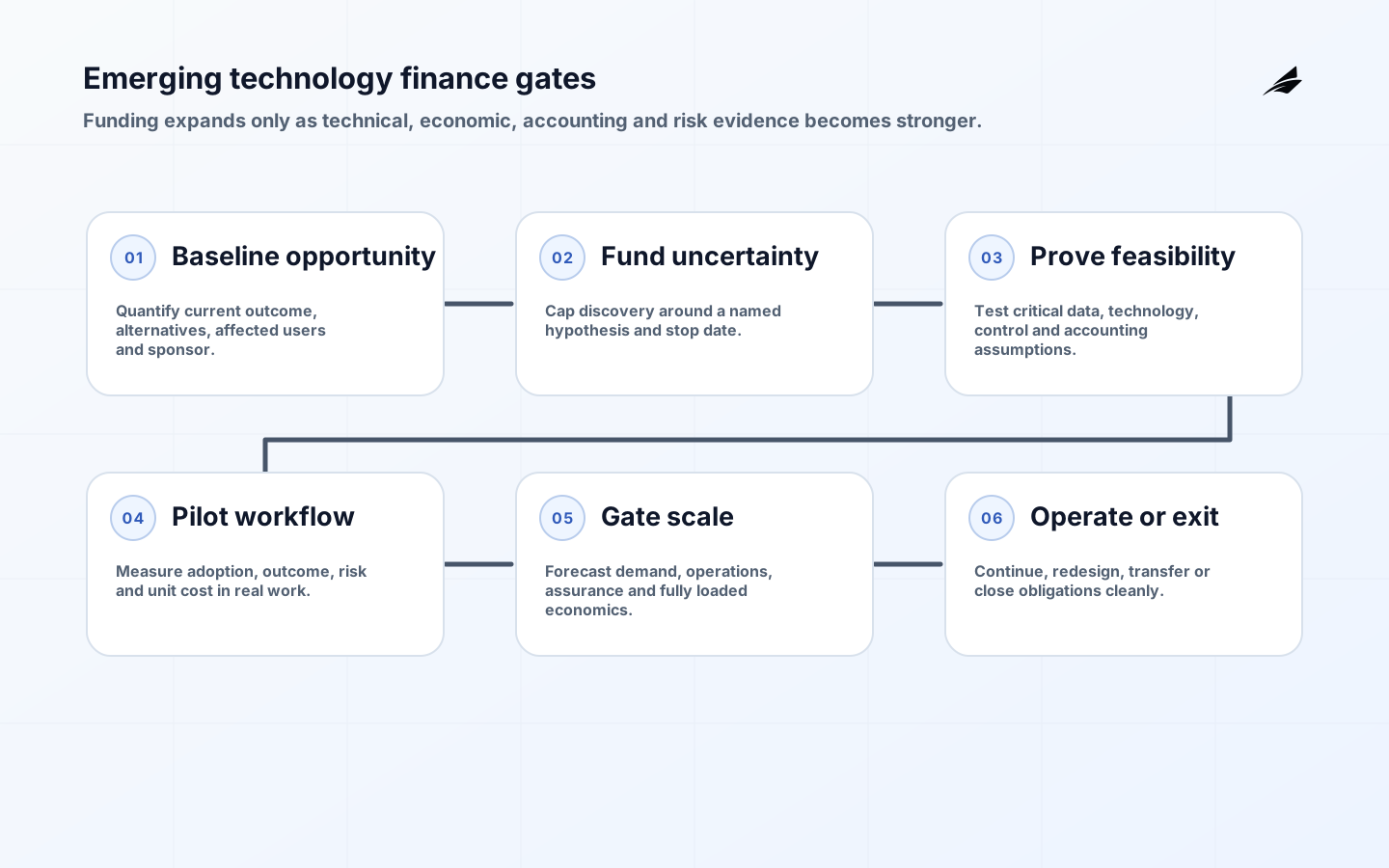
Emerging technology finance is the discipline of funding, accounting for and controlling technology whose benefits, usage and operating cost are still uncertain. It applies to AI, consumption-priced cloud, automation, distributed ledgers, connected devices and other capabilities where a conventional fixed-scope capital request can create false precision. Finance does not need to predict one number perfectly; it needs a decision system that exposes assumptions, limits loss and releases more funding when evidence improves.
This FAQ is for finance, product, engineering, procurement and risk leaders designing that system. It pairs with the emerging technology finance practical guide, the implementation checklist, the airline technology planning guide and its implementation checklist. Accounting conclusions depend on jurisdiction and facts, so involve qualified finance and tax advisers rather than using a delivery label as the policy.
What is different about emerging technology finance?
The uncertainty is multidimensional. Demand may grow nonlinearly, provider prices may be usage based, data preparation can exceed model work, and regulation or security findings can change the viable design. Benefits may arrive as revenue, productivity, resilience, learning or an option to enter a market. Some are measurable immediately; others need a defensible proxy. A good finance model preserves these distinctions instead of compressing them into an unsupported return percentage.
Govern the investment as a portfolio of hypotheses. Each initiative should name the business outcome, current baseline, technical uncertainty, adoption dependency, downside, evidence date and accountable sponsor. The FinOps Framework describes collaboration among engineering, finance and business to maximize technology value and create financial accountability. That collaboration is especially important when teams can create variable spend with an API call.
| Funding stage | Question to answer | Evidence before more spend |
|---|---|---|
| Discovery | Is the problem material and reachable? | Baseline, affected users and alternative options |
| Feasibility | Can the critical uncertainty be reduced? | Prototype result, data readiness and risk screen |
| Pilot | Does the change improve a real workflow? | Representative outcome, adoption and unit-cost evidence |
| Scale | Can value and controls survive volume? | Capacity, operating model, forecast and assurance |
| Operate or exit | Should funding continue? | Trend, incidents, obsolescence and exit cost |
How should finance build the business case?
Use scenarios rather than a single point estimate. A base case should show demand, adoption, productivity realization, price, support, risk treatment and timing. An upside case should explain which assumptions improve, while a downside case should show loss limits and exit cost. Separate cash flow from accounting treatment and separate gross time saved from realizable capacity. If five minutes are saved in a fragmented task, the organization may not reduce cost unless work is redesigned or volume grows.

Compare with the current process and the best non-emerging alternative, such as rules, process simplification or a mature product. Include opportunity cost and internal labor. For AI, include evaluation, data licensing, human review, incident handling and model changes. For cloud, include network, security, observability, support and commitments. For connected technology, include devices, field service, connectivity and end-of-life. State who owns each assumption and when actuals will replace it.
How should accounting treatment be approached?
Do not let project language decide recognition. Under IAS 38, research expenditure is recognized as expense when incurred, while development expenditure is treated differently only when specified criteria are demonstrated. Purchased software, configuration, data creation, training, maintenance and internally generated development may have different treatment depending on facts and the applicable reporting framework.
Create an accounting position early, map work packages to it and preserve evidence such as technical feasibility approval, intended use, resources, expected benefit and attributable cost. Time records and supplier invoices need enough detail to distinguish activities. Reassess useful life, impairment indicators, abandonment and material changes. Cloud arrangements and provider-hosted services require particular care because access to a service is not automatically control of a software asset. The controller or external auditor should approve policy, not the project team.
| Cost category | Planning treatment | Control question |
|---|---|---|
| Experiment and discovery | Capped learning budget | What uncertainty and stop date does it buy? |
| Build and integration | Milestone forecast with accounting mapping | Which deliverables and acceptance evidence exist? |
| Variable platform use | Driver-based range and anomaly threshold | Which team and outcome caused the usage? |
| Operations and assurance | Recurring run-rate | Are support, security, evaluation and compliance funded? |
| Exit and remediation | Contingency or scenario cost | Can data, contracts and dependent workflows be unwound? |
Which unit economics are useful?
Choose a unit connected to business activity: cost per resolved case, prediction, active customer, shipment, generated document accepted, or million authorized transactions. The FinOps unit economics guidance distinguishes resource-efficiency measures from business-unit measures. Cost per token or virtual CPU can help engineers, but executives need to understand cost per valuable outcome and its quality.
Calculate a fully loaded trend where practical, including shared platforms and review labor, and keep allocation rules transparent. Rising total spend can be healthy when unit cost improves and valuable volume rises. Falling spend can be harmful if teams suppress usage that produces margin or resilience. Use unit economics with service, quality and risk measures, and avoid comparing unrelated products as if one universal benchmark applied.
How are variable costs forecast and controlled?
Build forecasts from drivers: users, transactions, data volume, model calls, environments, retention and committed rates. The FinOps forecasting capability frames forecasting as a joint activity among engineering, product, finance and leadership. Assign forecast ownership close to the architecture, then review variances for changed demand, price, design or waste rather than merely asking teams to stay below a monthly ceiling.
Controls should act at several speeds. Budgets and architecture guardrails shape planning; quotas and policy prevent unsafe provisioning; anomaly alerts catch unexpected use; unit-cost reviews change design; and portfolio gates decide whether the initiative continues. Avoid automatic shutdown where it could interrupt critical operations. Define protected services, approval paths and emergency authority, and test alerts so a billing threshold is not discovered after the invoice closes.
How should technology risk enter the financial decision?
Translate risk into scenarios and obligations, not a vague discount rate. Record potential service interruption, data exposure, harmful automated decisions, supplier failure, regulatory change, concentration and skills loss. Estimate mitigation, transfer, residual exposure and time to recovery. The NIST AI RMF is useful for AI risk framing, while finance should ensure the budget includes the people and evidence needed to govern, map, measure and manage those risks.
Materiality and disclosure duties vary. For U.S. public companies, the SEC's 2023 cybersecurity rules require specified incident and annual risk-management disclosures. That is not a universal disclosure checklist, but it illustrates why finance, security, legal and leadership need a rehearsed process for assessing impact. Investment papers should identify reporting and assurance dependencies before an incident forces the conversation.
What belongs in a technology funding gate pack?
Use a short, versioned pack rather than a new business case at every meeting. It should contain the unchanged problem and baseline, current hypothesis, spend to date, forecast at completion, evidence produced, benefits observed, risk changes, accounting position, supplier commitments and recommendation. Show assumptions that moved since the prior gate and identify who approved each material change. Attach source analysis, but keep the decision visible without asking reviewers to infer it from a project dashboard.
A gate has several valid outcomes: continue as planned, release a bounded next tranche, narrow the hypothesis, branch to compare options, pause for a dependency, transfer to operations, or stop and close. Record the reason and obligations created by the decision. When stopping, cancel capacity, revoke access, return or delete data, settle contracts, preserve reusable findings and assess accounting consequences. This closure prevents a portfolio of nominally paused experiments from continuing to consume licenses, cloud resources and management attention.
Key takeaways
- Fund named uncertainties in stages and release scale capital only when evidence improves.
- Separate cash planning, accounting treatment and economic value; they answer different questions.
- Forecast consumption from operational drivers and assign variances to accountable owners.
- Pair unit cost with quality, risk and business outcome so optimization does not destroy value.
- Budget for operation, assurance, remediation and exit, not only prototype and build.
Frequently asked questions
What hurdle rate should an emerging technology use?
Apply the organization's approved capital framework, then represent unusual uncertainty through scenarios, staged commitments and evidence gates. Arbitrarily inflating a hurdle rate can hide assumptions. A small experiment may be justified by learning value even when a full deployment is not yet justified; the gate should limit exposure and state what decision the learning will support.
Should experimental cloud and AI costs be charged back?
Show costs to responsible teams from the start, but choose chargeback deliberately. Central funding can encourage exploration; direct chargeback can improve accountability but suppress useful tests. Whatever the model, tag or otherwise allocate spend, publish shared-cost rules and move mature products to an agreed operating model.
How are risk-reduction benefits measured?
Use exposure-based measures with transparent assumptions: reduced outage duration, fewer privileged paths, faster containment or improved recovery evidence. Do not present avoided loss as guaranteed cash. Pair leading control measures with incidents, near misses and tested recovery outcomes, and have risk owners approve the method.
When should finance stop an initiative?
Stop or redesign when the key hypothesis fails, the required data or controls cannot be obtained, unit economics remain outside the agreed range, a dependency changes materially, or the sponsor will not own adoption. A stop is a portfolio decision, not necessarily a delivery failure. Preserve findings and close contracts, access, data and accounting cleanly.
Conclusion
Emerging technology finance replaces false certainty with controlled learning. A strong model connects hypotheses, staged funding, accounting evidence, operational drivers, risk obligations and exit. Finance then becomes an active design partner: it can support useful experimentation while making the cost, value and downside visible enough for responsible decisions.