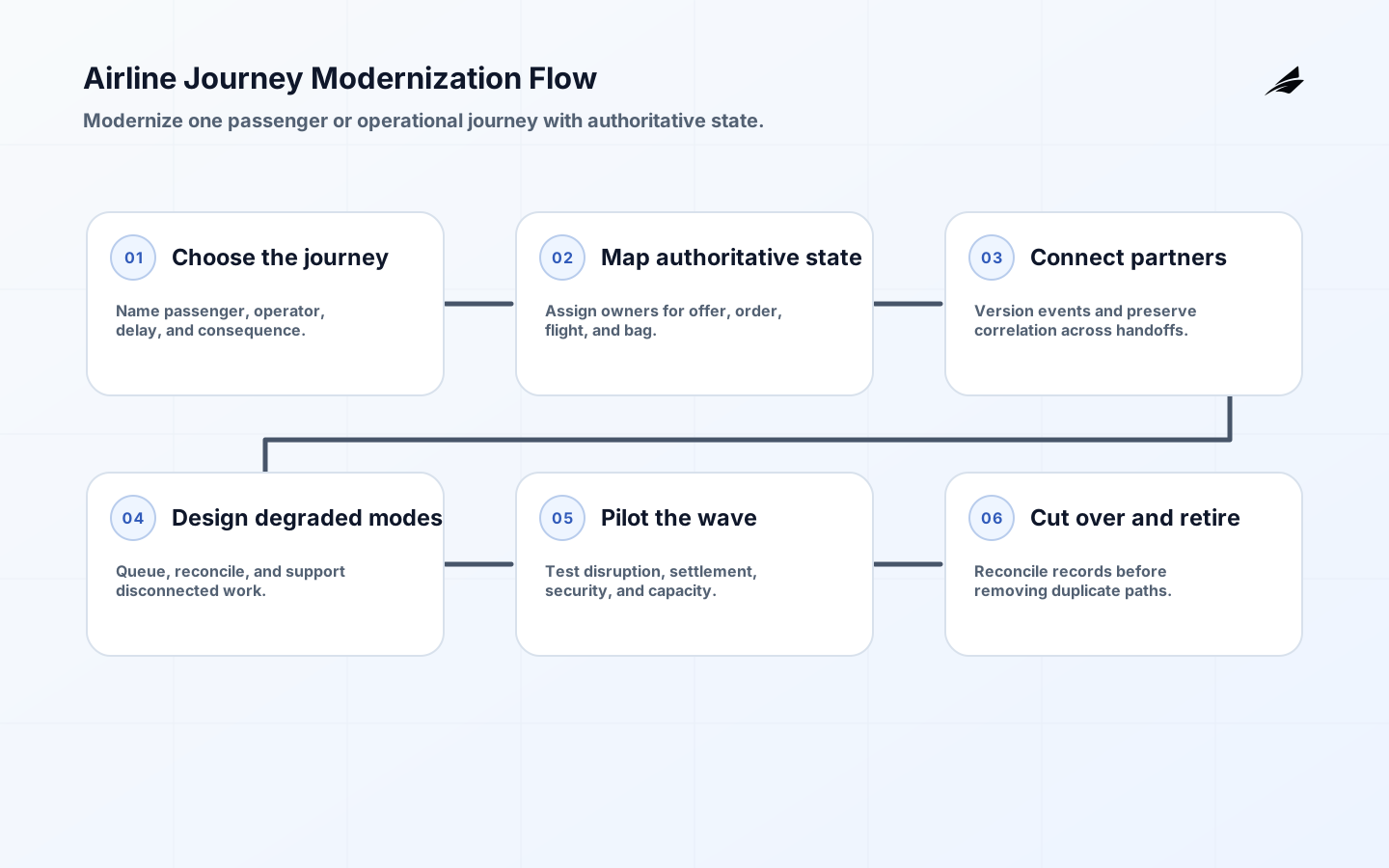
Technology solutions for airlines operate inside a network of passengers, airports, travel sellers, payment services, partners, ground handlers, regulators and aircraft operations. A change that improves one channel can create reconciliation or disruption elsewhere. The right modernization scope therefore begins with a passenger or operational journey and follows its records, decisions and handoffs across organizations. It must preserve safety, security and continuity while replacing fragmented processes. Start by pairing the scope with the airline implementation checklist and the airline technology FAQ so delivery questions are visible early.
Airline retailing is moving toward Offer and Order models. IATA's NDC supports richer offer distribution, while ONE Order aims to simplify reservation, ticket and ancillary records into an order-centric lifecycle. Baggage tracking and aviation cybersecurity add operational and risk obligations that cannot be separated from digital experience. This guide shows how to select a bounded program, establish authoritative state and deliver in stages without attempting a dangerous all-at-once replacement.
Choose a journey and operational outcome
Select a journey such as shopping and servicing, disrupted-journey reaccommodation, baggage handoff, turnaround coordination or crew communication. Name the user, decision, current delay and consequence. For disruption, useful outcomes might include time to present a valid option, successful self-service completion, agent handling time and reconciliation accuracy. For baggage, the goal may be complete, timely evidence at required custody points and faster exception action. Avoid a broad objective to improve passenger experience without operational measures.
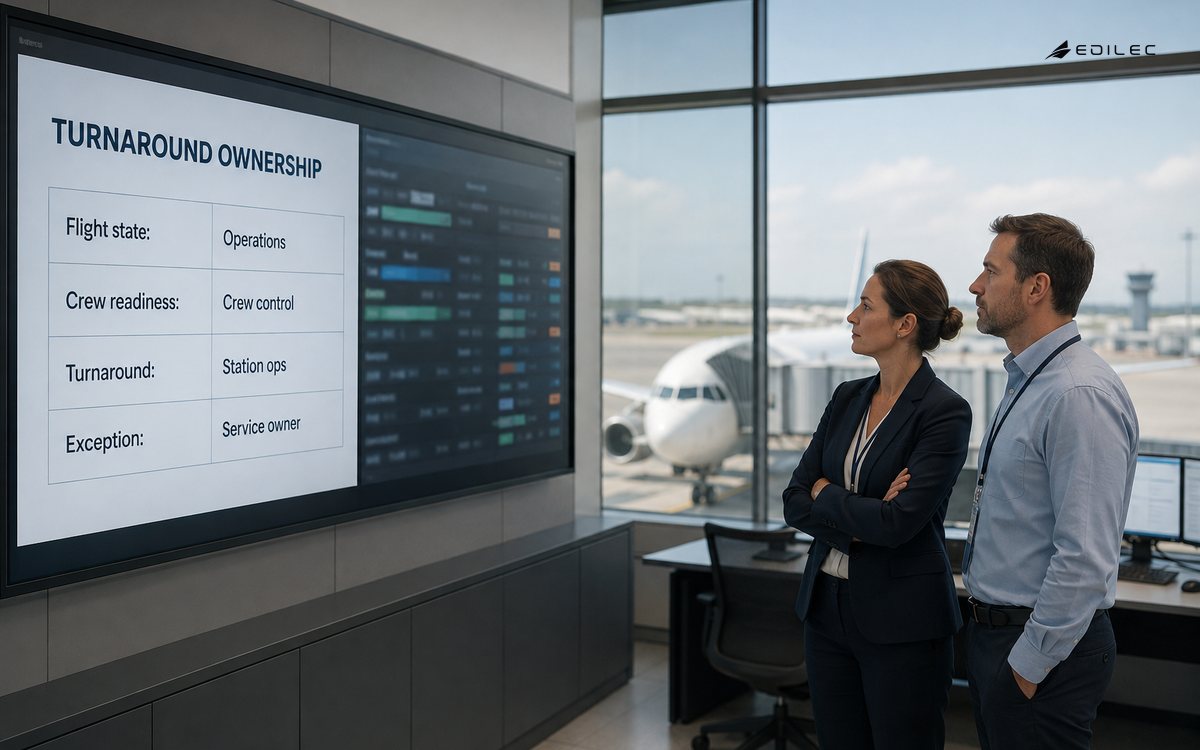
Map every participant and authority. The airline may own the customer promise while an airport controls scan infrastructure and a partner operates the next flight. Decide which record is authoritative for offer, order, payment, service delivery, flight, passenger eligibility, bag and communication consent. Preserve identifiers and event times across handoffs. A new interface cannot fix contradictory records unless ownership and correction are redesigned.
| Domain | Core state | Example acceptance evidence |
|---|---|---|
| Retailing | Offer, price and conditions | Channel receives consistent, time-bounded offer |
| Order | Customer commitment and servicing history | Change reconciles across payment and delivery |
| Operations | Flight, resource and disruption state | Decision uses current authoritative event |
| Baggage | Bag identity and custody events | Required handoffs are captured and shared |
| Customer | Identity, preference and consent | Communication is authorized and traceable |
| Finance | Payment, refund and accounting result | Order and settlement totals reconcile |
Design around orders, events and authoritative records
Separate systems of record from experience and decision services. Channel applications should not invent order or flight state. Use APIs and events with versioned schemas, stable correlation identifiers and explicit freshness. Preserve source, event time and correction behavior. Build read models for fast journeys, but reconcile them with authoritative records. Idempotency is essential because partner and operational messages can arrive more than once or out of order.
NDC and ONE Order can reduce bespoke distribution and fulfilment mappings, but adoption requires an airline-specific profile and partner testing. Define supported schema versions, optional fields, error semantics, servicing scenarios and deprecation. Validate complete business conversations, not isolated XML or JSON. Include interline, ancillary, refund, schedule change and partial failure where relevant. Keep a conformance corpus and compare results after each vendor or schema change.
Control integrations and legacy transition
Inventory interfaces by business journey, owner, protocol, volume, service objective, data class and replacement plan. Identify hidden file transfers, queues, screen automation and manual reconciliation. Introduce an anti-corruption layer where modern order or event models meet legacy records, but do not let it become permanent unowned middleware. Record transformation rules and unmatched cases. Reconciliation dashboards should produce owned work with source evidence.
Use coexistence deliberately. A strangler approach can move one channel or servicing capability while the passenger service system remains authoritative. Define dual-write avoidance, cutover authority and rollback. Historical records may need read access without full migration. Test business-day close, partner settlement and disruption peaks. Retire interfaces, credentials and duplicate stores after each wave; otherwise the program increases operational risk while claiming modernization.
Include airport, baggage and disruption realities
Operational networks are intermittent and distributed. Airport applications need clear offline, retry and stale-state behavior. A scan or mobile action should show whether it was accepted, queued or rejected. IATA Resolution 753 requires member airlines to track baggage at core journey points and share information with interline partners as required. The software plan must include airport and handler infrastructure, identifier quality, missing-event workflows and custody reconciliation, not only a passenger tracking screen.
Disruption tools should separate recommendation from authority. Capture constraints, source times and the reason an option is valid. Coordinate inventory, passenger eligibility, payment, baggage and communication. Define manual override and audit. Test mass disruption with production-like concurrency and dependency degradation. A system that performs well in routine individual servicing can fail when thousands of customers seek changes while schedules are still evolving.
Integrate aviation cybersecurity and privacy
ICAO's Aviation Cybersecurity Strategy emphasizes cooperation, governance, policy, information sharing, incident management and capacity. IATA's baggage-tracking guidance grounds custody and event obligations, while IATA NDC and ONE Order frame distribution and fulfilment boundaries. Apply those concerns to the program's trust boundaries. Separate safety-related and corporate environments where required, restrict partner access, use individual administration, protect signing and API credentials and log consequential changes. Threat-model account takeover, loyalty fraud, payment abuse, insider misuse, partner compromise, disruption manipulation and denial of service.
Classify passenger, travel, payment, identity and operational data. Minimize copies and define purpose, residency, retention, sharing and deletion. Mask sensitive data in support and telemetry. Maintain consent and communication preference as authoritative state. Incident plans need airline, airport, partner, payment, legal and communication roles, with evidence preservation and notification decisions. Exercise a cyber event during operational disruption because real incidents do not respect organizational boundaries.
Set reliability and recovery by journey
Define service indicators from passenger and operator outcomes: valid shopping response, order-change success, check-in completion, baggage-event latency or disruption-option completion. Use percentiles and cohort views rather than averages. Map dependencies, quotas and failure isolation. Design timeouts, retries and queues so they do not amplify an outage. Provide degraded modes that are operationally understood, such as read-only order access or queued airport updates.
Set recovery time and data-loss objectives for each authoritative record and journey. Backups need restoration and reconciliation with partners and downstream stores. Test regional and supplier failure, credential loss, corrupted messages and data replay. Include operational communication and decision authority. Recovery is complete when business state agrees and work can proceed, not when infrastructure is merely running.
| Delivery wave | Purpose | Exit gate |
|---|---|---|
| Discovery | Reconcile journeys, records, interfaces and constraints | Owners approve target outcome and unknowns |
| Foundation | Establish identity, event, API and observability patterns | Representative service passes control tests |
| Pilot | Move one bounded route, channel or station cohort | Operational and reconciliation measures pass |
| Expansion | Add partner and disruption complexity | Capacity, support and recovery evidence pass |
| Transition | Move authority and retire duplicate paths | No unexplained state divergence |
| Operate | Improve outcomes and standards adoption | Owned backlog and service review are active |
Estimate cost and select suppliers by lifecycle
Model software engineering, licenses, transactions, messages, cloud, airport hardware, connectivity, test environments, integration, certification, data migration, training, support and parallel operation. Include disruption peak capacity and partner onboarding. Separate one-time transition from recurring unit cost per order, passenger, bag or flight. Benefits may include lower handling, faster servicing, reduced reconciliation and better retailing, but baseline and attribution must be explicit.
Evaluate suppliers with representative scenarios and data. Ask for supported standard versions, performance limits, operating regions, incident evidence, subcontractors, release policy, data export and exit assistance. Retain airline ownership of architecture decisions, schemas, integration source and authoritative records. Contract for service and correction evidence rather than demonstrations. Ensure the receiving team can operate mixed old and new systems throughout transition.
Sequence airline change around the day of operation
Airline technology decisions are coupled by the operating day. A retailing change affects order data, payment, servicing, airport touchpoints, revenue accounting, customer communication, and disruption handling. Start with one passenger or operational journey and trace the authoritative record through each handoff. The design is ready for investment when teams can say what happens during a schedule change, a duplicate request, a baggage exception, and a disconnected airport location. Compare the boundary with enterprise blockchain solutions only where a shared record has a clear operational purpose.
Use offers and orders as a commercial boundary only when the surrounding processes can consume their meaning. Define which system owns an offer, an order, a ticket or document, a flight movement, and a baggage event; then define how identifiers relate. IATA’s NDC and ONE Order work can inform the direction, but local adoption still needs mapping, settlement, servicing, and partner readiness. Standards reduce ambiguity; they do not remove integration work.
A delivery plan should split reusable platform work from airline-specific rules. Identity, event correlation, audit, observability, and deployment controls may be shared, while disruption policy, airport procedure, loyalty, revenue, and partner settlement often need domain ownership. Estimate both build and change cost: data migration, cutover rehearsals, training, parallel operations, test environments, and support coverage are part of the product.
Resilience acceptance should be operationally realistic. Exercise a delayed departure feed, unavailable payment provider, baggage message backlog, stale crew or aircraft data, and an airport site with limited connectivity. Decide which work can continue locally, which records are queued, how duplicate events are reconciled, and who can authorize manual fallback. A green integration test is not enough if the recovery procedure cannot be run during a busy operating window.
Key takeaways
- Anchor modernization in a passenger or operational journey with measurable outcomes.
- Define authoritative offer, order, operation and custody state.
- Test complete standards-based conversations and legacy coexistence.
- Treat airport connectivity, disruption peaks and partner failure as normal design conditions.
- Accept each wave with reconciliation, recovery, security and operator evidence.
Airline technology succeeds when passenger promises, operational events and partner records remain consistent under pressure. Use industry standards where they improve interoperability, but define airline-specific ownership, profiles and recovery. Deliver by coherent journey, exercise disruption and cyber scenarios, and retire duplicate paths after reconciliation. That approach creates modernization the operation can trust rather than a new layer of channels over unresolved state.
Frequently asked questions
What is the best first airline technology use case?
Choose a bounded journey with measurable delay or revenue impact, a named business owner, representative integrations, and a safe fallback. A small complete slice teaches more than a broad platform catalogue.
How do NDC and ONE Order affect scope?
They provide industry direction and shared concepts for distribution and order fulfilment, but implementation still requires local data mapping, partner agreements, servicing, settlement, airport operations, and migration evidence.
What should airline technology cost estimates include?
Software, integration, data work, environments, security, testing, cutover, training, parallel running, support, resilience exercises, and recurring change. Excluding operational transition creates a misleading headline.
Conclusion
A dependable airline technology decision is visible in its boundaries, examples, ownership, failure behavior, and evidence. For airline technology operations, start with one complete workflow, make the hard case observable, and expand only when the people responsible for the outcome can operate and recover it. For airline technology operations, that discipline keeps the implementation useful after launch, when conditions are less tidy than the first demonstration.