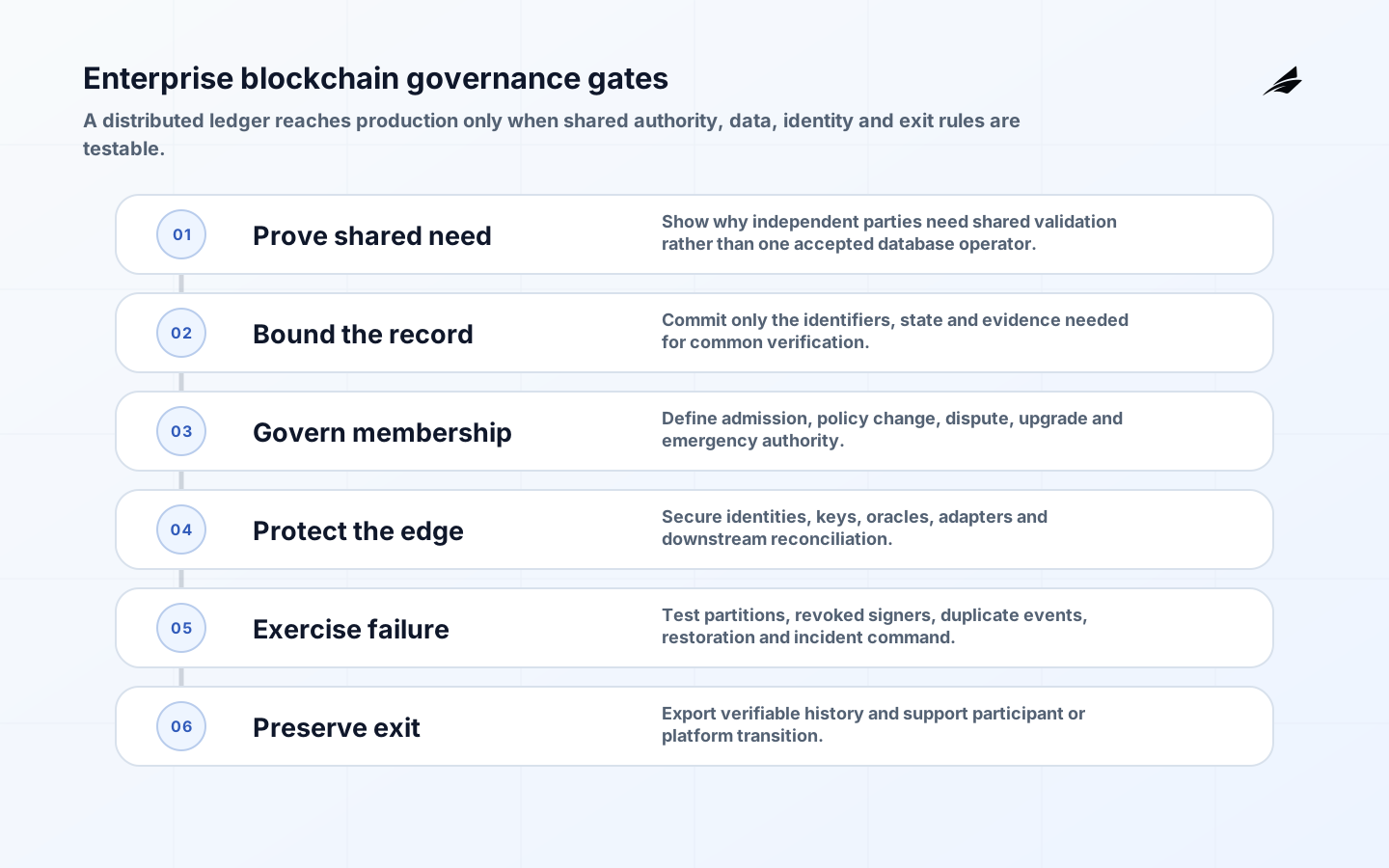
Enterprise blockchain solutions are justified when several organizations need a shared transaction history, no single participant can be accepted as the sole record keeper, and the rules for validating changes can be made explicit. A blockchain is not a faster database by default. NIST describes it as a distributed, tamper-evident ledger whose records are cryptographically linked and replicated across participants. Those properties introduce governance, privacy, key-management and operational costs. The first delivery decision is therefore whether shared control is valuable enough to pay for those costs.
This guide helps sponsors and architects frame a permissioned enterprise network without treating the platform as the product. It complements the enterprise blockchain implementation checklist and enterprise blockchain FAQ. The scope should begin with one cross-organization business event, the evidence each party needs, the authority each party retains, and the off-chain systems that remain authoritative. Only then should a team compare ledger technologies or estimate delivery.
Decide whether a distributed ledger fits the problem
Use a decision test before approving a proof of concept. Name the independent parties, the records they dispute today, the accepted source of identity, the transaction rules and the reason a conventional shared service cannot be trusted or governed. If one organization can legitimately operate the database and provide signed audit exports, a replicated ledger may add complexity without changing the trust model. If parties need separate control over validation and evidence, a permissioned network may be appropriate.
Avoid broad aims such as transparency or traceability. Define one business outcome: for example, reducing reconciliation delay for a shipment milestone, proving software-asset custody, or coordinating a regulated approval. Establish the current cycle time, dispute rate, manual matching effort and cost of missing evidence. A blockchain project should be compared with an API plus append-only journal, an event-stream architecture and a neutral managed platform. The comparison keeps the technology choice accountable to an operating result.
| Decision question | Ledger signal | Conventional alternative |
|---|---|---|
| Who may write? | Several independent parties validate writes | One service enforces roles |
| Who owns truth? | No sole operator is acceptable | A neutral or contracted operator |
| Can records change? | Corrections must be new traceable events | Versioned rows and audit logs |
| What must be private? | Participants see different authorized views | Field-level access in a shared service |
Keep sensitive and changeable data off the ledger
A ledger entry should contain the minimum facts needed to validate a business event: stable identifiers, state transition, participant signatures, timestamps and hashes that bind supporting evidence. Large documents, personal information, secrets and records subject to correction or deletion usually belong in governed off-chain stores. NIST notes that conventional immutability can conflict with privacy and deletion requirements. A hash proves that a retrieved object matches an earlier commitment; it does not make the object true, lawful or available.
Design the data model around business states rather than copying existing tables. Define which participant may propose each transition, which endorsements are required, how invalid or conflicting events are rejected, and how corrections are represented. The original source systems may continue to own customer, inventory or financial details. The ledger can coordinate a shared state while adapters reconcile local records. Record retention, encryption, regional storage and legal-hold rules separately for ledger and off-chain evidence.
Make network governance executable
A consortium needs rules before nodes go live. Document admission, identity proofing, certificate issuance, participant suspension, software upgrades, schema changes, transaction fees, incident authority and dispute resolution. Separate technical administration from business authority. A platform operator may deploy code while a governance council approves policy. Require defined voting thresholds and emergency procedures; consensus at the protocol layer does not decide commercial disputes or make ambiguous contract language disappear.

Treat smart-contract or chaincode releases as shared production changes. Specify who owns source code, where builds occur, how artifacts are signed, which participants review changes and how a faulty release is stopped. Preserve the policy and code version associated with every transaction. Test governance with scenarios such as a compromised participant key, an unavailable validating organization, a disputed upgrade and a participant exit. If the consortium cannot make those decisions in rehearsal, the technical network is not ready.
Design identity, keys and integration as one control system
Permissioned networks depend on reliable organizational identity. Use a membership model that maps legal entities, systems, administrators and transaction signers to explicit roles. Protect issuing authorities and private keys with appropriate hardware or managed key controls, rotation, revocation and recovery. Do not share administrative identities. A participant whose key is stolen may submit validly signed but fraudulent events, so monitoring must correlate ledger actions with business context and operator access.
Most failures occur at the edge of the ledger. An oracle, batch import or API adapter can assert false facts even when consensus works perfectly. Define authentication, schema validation, idempotency, replay protection and reconciliation for every integration. Store the external reference and outcome for each attempt. Build an exception queue for events that cannot be mapped or confirmed. The integration should tolerate node outages and duplicate delivery without creating duplicate business actions in downstream systems.
Estimate cost across the network lifecycle
Separate discovery, consortium formation, platform engineering, participant onboarding, integration, assurance and ongoing operations. A small technical pilot can be inexpensive while governance and production onboarding dominate the real program. Cost drivers include number of organizations, environments and channels; identity and key infrastructure; data-residency constraints; transaction throughput; observability; security review; legacy adapters; support hours; and the frequency of coordinated upgrades. Include the effort each participant must fund, not only the central platform budget.
Use stage gates. Discovery ends with a verified business case and alternative comparison. A technical spike proves a risky property such as private data distribution or throughput. A pilot proves one end-to-end transaction with real participant controls. Production begins only after operating agreements, support, recovery, audit evidence and exit procedures are accepted. Avoid estimating the complete network from a demonstration that excludes identity lifecycle, integration failures and governance.
| Delivery stage | Primary evidence | Stop condition |
|---|---|---|
| Business discovery | Dispute baseline and alternatives analysis | No shared-authority need |
| Technical spike | Measured privacy, throughput or interoperability result | Critical property cannot be met |
| Participant pilot | Signed event reconciles across real systems | Ownership or exceptions remain unclear |
| Production readiness | Governance, recovery, monitoring and exit drill | No accountable operator or rollback path |
Test failure, dispute and recovery before scale
Functional tests should cover every state transition and endorsement policy, but production acceptance must go further. Partition nodes, delay messages, revoke a signer, rotate certificates, submit duplicate events, corrupt an off-chain object and make an adapter retry after an ambiguous timeout. Confirm that participants converge on the same accepted state and that business systems reconcile. Measure commit latency by percentile, failed endorsements, queue age, node lag, certificate expiry and unresolved reconciliation cases.
Back up configuration, certificates, policies, source, build provenance and off-chain records according to their recovery objectives. A replicated ledger is not automatically a complete backup, especially when nodes share operational dependencies or private collections differ. Rehearse restoration into an isolated environment and prove that the restored network can verify history. Establish incident command across organizations, with authority to suspend credentials or transaction classes while preserving evidence.
Plan participant and platform exit at the start
A participant may merge, fail, be removed or move to another platform. Define how its credentials are revoked, how historical signatures remain verifiable, what records it can export and which obligations survive departure. Avoid storing the only usable copy of business evidence in a proprietary format. Preserve schemas, contracts, transaction history, configuration and verification tools in organization-controlled repositories. Identify licenses and managed services that could block an orderly transfer.
Platform exit is a business migration, not simply a node shutdown. Choose the authoritative cutover state, prevent new writes, reconcile all participants, export verifiable history and establish how future corrections will reference the old ledger. The design is more credible when participants can leave without destroying the evidence that justified the network. Periodic export tests also expose hidden dependencies before a commercial dispute forces the issue.
Use an evidence pack for production acceptance
The final acceptance pack should connect the business case to operating proof. Include the participant and responsibility map, approved data model, membership and key procedures, endorsement policies, smart-contract source and build provenance, integration contracts, performance results, security findings, recovery evidence, support roster and unresolved risk. Each item needs an owner and version. A board or sponsor should be able to see which property was tested and which assumption remains dependent on a participant or provider.
Run a witnessed scenario that begins in a participant system, crosses validation and consensus, updates authorized downstream records, creates an exception, recovers from a node or adapter failure and produces a verifiable audit trail. Compare the outcome with the earlier alternative analysis and cost baseline. Production approval should be conditional on the network solving the shared-control problem better than the conventional design, not on completion of a technical milestone.
Key takeaways
- Use blockchain only when shared control among independent parties is a core requirement.
- Keep personal, secret and changeable records in governed off-chain stores.
- Treat consortium governance, identity and integration as production architecture.
- Estimate participant onboarding and coordinated operations, not only platform build.
- Test disputed events, key compromise, partitions, restoration and exit before scale.
Frequently asked questions
Should an enterprise blockchain be public or permissioned?
Most enterprise workflows need known organizations, contractual authority and restricted data, which points to a permissioned design. A public network may fit when open verification or public settlement is the business requirement, but fees, privacy, finality and governance must be evaluated explicitly rather than assumed.
Can a blockchain guarantee that source data is correct?
No. It can make accepted records tamper-evident and show who signed them, but sensors, people and external systems can still provide false data. Input validation, trusted measurement, reconciliation and accountable dispute handling remain necessary.
What is the safest first production scope?
Choose one high-value event, two or three committed participants, a bounded data model and a manual exception path. Prove identity, endorsements, integration, reconciliation and support before adding more workflows or organizations.
Conclusion
A useful enterprise blockchain is a governed shared record, not a decorative technology layer. The design succeeds when every participant understands why control is distributed, which facts are committed, how identities and changes are governed, and how failures are reconciled. A narrow, evidence-driven pilot can establish those properties; expansion should follow only after the operating model proves as dependable as the ledger.