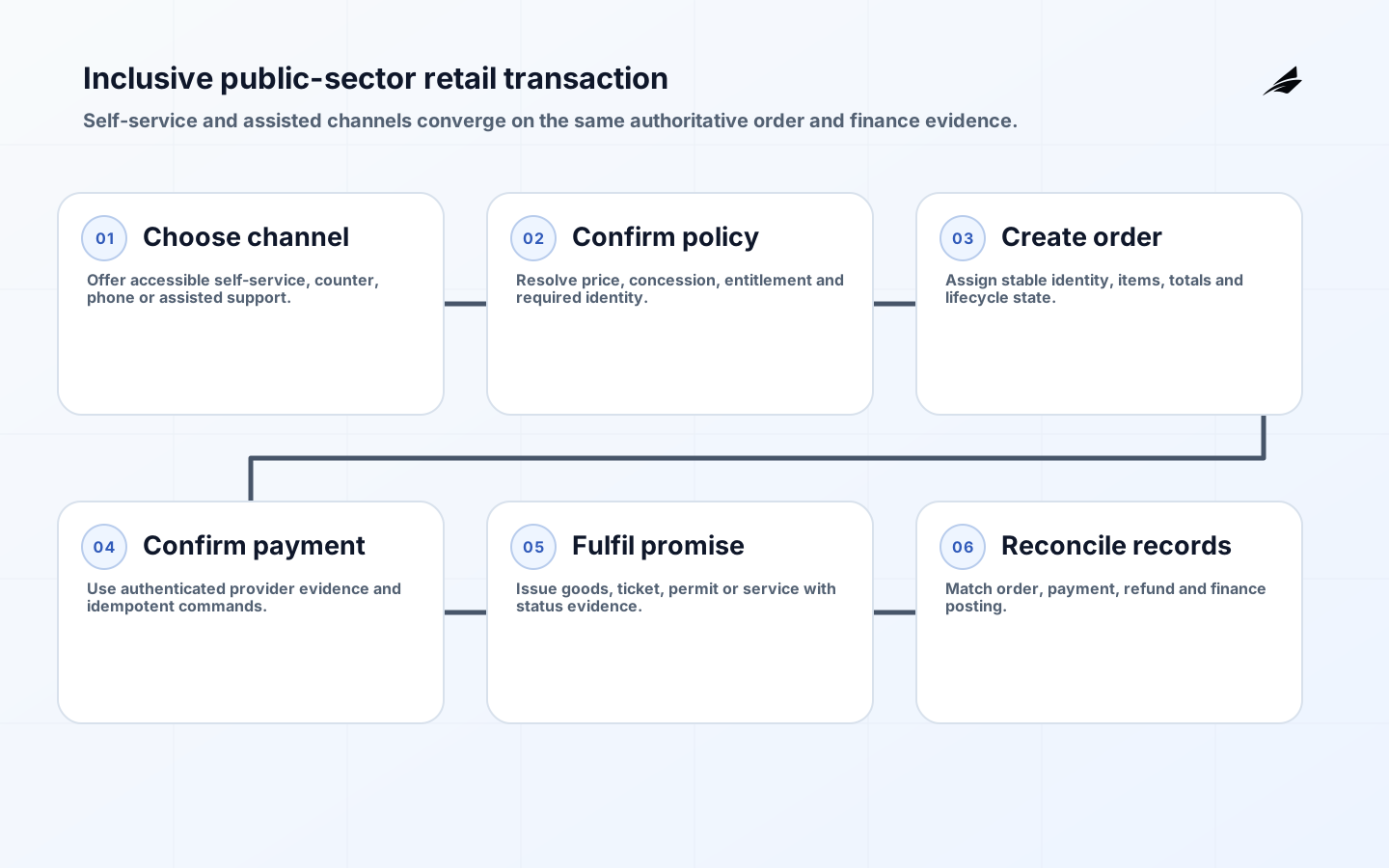
Public-sector retail systems support transactions in which a government or public body sells goods, tickets, permits, publications, memberships or services through websites, counters, contact centers and partner locations. They look like ordinary commerce, but public-service duties change the design. Users may need assisted access, exemptions or alternative payment routes; staff need auditable corrections; finance needs complete reconciliation; and procurement must preserve continuity and exit.
This public-sector retail FAQ should be read with Edilec's practical systems guide, implementation checklist and retail and travel systems guide. Requirements differ by jurisdiction and service, so legal, accessibility, finance, records and payment specialists must confirm the applicable obligations.
What belongs inside the service boundary?
Include the whole user and money journey: eligibility or entitlement, product and price, inventory or capacity, basket, payment, order, fulfilment, refund, receipt, support and finance posting. Include counter and telephone routes where they are part of delivery. Name the authoritative record for each state and the team allowed to correct it. A hosted checkout may reduce card-data exposure, but it does not own the agency's order, refund decision, accessibility or reconciliation responsibilities.
| Record | Authority | Essential control |
|---|---|---|
| Offer | Service or product owner | Versioned price, eligibility and effective date |
| Order | Retail service | Stable identity and explicit lifecycle |
| Payment | Payment provider evidence | Authenticated notification and idempotency |
| Entitlement | Authoritative public record | Policy version and reason |
| Finance posting | Finance system | Balanced totals and reconciliation |
| Stock or capacity | Operational system | Reservation, release and correction |
Must every transaction be digital self-service?
No. The service should support the people who need it, not merely publish a website. GOV.UK assisted-digital guidance says user research should identify barriers such as access, skills, confidence and trust. Design telephone, in-person or trusted-intermediary support with equivalent outcomes and proportionate identity checks. Staff-assisted transactions need consent, privacy, clear attribution and safeguards against staff seeing or changing more than the task requires.
Do not assume an alternative route excuses an inaccessible digital route. WCAG 2.2 AA is a useful technical baseline, and public bodies may have specific statutory requirements. Test the complete process with disabled users and common assistive technologies: search, product selection, error recovery, authentication, payment, receipt and refund. Kiosks and payment terminals also need reach, contrast, audio, privacy and physical-operability review.
Should customers be required to create accounts?
Only when an account supports a genuine service need such as repeat access, entitlement management or protected history. Guest checkout can reduce exclusion and data collection for one-off purchases. If identity is required, explain why, use proportionate assurance and offer recovery that works for users who change phone, email or address. Keep retail profile data separate from authoritative citizen records unless a defined legal and operational purpose requires the connection.
How should payment and reconciliation work?
Create the order before redirecting to payment and use authenticated provider evidence to advance payment state. Browser return pages are not authoritative because users can close, repeat or manipulate them. Use idempotency for payment and refund commands, retain provider identifiers and reconcile settlement totals, fees, refunds and chargebacks against orders and finance postings. Route breaks to a work queue with bounded correction actions; do not leave operators to edit database rows.

PCI DSS scope depends on the actual payment architecture and provider arrangement. Hosted components may reduce exposure, but the entity must confirm responsibilities with payment and compliance parties. Inventory payment-page scripts where relevant, protect administrative functions with strong authentication and restrict refunds by role, amount and separation of duties. Never store sensitive authentication data merely to simplify support.
How should privacy and fraud controls be balanced?
Collect the minimum data needed for the transaction, obligation and support period. Document purpose, source, sharing, retention, access and deletion. Fraud controls should be risk-based and appealable where they affect access to a public service. Monitor outcomes for groups that may be disproportionately blocked, and provide a human route for exceptions. NIST's Privacy Framework is a useful risk-management structure, but local privacy law determines duties.
What happens when connectivity or a provider fails?
Choose degraded behavior by transaction type. A museum shop may accept bounded offline sales; an entitlement-dependent permit may need to pause. Define what staff can promise, what data can be stored locally, how duplicate payment is prevented and how queued transactions reconcile after recovery. Test provider timeout, unknown payment result, terminal failure, stock conflict and delayed fulfilment. Publish clear user messages and give frontline teams the same incident status as digital support.
| Failure | Safe degraded behavior | Recovery evidence |
|---|---|---|
| Payment timeout | Keep order pending; do not charge again blindly | Provider lookup and reconciliation |
| Stock service unavailable | Pause scarce items or use bounded allocation | Reservation ledger and count |
| Identity dependency down | Use approved alternative or defer protected sale | Reason, verifier and later check |
| Counter offline | Apply service-specific offline policy | Queued receipt and duplicate control |
| Fulfilment delay | Accept only with transparent promise | Queue age and customer notification |
What should procurement and acceptance require?
Procure outcomes and evidence: supported channels, accessibility, payment responsibility, data ownership, open interfaces, service levels, incident cooperation, security testing, export and exit. Ask suppliers to demonstrate one complete transaction and failure recovery with realistic records. Acceptance should include reconciliation, role enforcement, audit lookup, assistive-technology testing, backup restoration and operational handover, not only feature demonstrations.
Which measures show that the service works?
- Successful completion and abandonment by channel and representative user group.
- Assisted-service demand, wait time and successful resolution.
- Payment reconciliation breaks, duplicate attempts and refund age.
- Accessibility defects and completion with assistive technologies.
- Order-to-fulfilment time, support contacts and unresolved exceptions.
- Fraud loss alongside legitimate transactions delayed or blocked.
Commission with real transaction evidence
Create an acceptance pack containing representative products, entitlements, concessions, refunds, failed payments, partial fulfilment and assisted-service scenarios. Include users with different access needs and frontline staff from busy locations. Run each scenario through customer view, staff view, provider evidence, finance posting and audit lookup. Record expected and observed states rather than accepting a verbal demonstration.
Rehearse day opening and closing, terminal replacement, lost receipt, disputed charge, stock correction and recovery. Confirm who can reverse each state and what approvals apply. Test a supplier outage with communications and backlog recovery. Backup restoration must reconcile orders with external payments made after the backup point; otherwise a technical restore can create financial duplication.
Before acceptance, reconcile a complete trading period, export records in an agreed open format and have the receiving team perform a configuration change and incident lookup. Keep unresolved gaps in a signed plan with owner, consequence and date. Procurement completion should never be mistaken for service readiness.
Key takeaways
- Treat digital, counter, telephone, payment and finance paths as one service.
- Build accessibility and assisted access into the transaction design.
- Keep order, payment, entitlement and finance authority explicit.
- Reconcile money and state instead of assuming integrations always complete.
- Procure for evidence, operational control and a tested exit path.
Frequently asked questions
Can a public body use a commercial ecommerce platform?
Yes, when it satisfies the service's accessibility, identity, payment, privacy, security, integration, records, support and exit requirements. Configuration should not hide critical logic in an unreviewable supplier workflow. Test real exceptions and ensure the public body can export authoritative records.
Must a public service continue accepting cash?
That depends on policy, law, user needs, fraud and operating context. Decide through evidence rather than assuming digital-only is universally acceptable. If cash is supported, design till control, receipt, banking and reconciliation; if not, provide workable alternatives for users without cards or accounts.
Can offline transactions be synchronized later?
Yes for bounded cases with stable transaction identity, local protection, duplicate handling, conflict rules and reconciliation. Do not use offline mode where current entitlement, scarce inventory or immediate external authorization is indispensable unless an approved fallback changes the risk.
Govern price, policy and configuration change
Public retail rules change after launch: prices, concessions, tax treatment, opening hours, stock policy, refund limits and identity requirements. Store effective dates and approval evidence, preview the effect on real examples and make changes through roles rather than supplier support tickets. Separate content changes from financial policy where approval differs. Keep a clear view of the configuration effective for each completed order.
Release changes through a bounded environment with regression tests for payment totals, eligibility, accessibility and reconciliation. Communicate frontline effects before activation and provide a fallback when a changed rule blocks legitimate service. Review administrative configuration regularly for unused accounts, unsafe defaults and differences between sites. Configuration is production code in operational form and deserves comparable control.
Create a monthly forum joining service, finance, support, security, accessibility and supplier owners. Review transaction outcomes, reconciliation, complaints, assisted access, incidents, changes and upcoming demand. Decisions should produce owned actions, not merely a report. This rhythm keeps a technically functioning shop aligned with public-service obligations as policy and user needs change.
Keep a small set of golden transactions and rerun them after provider, pricing, accessibility or finance changes. Stable examples make cross-team acceptance concrete and repeatable.
Conclusion
A dependable public-sector retail system is a public service with commerce components. It joins inclusive access, authoritative records, secure payment, frontline operation and finance evidence into one recoverable transaction. Define that transaction before selecting technology, then accept the service only when real users and operators can complete, explain and correct it under normal and failed conditions.