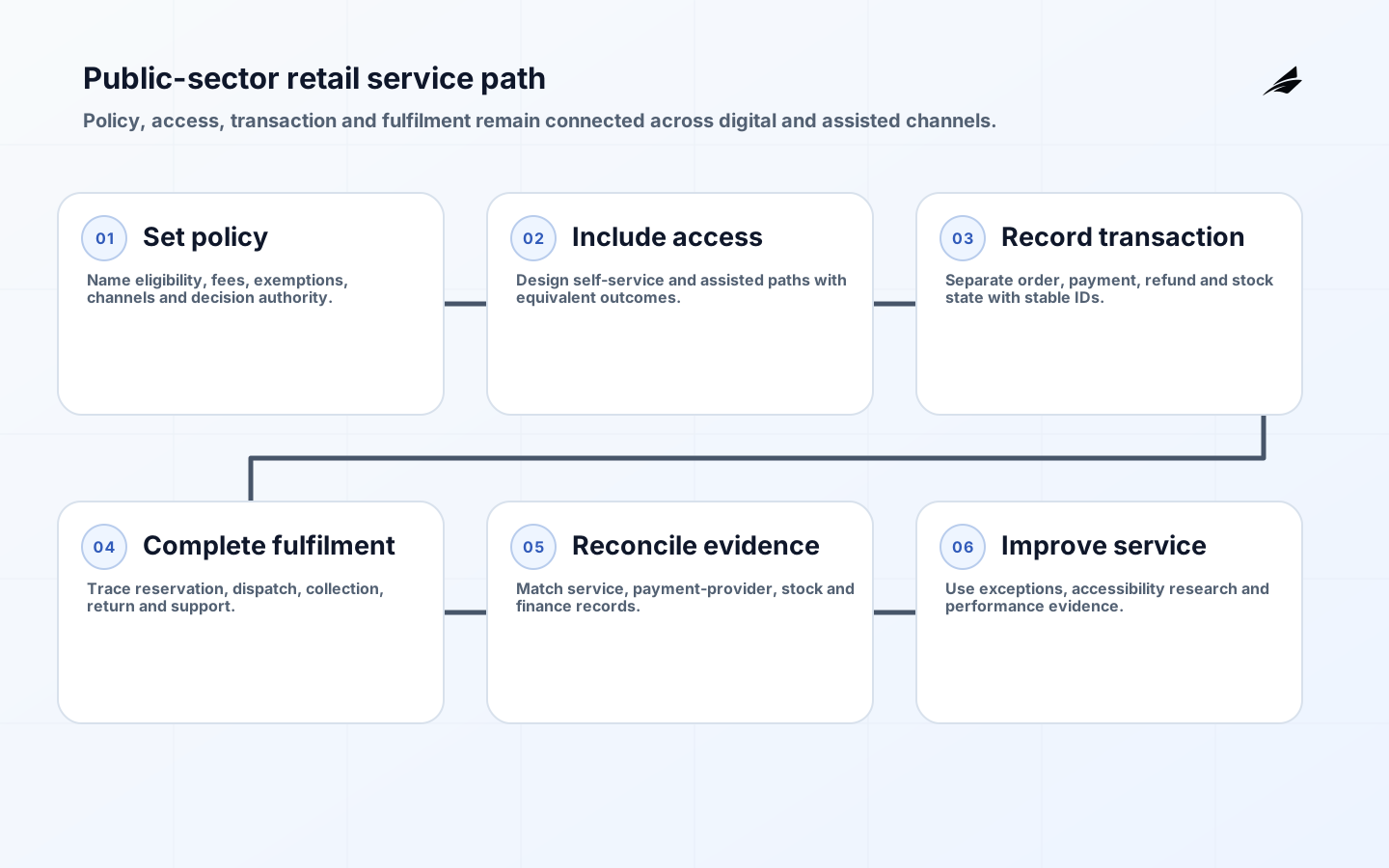
A public-sector retail system is the joined-up service used to sell permits, publications, equipment, tickets or other goods through a website, staffed counter, contact centre or kiosk. Its success is not measured only by completed card payments. The service must apply policy correctly, work for people with access needs, reconcile stock and money, preserve an auditable decision record and continue safely when a channel or supplier fails. This public-sector retail systems implementation checklist turns those obligations into evidence a delivery team can test before launch.
Start with the whole user journey rather than a point-of-sale product. The GOV.UK Service Standard asks teams to understand users, solve a whole problem, provide a joined-up cross-channel experience, protect privacy and operate reliably. Those principles expose gaps that a software demonstration hides: a person may qualify for an exemption, need assisted support, pay by telephone, return a controlled item or dispute a charge after the finance system has closed the period. Each path needs an owner and an authoritative record.
Define the public service before selecting retail software
Write a service charter that names eligible users, items, policy authority, channels, payment methods, fulfilment obligations and measurable outcomes. Separate a commercial choice from a policy decision. A product manager may change how stock is displayed, but only an authorized policy owner should change eligibility, fee, exemption or refund rules. Record the effective date and legal basis of every rule. Otherwise a configuration change can create unequal treatment while appearing to be a routine catalogue update.

Map the journey from discovery to receipt, collection, return and support. Include people who cannot use the primary digital path. Government guidance says services should avoid excluding people because they lack internet access, skills or confidence and should provide appropriate assisted support. That means a counter or contact-centre transaction must not become an undocumented workaround. It should invoke the same policy rules, create the same transaction identifiers and feed the same stock, payment and audit records as self-service.
| Journey decision | Authoritative owner | Acceptance evidence |
|---|---|---|
| Eligibility, fee or exemption | Policy/service owner | Versioned rule and representative test cases |
| Payment and refund | Finance and payment owner | Provider event reconciled to ledger entry |
| Stock allocation and fulfilment | Operations owner | Reservation, dispatch, collection and return history |
| Assisted transaction | Service operations | Equivalent outcome with staff action recorded |
| Accessibility | Service owner | Automated checks plus disabled-user research |
Model orders, entitlements, stock and money as separate records
Do not use payment status as order status. An authorization can succeed while fulfilment fails; a refund can be requested before it settles; a cash or telephone payment may follow a different path. Give the order, payment attempt, refund, stock reservation and fulfilment event their own identifiers and state transitions. Link them with immutable references. This makes retries safe and allows finance staff to reconcile provider settlements without changing the service history to fit an accounting report.
Keep personal data proportional to the service. Record why each attribute is needed, how long it is retained, who can access it and whether it must be shared with a delivery or payment supplier. Avoid copying card data into case notes or support tickets. A hosted payment service such as GOV.UK Pay can reduce the card-data boundary, but the public body still owns authorization, refund decisions, access control, reconciliation and user communication around the transaction.
Test accessibility and assisted service as core transaction paths
Use established components and plain content, then test the actual service against WCAG 2.2. Keyboard operation, focus order, error identification, status announcements, text resizing and contrast matter, but conformance checks are not the whole assessment. Research with people who use screen readers, magnification, speech input or other assistive technology. Include timeouts, payment redirects, receipt download and identity evidence, because failures often occur at supplier boundaries rather than on the catalogue page.
Define what staff may do for a user and how consent is captured. Staff-assisted access should not require sharing a password or bypassing a control. Provide delegated or staff roles, reason codes and clear confirmation to the user. Test low-bandwidth and interrupted journeys. Preserve a reference so a user can resume without repaying. Make telephone and in-person scripts match the digital service rules, while allowing reasonable adjustments instead of forcing every person through an identical interface.
Constrain the payment and administrative attack surface
Inventory every component that can affect a payment page, including third-party scripts, tag managers, content systems and support tools. PCI DSS v4.0.1 clarifies requirements around payment-page scripts, but scope must be confirmed with qualified payment and security advisers for the chosen integration. Prefer tokenized provider references over stored card data. Enforce phishing-resistant authentication where practical for administrators, individual staff accounts, least privilege, session limits and approval for high-risk refunds or price changes.
Threat-model abuse by insiders and external users. Relevant cases include discount manipulation, repeated refund attempts, stock reservation denial, credential stuffing, bot purchasing, malicious address changes and webhook forgery. Verify provider signatures, make event processing idempotent and alert on impossible state transitions. Logs should answer who changed a fee, who approved a refund and which provider event caused a ledger entry without exposing payment credentials or unnecessary personal information.
| Release gate | Required proof | Block release when |
|---|---|---|
| Policy | Rules trace to an accountable authority | Eligibility or fee logic is informal |
| Channels | Self-service and assisted paths reconcile | Staff rely on unlogged workarounds |
| Payments | Success, failure, retry and refund are exercised | Order state depends on browser return only |
| Accessibility | Critical journeys pass technical and user testing | Redirects or errors cannot be completed accessibly |
| Operations | Support, outage and reconciliation drills pass | No owner can repair a mismatched transaction |
Deliver one complete transaction slice before adding catalogue breadth
Choose one representative item with a real policy rule, payment, stock reservation, receipt, fulfilment and refund. Build it through production-like environments with audit and monitoring. Use test data that covers standard, exempt, assisted, duplicate and interrupted journeys. A narrow end-to-end slice reveals integration and ownership problems earlier than building hundreds of product records against mocked finance or identity systems. Add catalogue breadth only after the team can operate the first slice.
Plan migration around balances and obligations, not just rows. Reconcile open orders, outstanding refunds, stock on hand, unredeemed entitlements and financial totals before cutover. Keep a rollback rule that considers irreversible provider events: routing traffic back does not undo a captured payment. During launch, compare transaction counts and money across service, payment provider and ledger at short intervals. Give one incident lead authority to pause new transactions while preserving enquiry and support paths.
Operate the service with outcome and control measures
Track completion by channel and access need where lawful and useful, but investigate causes rather than ranking users. Measure payment failures, abandoned assisted journeys, fulfilment delay, refund age, stock variance, reconciliation exceptions, accessibility defects and support demand. Publish or report performance at an appropriate level. A high conversion rate can conceal exclusion if people who cannot begin the journey are absent from the denominator, so combine analytics with complaints, contact-centre evidence and user research.
Assign operational cadence. Daily work handles failed provider events, unmatched money, stock exceptions and urgent accessibility barriers. Weekly review looks for repeated failure and support burden. Monthly governance examines service outcomes, policy changes, supplier performance, privacy and security risks. Every exception needs an owner and expiry. Retain enough internal capability to change rules, inspect evidence and exit a supplier; a public authority cannot outsource accountability for lawful and inclusive service delivery.
Run a commissioning workshop with real records
Before final acceptance, bring policy, service operations, finance, accessibility, security, support and supplier representatives into one evidence review. Select several completed and failed transactions and trace the rule version, user channel, staff intervention, provider event, stock movement, receipt, ledger entry and support history. Resolve any point where teams use different identifiers or cannot explain the authoritative state. This workshop should produce owned defects and operating decisions, not a new presentation.
Repeat the review after the first live reporting period and after material policy or supplier change. Commissioning is not one ceremony: it confirms that the service can remain lawful, inclusive and financially controlled under normal operational pressure. Keep representative regression journeys and reconciliation queries so future releases can prove the same properties without reconstructing the method from memory.
Key takeaways
- Treat the retail platform as a public service spanning digital and assisted channels.
- Separate policy, order, payment, stock and fulfilment state.
- Test accessibility through redirects, errors and support, not only catalogue pages.
- Reconcile service, provider and finance records with stable identifiers.
- Launch one complete slice and require operational evidence before scale.
Frequently asked questions
Can an ordinary commercial point-of-sale product be used?
Possibly, if it can support the policy, accessibility, audit, integration, security and retention requirements of the service. The procurement decision should be based on tested journeys and exportability, not a feature checklist. Significant custom logic around a rigid product can be harder to assure than a smaller well-bounded service.
Does using a hosted payment page remove PCI responsibilities?
It can reduce scope, but it does not remove every responsibility. The organization must choose an appropriate integration, control its own pages and scripts, manage supplier relationships and complete the validation applicable to its environment. Obtain current advice for the exact payment design.
Should offline transactions use a separate process?
The user interaction may differ, but authoritative rules and records should converge. An offline-safe design needs bounded authority, unique references, duplicate prevention and later reconciliation. A spreadsheet that never returns to the service record creates financial and equality risks.
Conclusion
A public-sector retail implementation is ready when a team can prove that each person receives the right outcome, each payment and item can be reconciled, each staff action is accountable and each critical journey remains accessible across channels. Software selection follows from that operating model. Begin with the hardest representative journey, make authority and state explicit, and scale only after the service can detect and repair its own exceptions.