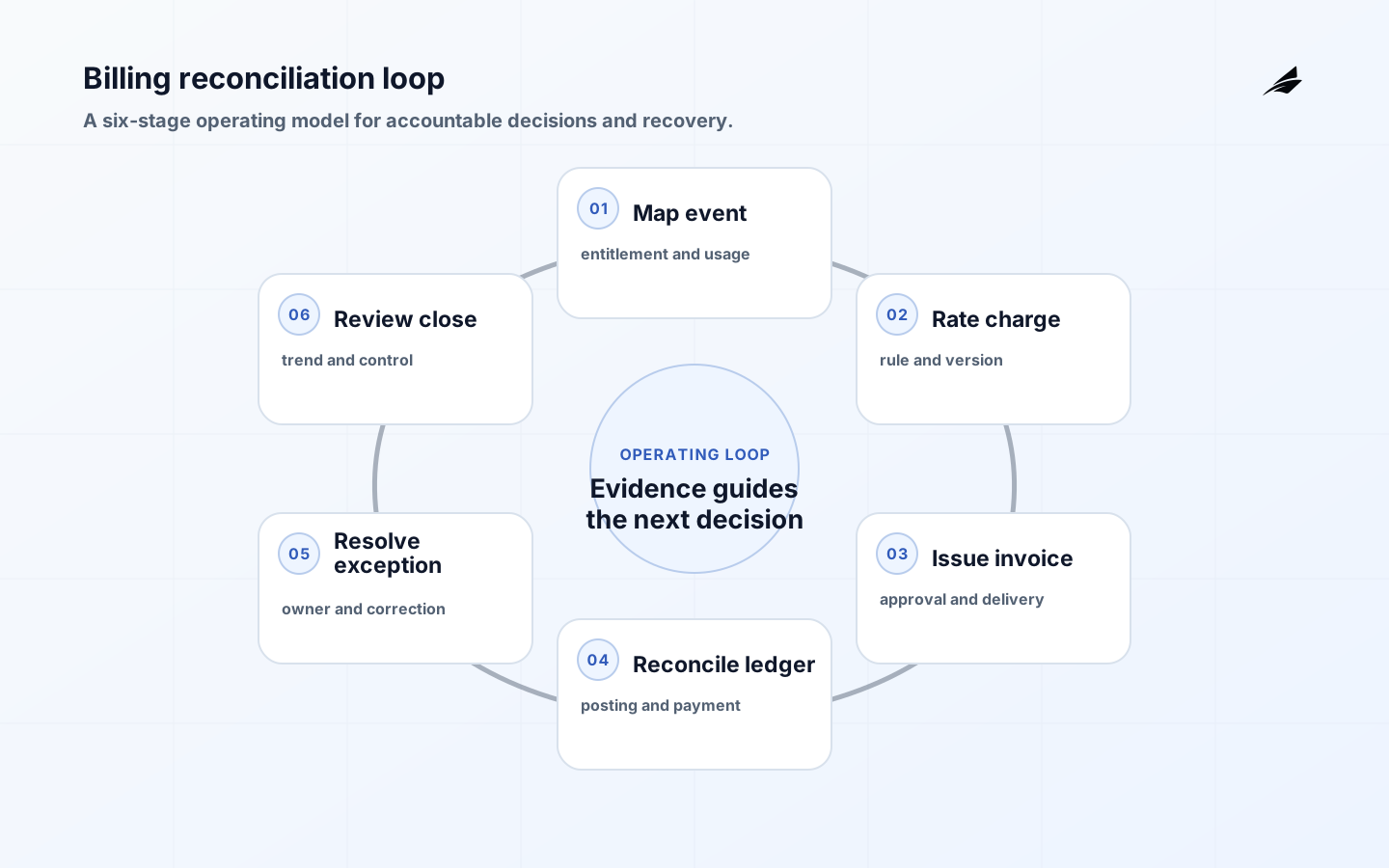
Billing operations turn an agreement and a delivered event into an amount a customer can understand, pay, and later question. That sounds linear until subscriptions change mid-period, usage arrives late, taxes differ by jurisdiction, payments fail, or a customer disputes the underlying service. Reliable billing therefore combines product, finance, engineering, customer support, and collections decisions. It is not merely an invoice generator. The practical objective is to preserve a traceable route from contract and service evidence to invoice, payment state, adjustment, and accounting close. When that route is weak, teams spend close week reconciling spreadsheets and explaining balances that no system can fully prove.
Map the billable event
Begin by naming the event that creates an entitlement or charge. It may be an order accepted, a subscription period started, an approved timesheet, a shipment delivered, or a metered unit consumed. For each event, specify the contract version, customer and legal entity, price or rate source, currency, tax context, service period, and correction rule. Distinguish the time the service happened from the time the system received its record. This prevents a late event from silently changing the wrong period. The NIST Cybersecurity Framework is relevant because consequential operational processes need governed ownership, protected data, detection of deviation, and recovery from failure, even when the process is financial rather than purely technical.

| Billing fact | Question | Control evidence |
|---|---|---|
| Contract | Which terms applied at the event time? | Versioned agreement reference. |
| Usage or delivery | What proves the billable event occurred? | Source event and correlation ID. |
| Price | Which rate and adjustment rule applies? | Approved rate card or pricing decision. |
| Period | Where does the event belong? | Service and posting-time policy. |
Make rating and calculation reproducible
A billing calculation should be reproducible from retained inputs, rules, and version information. Treat discounts, proration, credits, minimum commitments, currency conversion, and tax treatment as policies that have an effective date and approval route. Avoid embedding important commercial decisions only in a script or a customer-service note. When an input is missing or contradictory, route it to an exception state instead of guessing. Store enough detail to explain an invoice line without exposing unnecessary customer data. For usage billing, retain the raw event reference and the aggregation rule; for milestone billing, retain the approval that released the charge. The billing operations checklist provides useful additional tests for these handoffs. Stripe invoicing overview illustrates the invoice states and collection choices that a billing design must make explicit.
- Version pricing and policy changes with effective dates.
- Use an immutable source reference for each chargeable event.
- Make retries idempotent so a repeated message cannot create another charge.
- Separate provisional estimates from final invoicing states.
- Require an authorized reason for manual price or tax overrides.
Issue, collect, and reconcile
Invoice delivery is a state transition, not the end of the process. Record whether an invoice was generated, approved, delivered, viewed where applicable, paid, failed, written off, credited, or disputed. Connect payment processor references to the invoice and do not assume a payment attempt equals settled funds. Reconcile three populations on a cadence: eligible billable events, invoices issued, and financial postings or payment outcomes. Differences need categories such as timing, expected exclusion, error, or unresolved investigation. This protects customers and the business alike because it makes a missing charge or an incorrect one discoverable before it becomes a relationship problem.
| Exception | First question | Accountable action |
|---|---|---|
| Late usage | Did it belong to a closed period? | Apply documented adjustment policy. |
| Failed payment | Was the attempt declined, pending, or duplicated? | Use payment status before outreach. |
| Invoice dispute | Is the service evidence, price, or identity contested? | Pause collection path and investigate. |
| Posting difference | Is it timing, mapping, or calculation? | Reconcile to source and correct with trace. |
Guard data and financial changes
Billing systems contain personal data, payment references, contractual terms, and the power to create financial outcomes. Limit access by job responsibility and prevent routine support roles from changing high-impact pricing, write-off, refund, or bank details without a separate authorization. The OWASP Authentication Cheat Sheet is a useful application-level reference for authorization, session handling, logging, and input validation. Retain who made a change, why, when it took effect, and which invoices or customers were affected. Keep payment credentials and secrets out of support tickets and diagnostic logs. A fast correction is valuable, but an unaudited correction creates a larger reconciliation problem later.
Design customer corrections with care
Make the correction service easy to find and accountable from the first contact. A customer should not have to identify the internal source of a billing discrepancy before a case can be opened. Capture the invoice reference, disputed line, claimed issue, and preferred contact route, then let the internal workflow determine whether the evidence points to usage, price, tax, payment, or identity. This creates a reliable front door without losing the specialist review each kind of issue needs.
A correction path is part of the billing product. Define how customers ask a question, what evidence the service team can see, who may approve a credit or rebill, and how the final decision appears in both the customer record and finance record. A credit should refer to the original invoice and the specific adjustment reason; a rebill should make the replacement relationship clear. Do not ask a support agent to choose between opaque technical labels when the customer needs a straightforward explanation of what changed. Clear correction states also prevent a collection action from continuing while a legitimate dispute is being reviewed.
Set thresholds for when a correction can be routine and when it needs finance, tax, or commercial review. A small duplicate payment may have a simple documented route, while a disputed contract interpretation or cross-border tax change needs different authority. Capture the reason code, customer communication, evidence reviewed, approver, and downstream posting result. This information lets the team distinguish isolated mistakes from recurring defects in price configuration, metering, invoice presentation, or data exchange. It also helps the organization answer a customer quickly without creating a second unofficial record of the balance.
Read correction trends as design evidence. Repeated questions about a usage period can indicate that the invoice hides the unit, date range, or aggregation. Frequent credits after a plan change may reveal an effective-date defect. A high volume of manual tax corrections can point to missing address or entity controls upstream. Bring product, finance, support, and engineering to a short review of material themes, then select one change that can be tested in the next cycle. This keeps billing operations close to customer experience while maintaining the discipline needed for close.
Run close as an operating routine
Give period close an owner, calendar, entry criteria, investigation queue, and communication route. Baseline invoice error rate, disputed amount, aged payment failures, manual adjustment volume, and time to resolve a billed-event discrepancy. Use Google SRE monitoring guidance to separate alerts that require immediate action from dashboards used for diagnosis and trend review. For instance, an unusual spike in duplicate charge attempts may require an immediate stop, while an increase in correction age may lead to a process change. Review customer-facing wording too: a correct calculation is still hard to trust if the invoice does not explain the period, service, and adjustment.
The Plain-Language Guide to Billing Operations: Key takeaways
- Start with a versioned definition of the billable event and its time policy.
- Make pricing, adjustments, and calculation inputs reproducible after the invoice is issued.
- Track invoice and payment states separately, then reconcile each population to source evidence.
- Protect high-impact financial changes with role separation and an audit trail.
- Treat close as a regular operating process with explicit exception ownership.
The Plain-Language Guide to Billing Operations: Frequently asked questions
What is billing reconciliation?
Billing reconciliation compares the events that should have produced a charge with the invoices, financial postings, and payment outcomes that actually occurred. Its purpose is to classify and resolve differences before they become silent revenue loss, customer harm, or unreliable reporting.
Why retain raw usage references?
A raw usage reference lets the team explain and, where permitted, recalculate a charge when aggregation or pricing rules change. It is more dependable than relying only on a final total whose inputs can no longer be inspected.
When should a billing correction require approval?
Require approval when the correction changes tax, contract meaning, material value, a closed period, or a customer outcome outside the routine policy.
The Plain-Language Guide to Billing Operations: Conclusion
Reliable billing operations make financial outcomes explainable at the level where customers and finance teams need answers. Preserve the link from agreement to event to invoice to correction, and make exceptions visible before close turns them into expensive mysteries.
The Plain-Language Guide to Billing Operations operating checklist
A dependable billing operations design makes the decision boundary visible. Define the user, the unit of work, the allowed action, the evidence required, the time boundary, and the owner who can correct a result; billing ledgers preserve the explanation. Apply the official controls already named in this article: provenance should connect entities, activities, and responsible agents; security controls should protect the action that matters; observability should describe a customer-relevant outcome rather than only a technical event; billing ledgers preserve the explanation. In practice, this means a late source, rejected request, disputed invoice, blocked service, or reconnecting device becomes an owned state with a next review, not an unexplained red badge; billing ledgers preserve the explanation. Use one representative path as the release test. For a data path, reconcile a sample against the source. For a portal, prove tenant isolation and safe correction. For a workflow, replay a duplicate and a dependency failure. For billing, reproduce the same charge from retained inputs. For MQTT, exercise expiry, reconnect, authorization, and downstream acknowledgement. The test should produce evidence that an operator can inspect without asking the original implementer; billing ledgers preserve the explanation. Read the related Edilec guides related guide, workflow exceptions, and production operations; billing ledgers preserve the explanation. | Review question | Evidence to retain | Decision when absent | |---|---|---| | What was requested? | scope, actor, time | clarify or reject | | What changed? | event, version, owner | investigate or replay | | What is trusted? | usage, rating rule, ledger reconciliation | publish with caveat or hold | | How is it corrected? | before, after, reason | approve, reverse, escalate | | What improves next? | cause, trend, owner | schedule a bounded change | ### FAQ What belongs in the first release? One complete path with its highest-cost exception. Who owns the result? The person accountable for the business meaning, supported by a technical owner; billing ledgers preserve the explanation. When should scope expand? After normal work, failure recovery, access review, and correction are all measurable; billing ledgers preserve the explanation. ### Conclusion The durable form of billing operations is an operating capability: explicit promise, controlled action, inspectable evidence, and a review loop. Start narrow, test the uncomfortable cases, and scale only when the evidence remains understandable; billing ledgers preserve the explanation.