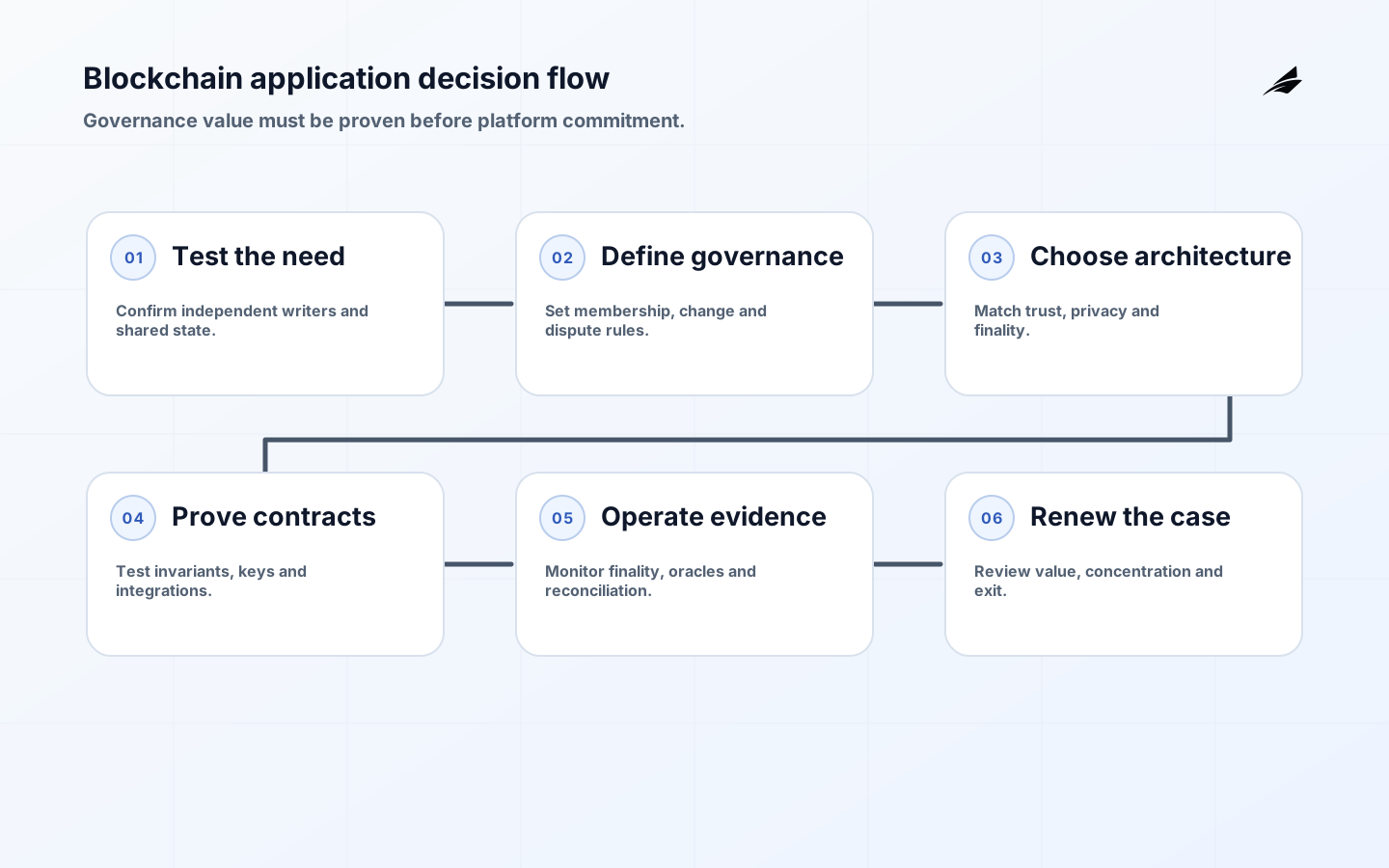
A blockchain application services FAQ should begin with the decision most sales material skips: does the problem actually require a shared ledger? Blockchain can coordinate records among parties that do not want one participant to control the history, but it adds distributed governance, key custody, privacy, consensus, smart-contract and operational obligations. When one accountable organization can maintain the authoritative database and expose audited interfaces, a conventional system is usually simpler to change, protect and operate.
This guide helps sponsors test that boundary and plan a production service when the case survives it. The blockchain scope and cost guide covers the commercial model, while the production implementation checklist provides detailed controls. The questions below focus on architecture, governance, data, smart contracts, identity and acceptance.
When is blockchain application development justified?
Look for multiple independent writers, a shared state transition, a need for common ordering or tamper evidence, and a governance reason no single participant should control the record. Identify the legal authority and off-chain process behind every on-chain event. NIST's Blockchain Technology Overview describes blockchains as distributed, tamper-evident and tamper-resistant ledgers; it does not claim they make inputs true or remove all trust.
Reject weak cases. A blockchain does not improve bad master data, prove that a physical item matches its digital claim, keep public data private, or make an oracle trustworthy. It cannot replace contracts, identity proofing, dispute resolution or accountable operations. Run a conventional database and signed-event comparison during discovery. Choose the ledger only when its governance and verification benefits exceed the added lifecycle cost.
| Decision test | Ledger-favorable evidence | Conventional alternative |
|---|---|---|
| Writers | Independent parties must submit state changes | One accountable service owns writes |
| Authority | No participant should control shared history alone | Central governance is accepted |
| Verification | Participants need independently verifiable ordering | Audit logs and signatures are sufficient |
| Availability | Replicated validation serves the operating model | Managed database resilience is adequate |
| Privacy | Permitted data can be shared under clear rules | Central access control is simpler |
| Change | Governed protocol change is acceptable | Frequent unilateral change is required |
How should network and governance models be chosen?
Choose public permissionless, public with application permissions, consortium permissioned or centrally operated distributed ledger according to participant identity, openness, finality, confidentiality, performance and governance. The label is less important than explicit rules for joining, validating, upgrading, suspending, resolving disputes and exiting. A consortium needs legal agreements and technical controls that name who can change membership, code, policies and emergency state.

Hyperledger Fabric documentation illustrates permissioned-network concepts including identities, policies, channels and endorsement. Ethereum development documentation describes a public network stack of accounts, transactions, smart contracts, clients and APIs. These are different trust and operating models, not interchangeable hosting choices. Benchmark the actual transaction, participant and privacy profile before selecting a platform.
What data should be stored on the ledger?
Store the minimum data required for shared verification. Personal, confidential, regulated or frequently corrected records often belong off-chain behind access control, with a carefully designed reference or commitment on-chain. A hash is not automatic anonymization: predictable source values can be guessed, and immutable references can preserve linkability. Define retention, deletion, correction, jurisdiction and participant visibility with privacy and legal specialists before implementation.
Document the relationship between on-chain state and off-chain systems. Name the authoritative source for identity, assets, documents, prices and physical events. Oracles and integration services require authentication, replay protection, monitoring and dispute rules. Reconcile ledger events to business systems and preserve idempotency. If an off-chain record is deleted or corrected, the application must display a coherent current state without pretending the historical ledger changed.
How should smart contracts be designed and changed?
Keep contract logic small, deterministic and explicit about authorization, state transitions, bounds and failure. Avoid encoding ambiguous legal judgment or rapidly changing policy in immutable code. Define upgrade authority, time delays, emergency pause, migration and retirement before deployment. Tests should cover unauthorized calls, repeated and reordered transactions, boundary values, denial of service, dependency failure and invariants such as conservation of value or single ownership.
The official Ethereum smart contract security guidance emphasizes access controls and the difficulty of repairing deployed code. Independent review is appropriate for contracts controlling consequential value or rights, but an audit is not a guarantee. Follow secure development practices across source, dependencies, builds and response; NIST's SSDF provides a lifecycle structure beyond the contract language itself.
| Control area | Production question | Required evidence |
|---|---|---|
| Authorization | Which identities may invoke each transition? | Role and negative-path tests |
| Invariant | What must remain true after every transaction? | Property and boundary tests |
| Upgrade | Who can change logic and after what notice? | Governance decision and rehearsal |
| Emergency | How is harm contained without hidden control? | Pause, recovery and disclosure procedure |
| Oracle | Why should participants trust external input? | Source, signature, freshness and dispute rule |
| Build | Does deployed bytecode match reviewed source? | Compiler settings, digest and verification |
How should identity and keys be managed?
Separate human or organizational identity proofing from cryptographic account control. Define enrollment, authorization, key storage, rotation, recovery, revocation and delegation. A lost private key should not automatically erase a legitimate business right, and a stolen key should not make every resulting action legally uncontestable. Use multi-party approval or hardware-backed custody where impact warrants it, with tested recovery that does not create an undocumented master key.
The W3C Decentralized Identifiers v1.0 Recommendation specifies DID syntax, a data model and operations for resolving identifier documents. It does not prescribe identity proofing, governance or a particular blockchain. If DIDs are used, select the method according to control, privacy, update and recovery properties. Explain to users which identifier, credential, wallet and legal account they are operating.
What drives cost and production operations?
Cost includes discovery, protocol integration, contract development, security review, nodes or provider services, transaction fees, indexing, off-chain storage, key custody, monitoring, support, governance meetings, upgrades and compliance. Public-network fees and finality vary; permissioned networks shift expense to member infrastructure and coordination. Model normal, peak and degraded conditions, including failed transactions and replay. Do not quote only contract-development hours.
Operate user journeys rather than node health alone. Monitor transaction submission, inclusion or finality, contract events, indexing lag, oracle freshness, peer disagreement, key operations and integration reconciliation. Define how users see pending, failed, replaced and disputed state. Test provider outage, network congestion, chain reorganization where applicable, validator loss, stale oracle, compromised key and failed upgrade. Preserve enough evidence for both technical investigation and participant dispute.
How should a blockchain service be accepted?
Run a multi-party lifecycle with production-like identities. Enroll members, submit valid and invalid transactions, rotate and revoke keys, interrupt integrations, dispute an input, upgrade code, recover an index, reconcile off-chain records and exit a participant. Confirm that no vendor-only account is required. Store source, deployment configuration, governance decisions, contracts, schemas, runbooks and evidence under accountable participant control.
Compare the result with the original decision test. If participants still rely on one company to validate every input, host every node and approve every change, the distributed design may add cost without changing authority. For adjacent automation decisions, the AI-led application checklist and AI-led services FAQ show how probabilistic systems require a different control model.
How should performance and economics be tested?
Benchmark the complete user journey under normal, burst and degraded conditions. Measure submission, endorsement or validation, ordering, finality, indexing and downstream reconciliation separately. Include payload size, participant count, privacy mechanism, contract complexity and node geography. A headline transactions-per-second result from a laboratory cannot predict how long a user waits for an independently verifiable business outcome.
Compare total cost with the conventional design over an agreed horizon. Include member coordination, legal governance, keys, node or provider operation, transaction fees, security review, monitoring, upgrades, indexing and support. Assign value only to benefits the ledger causes, such as reduced bilateral reconciliation or independently verifiable history. If every participant still maintains the same duplicate process, the network has not yet delivered the proposed coordination value.
Define a renewal decision for the network. Review active participants, transaction utility, disputes, operating concentration, protocol support and exit cost. A ledger should not continue indefinitely because historical records depend on it; archive verifiable evidence and maintain a documented read path even if new transaction activity moves elsewhere.
Key takeaways
- Use a ledger only when independent parties need shared ordering or verification without one controlling history.
- Define membership, upgrade, emergency, dispute and exit rules before selecting a platform.
- Keep sensitive and correctable data off-chain unless the requirement clearly justifies permanence.
- Design contract authorization, invariants, upgrade and recovery together.
- Treat identity proofing, keys, wallets and legal authority as related but distinct.
- Accept the service through multi-party failure, reconciliation, upgrade and exit exercises.
Additional blockchain application services FAQ
Is blockchain data immutable? It is better described as tamper evident and resistant under the network's assumptions. Applications can append corrections, while protocol governance may permit exceptional changes.
Does permissioned mean private? Not automatically. Privacy depends on data placement, participant visibility, channels or collections, access controls, logs and off-chain systems.
Can a smart contract replace a legal contract? Code can automate precise transitions, but legal rights, ambiguity, jurisdiction, mistakes and disputes still require an agreed governance and legal framework.
Should a proof of concept use real assets or personal data? No. Use representative synthetic data and bounded value until governance, security, privacy, recovery and participant authority are accepted.
Conclusion: prove the governance value first
Blockchain application services are justified when a shared, verifiable history solves a real multi-party authority problem better than a conventional service. Prove that case first, minimize permanent data, engineer contracts and keys for failure, and accept the network through participant-led operation. The strongest implementation is often the one that knows which responsibilities cannot be delegated to the ledger.