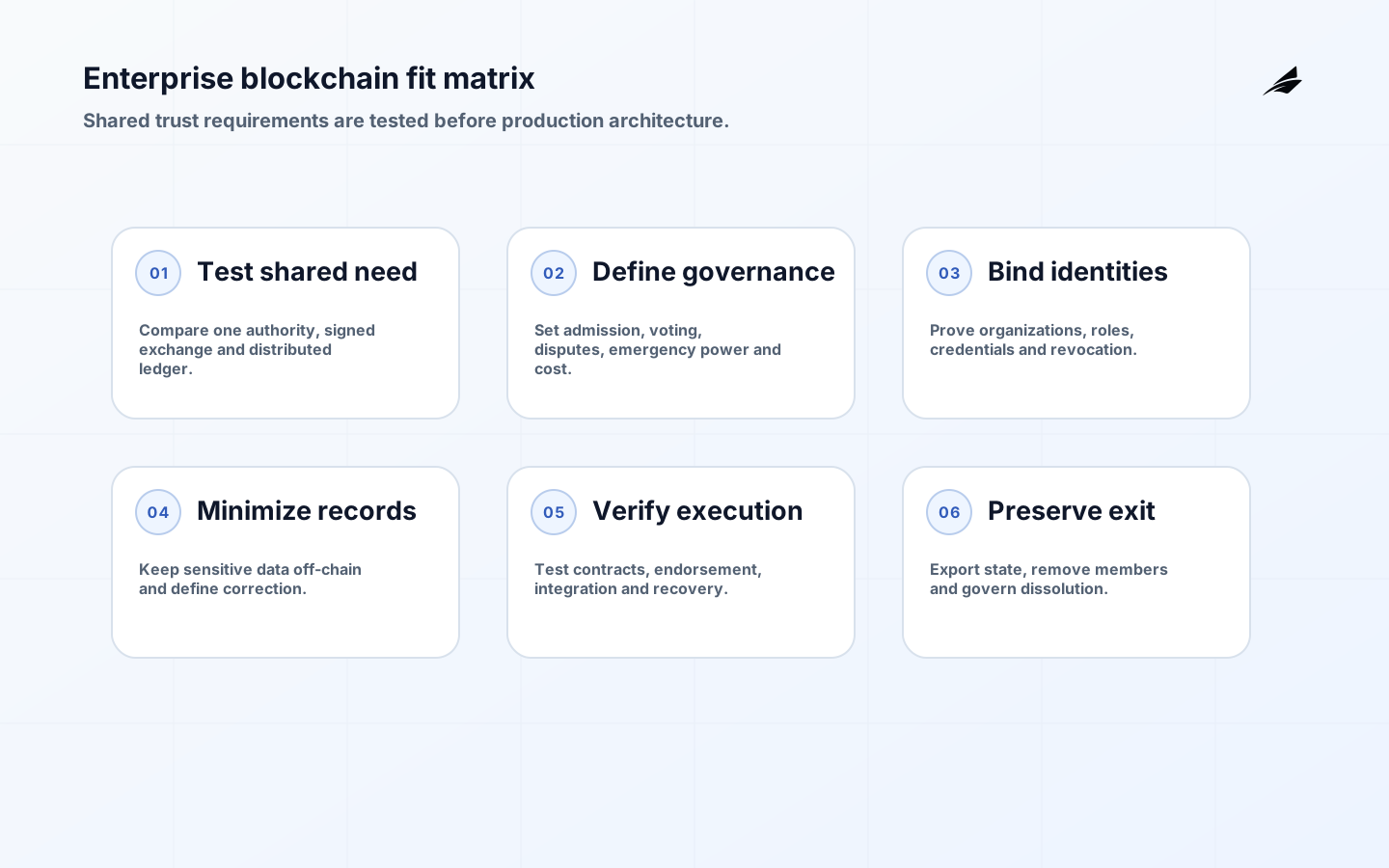
This enterprise blockchain solutions FAQ is designed for teams moving from research to an accountable delivery decision. Use the enterprise blockchain scope and cost plan, enterprise blockchain implementation checklist and blockchain application services plan for adjacent scope, implementation and operating questions. The practical standard here is evidence: named owners, explicit boundaries, representative tests and a route to stop or correct the system when assumptions fail.
Enterprise blockchain is appropriate only when multiple parties need a shared, tamper-evident transaction record and cannot meet the requirement more simply through one trusted operator, signed messages or conventional replicated databases. NIST’s blockchain overview describes distributed ledgers, consensus, cryptographic linking and smart contracts while also discussing limitations. A permissioned network still needs enforceable identity, governance and operations; distribution does not remove trust, it relocates trust into membership, software, validation policy and consortium decisions.
When is an enterprise blockchain a credible fit?
Start with a disputed or costly cross-organization process, not a desire to use a ledger. Identify participants, records, current authority, reconciliation work, write rights, validation rules, latency, confidentiality and correction obligations. Blockchain is potentially useful when independent parties must submit and verify ordered transactions, need shared evidence and cannot grant one participant unilateral control. It is weak when one organization is already the accepted authority, data changes frequently, transactions require broad secrecy, throughput is extreme, deletion is mandatory or the main problem is poor master data. Compare at least three designs: conventional system of record with APIs, signed event exchange and distributed ledger. Price governance, integration and exit, not only nodes. A proof should test the trust assumption and disputed cases; token movement or a successful transaction demo proves very little about enterprise fit.
What governance must a consortium decide?
Create a binding governance agreement covering admission, identity proofing, voting, software ownership, node obligations, service objectives, fees, intellectual property, data roles, audit, sanctions, incident authority, dispute resolution, jurisdiction, exit and dissolution. Define who can approve protocol, membership, endorsement, schema and smart-contract changes, and what happens during deadlock or emergency. Technical majority and legal authority are not automatically the same. Avoid giving the implementation vendor permanent unilateral administrator power. Publish a decision register and versioned network policy. Include minority protections and a route to challenge erroneous or abusive transactions. Plan for participant insolvency, acquisition, key compromise and regulator requests. The consortium’s operating body needs funding and people after launch; otherwise apparently decentralized infrastructure becomes dependent on one sponsor’s team.

| Question | Ledger-favorable signal | Conventional alternative | Evidence |
|---|---|---|---|
| Authority | No accepted unilateral operator | Single system of record | Participant agreement |
| Writers | Several independent organizations | Controlled API submissions | Write-rights map |
| Verification | Shared ordered evidence matters | Signed event archive | Dispute cases |
| Data | Small shared transaction facts | Central protected records | Privacy assessment |
| Change | Append and supersede is acceptable | Mutable database | Records decision |
How do identity and permissions work?
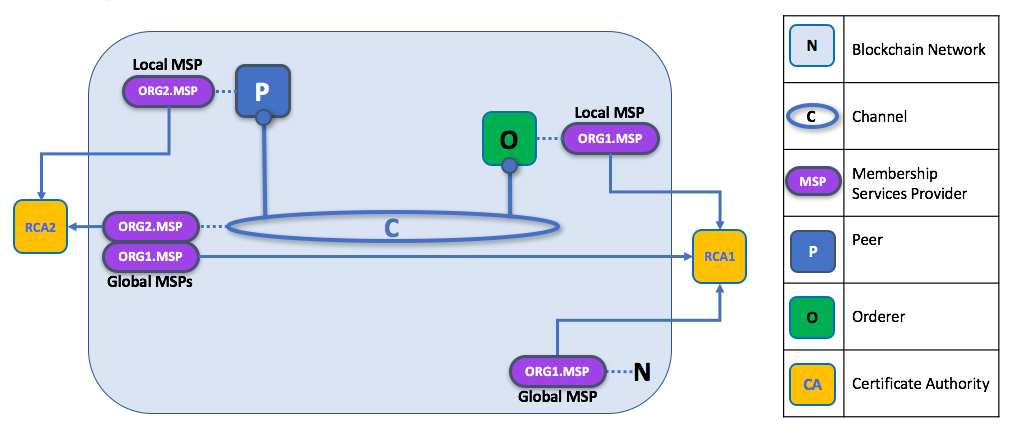
Permissioned networks authenticate organizations, nodes, administrators and transaction submitters, then apply policies to their actions. Hyperledger Fabric’s membership documentation explains how Membership Service Providers turn verifiable identities into network roles. Design enrollment, credential issuance, hardware protection, rotation, revocation, recovery and separation of duties. Give applications and automated agents distinct identities rather than sharing organizational administrators. Map network identity to the real legal entity and business role, preserving evidence for off-ledger approval where required. Test revocation across peers, clients and cached authorization. A private channel or permissioned network is not confidential by default; participants may still see metadata, payloads or access patterns. Apply least privilege at the application and infrastructure layers as well as the ledger policy.
Can sensitive data and correction rights be handled?
Minimize on-chain data. Store personal, confidential or bulky records in governed repositories and place only necessary identifiers, commitments or hashes on the ledger when that design genuinely helps verification. A hash can still be personal or sensitive when it links to an identifiable record, and deleting off-chain content may not remove all derived risk. Hyperledger Fabric private-data guidance describes restricted collections where authorized peers hold private data while hashes support validation; teams still must govern retention, backups, logs, membership changes and inference from transaction patterns. Define correction as an appended authoritative event, reversal or superseding state rather than claiming history changed. Involve privacy, records and legal owners early because immutability and replication can conflict with purpose limitation, minimization, localization and deletion duties.
How should smart contracts and integration be designed?
Treat smart contracts as deterministic shared business rules with high change cost. Specify states, permitted transitions, endorsers, time semantics, external data, idempotency, error handling and compensation. Hyperledger Fabric endorsement policies show how required organizational signatures can be attached to chaincode or state. Review code, test invariants and adversarial sequences, control dependencies, sign releases and rehearse upgrade and rollback. Never assume a smart contract can establish the truth of an external event; an oracle, user or integration supplies that assertion and remains a trust boundary. Connect enterprise systems through durable APIs and events with stable identifiers, replay protection and reconciliation. Keep a designated system of record for customer, product and financial data unless governance explicitly transfers that authority.
| Control | Design decision | Production proof | Accountable party |
|---|---|---|---|
| Membership | Admission and revocation | Compromised identity removed | Consortium |
| Endorsement | Required organizations | Invalid proposal rejected | Business owners |
| Privacy | On-chain minimum and collections | Unauthorized peer cannot read | Data owners |
| Upgrade | Approval and compatibility | Canary plus rollback exercise | Technical council |
| Exit | Export and final authority | Independent state verification | Governing body |
What must production operation prove?
Set objectives for transaction acceptance, finality, query freshness, node availability and recovery. Benchmark realistic payloads, endorsement policies, participant count, privacy patterns and bursts; a single-node lab result is not capacity evidence. Monitor proposal, endorsement, ordering, validation, commit, peer lag, certificate age, storage growth, failed transactions and integration queues. Correlate a business transaction across off-chain systems and ledger identifiers without exposing confidential payloads in broad logs. Back up keys, configuration, ledger data and off-chain records according to the chosen platform’s recovery model. Exercise peer rebuild, certificate-authority recovery, participant isolation, bad release rollback and consortium communications. Define who can halt submissions or change policy during an incident and how emergency action is reviewed afterward. Operations must preserve shared trust under stress.
What drives cost and how is exit preserved?
Total cost includes discovery, consortium law and governance, integration, identity and key management, nodes, environments, observability, audits, smart-contract assurance, support, upgrades, data growth and participant onboarding. Compare cost per reconciled transaction or avoided dispute, not cost per server. Allocate common and participant costs transparently and define consequences when a member stops paying. Preserve portability by documenting schemas, contracts, identities, configuration, endorsement policy and off-chain references. Periodically export ledger history and current state in usable formats and prove independent verification. Define how the consortium winds down, how records remain accessible, how keys and nodes are retired, and which authority issues a final state. Exit planning is part of governance because a network that cannot be left safely creates concentration and continuity risk.
Set pilot acceptance and stop criteria
Run a bounded pilot with real participant roles and representative disputes. Test onboarding, endorsement disagreement, duplicate submission, invalid transition, unavailable members, credential revocation, external-data conflict, privacy restriction, contract upgrade and recovery. Compare time, reconciliation, evidence and cost with the strongest conventional alternative. Include legal and operational staff because a technically valid transaction may lack contractual authority. Inspect what participants infer from payloads, hashes, timing and metadata, and count manual work keeping the pilot alive. Define stop criteria before starting: no agreement on authority, unlawful sharing, added reconciliation, missed business timing, unfunded operations or a simpler option meeting the need with less risk. Success requires signed governance, agreed semantics, independent validation, tested operations, sustainable cost allocation and exit. Do not promote prototype keys or contracts. Build production through controlled issuance and reviewed configuration. A stopped pilot still creates value when it reveals that the actual problem is master-data governance, contract standardization or API interoperability.
Review consortium health as well as platform health. Track active participation, concentration of voting or node operation, onboarding time, disputes, policy exceptions, failed transactions, ledger growth, upgrade lag and unpaid common costs. Examine whether business value is shared fairly or one member carries operations for others. Trigger governance review after merger, regulatory change, participant exit, major incident or proposed new data use. Require periodic re-acceptance of network policy and test that a departing member loses access without making required records unavailable. Healthy governance makes power and dependency visible; without it, technical distribution can conceal practical control by one sponsor, vendor or identity authority.
The broader NIST blockchain program covers ledger applications and research, while the W3C Decentralized Identifiers standard shows one standards-based identifier model; neither removes the need to choose authority, credential lifecycle and legal meaning for the consortium.
Key takeaways
- Use blockchain only when the multi-party trust problem survives comparison with simpler designs.
- Treat consortium governance as a production system.
- Minimize on-chain data and design correction explicitly.
- Test contract invariants, integration reconciliation and identity revocation.
- Fund operations and prove export, participant exit and network dissolution.
Frequently asked questions
Does a permissioned blockchain eliminate intermediaries?
No. It may redistribute validation and record keeping, but membership authorities, network operators, governance bodies, software maintainers, identity providers and external data sources remain intermediaries or trust points.
Are blockchain records automatically legally authoritative?
No. Legal effect depends on contracts, law, identity, evidence and the underlying transaction. The consortium must define which records are authoritative and how disputes, corrections and external approvals are handled.
Should personal data be stored on-chain?
Usually minimize it aggressively. Prefer governed off-chain records with only necessary verification material on-chain after a privacy and records assessment. Hashing does not automatically anonymize linked data.
Conclusion
Enterprise blockchain solutions become credible when the shared-ledger requirement, governance, identity, privacy, contract logic and operating model are all explicit. Compare simpler architectures first, pilot the disputed process rather than the technology, and require production evidence for recovery and exit. Distribution is useful only when it improves accountable cooperation.