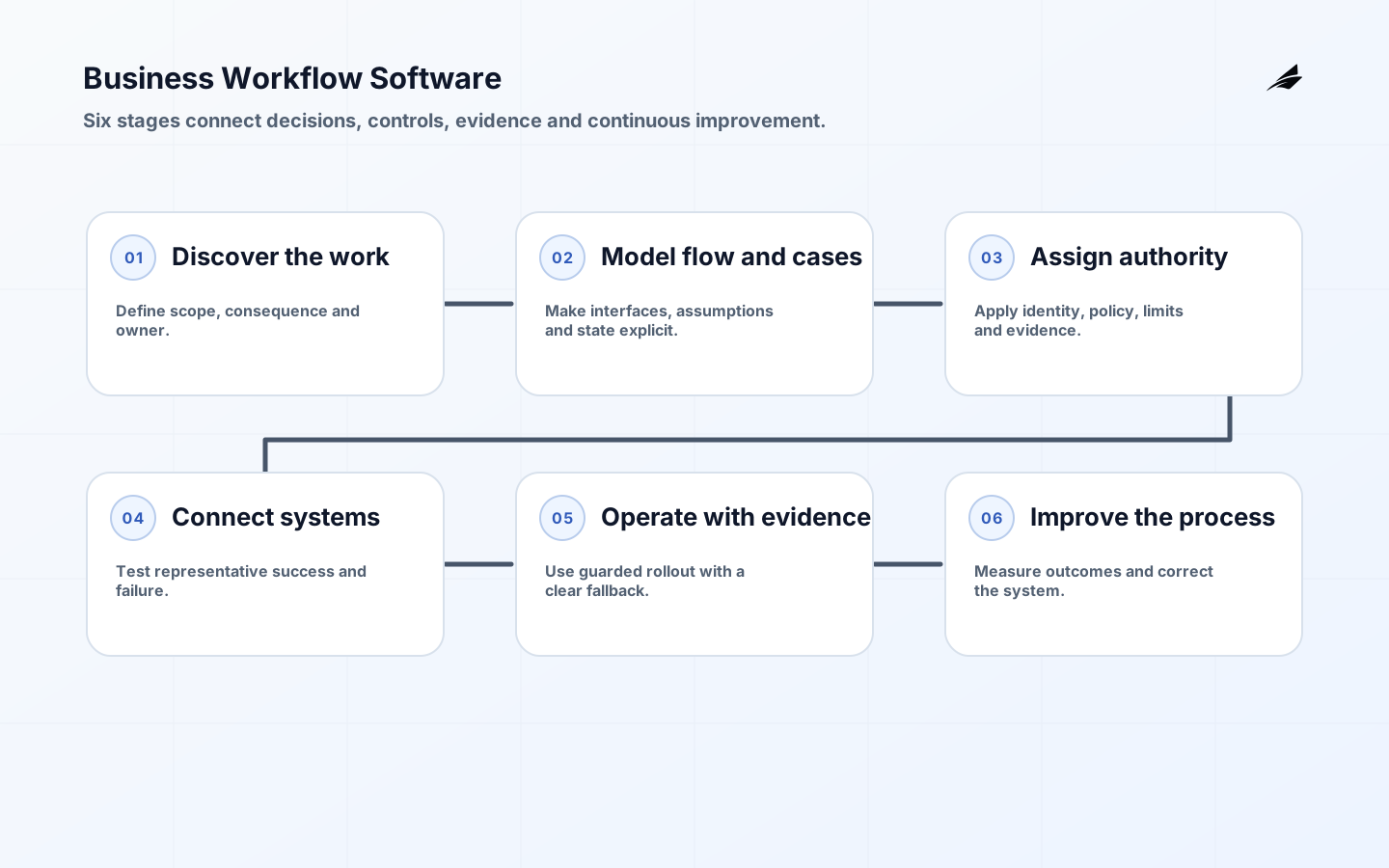
Business workflow software coordinates tasks, decisions, records and handoffs across people and systems. The useful question is not whether a product can draw a flowchart; it is whether the configured workflow preserves business rules, handles exceptions, controls authority and produces evidence without trapping the organization in brittle automation. This FAQ gives buyers and delivery teams a practical basis for evaluating that capability.
Use it with the business workflow software practical guide, implementation checklist, startup AI workflow delivery plan and startup automation checklist. Begin with a real process and its failure modes, then decide which work should be deterministic, case-based, decision-driven or left to human judgment.
What business workflow software should actually manage
A workflow platform should maintain state, route work, enforce decisions, call systems, wait for events, manage deadlines and record outcomes. Repeatable sequences suit process orchestration; evolving investigations may need case management; complex eligibility logic belongs in explicit decision models. The OMG BPMN 2.0.2 specification supplies a common notation for events, tasks, gateways and participants, but a diagram still needs operational ownership and testable rules.
Describe one case from trigger to closure. Name the system of record, required inputs, actors, decisions, service targets, exception paths and evidence. Include cancellation, duplication, timeout, reassignment and partial failure. If the process cannot be explained without vendor vocabulary, discovery is incomplete. Software should express the operating model, not quietly become the only place where the organization understands it.
Choose process, case and decision patterns deliberately
Straight-through work has known stages and predictable transitions. Knowledge work changes as facts arrive, so forcing it into a rigid sequence creates workarounds. The OMG Case Management Model and Notation covers cases whose activities may occur in an unpredictable order, while decision tables can separate policy logic from orchestration. A portfolio may use all three patterns behind one user experience.
Ask vendors how versions, in-flight instances and decisions are represented. A policy change should not silently alter a case already under review unless that is an approved migration. Rules need effective dates, owners and test examples. Process definitions need readable exports and change history. These capabilities matter more than a large connector count because they determine whether the organization can explain and safely modify its operation.
| Work pattern | Best-fit capability | Evidence to request |
|---|---|---|
| Repeatable sequence | Process orchestration with explicit events and gateways | Versioned model, test cases and instance history |
| Evolving investigation | Case management with discretionary tasks | Case file, role controls and milestone rules |
| Policy-heavy decision | Decision table or rules service | Effective dates, examples and decision trace |
| Cross-system transaction | Durable orchestration and reconciliation | Idempotency, retry policy and correlation IDs |
Build authority and evidence into every transition
Workflow roles must map to real authority. Requesters, approvers, delegates, administrators, integration identities and auditors need distinct permissions. Current NIST Digital Identity Guidelines cover identity proofing, authentication and federation; apply the required assurance to the consequence of the action. Re-authentication or step-up approval may be appropriate for high-impact releases, payments or access changes.

Log who or what changed state, the prior and new values, the governing rule, timestamp, correlation identifier and outcome. Protect logs from unauthorized alteration and define retention by legal and operational need. NIST log management guidance remains a useful foundation for planning collection, storage, analysis and disposal. Do not put secrets or unnecessary personal data into convenient audit fields.
Design integrations for retries, drift and ownership
Integrations should use documented APIs or events with authenticated workload identities, bounded scopes, timeouts and idempotency. Record the business transaction identifier separately from a transport request ID. When a downstream system is unavailable, define whether work pauses, retries, moves to a queue or creates a human task. A successful HTTP response is not proof that the business record reached the required state.
Maintain contracts for schemas, status values, rate limits and error meanings. Consumer and provider owners should agree change notice and compatibility rules. Test expired credentials, duplicate messages, out-of-order events and slow dependencies. Reconcile workflow state with systems of record so a lost callback cannot strand work indefinitely. Connector ownership belongs in the service model, including monitoring, support and retirement.
Make workflow screens usable under real operating pressure
Users need to see what requires action, why it is assigned, what information supports the decision, the deadline and what happens next. Avoid long forms that repeat known data or expose internal state names. WCAG 2.2 adds relevant criteria for focus visibility, target size, redundant entry and accessible authentication; accessibility testing should cover every role and exception path, not only the happy path.
Design queues for prioritization without encouraging people to game status. Make delegation explicit and time-bounded. Preserve drafts safely, validate fields near the point of entry and explain errors in business language. For consequential submissions, provide review and correction before finalization. Mobile use, assistive technology, intermittent connectivity and bulk work may each need a deliberate interaction pattern.
| Selection area | Practical test | Failure signal |
|---|---|---|
| Change control | Promote a rule change while older cases remain open | In-flight behavior cannot be explained |
| Operations | Diagnose and recover a deliberately failed connector | Only vendor support can inspect state |
| Access | Delegate approval, expire it and review the audit trail | Privilege persists or attribution is lost |
| Portability | Export one live case with history and attachments | Export omits semantics or cannot be parsed |
Evaluate products with scenarios and exit evidence
Run a scripted proof using representative data and the hardest exception, not a polished vendor demonstration. Score model expressiveness, identity, integration, accessibility, observability, deployment, environment promotion, data location, administration and support. Require the vendor to show how an operator diagnoses a stuck instance, how a rule version is traced and how permissions are reviewed.
Commercial comparison should include licenses by role, transaction or execution charges, environments, premium connectors, storage, log export, implementation, testing, training and ongoing administration. Test export of process definitions, case history, attachments, rules and audit records. An exit plan is credible only when another team can read the export and continue or close open work without relying on the departing platform.
Measure flow, quality and control together
Track end-to-end elapsed time, active work time, wait time, rework, exceptions, abandonment and outcome quality by meaningful segment. Queue age and deadline breaches reveal different problems than average cycle time. Measure automation coverage only alongside correction cost and customer effect. A process can become faster while producing more disputed or inaccessible decisions.
Instrument transitions with stable identifiers and definitions. Review the longest waits and highest rework paths with process owners each month. Separate demand changes from process performance so rising volume is not misdiagnosed as slower execution. Use findings to simplify policy, improve source data or remove unnecessary approval, rather than automating every historical step more aggressively.
Example: automate supplier onboarding without losing control
A procurement team receives supplier requests by email, checks tax and bank details, collects risk evidence and creates records in finance systems. Model the request, duplicate check, evidence collection, risk decision, approval and activation as separate states. Keep the finance platform authoritative for supplier identity and the workflow authoritative for review state. Route unusual ownership structures or bank changes to specialist review.
- Reject incomplete requests before costly external checks.
- Use a stable supplier-request ID across forms, checks and finance APIs.
- Require independent approval for bank-detail changes above the risk threshold.
- Pause safely when sanctions, identity or finance services are unavailable.
- Reconcile activated suppliers daily against approved workflow outcomes.
- Test withdrawal, resubmission, duplicate and emergency exception paths.
Pilot with one supplier category and measure total time, waiting by team, resubmission, false duplicate matches and post-activation correction. Review every override during the pilot. The release gate should require successful access revocation, replay of a duplicate integration message, evidence export and recovery of a deliberately stalled case.
Operate the capability as a managed system
Before procurement, establish a governance cadence for process owners, platform operations, security, records and affected user groups. Review open exceptions, delayed instances, rule changes, integration health, access recertification and evidence exports. Keep a decision log for changes that alter customer or employee rights. Periodically observe users completing real work; dashboard metrics rarely reveal confusing assignments, inaccessible controls or informal workarounds. Test continuity when the workflow vendor, identity provider or a major connector is unavailable. Document the minimum manual process, capacity limits and later reconciliation. These operating practices keep the modeled workflow aligned with policy and make platform dependence visible before an incident or contract renewal.
Key takeaways
- Model process, case and decision work according to how the business actually operates.
- Treat role authority, versioning, audit evidence and exception recovery as core product requirements.
- Evaluate integrations under retry, duplication and schema-change conditions.
- Test accessibility and operator diagnosis across every consequential path.
- Measure customer outcome, wait and rework alongside automation and speed.
Frequently asked questions
Is workflow software the same as robotic process automation?
No. Workflow software usually manages state, routing, decisions and human work across a process. Robotic process automation often imitates user actions in an existing interface. They can be combined, but UI automation is more sensitive to screen changes and should sit behind monitored exceptions and a clear system-of-record design.
Should every approval be automated?
No. Remove approvals that add no risk control, automate deterministic checks, and preserve accountable judgment where context matters. High-impact decisions may be assisted by rules while still requiring an authorized person. Document the reason for each approval and measure whether it catches meaningful issues.
How long does implementation take?
A bounded workflow with stable APIs may reach a controlled pilot in weeks; a cross-enterprise process with unclear policy, legacy integration and data remediation can take months. Estimate discovery, rule agreement, integration, migration, testing, training and operating readiness separately. Scope the first release around one complete outcome.
Conclusion
Business workflow software succeeds when it makes work more legible and controllable, not merely more automatic. Start with the actual operating model, separate process, case and decision logic, design integrations for failure and give operators evidence they can use. A small workflow that handles exceptions, authority and change cleanly is a stronger foundation than a broad rollout built on hidden assumptions.