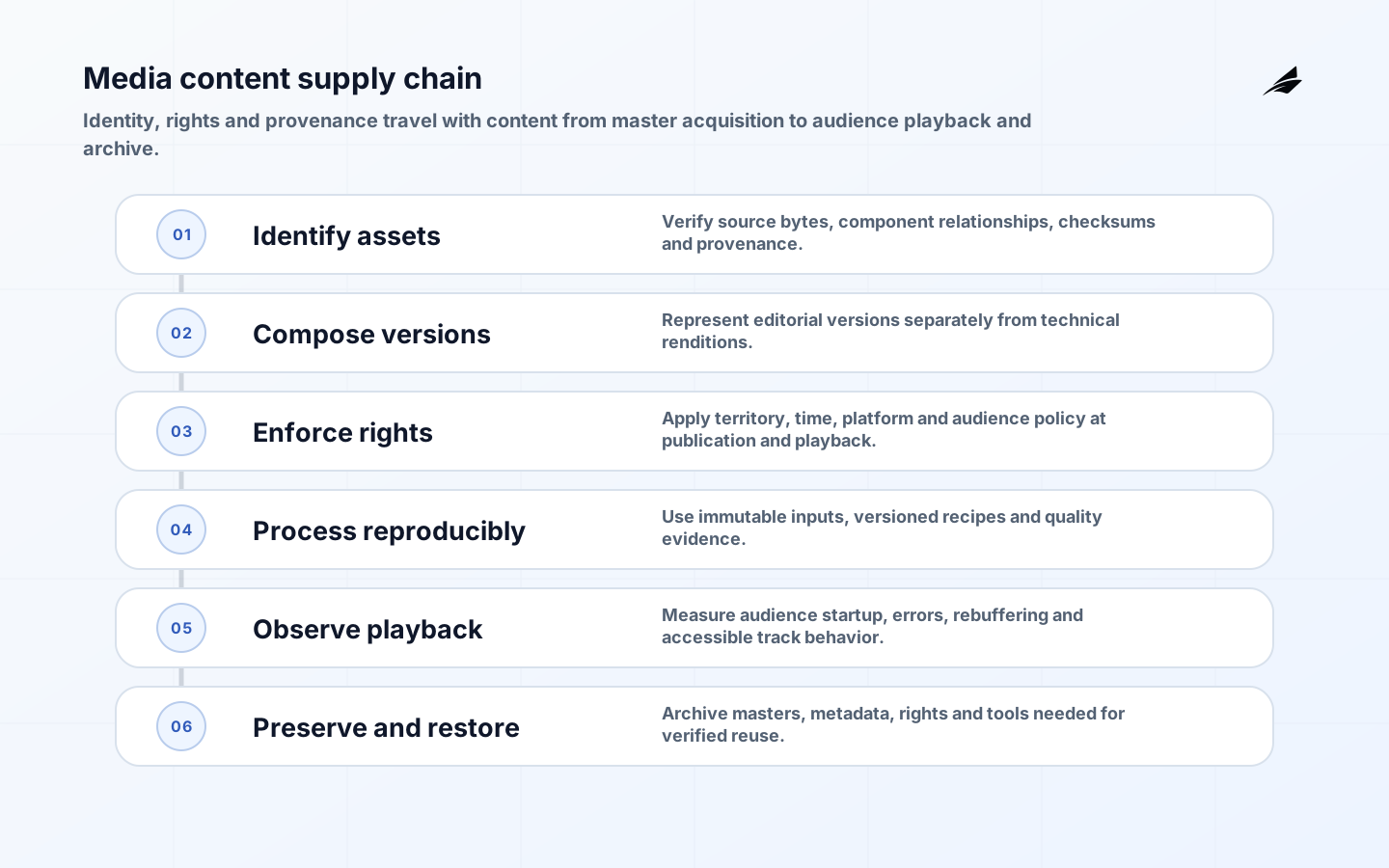
A media and entertainment platform is a content supply chain, not simply a video player or asset library. It receives large files and live signals, identifies versions, applies rights and editorial decisions, runs compute-intensive processing, packages outputs for many devices, distributes them globally and preserves masters for reuse. The architecture must keep content identity, provenance, rights, accessibility and quality intact while individual services scale and fail independently.
This FAQ is for product, engineering and operations teams planning streaming, publishing, post-production or media-asset workflows. The media and entertainment implementation checklist provides a companion rollout sequence. Answers here emphasize durable records and measurable service behavior so teams can change encoders, storage, delivery or playback components without losing control of the title and rights they serve.
What belongs in the platform boundary?
Start with one content journey: acquisition to approved master, live event to replay, or title onboarding to customer playback. Identify source assets, editorial decisions, rights, timed text, artwork, renditions, distribution endpoints and reporting. Separate the media bytes from metadata and workflow state. Object storage may hold essence files while an authoritative catalog records identity, relationships, checksums, technical properties, provenance and allowed use.
Use stable identifiers for title, version, asset, track, package, territory and publication. Display names change and filenames are not reliable identity. Model work as state transitions with an append-only event history: received, verified, processing, review required, approved, published, withdrawn and archived. Each transition needs an actor or service, reason and evidence. That record makes retries, partial processing and later investigation understandable.
| Domain | Authoritative concern | Typical evidence |
|---|---|---|
| Asset identity | Which exact bytes and version? | Stable ID, checksum and provenance |
| Rights | Where, when and how may it be used? | Contract rule and decision version |
| Processing | Which transformation produced the output? | Recipe, tool version and job trace |
| Distribution | What was published to each endpoint? | Package ID, manifest and acknowledgement |
| Playback | What did the audience experience? | Startup, errors, quality and accessibility signals |
How should masters, versions and renditions be modeled?
Do not duplicate a complete master for every territory and platform if the workflow can preserve common components and explicit differences. SMPTE Interoperable Master Format defines compositions and reusable track files for finished masters. Even when a team does not implement IMF, the principle is useful: represent picture, audio, captions and edit decisions as identifiable components, and record which composition was approved for each purpose.
Keep editorial version separate from delivery rendition. A director cut, censored edit or dubbed language changes the intended composition; a bitrate or resolution is a technical rendition. Store checksums and technical metadata at ingest, then verify them after transfer and before archive. Never overwrite an approved asset in place. Corrections should produce a new version with a relationship to the prior one and an explicit publication decision.
How do rights become enforceable platform policy?
Represent rights as structured rules tied to title or version, territory, time window, platform, audience, language and permitted action. Preserve the contract or licensed source and the rule version used for a decision. A simple available flag cannot explain why one rendition may stream in one region but not download, clip or advertise in another. Define precedence when rights overlap and a review path when metadata is incomplete.
Enforce rights at publication and playback, not only in an editorial dashboard. Distribution jobs should refuse packages outside approved windows, and playback authorization should use current policy without trusting client controls. Cache carefully around boundary times and emergency withdrawals. Test daylight-saving changes, clock skew, territory ambiguity, account travel and rights updates during active sessions. Log decisions without exposing sensitive contract detail.
How should processing and quality control work?
Build processing as idempotent jobs that take immutable inputs and a versioned recipe, then produce immutable outputs and machine-readable results. Separate orchestration from workers so queues can absorb bursts and specialized compute can scale. Record tool version, parameters, logs, checksums and resource use. A retry should not create ambiguous duplicate assets. Failed jobs need a classified reason and an owner, not an endless retry loop.
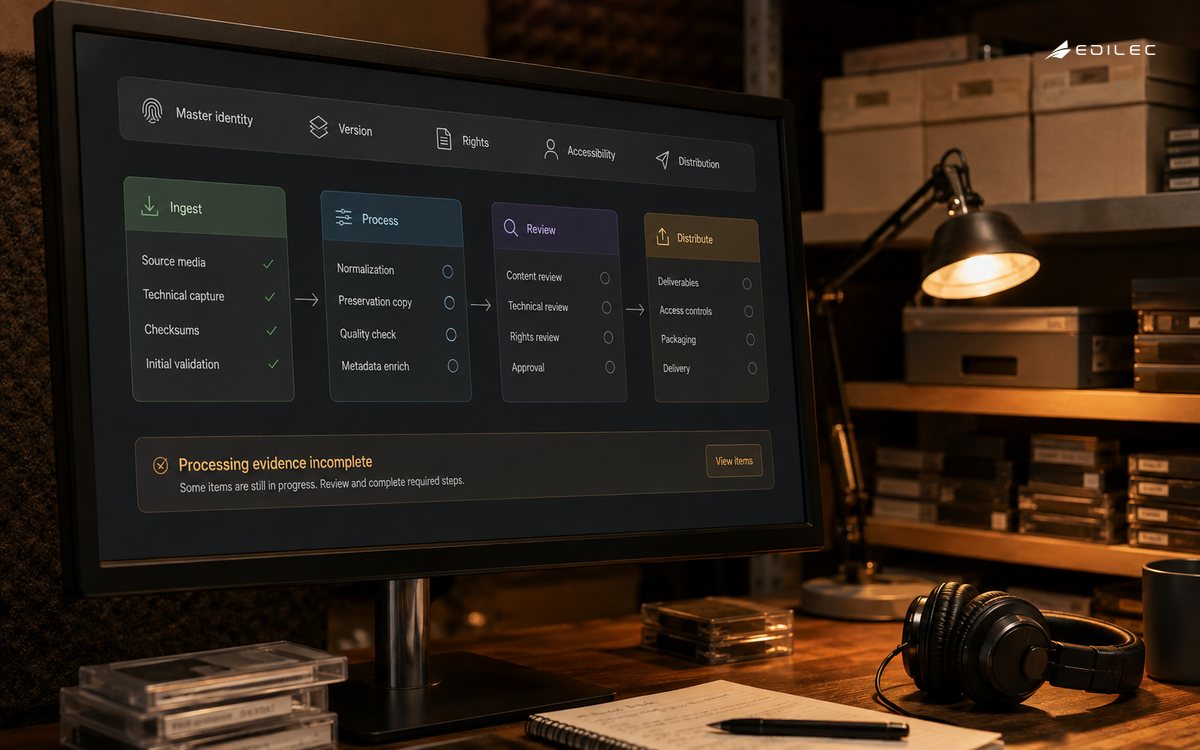
Automated quality control can detect corruption, silence, black frames, loudness, caption timing and technical conformance, but editorial acceptance still needs human review for material content. Set thresholds by content class and destination. Sample generated renditions and compare duration, frame rate, channel layout and subtitle language. Treat warnings differently from blockers and preserve the approved exception. The platform should show whether a title is safe to publish, not merely whether the transcoder exited successfully.
| Failure | Safe platform response | Recovery proof |
|---|---|---|
| Duplicate ingest | Reuse or link the existing asset | Checksum and source identity match |
| Worker timeout | Mark attempt unknown before retry | One accepted output per recipe |
| Failed caption validation | Block affected package only | Corrected track passes review |
| CDN publication mismatch | Withdraw or repair endpoint state | Manifest and endpoint reconcile |
| Master unavailable | Restore verified bytes and metadata | Checksum and composition validate |
What makes streaming delivery dependable?
Adaptive streaming separates encoded media, packaging, manifests, content delivery and player behavior. The W3C Media Source Extensions API enables scripted media buffers in browsers, while DASH-IF guidelines support interoperable packaging and playback. Choose a controlled codec, container, encryption and manifest matrix based on actual devices. Every extra combination increases encoding, validation, storage, support and observability cost.
Measure the audience session rather than CDN uptime alone. Track playback start success, time to first frame, rebuffering, fatal error, quality switches and exit, segmented by player version, device, network, title and CDN. Use synthetic probes for known paths and real-user telemetry for actual conditions. Correlate playback errors with manifest, segment, rights and service traces using privacy-preserving session identifiers. A fast API is not success if the user sees a black screen.
How should security and accessibility be incorporated?
Use least-privilege identities for people, services and vendors. Protect pre-release masters, signing keys, DRM credentials, distribution tokens and administrative actions. Segment production and partner transfer paths, scan inbound files, and expire temporary links. NIST CSF 2.0 helps assign governance, protection, detection, response and recovery work. Watermarking or DRM may deter misuse, but neither replaces access control, monitoring and contractual response.
Accessibility assets are part of the title, not optional attachments. Track captions, subtitles, audio description and language metadata with the same version discipline as picture and audio. Test keyboard and screen-reader operation of playback controls, visible focus, captions, contrast and error recovery against WCAG 2.2. Confirm that accessible tracks survive packaging and each distribution endpoint. An accurate source caption file provides no value if the player selects or renders it incorrectly.
How should the service be operated and archived?
Define service objectives for ingest availability, processing completion, publication lead time, playback success and restoration. Monitor queue age, retry storms, expiring rights, missing renditions, manifest errors, storage integrity and archive verification. Runbooks need authority to stop publication, withdraw a title, reroute delivery and preserve evidence. Incident review should connect technical failure to affected titles, territories and audience sessions.
Archive masters, metadata, compositions, rights evidence, checksums and software recipes according to preservation policy. Use multiple failure domains and periodic fixity checks. A backup is not an archive if formats, keys or metadata required to interpret the content are missing. Rehearse restoration of a complete title into a clean environment and republish a test package. Migration plans should preserve identifiers and provenance when storage or media systems change.
Accept one title through the complete supply chain
Use a representative title with picture, multiple audio languages, captions, artwork, rights windows and at least two delivery destinations. Trace it from ingest through identification, editorial composition, automated and human quality review, packaging, publication, playback and archive. Repeat one failed processing job and one withdrawn publication. Confirm that every output retains the source asset, recipe, rights decision and approval reference. The exercise should be reproducible by operations without the implementation team improvising database changes.
Review evidence with editorial, distribution, accessibility, security and support owners. Editorial confirms the intended version; rights confirms policy; accessibility verifies tracks and controls; operations explains job and endpoint state; support traces a failed audience session; archive restores the master and metadata. Production readiness means these roles agree on the record and recovery path. A demonstration of clean playback alone cannot prove that a global content supply chain is operable. Repeat the exercise after a material packaging, player or rights-service change. Keep the test title and expected outputs as a permanent regression asset.
Key takeaways
- Treat the platform as an end-to-end content supply chain.
- Separate title versions, component assets and delivery renditions.
- Encode rights as versioned policy at publication and playback.
- Measure processing evidence and audience playback outcomes.
- Preserve accessibility, provenance and restoration capability with the master.
Frequently asked questions
Should a media platform build its own transcoder?
Usually only when processing behavior is strategically distinctive or existing services cannot meet format, control or cost needs. Most teams gain more value by owning orchestration, metadata, quality policy and evidence while using replaceable processing engines.
Is DRM enough to protect premium content?
No. DRM protects a delivery path under defined device rules, but pre-release access, keys, vendor transfer, administrative actions, screen capture and account abuse need separate controls and monitoring.
What is the safest first platform scope?
Choose one content class, one approved master workflow and a limited device matrix. Prove identity, processing, rights, quality, publication, playback telemetry and archive restoration before adding live events, more territories or more codec combinations.
Conclusion
A professional media platform preserves meaning while moving large assets through many technical systems. Stable identity, component-aware versioning, enforceable rights, reproducible processing and audience-level telemetry make that possible. When accessibility and archive restoration are accepted alongside playback, the platform can evolve without losing control of the content it exists to serve.