Case management is useful only when it improves a real operating decision: how a complex request should be owned, investigated, decided, and closed over time. That decision is carried by intake, triage, evidence collection, assignment, decision, communication, and closure, not by a feature checklist.A reliable design makes the owner, current state, evidence, and correction path visible to the people who have to act (for a plain-language case decision). The practical baseline comes from the NIST Cybersecurity Framework, NIST SP 800-53, the W3C PROV Data Model, and DCAT 3: protect consequential operations, retain provenance for important assertions, and describe data so that consumers can understand its source and scope. Teams working through adjacent dependencies can also use Ticketing Workflows Checklist for Reliable Digital Operations and The Plain-language Guide to CRM Automation to clarify system boundaries before choosing screens or automation.
Set the plain-language case boundary
Start with one decision that occurs often enough to observe and matters enough to get wrong (for a plain-language case decision). For case management, that is how a complex request should be owned, investigated, decided, and closed over time. Name case operations lead as the accountable business role, then distinguish the people who submit information, the people who review it, and the service that records the outcome. Write down the included records: case identifier, person or organisation, issue, evidence, sensitivity, owner, decision, and correspondence. The boundary also needs an explicit stop condition. Work outside the defined service, missing essential evidence, or a conflicting authority should become an owned exception rather than an improvised workaround (for a plain-language case decision). This is how a team prevents a project from turning into a vague promise to connect everything (for a plain-language case decision).
| Decision element | Question to settle | Evidence to retain |
|---|---|---|
| Accountable owner | Who may decide how a complex request should be owned, investigated, decided, and closed over time? | Named case operations lead, delegated limits, and escalation path. |
| Authoritative records | Which facts establish the outcome? | case identifier, person or organisation, issue, evidence, sensitivity, owner, decision, and correspondence |
| Service boundary | What belongs in the first release? | Entry criteria, rejected cases, and manual fallback. |
| Correction route | What happens when evidence conflicts? | Queue, decision record, notification, and recovery action. |
Model understandable states before interfaces
The visible interface should reflect a state model, not conceal one. A useful case management lifecycle is received, triaged, assigned, awaiting information, under review, decided, appealed, and closed. Each transition needs an actor, a timestamp, an input, and a rule or reason (for a plain-language case decision). Do not overwrite a meaningful prior decision just to make the current screen tidy; retain the version or event that explains why the record changed (for a plain-language case decision). Provenance is especially important where a person has to challenge an outcome later (for a plain-language case decision). The W3C PROV model is helpful here because it separates an entity, the activity that changed it, and the agent responsible for that activity (for a plain-language case decision). That simple distinction keeps audit evidence comprehensible without forcing every operational screen to become a log viewer (for a plain-language case decision). Cases are not simple tickets when the next step changes as evidence arrives. The system must preserve the evolving narrative while showing responsibility, deadline, confidentiality, and the basis for a fair decision.
- Give every consequential case management item a stable identifier that survives handoffs.
- Record the effective time and rule or policy version for state-changing decisions (for a plain-language case decision).
- Keep attachments, source events, and human notes linked to the decision they support (for a plain-language case decision).
- Expose a clear next owner and deadline instead of an ambiguous “in progress” status (for a plain-language case decision).
- Make correction additive and reviewable when a prior result may already have been consumed (for a plain-language case decision).
Apply controls where case action has consequences
Security and governance should follow the operational consequence, not a generic role label (for a plain-language case decision). The principal risk in this domain is a sensitive request being lost between teams, decided without context, or closed without a defensible explanation.NIST SP 800-53 is useful as a catalogue of control objectives, but the implementation question is concrete: who can take the action, what context must be true, what evidence is written, and how is misuse detected or reversed (for a plain-language case decision). Separate routine work from high-impact changes. Require stronger authentication, review, or dual control only where the harm warrants it, and make those gates legible to the operator (for a plain-language case decision). Controls that are invisible or impossible to recover from encourage bypasses; controls paired with a useful exception route protect both the organisation and the user (for a plain-language case decision).
| Risk condition | Control response | Operating signal |
|---|---|---|
| a sensitive request being lost between teams, decided without context, or closed without a defensible explanation | Contextual authorization, recorded approval, and an accountable exception route. | Unexpected changes, denied actions, and time to acknowledgement, case age, transfer count, overdue evidence, reopen rate, and appeal outcome. |
| Stale or conflicting data | Source ownership, effective-time checks, and reconciliation before action. | Mismatch count, correction lead time, and unresolved conflicts. |
| Failed handoff | Idempotent exchange, durable reference, retry limit, and human escalation. | Queue age, duplicate actions, and recovery success. |
| Over-broad access | Least-privilege scope with scheduled review and fast revocation. | Dormant entitlements, review completion, and access anomalies. |
Integrate case contracts, not screens
Case management usually touches customer portal, CRM, document store, identity service, policy rules, and communications. Map the contract at each boundary: which service owns a field, what event announces a change, what acknowledgement proves receipt, and what happens when a dependency is unavailable (for a plain-language case decision). A copy can be useful for speed or resilience, but a copy is not a new authority (for a plain-language case decision). DCAT 3 offers a practical vocabulary for describing datasets and distributions; use that discipline even for small internal exchanges by recording owner, refresh expectation, access condition, and purpose (for a plain-language case decision). Build reconciliation into the operating process from the first release. It is cheaper to compare counts and representative records every day than to discover after a quarter that two systems used different definitions (for a plain-language case decision).
Measure whether case language supports trust
Choose measures that reveal whether people can complete, understand, and correct the work (for a plain-language case decision). For case management, begin with time to acknowledgement, case age, transfer count, overdue evidence, reopen rate, and appeal outcome. Pair speed with quality: a short cycle time is not success if it produces avoidable reversals, rework, disputes, or inaccessible decisions (for a plain-language case decision). Review a small sample of normal and exceptional records each week with the business owner (for a plain-language case decision). Ask whether the stated source, state, owner, and result match what actually happened (for a plain-language case decision). This qualitative check catches semantic drift that aggregate dashboards miss. The goal is not perfect instrumentation; it is enough evidence to decide what to fix next and whether a proposed expansion is earned (for a plain-language case decision).
- Track time to acknowledgement, case age, transfer count, overdue evidence, reopen rate, and appeal outcome at the workflow boundary, not only in a downstream report.
- Break results down by state, owner, channel, and exception reason before assigning blame (for a plain-language case decision).
- Set a review rhythm that includes representative records as well as totals (for a plain-language case decision).
- Treat an unexplained number as a data-quality incident with a named resolver (for a plain-language case decision).
- Publish the action taken after each review so users see that feedback changes the service (for a plain-language case decision).
Release plain-language case work in stages
A practical rollout starts with a bounded population, a documented fallback, and people who can answer questions during the first operating cycles (for a plain-language case decision). Rehearse normal completion, missing data, duplicate submission, permission denial, failed integration, and reversal before expanding (for a plain-language case decision). Preserve the old route long enough to compare outcomes, but avoid running two silent systems of record indefinitely (for a plain-language case decision). Decide the cutover signal in advance: reconciled records, trained owners, acceptable exception age, and a tested recovery procedure (for a plain-language case decision). The case operations lead should sign off on operational readiness because they will live with the consequences after the project team has moved on. The related guide Customer Portals: An Operations Leader’s Guide to Secure Self-Service offers another useful point of comparison for this boundary.
Use adjacent workflow guidance only after the user outcome and authority boundary are clear; this guide stays centred on plain, reviewable case decisions.
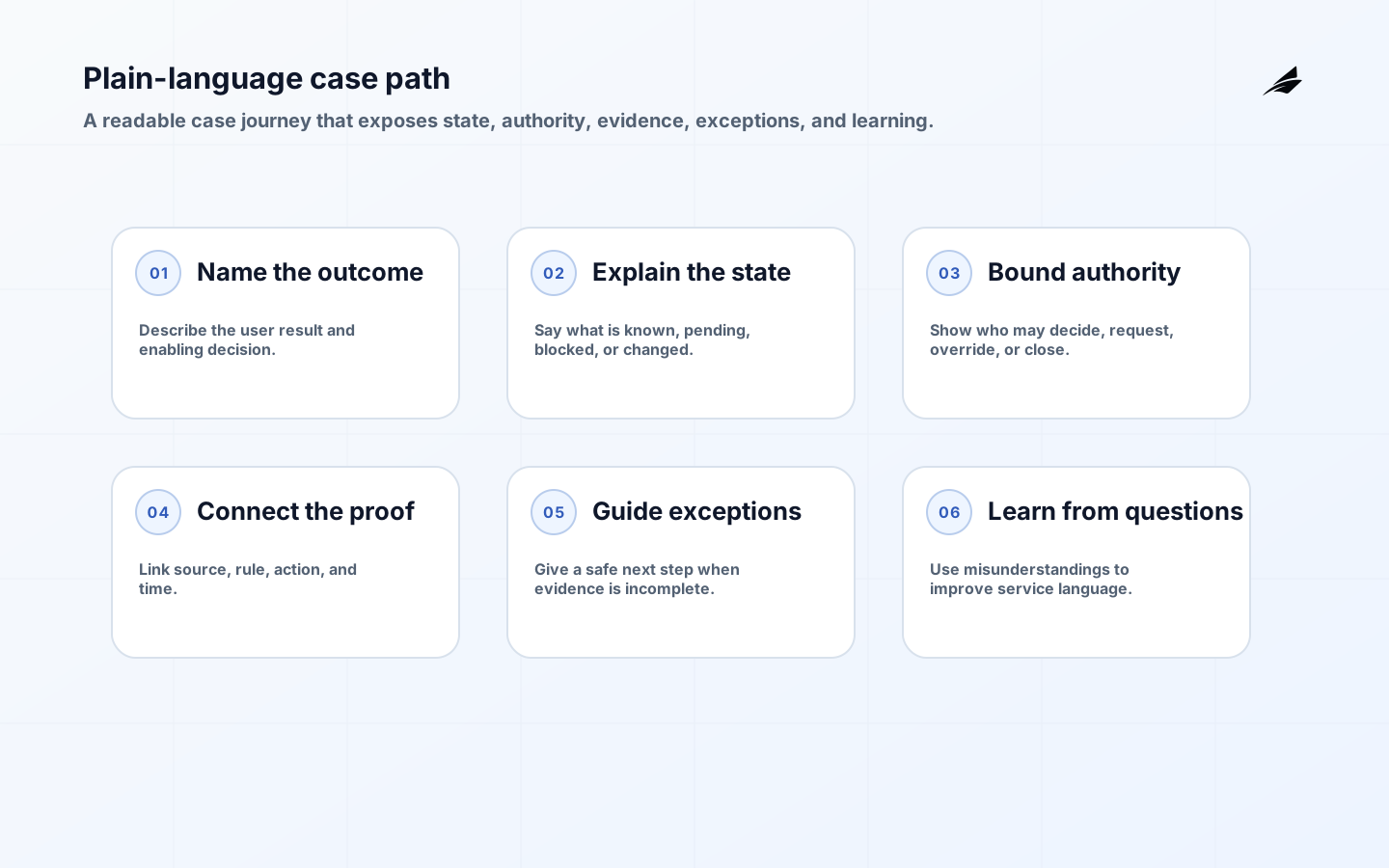
Name the outcome in language users can test
Plain language starts with a user-visible promise: what decision is being made, what the person can do now, and what evidence may still be needed. Replace vague states such as in progress with labels like awaiting approval, evidence requested, or ready for review when those distinctions change the next action. Keep the wording short, but preserve the authority and time context behind it so a simple message does not become a misleading one.
Define states that explain what happens next
Design each case transition around a sentence a participant can understand. Explain who is acting, what changed, why the case is waiting, and when an update is due. Link the notice to the underlying source or rule without making the reader search several tools. If an exception requires discretion, say who can decide and what the person may provide. Good language exposes uncertainty while still giving the user a safe next step.
Bound authority where consequences begin
Test the language at pressure points: a missing document, a disputed classification, a delayed approval, and a correction after closure. Ask a participant to identify the current state, the responsible role, and the next action from the message alone. Review misunderstandings and support questions as design evidence. Revise the state label or notice, then repeat the exercise until the plain-language path remains accurate under stress.
- Name the plain-language guide to case management decision, owner, timing, evidence, and unacceptable failure.
- Distinguish current, provisional, blocked, corrected, and recovered states.
- Test normal, late, duplicate, denied, partial, and recovery outcomes before expansion.
- Keep source, identity, policy, version, and authority close to consequential actions.
- Review one real exception with operators and record the correction.
Key takeaways
- Anchor case management in one consequential decision rather than a vendor feature list.
- Make states, owners, source records, and correction routes explicit before automating handoffs (for a plain-language case decision).
- Apply proportionate controls to the action that creates real operational risk.
- Use contracts and reconciliation to prevent integration copies from becoming competing authorities (for a plain-language case decision).
- Expand only after operating evidence shows the first path is understandable and recoverable (for a plain-language case decision).
Frequently asked questions
When is a ticketing tool not enough?
Use case management when a request has a changing evidence set, discretionary decisions, multiple parties, confidentiality rules, or a need to explain why a particular outcome was reached. A linear ticket can still be one task within the wider case.
What should a case closure prove?
Closure should show the decision maker, policy or criteria used, evidence considered, communication sent, unresolved follow-up, retention rule, and route to challenge or correct the outcome where appropriate.
Plain language is a control because it lets a participant recognise the current state and the next safe action. Test labels and notices with people who do the work, then revise terms that conceal uncertainty, authority, or the evidence needed for closure.
A readable service should also preserve the original question alongside the answer. That lets a reviewer distinguish a misunderstanding from a missing rule, a policy exception, or a genuine system defect. Keep the correction route as plain as the primary path.
Plain language should survive the exception path too: state what the person can do now, what evidence is missing, who may decide, and when the next update will arrive. That clarity protects users from treating a polite but vague status as a completed outcome.
Test the language at the point of pressure, not only in a quiet usability session. Ask a participant to respond to a missing document, a disputed classification, and a delayed approval. If the next action is still ambiguous, revise the state label, notice, or escalation route until the person can proceed safely.
Conclusion
Good case management makes a consequential decision easier to complete, inspect, and correct. Keep the first release narrow enough to test against real work, then connect each expansion to an owner, an evidence trail, a recovery path, and a measure that users recognise (for a plain-language case decision). That is how enterprise systems become dependable operating infrastructure instead of another place where work disappears (for a plain-language case decision).