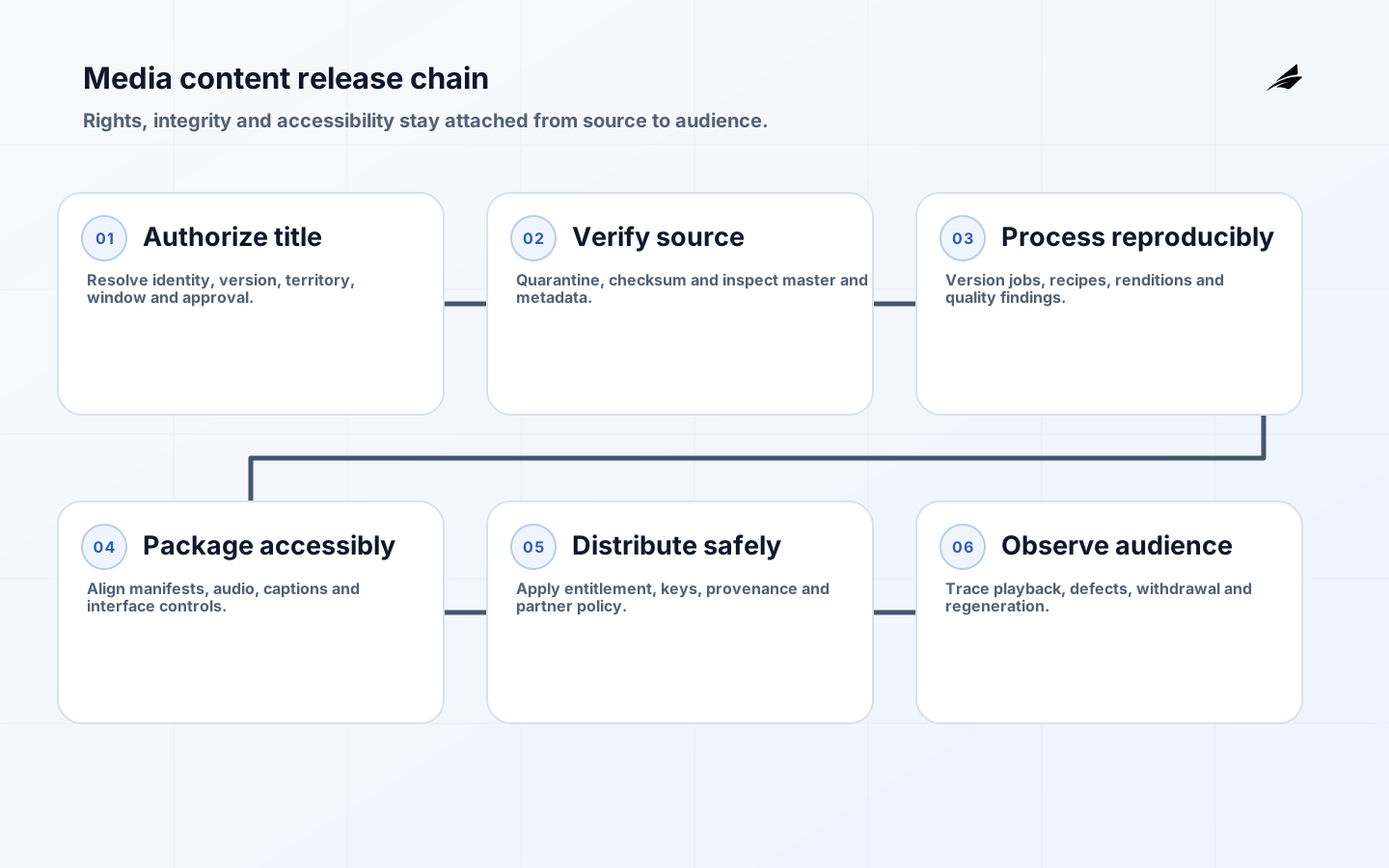
A media and entertainment implementation is a content supply chain, not just a player or asset library. A single title may pass through acquisition, rights, ingest, quality control, transformation, localization, packaging, distribution, playback, measurement, correction and retirement. Each stage changes files or metadata while commercial rights and audience expectations remain attached. The implementation is ready only when a team can prove which asset is authoritative, whether it may be used in a market and window, which rendition reached a viewer, and how to recover when processing or distribution fails.
This checklist applies to streaming, publishing, podcast, learning, sports and internal media platforms, with controls scaled to consequence. The media and entertainment planning guide and media technology FAQ provide companion context. Industry standards differ by format and distribution partner, so select only those needed by the actual delivery chain. Begin with an inventory and a representative title that exercises rights, language, accessibility and playback rather than proving success with a clean sample file.
1. Establish rights, identifiers and authoritative metadata
Assign a stable content identifier independent of filename and rendition. Model work, season, episode, version, clip and asset relationships explicitly. Record title, contributors, language, editorial state, territories, windows, platforms, audience restrictions, ownership and source. Mark which system is authoritative for each field. Rights must be machine-checkable at publish time and visible to operators; a spreadsheet note that does not reach packaging cannot prevent an unauthorized release. Define correction and approval paths for conflicting metadata and preserve decision history.
Normalize controlled vocabularies and external identifiers where contracts or partners require them. Separate descriptive metadata from operational state and rights. Store timestamps with timezone semantics, including inclusive or exclusive window boundaries. Test daylight-saving and cross-region conditions. Retain source contracts or verifiable references with access controls rather than copying sensitive terms into every downstream system. A deletion request may affect promotional derivatives, subtitles, thumbnails and caches as well as the master, so maintain relationships that let operations find all governed outputs.
| Control domain | Required evidence | Release blocker |
|---|---|---|
| Identity | Stable asset and work relationships | Duplicate or ambiguous authoritative title |
| Rights | Territory, window, platform and approval | No machine-checkable permission |
| Language | Declared audio, text and subtitle metadata | Track labels conflict with media |
| Accessibility | Caption, transcript and audio-description status | Required alternative missing or unverified |
2. Protect ingest and source integrity
Define accepted containers, codecs, profiles, color, audio, caption and metadata formats. Quarantine uploads until type, size, malware and integrity checks pass. Compute checksums and preserve provenance from receipt through each transformation. Never overwrite the only master. Record transfer source, time, operator or service identity and validation result. Handle partial uploads and retries idempotently. A duplicate delivery should match or create a review case, not silently produce another title. Use synthetic media for automated tests and protect unreleased content in nonproduction environments.
Quality control should combine automated inspection with human review at material points. Validate duration, frame rate, resolution, black or frozen frames, loudness, audio channels, subtitle timing, language tags and expected start or end. Human review remains important for editorial sync, readability, visual artifacts and correct version. Capture findings as structured defects tied to the asset and rendition. Define which defects block processing, which permit release with approval and which can be repaired later. A green transcoder status proves job completion, not audience quality.
3. Make processing reproducible and recoverable
Version transformation recipes, codec settings, packaging profiles, watermark rules, subtitle conversion and thumbnail logic. Every output should trace to source checksum, recipe version, tool version and job run. Use immutable intermediate outputs where cost permits and make jobs restartable without duplicating publication. Separate compute completion from editorial approval. Design queues with visible age, priority and dead-letter handling. Capacity plans should cover launch peaks, back-catalog migration and supplier outages. Test cancellation and priority changes without corrupting state.
Create a representative encoding ladder from measured audience devices and network conditions rather than copying arbitrary profiles. Validate manifests and segments with target players and distribution partners. DASH-IF interoperability guidance can inform MPEG-DASH profiles, but the chosen delivery stack and device matrix determine the required tests. Preserve audio and caption alignment across renditions. Package encryption and keys through a dedicated rights path; do not log keys or place them in build artifacts. Test expired, unavailable and rotated licenses as well as successful playback.
4. Build accessibility and playback into acceptance
Define caption, transcript, audio-description, sign-language and interface requirements by audience and jurisdiction. WCAG 2.2 requires alternatives and operable interfaces in applicable web contexts, but exact media obligations may go beyond WCAG. Captions need accuracy, synchronization, speaker identification and meaningful sound information. Player controls need keyboard access, visible focus, labels and sufficient contrast. Test track selection, persistence, resizing and full-screen behavior. Do not make autoplay or motion unavoidable when user control is expected.
Maintain a device and browser matrix based on actual use and commercial commitments. Test startup, seeking, bitrate changes, captions, audio selection, advertising transitions, entitlement, resume and error recovery. Include slow networks, packet loss, clock differences and expired sessions. Measure startup time, rebuffering, fatal playback errors and completion, but protect privacy and distinguish player behavior from content preference. Provide support with playback identifiers and a safe diagnostic view so a customer report can be traced without exposing unrelated viewing history.
5. Govern provenance, security and authenticity
Classify masters, pre-release cuts, credentials, personal data and audience records. Use least privilege, short-lived service identity, encryption, audited administrative access and controlled export. Segment partner access by title and purpose. Review watermarking and digital-rights controls as deterrence and business controls, not absolute prevention. NIST CSF 2.0 can organize governance, identification, protection, detection, response and recovery. Include content leaks, compromised partner accounts, malicious uploads and mass scraping in incident scenarios.
C2PA defines a technical approach for recording content provenance and edits using signed manifests. It can help compatible workflows communicate origin and transformation, but it does not determine truth or replace editorial verification. If provenance is adopted, define signing authority, key protection, validation behavior, metadata privacy and what the user sees when credentials are absent or invalid. Preserve provenance through transformations that support it and avoid claims stronger than the evidence. Establish an escalation path for disputed ownership or manipulated media.
| Failure | Detection | Recovery test |
|---|---|---|
| Bad source | Checksum, ingest and editorial QC | Quarantine and replace without losing history |
| Processing defect | Rendition validation and playback sample | Reprocess affected outputs from known source |
| Rights conflict | Publish-time policy and audit alert | Withdraw by market and preserve decision evidence |
| Distribution outage | Manifest, origin and CDN telemetry | Fail over or pause release with clear status |
| Credential compromise | Access anomaly and provenance validation | Revoke, rotate, investigate and republish if needed |
6. Rehearse release and ongoing operation
Create environments and test catalogs that exercise rights, languages, captions, advertisement rules and device behavior. Release a bounded cohort or low-risk catalog first. Run synthetic playback from important regions and providers. Define a go or no-go owner, a rollback or withdrawal path and customer communication authority. For live events, rehearse the complete signal, contribution, processing, distribution, monitoring and backup path under expected peak. Record switching time and missing access rather than assuming redundancy works.
Operate with dashboards that connect content identifier, job, rendition, manifest, distribution and playback. Alert on actionable failures such as growing ingest queues, widespread packaging errors, rights-policy rejection and regional playback failure. Review quality and capacity trends separately from incidents. Maintain runbooks, contact trees and status-page procedures. Periodically restore archived masters and regenerate a rendition. Retire expired assets from catalogs and caches according to rights and retention while preserving required business evidence. A media platform remains trustworthy through continuous metadata and operational care.
Include commercial and editorial teams in operational review. A technically healthy stream can still show the wrong cut, artwork, language or availability window. Compare audience complaints, entitlement failures and content corrections with technical telemetry. For high-profile premieres or live events, freeze risky configuration changes, confirm partner contacts and assign decision authority for delaying publication. Afterward, review both audience experience and supply-chain evidence so the next release benefits from observed bottlenecks rather than assumptions.
Implementation order
- Select a representative title and map rights, identifiers, versions and outputs.
- Build controlled ingest with integrity, quarantine and quality evidence.
- Version processing and packaging with restartable, traceable jobs.
- Test accessibility and playback across a risk-based device matrix.
- Add provenance, security, publishing and distribution controls.
- Release narrowly, rehearse failure and prove archive-to-playback recovery.
Key takeaways
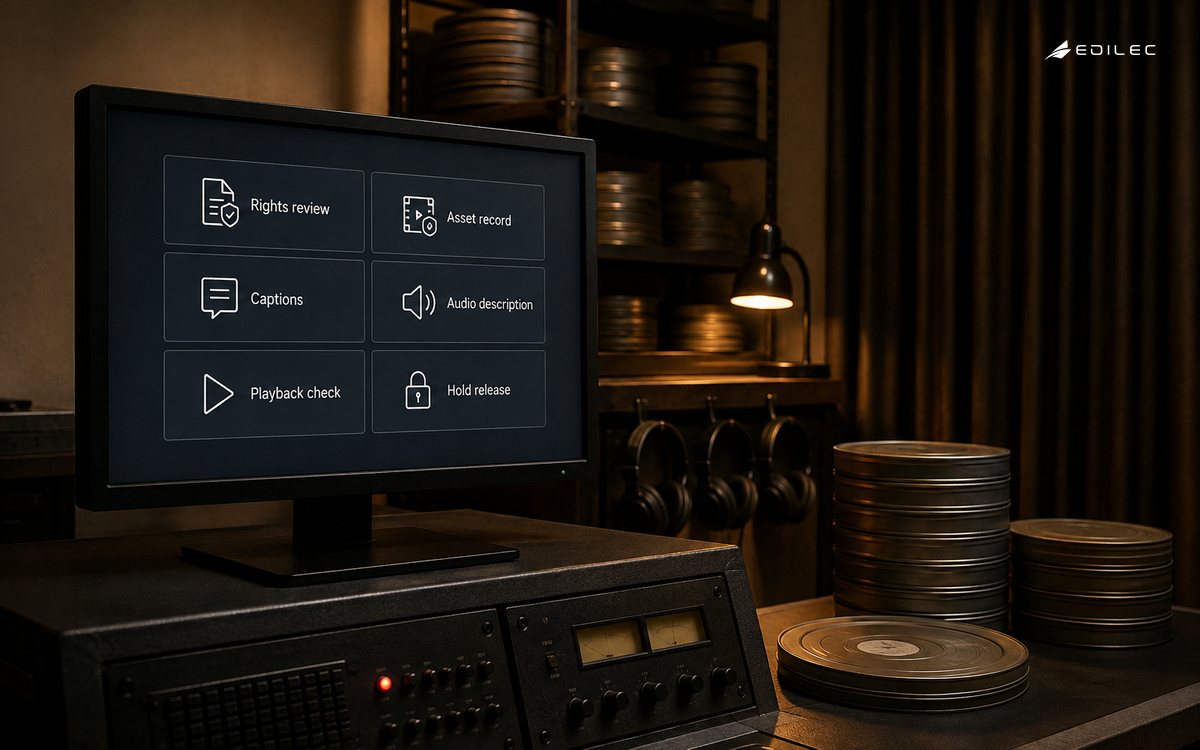
- Keep rights and asset identity attached through every transformation.
- Treat job success and audience quality as different checks.
- Make accessibility and playback part of release acceptance.
- Use provenance claims carefully and protect signing authority.
- Prove withdrawal, failover and regeneration before major releases.
Frequently asked questions
Must a modern media platform run entirely in the cloud?
No. Cloud services can provide elastic processing and distribution, while some acquisition, archive or specialist systems may remain elsewhere. Design around secure interfaces, identity, data movement, latency, cost and recovery. The operating boundary matters more than a pure label.
How many formats should be supported?
Support the smallest set that meets source, archive, editing, distribution and device obligations. Every additional format adds validation and support paths. Preserve a high-quality master and generate delivery renditions through versioned recipes rather than accepting uncontrolled variants.
How should a back catalog be migrated?
Inventory and deduplicate first, prioritize by value and rights, migrate in measurable cohorts and reconcile identifiers, files, metadata and accessibility assets. Keep the source until checks and business acceptance pass. Sample actual playback and exercise rollback before scaling throughput.
Conclusion
A dependable media implementation preserves meaning, rights and quality while content moves through many systems. Establish authoritative identity, make transformations reproducible, verify accessibility and playback, and rehearse security and distribution failures. The result is not merely a catalog that can publish; it is a supply chain that can explain, correct and recover every important title.