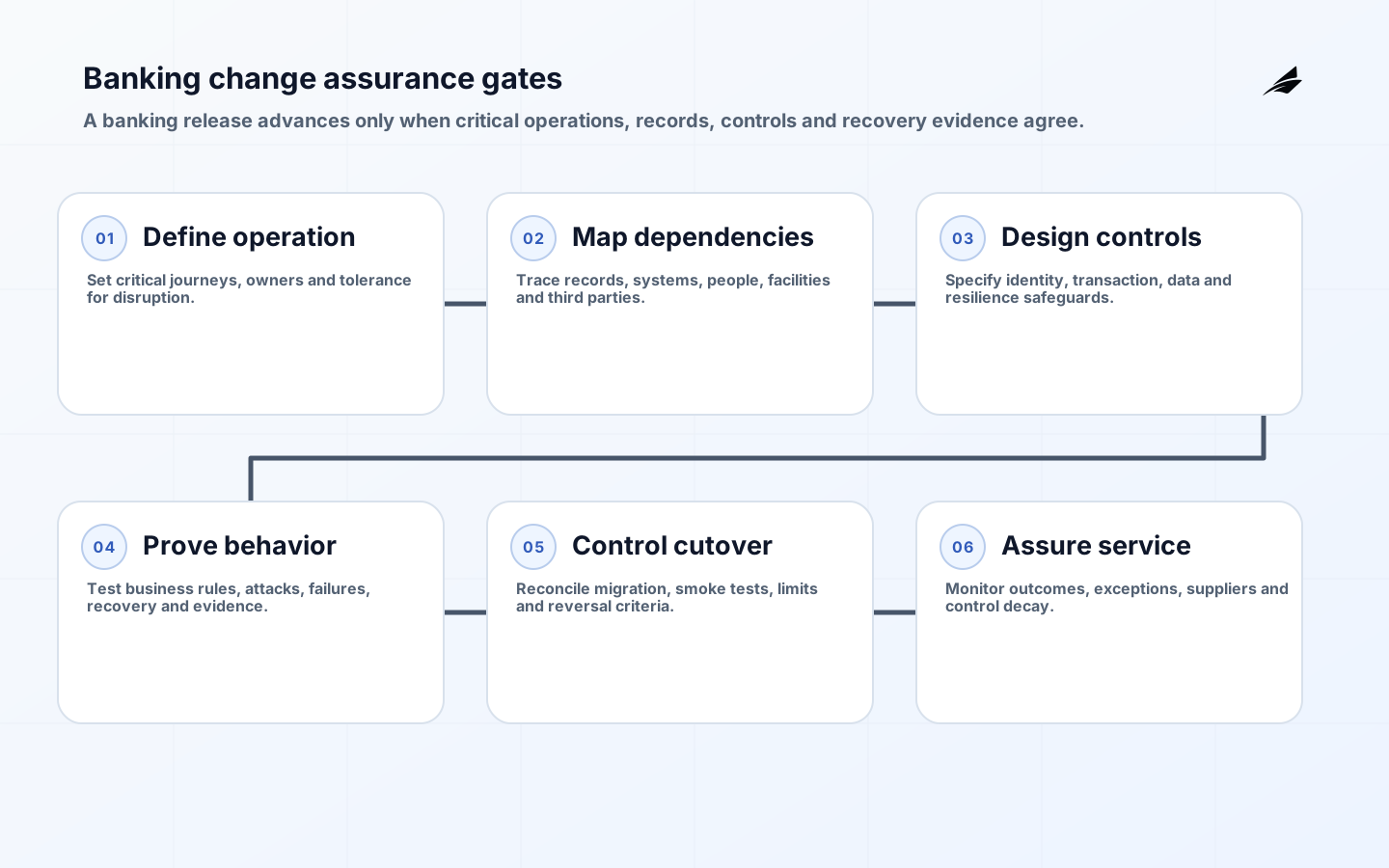
A banking technology implementation checklist must protect the delivery of critical operations while changing the systems that support them. Availability is only one outcome: balances must remain correct, access must be authorized, transactions must be traceable, customer treatment must be controlled and recovery must work through severe but plausible disruption. The program therefore needs business, risk, operations, security, data and engineering evidence at every gate.
This checklist is a planning aid, not jurisdiction-specific regulatory advice. Use it alongside the banking architecture and risk FAQ, the financial services implementation checklist and the business process controls checklist. Map applicable laws, supervisory expectations, payment rules and internal policy with qualified specialists before design approval.
Define critical operations and tolerance for disruption
Start with customer and market services such as login, balance inquiry, payment initiation, cash access, deposit posting, loan servicing, fraud response and regulatory reporting. For each, define impact, peak volumes, cutoff times, dependencies, manual alternatives, recovery objectives and tolerance for disruption. The current Basel operational-resilience chapter defines operational resilience as the ability to deliver critical operations through disruption and emphasizes governance, mapping, testing, third parties and resilient ICT.
Map people, process, information, facilities, applications, infrastructure, networks and external providers needed for each critical operation. Include concentrated dependencies such as identity, payment rails, cloud regions, core ledger, telecommunications and specialist staff. Approve severe but plausible scenarios and measurable impact tolerances before architecture is fixed. Recovery design should preserve the business operation, not just restart a server.
| Implementation gate | Required decision | Evidence for approval |
|---|---|---|
| Business and conduct | Journey, customer segment, product rule and exception owner | Process map, policy trace and adverse-outcome tests |
| Architecture | Systems of record, trust boundaries and failure modes | Dependency map, decisions and resilience analysis |
| Data | Authoritative fields, reconciliation and retention | Lineage, control totals, migration and deletion rules |
| Security | Identity, access, fraud and monitoring controls | Threat model, role tests and incident procedures |
| Operations | Tolerance, recovery, support and supplier response | Runbooks, exercises, staffing and communication plan |
| Launch | Cohort, limits, rollback and acceptance authority | Rehearsal results, open risks and signed go/no-go record |
Design architecture and data controls around authoritative records
Identify the authoritative record for customer, account, agreement, balance, transaction, limit, consent and case. Define posting states, effective and processing dates, idempotency, reversal and correction. Separate a payment instruction from its authorization, execution, settlement and customer-visible status. Use append-only business events or equivalent history where reconstruction matters, and prevent downstream caches or analytics stores from becoming accidental systems of record.
Document synchronous and asynchronous boundaries, timeouts, retries, queues, duplicate handling and degraded modes. The FDIC notice for the updated FFIEC architecture, infrastructure and operations booklet addresses governance and risk management across these capabilities. Reconcile transaction counts and values across every handoff, retain unexplained differences in an owned queue, and ensure a technical retry cannot produce a duplicate financial effect.
Implement layered identity, access and cybersecurity controls
Inventory customers, employees, contractors, service identities, devices and customer-permissioned entities. Assess access risk by journey and privilege. Current NIST Digital Identity Guidelines define risk-based identity proofing, authentication and federation requirements, including assurance levels and continuous evaluation. Apply least privilege, segregation of duties, phishing-resistant authentication where warranted, just-in-time administration, strong recovery controls and periodic access review.
Use the NIST Cybersecurity Framework 2.0 to express target outcomes across Govern, Identify, Protect, Detect, Respond and Recover, then map to detailed controls. Threat-model credential theft, account takeover, payment manipulation, insider misuse, API abuse, ransomware, data exfiltration and supplier compromise. Preserve security logs with synchronized time, protected access and tested investigation procedures.
| Risk scenario | Prevent or limit | Detect, respond and prove |
|---|---|---|
| Account takeover | Risk-based authentication, MFA and recovery hardening | Behavior signal, customer confirmation and session revocation |
| Unauthorized staff action | Least privilege, maker-checker and privileged access management | Immutable action record and rapid access suspension |
| Duplicate or altered transaction | Idempotency, integrity checks and controlled state machine | Control-total break, exception queue and reversal evidence |
| Third-party outage | Exit plan, capacity fallback and contractual response | Dependency telemetry, failover exercise and communications |
| Data migration error | Rehearsed transforms, dual controls and reconciliation | Record and value totals, sample traces and rollback rule |
| Payment-data exposure | Scope reduction and PCI-aligned controls where applicable | Monitoring, incident plan and validated remediation |
Control cloud, fintech and other third-party dependencies
Perform due diligence on service scope, financial and operational capability, security, data location, subcontractors, concentration, resilience, incident notification, audit rights and exit. Translate contract promises into operating procedures: who opens a severity-one case, who can invoke failover, what evidence arrives after an incident and how data is returned or deleted. Track fourth parties where they materially support the critical operation.
Shared responsibility needs a control matrix by layer and service. A cloud provider may secure facilities and managed infrastructure while the bank remains responsible for identity, configuration, application logic, data use and recovery design. Test provider failure assumptions and portability for the specific workload. Exit planning should cover data format, replacement interfaces, key ownership, retained records, skills and realistic transition time.
Build and test controls with production-like evidence
Trace requirements from policy and risk to design, code, configuration, test and approval. Protect source, dependencies, pipelines and artifacts; separate development and production privileges; and use synthetic or masked test data under approved controls. Test business rules, authorization, accessibility, performance, batch cutoffs, concurrent transactions, interfaces, reconciliation and customer communications. Payment-card scope should follow the applicable PCI DSS version and validation route; PCI SSC published v4.0.1 as a limited revision.
Resilience testing should include dependency loss, partial region failure, identity outage, queue backlog, corrupted input, unavailable staff and cyber containment. Exercise backup restoration and prove business correctness after recovery. Measure recovery from impact start through verified operation, not infrastructure restart. Capture actual access gaps, manual capacity and communication delays, then fund remediation before the test becomes ceremonial.
Rehearse migration, cutover and controlled launch
- Approve critical journeys, impact tolerances, regulatory map, product rules and accountable owners.
- Baseline records, balances, volumes, exceptions, service performance and access before migration.
- Rehearse extraction, transformation, load, reconciliation and rollback using production-shaped data.
- Freeze or coordinate changes, validate environment and access, and confirm support and supplier bridges.
- Execute cutover with timestamped checkpoints, maker-checker approval and control totals.
- Run technical and business smoke tests, including customer-visible balances and end-to-end transactions.
- Release to a bounded cohort or channel where possible, with limits and a clear reversal threshold.
- Stabilize under enhanced monitoring, reconcile daily and close risks only with retained evidence.

Establish post-launch assurance and ownership
Monitor critical-journey success, latency, rejected transactions, reconciliation breaks, fraud outcomes, privileged actions, dependency health, customer complaints and impact tolerance consumption. Segment signals by channel, product, customer group and release where this can reveal concentrated harm. Keep alert thresholds, investigation guides and communication authority current. Independent risk and audit functions should retain appropriate challenge without becoming substitute operators.
Review changes, incidents, control exceptions, third-party performance and customer outcomes on a fixed cadence. Verify that temporary access and compensating controls expire. Track remediation by risk and age. Feed operational evidence into architecture, capacity and product decisions. A compliant launch that gradually loses reconciliation, access discipline or recovery capability is not a successful implementation.
Example: control a payment-limit change
A payment-limit change should authenticate the customer with controls appropriate to risk, verify account authority, display the existing and proposed limit, and apply cooling-off or additional review where policy requires it. The API must enforce allowed ranges and state transitions. Store request, decision, effective time and actor separately from later payment instructions, and notify the customer through an independently controlled channel.
Test compromised credentials, a newly enrolled device, simultaneous requests, support intervention, downstream delay and reversal. Monitor unusual limit changes followed by payment attempts, with a defined fraud response. Reconcile the customer-visible limit with the authoritative control record. This narrow journey brings conduct, authentication, authorization, fraud, audit, notification and recovery requirements into one release acceptance test.
Key takeaways
- Design around critical banking operations and explicit tolerance for disruption.
- Preserve authoritative records, transaction states, idempotency and reconciliation at every boundary.
- Use layered identity controls and test access with realistic roles and recovery paths.
- Convert third-party contracts into exercised response, resilience and exit procedures.
- Treat migration, rollback and post-launch assurance as business-control activities.
Frequently asked questions
Does regulatory compliance guarantee a resilient banking system?
No. Compliance establishes applicable obligations and evidence, but resilience also depends on architecture, people, operating discipline, supplier behavior and learning from disruption. Test the bank’s actual critical operations under severe scenarios and close observed capability gaps.
How long should old and new systems run in parallel?
Long enough to prove defined records, balances, journeys and reporting across representative cycles, but only where parallel operation does not create competing authority. Set entry, reconciliation, discrepancy and exit criteria. Some transactional migrations need controlled cutover rather than dual writing.
Can critical banking workloads use public cloud?
Potentially, subject to applicable rules and the institution’s risk assessment. Evaluate shared responsibility, data, identity, resilience, concentration, auditability, skills and exit. Cloud capability does not remove the bank’s accountability for delivering critical operations and controlling customer outcomes.
Conclusion
Preserve the go-live evidence package for later supervisory, audit and incident use: approved scope, risk decisions, role tests, reconciliation, resilience exercises, supplier readiness, customer communications and post-launch exceptions. Evidence should identify versions and approvers so it can be interpreted after teams and systems change.
A banking implementation is ready when the institution can explain, test and evidence how a critical operation survives change and disruption. Anchor the program in authoritative records, layered access, reconciled transactions, exercised third-party response and controlled cutover. Launch is one gate in a continuing assurance cycle, not the end of risk ownership.