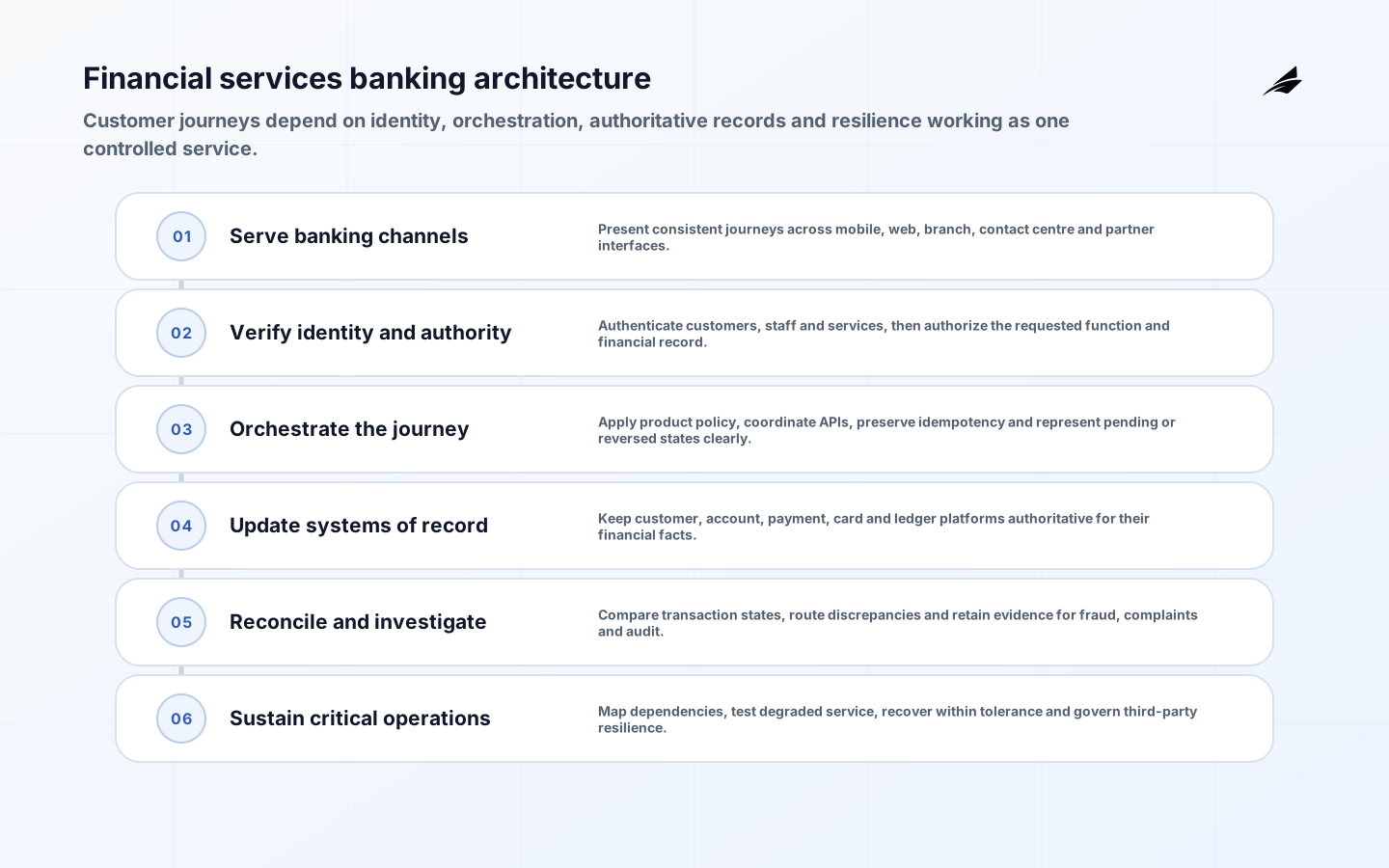
Banking technology is not one application. It is a network of customer channels, identity services, product engines, ledgers, payment rails, data platforms, fraud controls, reporting and operational teams. A change that looks local can affect money movement, customer access, regulatory evidence or the ability to continue a critical operation during disruption.
That is why financial services software should be designed around business invariants and operational responsibilities before products or cloud services are selected. The central questions are straightforward: who is authorized, which record is authoritative, when does a transaction become final, how is a disagreement repaired, and what must keep working when a dependency fails?
Separate banking capabilities and records
Map capabilities such as customer onboarding, deposits, lending, payments, cards, treasury and regulatory reporting. Within each, distinguish the system of engagement from the system of record. A mobile interface may initiate a transfer, but it should not invent the ledger state. A fraud service may recommend a hold, but policy and authorized application controls should commit it.
Define identifiers and state transitions across boundaries. Customer, account, payment, instruction, posting and settlement are related but not interchangeable. When teams compress them into one “transaction status,” reconciliation becomes difficult. Preserve the source instruction, business decision, ledger entries, external messages and final outcome as linked records.
| Capability | Authoritative concern | Failure to design for |
|---|---|---|
| Digital identity | Proofing, authentication, federation and recovery | Account takeover or exclusion |
| Payments | Instruction, authorization, clearing and settlement | Duplicate, lost or ambiguous payment |
| Ledger | Balanced immutable postings and periods | Unexplained balances |
| Lending | Decision evidence, terms and servicing state | Inconsistent or unreviewable decisions |
| Reporting | Lineage, definitions and submission evidence | Conflicting regulatory figures |
Protect transaction and ledger integrity
Money movement needs explicit invariants. Every instruction has a stable identifier. Retries are idempotent. Authorization is checked against the current account and role state. Monetary values use defined currency precision and rounding. Ledger postings balance. Reversals reference the original entry rather than deleting history. Reconciliation identifies differences between internal and external records.

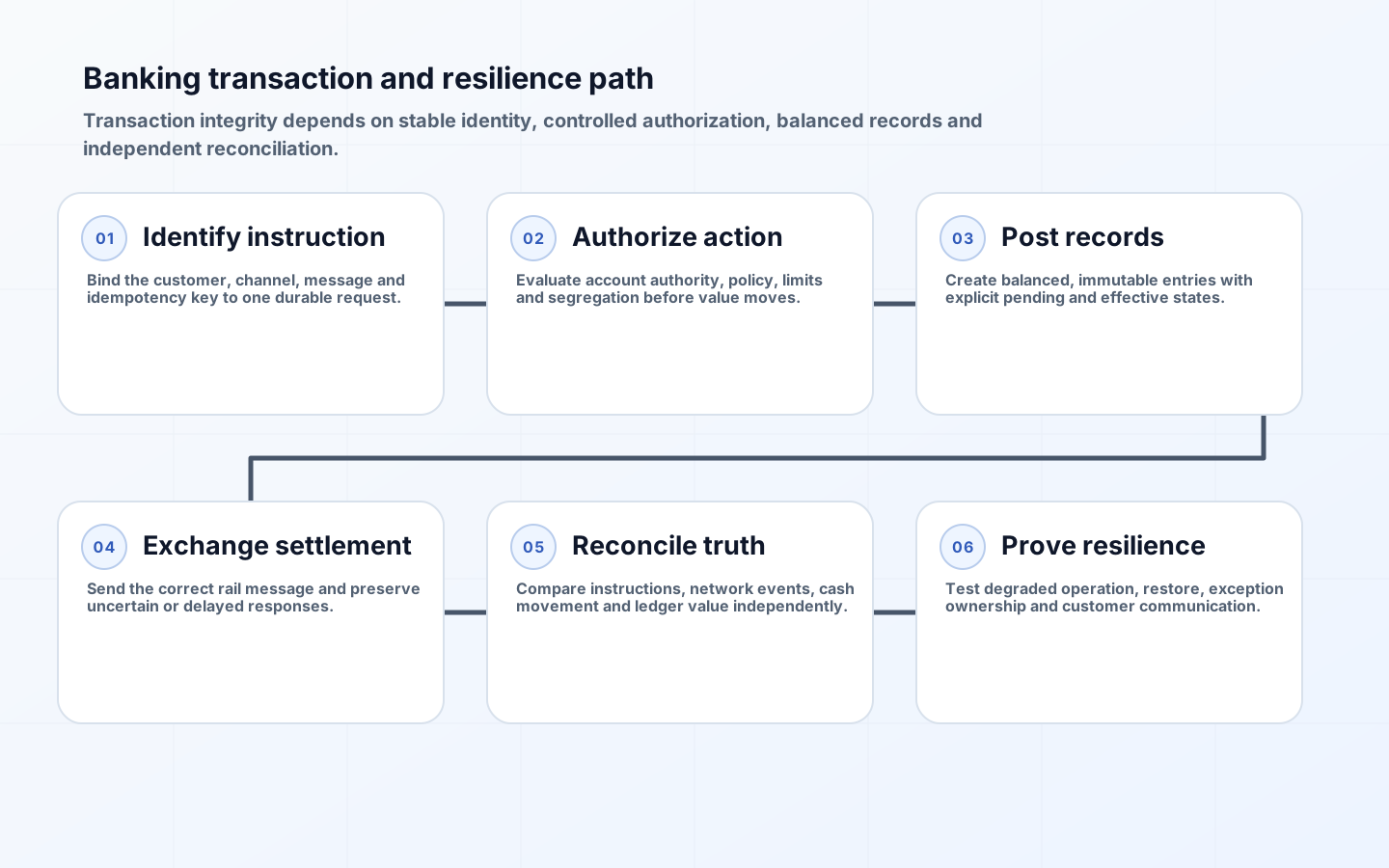
ISO 20022 provides a standardized approach to financial message semantics, but adopting a message format does not settle a bank's business rules. Communities define implementation details, and systems still need validation, versioning and mapping. Store both the received message and the interpreted business record so an operator can explain how an external instruction became an internal posting.
Design identity and access for customer and workforce risk
Customer authentication, employee access, service identities and privileged administration have different assurance needs. Use risk assessment to select identity proofing, authenticators and federation. Bind sensitive actions to fresh authorization where appropriate, and design account recovery as carefully as sign-in. A strong primary login can be undermined by a weak recovery desk.
For the workforce, separate transaction initiation, approval, release and administration. Time-bound privileged access, log emergency use and review dormant accounts. Service-to-service credentials need owners, rotation and narrow permissions. Authorization must be enforced by the target service, not inferred from a user-interface menu.
Engineer critical operations for disruption
The Basel Committee defines operational resilience around the ability to deliver critical operations through disruption. Translate that idea into a map of the people, technology, information, facilities and third parties that support each critical operation. Set a tolerable disruption and test severe but plausible scenarios rather than assuming every component can be made failure-free.
A payment service may depend on identity, sanctions screening, account balances, messaging, networks and an external clearing system. Decide what happens when each is slow, unavailable or inconsistent. Queues need limits and replay controls. Manual contingency procedures need capacity and reconciliation. Recovery objectives should be tied to customer and market impact, not only server restoration.
| Decision | Evidence before launch | Operating signal |
|---|---|---|
| Disruption tolerance | Approved impact and time boundary | Time at degraded service |
| Dependency recovery | Failure-mode and failover test | Dependency error and queue age |
| Data recovery | Restore and reconciliation exercise | Recovery point and unmatched records |
| Manual continuity | Capacity-tested procedure | Backlog and error rate |
| Communication | Customer and regulator playbook | Notification time and accuracy |
Apply security and privacy by data path
Classify data and follow it from collection through use, sharing, retention and deletion. Encrypt sensitive data in transit and at rest, but also control who can decrypt it and for which purpose. Tokenization can reduce payment-card exposure. PCI DSS applies to account-data environments; scope reduction is valuable only when data flows and connected systems are accurately understood.
Threat modeling should cover customer abuse, insider misuse, compromised dependencies, fraudulent instructions and availability attacks. Central logs need protected time, identity and transaction context. Detection rules should map to a response owner and a safe action. Retention should satisfy legal and operational needs without keeping sensitive data indefinitely.
Make integration and data lineage reviewable
Banking estates often combine legacy platforms, vendor products, internal services and external networks. Put versioned contracts around them. Define schema ownership, compatibility, delivery guarantees, retry behavior and reconciliation. Avoid a “canonical model” so broad that it loses product-specific meaning; use stable identifiers and explicit transformations instead.
For reports and analytics, preserve lineage from submitted figure to source records and transformations. Definitions need owners and effective dates. Correcting historical data should create a traceable revision. Data quality controls should identify missing, late, duplicate and inconsistent records before they become customer statements or regulatory submissions.
Test business invariants and recovery paths
Unit and contract tests are necessary but insufficient. Build scenario tests around authorization, precision, duplicate messages, partial posting, timeout, reversal, end-of-day boundaries and external reconciliation. Use synthetic or properly protected data. Verify that logs and operator tools provide enough evidence to repair a failure without changing records directly.
Release progressively where the architecture permits it. Compare transaction counts and values between old and new paths, define abort thresholds and keep rollback honest: a schema or ledger change may require forward repair rather than binary rollback. Exercise incident roles and customer communication before a major migration.
- Approved capability and data-flow map
- Business-invariant and security test results
- Reconciliation across representative transaction states
- Performance and capacity under peak and recovery load
- Failover, restore and continuity exercise
- Named owners for release, incident and customer decisions
Govern providers and concentration risk
A provider may operate infrastructure or a specialized service, but the bank retains responsibility for understanding how the critical operation is delivered. Review subcontractors, regions, access, evidence, incident notification, continuity, data return and exit. Contract language should be testable through operating evidence rather than annual assurances alone.
Look for correlated dependencies. Two applications may appear diversified while using the same identity provider, cloud region or network carrier. Maintain an exit and substitution plan for material services, but do not pretend every platform can be replaced quickly. The credible plan identifies minimum continuity, data portability and the decisions required under stress.
Example: modernizing a payment initiation service
A new API accepts corporate payment instructions. It validates the client identity and message, checks account authority and policy, assigns an idempotency key and records the original instruction. Approved instructions create balanced pending postings and an outbound ISO 20022 message. A response updates settlement state; reconciliation compares network and ledger records.
If the network times out, the service does not blindly resend. It queries or waits according to the rail's rules, then routes unresolved items to an operator with the full trace. Deployment metrics include authorization failures, duplicate suppression, pending age, unmatched value, customer-visible latency and recovery time. That is a banking product operating model, not simply an API project.
Keep an auditable decision and evidence record
Architecture and risk decisions should identify the capability, affected critical operation, alternatives, assumptions, control owner and review trigger. Link those decisions to tests, provider evidence, incident findings and regulatory obligations. This record matters when systems evolve: a control approved for one transaction limit or dependency profile may not remain adequate after scale, geographic expansion or a new product.
Set review triggers around material changes rather than waiting only for annual governance. Examples include a new payment rail, changed data residency, outsourced operations, increased transaction value, authentication redesign or repeated reconciliation breaks. Evidence should show what was tested, who accepted residual risk and how operators will detect failure. That discipline makes oversight part of delivery instead of a late documentation exercise.
Use that evidence during incidents and audits, but also during ordinary prioritization. If reconciliation exceptions rise or a provider misses notification targets, the response should connect directly to the responsible capability and approved tolerance. Governance becomes useful when it changes funding, release or risk decisions before customer harm occurs.
Related reading
See Finance Systems: Mistakes and Fixes for record ownership, Finance Reporting in Production for lineage and governance, and Finance Approval Systems for controlled decisions.
Frequently asked questions
What is the first banking architecture decision? Establish authoritative records and transaction states. Channels and reports may present those records differently, but they must not create competing truth about customers, instructions, postings or settlement.
Does cloud adoption transfer banking compliance responsibility? No. A provider operates defined service layers. The institution still governs configuration, identity, applications, data, dependencies, continuity and its legal or regulatory obligations.
How should payment retries work? Use a stable instruction identity, idempotency and rail-specific status checks. A timeout does not prove failure, so blind retry can duplicate value. Uncertain cases need an explicit pending state and reconciliation.
What makes a resilience exercise credible? It tests a critical operation across technology, people, information and third parties, measures disruption against approved tolerance, reconciles data and proves who can make recovery and communication decisions.
Key takeaways
- Model banking technology as connected capabilities and records, not one platform.
- Protect transaction identity, ledger balance, reconciliation and reversal as explicit invariants.
- Map critical operations to dependencies and test delivery through disruption.
- Treat identity recovery, privileged access and service credentials as separate control problems.
- Require operating evidence and exit decisions for material providers.
Conclusion
Financial services technology succeeds when customers can act, money and records remain correct, and the institution can explain and recover every material state. Start with capability boundaries and transaction invariants. Add identity, security, resilience, lineage and third-party controls around the complete operation. The resulting architecture may use modern APIs, cloud platforms and standardized messages, but its quality is measured by trustworthy outcomes under normal work and disruption alike.