Financial services technology work succeeds when it improves a defined customer or operational outcome while preserving integrity, availability, confidentiality and evidence. The scope may cover onboarding, payments, lending, trading, insurance, finance, compliance or shared platforms. Yet a feature list is not enough. A useful plan identifies the critical operation, the records and decisions it changes, the parties that depend on it, the tolerance for disruption and the controls that must remain effective during transition.
Start with the critical operation, not the product category
Begin with a service that customers or markets must be able to use, such as receiving a payment, accessing funds or settling a claim. Map the complete path across channels, identity, decision engines, ledgers, networks, people, facilities and providers. Basel operational resilience guidance emphasizes critical operations and their interdependencies because a healthy application can still sit inside a failed service. The map should show manual workarounds and time-sensitive obligations as clearly as APIs.

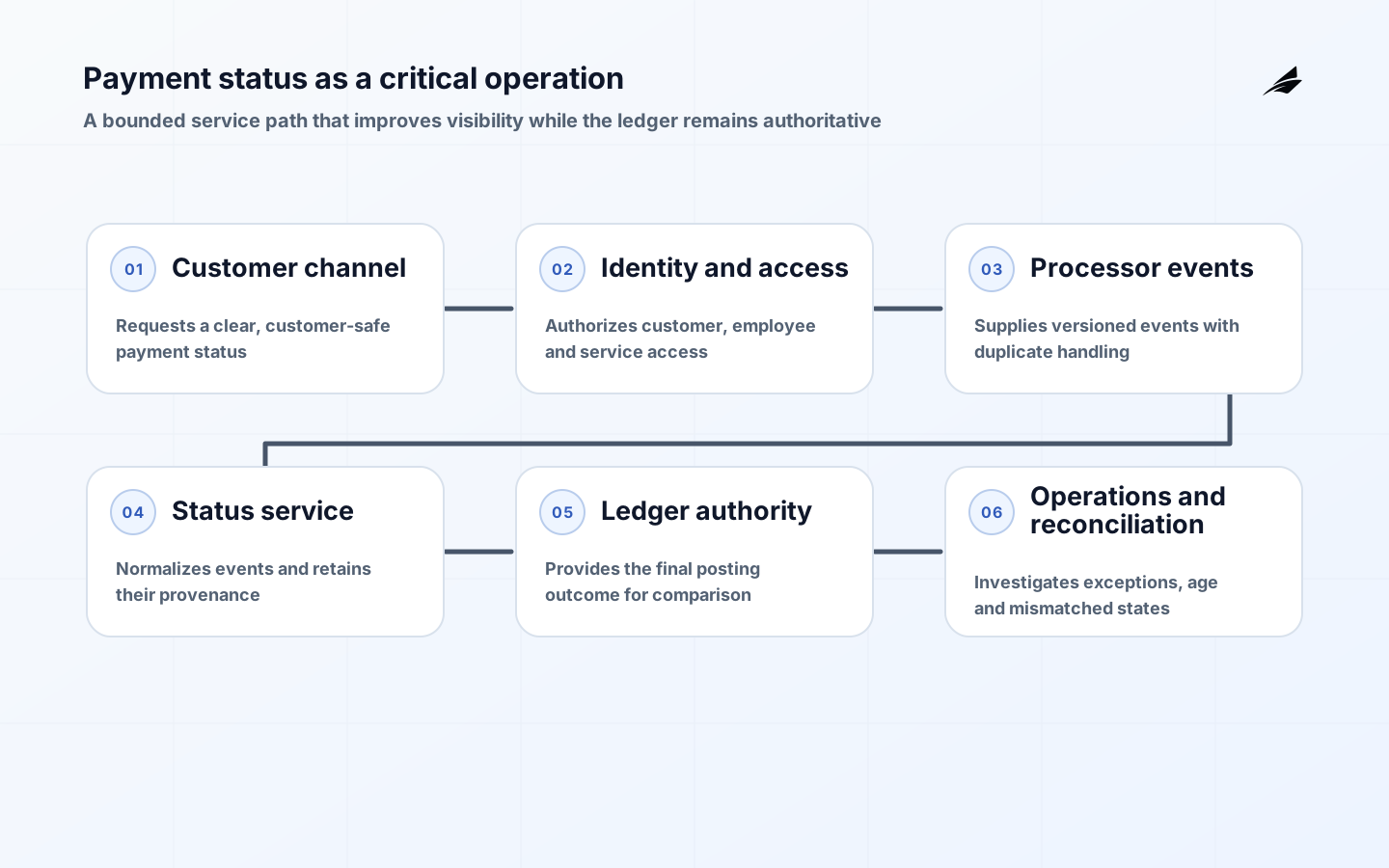
Set an outcome and boundaries. For example, a payment-status initiative might reduce ambiguous states for customers and operations without replacing the ledger. Its first release could include event capture, a normalized status model, customer notifications, operations search and reconciliation. Settlement logic, pricing and unrelated channels remain outside scope. This boundary makes control assessment and testing credible and creates a release that can be reversed.
| Scope layer | Questions to answer | Required evidence |
|---|---|---|
| Business service | Which customer promise or obligation changes? | Journey, owner, impact tolerance and acceptance measures |
| Process and decisions | Which approvals, exceptions and cutoffs apply? | Process map, decision rules and escalation paths |
| Data | Which authoritative records are read or written? | Classification, lineage, retention and reconciliation rules |
| Technology | Which channels, services, networks and jobs participate? | Dependency map, contracts and capacity assumptions |
| Controls | Which preventive, detective and recovery controls are required? | Control mapping, test method and evidence owner |
| Transition | How will old and new paths coexist and retire? | Migration, rollback and decommission criteria |
Design architecture and controls as one system
Financial architecture should make authority and state explicit. Identify the system of record, idempotency behavior, transaction boundaries, timestamps, duplicate handling and reconciliation. A message standard such as ISO 20022 supplies a common development method and repository, but implementers still need agreed usage rules, identifiers, versions and exception handling. Treat every translation between channel, processor and ledger as a controlled transformation with traceable input and output.
Access design must distinguish customers, employees, service identities, privileged administrators and emergency access. Apply least privilege, strong authentication, separation of duties, protected secrets and reviewable authorization changes. Encrypt sensitive information in transit and at rest according to the applicable risk and rules. Logging should support fraud, security, operations and audit needs without becoming an uncontrolled copy of account or card data. Where cardholder data is present, confirm PCI DSS scope and validation obligations with qualified specialists rather than assuming a token removes every connected system.
Model cost across change, assurance and operation
There is no responsible universal price for financial services technology. Cost changes with transaction criticality, legacy condition, data quality, integration count, assurance depth, migration method and service objectives. Estimate work from evidence: sampled journeys, interface inventory, data profiling, control requirements, test volumes and provider terms. Keep ranges until discovery closes major unknowns, and state the assumptions behind each range.
| Cost area | Typical drivers | Often missed |
|---|---|---|
| Discovery and design | Journeys, jurisdictions, products, dependencies and unknown rules | Operations observation and control-owner time |
| Build and integration | Interfaces, message transformations, workflow exceptions and environments | Partner certification and test-data preparation |
| Data and migration | Volume, quality, history, cutover window and reconciliation | Repeated rehearsals and retained archives |
| Security and assurance | Threat model, code review, testing, evidence and remediation | Independent review and retesting |
| Resilience | Redundancy, recovery design, capacity and exercises | Business participation in severe-scenario tests |
| Run and exit | Licensing, consumption, support, monitoring and supplier management | Dual running, egress and decommission work |
Separate one-time delivery cost, recurring service cost and transition cost. Include internal staff, not just supplier invoices. A lower implementation quote can create a higher total cost when it omits data repair, operational readiness, evidence production or exit. Link forecast lines to scope items and risks, review actual consumption and support demand after each wave, and retain contingency for documented uncertainty rather than an unexplained percentage.
Example: improving payment status without replacing the ledger
Consider an institution whose customers see a generic pending state while operations consult several systems. The team first defines a canonical set of customer-safe statuses and maps processor events to them. A read-only service assembles status and provenance while the ledger remains authoritative. Contract tests cover message variants; reconciliation compares displayed status with ledger outcome; operations can see richer diagnostic detail than customers. The first rollout is limited to one payment type and channel, with old status logic available as rollback.
This example is intentionally modest. It can improve clarity and support work without moving money or changing posting rules. It still requires privacy review, authorization, monitoring, provider coordination and failure handling. Success measures might include the proportion of events mapped without manual intervention, status age, reconciliation exceptions, support contacts about unknown status and recovery exercise results. Targets must come from the institution's baseline and obligations, not generic benchmarks.
Manage the risks that shape delivery
| Risk | Early indicator | Treatment |
|---|---|---|
| Hidden dependency | Late discovery of files, jobs or manual handoffs | Trace representative transactions and verify maps with operations |
| Control regression | Evidence cannot show who approved or changed a decision | Make control acceptance part of each release |
| Data mismatch | Totals or statuses diverge between systems | Define balancing rules and automated reconciliation |
| Provider concentration | Several critical services share one provider or region | Assess concentration, substitution and tested exit paths |
| Migration failure | Rehearsals exceed the cutover window | Reduce wave size and retain reversible coexistence |
| Operational overload | Exceptions grow faster than staff can clear them | Load-test exception processes and set stop thresholds |
Use a gated delivery plan
- Frame: name the accountable business owner, critical operation, regulatory perimeter, outcome and disruption tolerance.
- Discover: trace journeys and transactions; inventory data, controls, dependencies, providers, volumes and failure history.
- Design: choose boundaries, authoritative records, security patterns, recovery approach, migration method and measurable acceptance criteria.
- Prove: implement a representative vertical slice using realistic data shapes and volumes; test controls, reconciliation and rollback.
- Pilot: expose a limited product, channel or population with enhanced monitoring and daily business review.
- Expand: add waves only when service, control and operational thresholds remain within tolerance.
- Retire: remove access, jobs, interfaces, licenses and data copies only after consumers and retention duties are verified.
Each gate needs a decision maker and evidence. A steering meeting should not substitute for acceptance criteria. Before expansion, require completed reconciliation, open-risk disposition, support readiness, recovery evidence, capacity results and a current rollback plan. During early production, use a joint business, operations, risk and engineering review. Pause when leading indicators deteriorate; a schedule date is not a reason to absorb uncontrolled financial risk.
Key takeaways
- Scope the end-to-end critical operation, including people and providers, rather than one application.
- Make data authority, transaction integrity, access and evidence explicit in the architecture.
- Estimate transition, assurance and ongoing operation alongside build cost.
- Treat third-party concentration, resilience and exit as design concerns before contracting.
- Expand through reversible waves with control, reconciliation and recovery gates.
Frequently asked questions
Must financial services modernization move to cloud?
No. Placement should follow workload, regulatory, resilience, data, latency, skills and commercial requirements. Cloud services can provide useful capabilities, but architecture and controls remain the institution's responsibility. Compare on-premises, managed and cloud options against the same service outcomes and exit needs.
How should a financial technology budget be estimated?
Build a bottom-up range from scoped journeys, interfaces, records, controls, environments, migration waves and operating requirements. Show assumptions and uncertainty separately. Reforecast after discovery and the proof slice, when throughput, exception and evidence effort are better understood.
What should be checked before selecting a provider?
Assess functional fit, security, resilience, audit access, subcontractors, data locations, incident obligations, interoperability, financial viability, service management and exit. Test claims against a representative workflow and clarify which party performs and evidences every important control.
How should success be measured?
Use a balanced set tied to the original outcome: customer completion, processing accuracy, reconciliation exceptions, control effectiveness, service objectives, recovery performance, operational effort and unit cost. Delivery milestones alone do not show that the critical operation improved.
Conclusion
Operational readiness deserves its own acceptance gate. Confirm named support coverage, privileged and emergency access, dashboards, alert thresholds, reconciliation ownership, known-error guidance, incident communications and recovery materials under the permissions and timing that will exist in production. Run a simulation that includes an ambiguous transaction state, a delayed provider response and a customer inquiry, then observe whether teams can establish authority, protect the customer, preserve evidence and resolve the record without uncontrolled edits. Feed the result into training, runbooks and architecture. This exercise tests the service as an organization operates it, not merely whether its components return successful technical responses.
Release governance should also account for the financial calendar. Avoid placing irreversible migrations beside settlement peaks, regulatory submissions, interest or fee processing, statement production, or other periods when operational capacity is constrained. Confirm that finance, fraud, customer support and reconciliation teams can participate in the early-life review, and define who may extend parallel operation when unexplained balances or transaction states remain. A technically successful cutover should not advance to decommission while financial control evidence is incomplete. Preserving the old path for a short, explicitly governed period can be less costly than forcing closure before records, obligations and customer outcomes are demonstrably aligned.
A sound financial services delivery plan turns a broad technology ambition into an owned, testable change to a critical operation. It connects customer outcomes with transaction integrity, controls, resilience, supplier oversight and total cost. The practical route is to discover the real service, prove a narrow vertical slice, expose it gradually and retire old paths only when evidence supports the decision. That discipline creates room for useful change without asking customers, operations or risk teams to trust an uncontrolled leap.