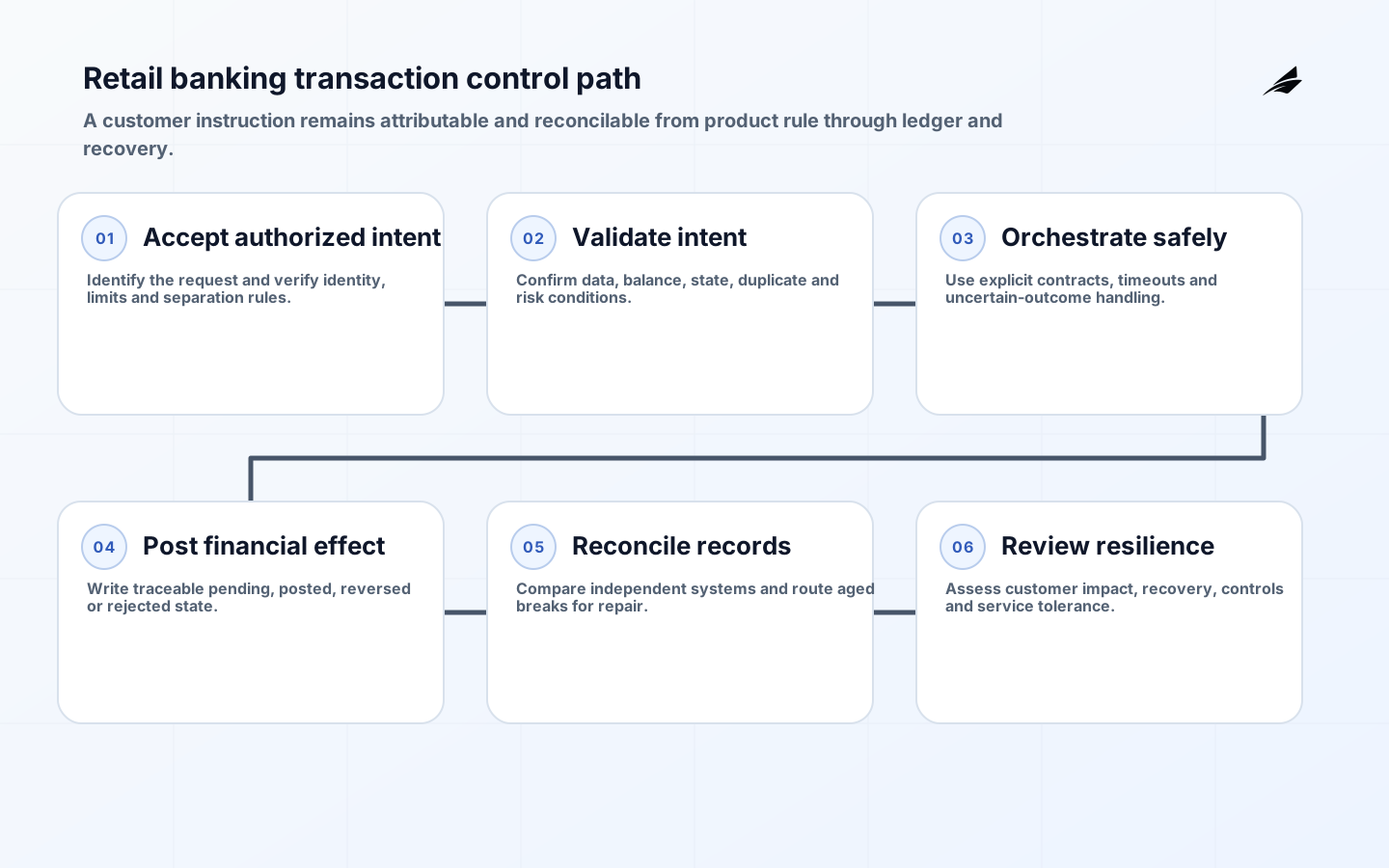
Retail banking solutions connect customer identity, accounts, deposits, lending, payments, fees, servicing and financial records. Implementation quality depends on the integrity of that chain: a channel may look correct while a posting fails, a limit is evaluated against stale data or a reversal never reaches the ledger. The checklist must therefore cover business products, authoritative state, controls, reconciliation and operations as one release system.
This guide supports bank product, operations, risk and technology teams preparing a new platform, digital channel or major modernization. Start with the retail banking capability and delivery plan and use the retail banking architecture FAQ for design questions. The financial services banking checklist provides broader program controls.
Confirm product, customer and jurisdiction scope
List the deposit, payment, card, loan and servicing products in the release, including variants, currencies, channels and jurisdictions. For each product, document eligibility, pricing, rates, fees, limits, disclosures, approval authorities, posting rules, statements and lifecycle states. Identify customer types and relationships such as individual, joint, guardian, business owner or authorized representative. Product owners, finance, operations, risk and compliance should approve the interpretation before configuration becomes code.
Map complete journeys: onboarding, funding, payment, transfer, dispute, account maintenance, delinquency, closure and bereavement where applicable. Include branch, contact-center, web, mobile and partner handoffs. Record manual exceptions and end-of-day dependencies. Confirm which functions are critical operations and define tolerances for disruption in line with the bank's own regulatory context. Jurisdiction-specific legal and regulatory requirements require qualified local review.
| Checklist area | Decision to approve | Evidence |
|---|---|---|
| Product | Terms, rules, lifecycle and financial treatment | Signed product specification with test cases |
| Customer | Identity, relationship and consent states | Customer model and journey scenarios |
| Authority | Role, limit and separation rules | Permission matrix and negative tests |
| Channel | Supported actions and degraded behavior | Cross-channel acceptance results |
| Jurisdiction | Disclosure, retention and reporting obligations | Compliance approval and traceability |
Define transaction and ledger truth
Name the authoritative system for customer, account, balance, transaction, limit, rate and product configuration. Model pending, posted, reversed, rejected and disputed states explicitly. Use stable transaction identifiers across channel, orchestration, payment rail and ledger. Preserve original instructions and correction links instead of overwriting financial history. Time, currency precision, value date and accounting date must be handled deliberately.
Design every money movement for duplicate, timeout and uncertain-outcome scenarios. An idempotency key can prevent repeated effects, but it does not replace reconciliation. Define debit and credit posting expectations, fees, holds, releases, reversals and compensation. Test partial failure between systems. Customer-facing status should reflect known state rather than declare failure when the bank cannot yet determine whether an external payment was accepted.
Implement customer identity and staff authority controls
Separate customer authentication, identity proofing, account recovery and transaction authorization. Apply stronger controls for changed contact details, new payees, sensitive exports and high-risk payments based on the bank's risk model. Keep recovery resistant to social engineering and notify customers through independent channels where appropriate. Device and behavior signals can inform decisions but need governance, testing and a fallback for legitimate customers.
For staff, map stable responsibilities to least-privilege roles, then enforce branch, portfolio, amount and relationship scope. Require dual control or separation of duties for selected high-consequence actions. Use named privileged accounts, time-bound emergency access and review of consequential operations. OWASP ASVS can help specify application security verification, but bank-specific authorization and fraud rules still need domain tests.
Control integrations and financial messages
Inventory core, payment, card, CRM, identity, credit, fraud, document, notification, data and regulatory interfaces. Record schema, direction, frequency, authentication, encryption, timeout, retry, duplicate handling, version and business owner. ISO 20022 provides a common methodology and business semantics for financial messages, but implementation requirements vary by community. Use the applicable message definitions and usage rules for each rail rather than claiming generic compliance.
Validate messages at entry and preserve a traceable transformation from external fields to internal records. Reject invalid data safely and route repairable exceptions to controlled queues. Test out-of-order, duplicate, delayed and changed messages. Reconcile independent records at agreed intervals and assign aged breaks. A successful transport acknowledgment does not prove that the intended account effect was posted.
Rehearse migration and financial reconciliation
Profile customer, account, balance, transaction, mandate, document and reference data. Define mapping, cleansing and exclusion rules with business owners. Preserve lineage and legal holds. Protect production data used in test environments through approved masking or other controls. Build a restartable migration pipeline and repeat it with production-scale volumes until elapsed time and defect patterns are understood.
Reconcile counts and control totals by product, currency, branch, account status and financial category. Sample customer histories and edge cases, but do not rely on sampling alone for monetary totals. Prove opening balances, accrued interest, fees, holds, limits and pending items. Track every rejected record to disposition. Finance and operations should sign acceptance independently of the migration engineering team.
| Failure scenario | Required behavior | Test evidence |
|---|---|---|
| Duplicate payment request | One business effect and traceable response | Replay test with stable identifier |
| External timeout | Pending or unknown state without unsafe retry | Delayed-response simulation |
| Partial posting | Detected break and controlled repair | Ledger-interface fault injection |
| Stale staff privilege | Immediate deny after lifecycle change | Revocation propagation test |
| Corrupt migration record | Quarantine without silent truncation | Rejected-record reconciliation |
| Critical supplier outage | Degraded service within tolerance | Joint resilience exercise |
Prove security, privacy and operational resilience
Use NIST CSF 2.0 to organize governance, identification, protection, detection, response and recovery outcomes. Classify customer and payment data, minimize collection, manage encryption and keys, protect secrets and maintain vulnerability response. PCI DSS applies to entities that store, process or transmit payment card account data or can affect that environment; confirm scope with qualified expertise rather than assuming a cloud provider or processor removes the bank's responsibilities.
The Basel Committee defines operational resilience as the ability to deliver critical operations through disruption and emphasizes governance, mapping dependencies, business continuity, third parties, incidents and resilient ICT. Set impact tolerances for the bank's critical services, map people and suppliers as well as technology, and exercise severe but plausible scenarios. Recovery acceptance must verify customer journeys, ledger integrity, queues, interfaces and communication, not merely server availability.
Run the retail banking implementation sequence
- Approve product, customer, jurisdiction and critical-operation scope.
- Model authoritative records, transaction states, accounting effects and exceptions.
- Configure identity, staff authority, fraud and separation controls.
- Build and contract-test integrations with reconciliation and repair queues.
- Repeat data migration, financial balancing and operational rehearsals.
- Release a bounded cohort under explicit go, hold and recovery authority.
- Stabilize service, close breaks and review product and risk outcomes.
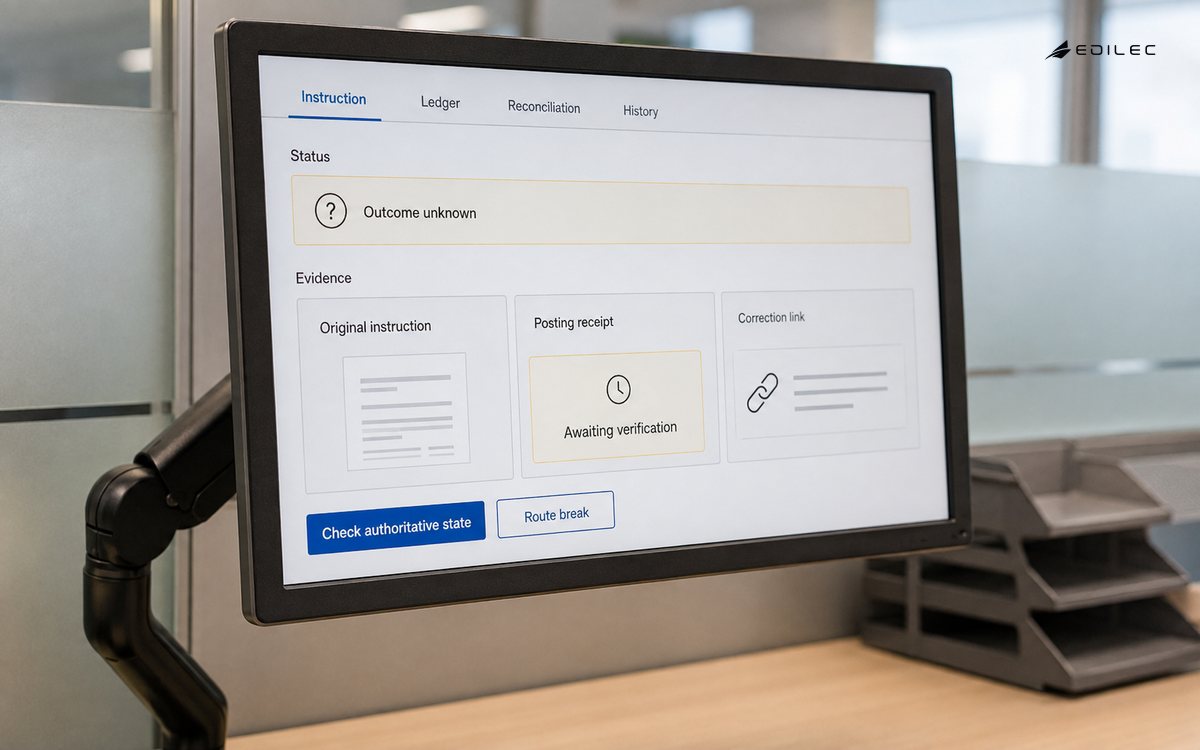
The cutover plan should name source freeze, conversion, reconciliation, interface enablement, channel release, business verification and customer communication checkpoints. Define a point of no return once new financial transactions make rollback unsafe. Prepare a forward-repair process, transaction correction authority and extended support coverage. Use the same identities, scripts and monitoring in dress rehearsal that the production team will use.
After launch, reconcile more frequently until volumes and exceptions stabilize. Monitor successful transactions, unknown outcomes, breaks, fraud signals, access denials, support demand, latency and critical-operation availability. Review customer harm and complaints, not only system uptime. Transfer open risks, runbooks, supplier contacts and control evidence to named service owners before the program team exits.
Prepare customer communication and redress
Define how customers are informed about migration, changed terms or channels, planned downtime and service incidents under applicable requirements. Messages should explain action, timing, support and fraud precautions without exposing security details. Confirm accessible formats and language coverage. Test contact data quality and channel capacity before a high-volume event; a communication plan is not executable when the audience cannot be reached.
Create a controlled path for disputes, complaints and redress. Support staff need correlated transaction evidence, authority to apply bounded corrections and escalation for potential customer harm. Track complaints by product, journey and root contributor during stabilization. Correct the authoritative ledger and customer status through approved transactions rather than hidden data edits, preserving the original record and reason.
Review whether vulnerable customers or assisted-service users experience disproportionate friction in identity, recovery or payment controls. Include those scenarios in acceptance testing with appropriate privacy safeguards. A control that prevents fraud but blocks legitimate access without a workable recovery route can shift risk into customer harm and manual workarounds.
Key takeaways
- Translate retail products into explicit customer, transaction and accounting states.
- Preserve one authoritative, traceable financial effect across retries and failures.
- Reconcile integrations and migration independently from transport success.
- Test staff authority, customer recovery and payment exceptions as critical paths.
- Prove critical banking operations through disruption before expanding rollout.
Frequently asked questions
Does a digital banking channel replace the core banking platform?
Usually no. The channel orchestrates customer interaction while authoritative account and ledger functions remain in a core or designated system of record. Define the boundary and failure behavior explicitly so the channel does not create a second version of financial truth.
Does using ISO 20022 guarantee interoperability?
No. ISO 20022 supplies common modeling and message definitions, but communities use specific versions, rules and extensions. Teams still need agreed usage, field semantics, validation, transport, security and end-to-end testing with each counterparty.
Can a banking platform use a pilot rollout?
Yes, when the cohort and product boundary are controlled and coexistence is safe. The bank must still meet applicable obligations, reconcile all financial effects and define customer support and recovery. A pilot limits exposure; it does not lower integrity requirements.
Conclusion
Retail banking implementation is ready when every customer instruction has controlled authority, an explainable financial outcome and a recovery path. Align product rules, ledger truth, integration contracts, reconciliation, security and resilience before cutover. The result should be a banking service that remains trustworthy during exceptions and disruption, not only during the designed happy path.