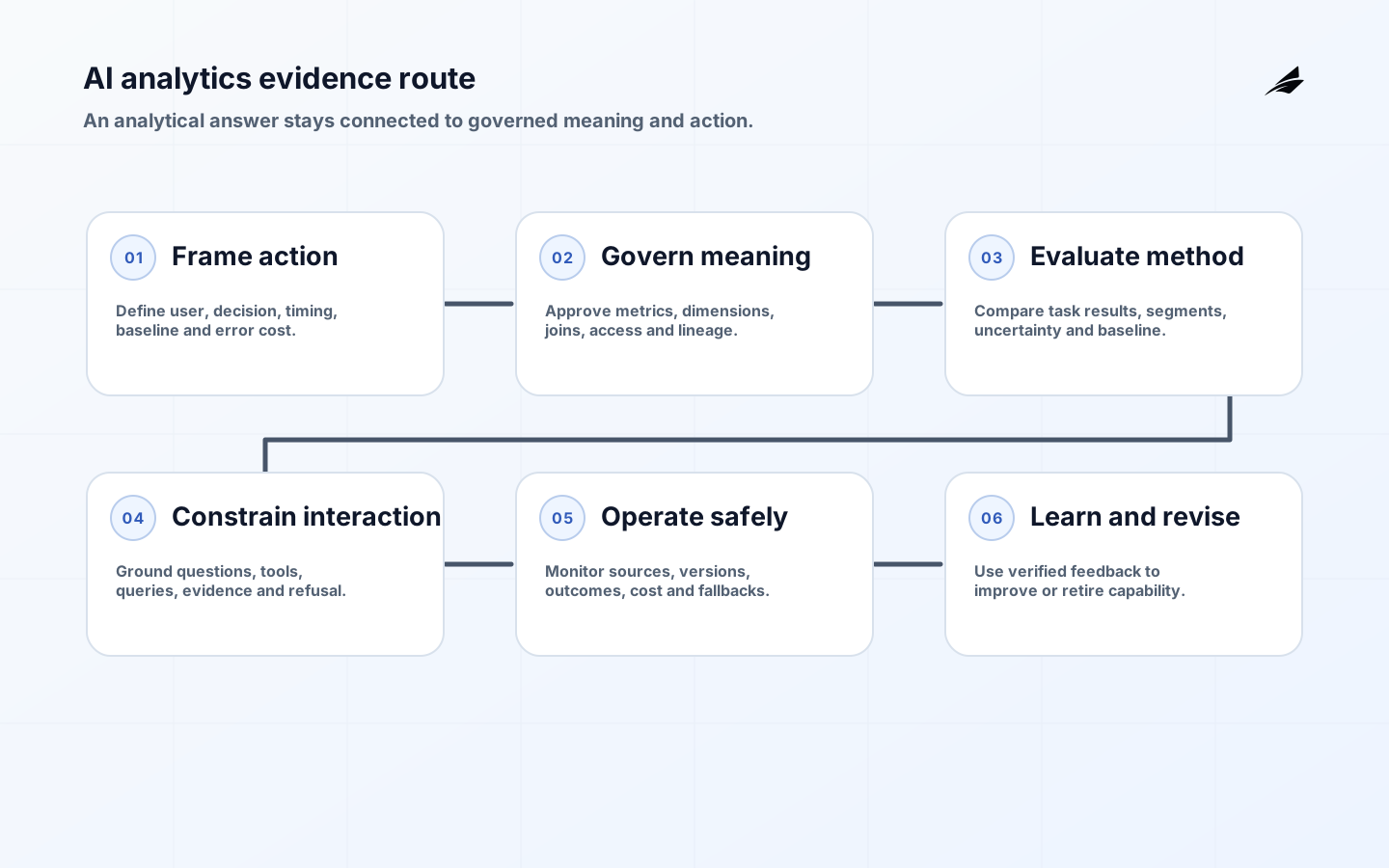
Analytics artificial intelligence adds prediction, classification, anomaly detection, natural-language interaction and automated recommendations to analytical workflows. Its value is not a more conversational dashboard. It should help a named user make a better or faster decision while preserving metric meaning, source lineage and authority. This FAQ explains how to choose uses, prepare analytical data, evaluate outputs and operate the resulting capability.
Readers moving to delivery can use the analytics AI implementation checklist, the analytics AI practical guide and the related AI in data analytics guide.
Where does AI improve analytics?
Useful patterns include demand forecasts, churn or risk scores, anomaly prioritization, causal or scenario analysis, automated data classification and natural-language access to governed measures. Start where decisions recur, historical evidence exists and action is possible. A prediction without an owner or intervention becomes an interesting chart. Define the population, action, timing, cost of errors and current baseline. Use a simpler rule or statistical method when it performs adequately and is easier to maintain.
Distinguish descriptive, predictive and prescriptive authority. A narrative that summarizes a report has different consequences from a system that changes prices or allocates care. Scale evaluation, access and human review accordingly. Inventory embedded AI in BI platforms and vendor features. The NIST AI RMF provides Govern, Map, Measure and Manage functions that can structure oversight without pretending every use has equal risk.
| Analytics pattern | Decision supported | Critical control |
|---|---|---|
| Forecast | Plan capacity or inventory | Backtest by horizon and show uncertainty |
| Anomaly detection | Prioritize investigation | Measure precision at workable review volume |
| Propensity score | Select an intervention | Test segment outcomes and action value |
| Narrative summary | Understand a governed report | Ground claims in approved metrics and sources |
| Natural-language query | Explore approved data | Semantic layer, access enforcement and query audit |
Why is a governed semantic layer important?

AI can generate plausible analysis from inconsistent definitions. Establish authoritative measures, dimensions, time logic, joins and access policies before allowing free-form questions. A metric needs an owner, formula, population, grain, freshness and limitations. Preserve lineage from displayed answer through semantic definition and transformation to source. When terms such as active customer or margin vary by domain, require the user to select context rather than allowing the system to guess silently.
Data quality should be evaluated for the analytical purpose: timeliness, completeness, accuracy, consistency, representativeness and label reliability. Keep event time separate from processing time. Prevent target leakage and future information from entering training features. The GAO artificial intelligence guidance emphasizes governance, data, performance and monitoring, a useful reminder that analytical accountability extends beyond model accuracy.
How should analytics AI be evaluated?
Create a frozen test set and a scenario suite from real decisions, including rare high-cost cases. Compare against the current analytical process and a simple baseline. Forecasts need error by horizon and segment, plus calibration of intervals. Classifiers need precision, recall and error costs at the chosen threshold. Recommendations need evidence that action improves outcomes. Natural-language systems need task success, correct metric selection, groundedness, access control and resilience to ambiguous or adversarial requests.
Have analysts and domain owners adjudicate disputed cases with documented criteria. Do not optimize solely for user preference: a confident but wrong narrative may be preferred to a cautious accurate one. Set acceptance and stop thresholds before final testing. Publish known limitations in the interface. For high-impact uses, seek independent validation and separate model development from approval.
Can generative AI safely answer data questions?
It can assist when grounded in a controlled catalog and semantic layer. Restrict accessible datasets by user identity, validate generated queries, limit cost and rows, and display the measure definition, time range and source. Prefer an approved query or calculation service over letting a model invent business logic. The NIST Generative AI Profile discusses confabulation, privacy, harmful bias, information integrity and supply-chain risks that are directly relevant to conversational analytics.
Treat retrieved documents and metadata as untrusted input because they may contain instructions or sensitive content. Separate instructions from data, constrain tools and log tool use. Refuse questions outside authorized scope and avoid exposing hidden schema details through errors. For material answers, show supporting tables or query results and encourage verification. A citation is useful only when it actually supports the generated claim.
How do privacy and regulation affect analytical AI?
Minimize personal data, define purpose, restrict secondary use and protect outputs that infer sensitive information. Aggregate reporting can still create re-identification risk for small groups. The NIST Privacy Framework helps connect processing to privacy risk. Apply row, column and purpose-based access through the analytical path, including model features, prompts, caches, logs and exports. Test whether summarized answers bypass controls enforced in the underlying dashboard.
Rules depend on system, role, people affected and jurisdiction. The EU AI Act text establishes risk-based obligations and phased dates. Obtain current legal advice rather than relying on product labels. Keep intended purpose, classification, evaluation, oversight and provider evidence current. An internal analytics tool may become consequential when its recommendation is routinely used for employment, credit, insurance or access decisions.
What changes in production operations?
Monitor source freshness, schema, metric definitions, feature distributions, model version, query failures, task success, latency, cost, overrides and downstream outcomes. Data-pipeline incidents often look like model drift. Route each signal to an owner and preserve versioned evidence for reproduction. Evaluate periodically with fresh labeled cases and after material source, policy or product changes. Do not retrain automatically on unverified feedback or model-generated labels.
Define fallback: last approved forecast, standard dashboard, rule-based alert or manual analysis. Show staleness clearly. Rehearse provider outage, corrupt source, unauthorized query, cost surge and harmful output. Incident review should update data contracts, tests, prompts, model, interface and governance as appropriate. Retirement needs archived evidence, downstream dependency removal and communication to users.
| Operating signal | What it may mean | Decision |
|---|---|---|
| Metric mismatch | Semantic definition or join changed | Stop narrative; reconcile authority |
| Forecast error rise | Regime shift, stale data or model decay | Investigate segments; fall back or retrain |
| Low alert precision | Threshold or source behavior changed | Retune against review capacity |
| Query cost spike | Unbounded generated SQL or retry loop | Enforce budgets and approved query patterns |
| Override increase | Output quality or user trust changed | Sample reasons and redesign workflow |
Which team and measures demonstrate value?
Use a cross-functional product team with business decision owner, analytics engineer, data owner, model specialist, application engineer, security, privacy and operations. Assign a metric steward for shared measures. Analysts should remain able to challenge model output; AI should remove repetitive preparation and improve exploration, not eliminate independent reasoning. Train users on scope, uncertainty and escalation using real work examples.
Measure completed decisions, cycle time, forecast or classification quality, intervention outcome, user effort and risk. Compare with a valid baseline or holdout where possible. Include data engineering, evaluation, review, platform usage and monitoring in cost. Scale when incremental benefit, representative quality and operating readiness all pass. A successful pilot can also conclude that governed self-service analytics, without AI, solves the underlying problem.
Key takeaways
Keep a benchmark pack that can be rerun after changes to data, semantic definitions, models, prompts or providers. It should contain ordinary and consequential cases, expected evidence and cost limits. Repeatability is what turns one successful evaluation into an operating control.
How do practical analytics AI pilots differ?
For demand forecasting, select representative products with intermittent, seasonal and stable demand. Backtest several horizons, compare with the planning baseline and show uncertainty. Let planners record override reasons and measure whether overrides improve realized outcomes. A lower aggregate error is not enough if the model systematically misses high-margin or supply-constrained items. The operating gate should include source freshness, retraining criteria and a fallback forecast.
For anomaly triage, the scarce resource is reviewer attention. Evaluate precision among the top-ranked cases at the daily review capacity, not only area under a curve. Include known process changes that look anomalous but are legitimate. Measure discovered value, wasted review and time to action. Feed verified dispositions back through controlled labels; free-text closure notes need review before becoming training truth.
For a conversational analytics assistant, create questions with ambiguous terms, prohibited data, tricky time windows, empty results and misleading premises. Require the assistant to ask for clarification, enforce access, state metric definitions and decline unsupported conclusions. Compare answers with approved queries and have analysts grade both result and reasoning path. Monitor generated query cost and prevent write operations. These tests turn a compelling demo into evidence about daily analytical work.
What should buyers test in an analytics AI platform?
Test connection to the governed catalog, row and column security, semantic-layer reuse, lineage display, model-version control, prompt and query logs, evaluation export, cost limits and provider change notice. Ask whether customer data, prompts or corrections train shared models. Verify how deleted data leaves caches and indexes. Preserve the ability to export definitions, tests and decision evidence. A proprietary interface is manageable; proprietary meaning that cannot be reconstructed is a serious analytical lock-in risk.
- Start with a recurring decision and an actionable user, not a conversational interface.
- Ground outputs in governed metrics, access policy and source lineage.
- Evaluate by task, segment, error cost and baseline before deployment.
- Constrain generative tools and show supporting evidence for material claims.
- Monitor the whole analytical chain and retain a usable non-AI fallback.
More analytics AI questions
Will AI replace business intelligence dashboards?
Not generally. Stable dashboards remain efficient for recurring governed monitoring. AI can assist exploration, explanation and prediction. The strongest design routes both through the same semantic definitions and access controls.
Conclusion
Analytics AI is trustworthy when an answer remains traceable from decision to metric, model and source. Govern meaning first, evaluate representative tasks, constrain authority and monitor operation. That foundation makes advanced interaction useful without sacrificing the analytical discipline leaders rely on.