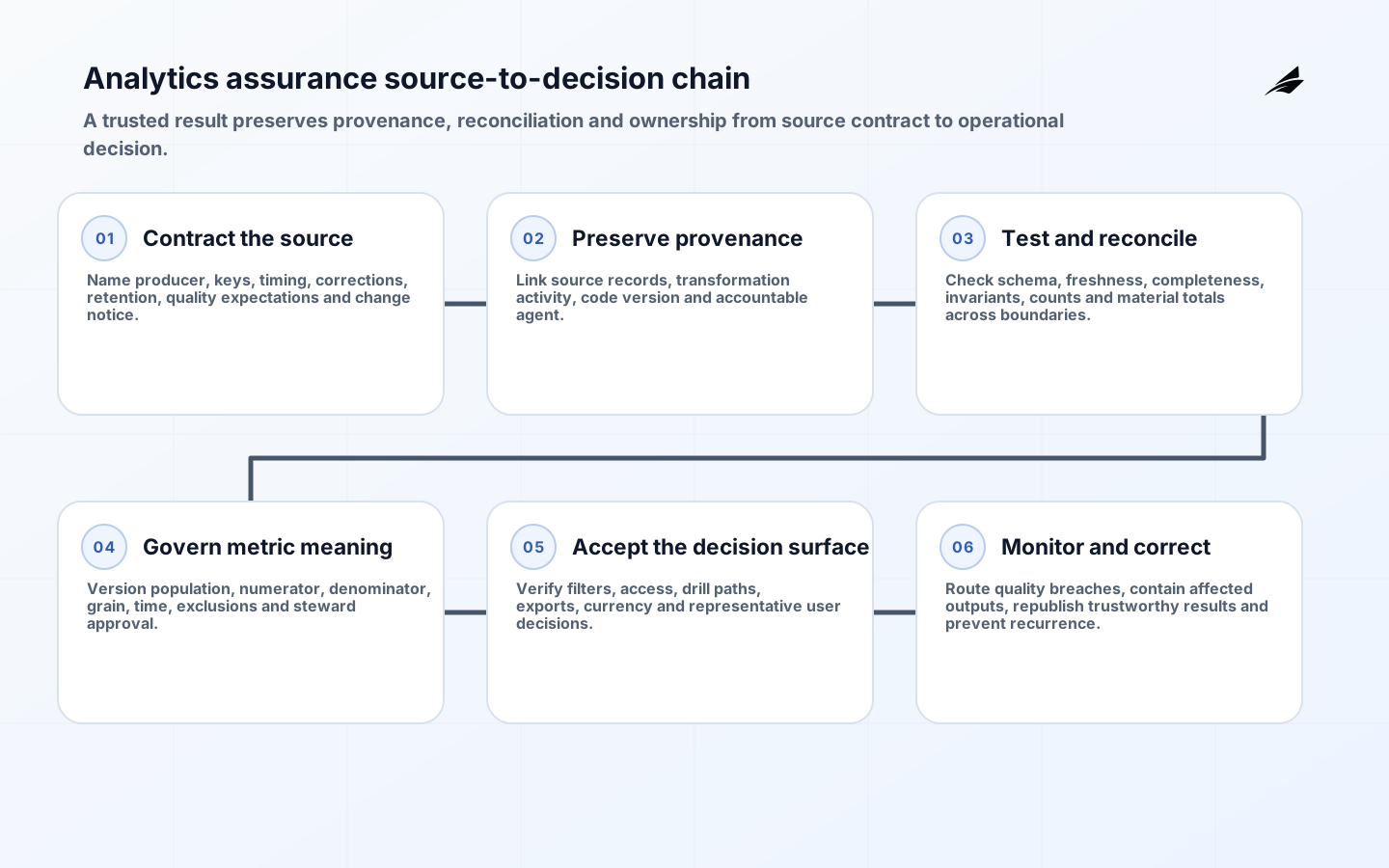
Analytics assurance services determine whether data products are reliable enough for a stated decision. They do not certify that every record is universally correct. A revenue dashboard, regulatory extract and exploratory model require different evidence. Assurance connects source ownership, ingestion, lineage, transformation tests, reconciliation, metric definitions, access, presentation, release and production monitoring. The result should tell an accountable user what was tested, what remains uncertain and how failures are detected and corrected.
Use the analytics assurance implementation checklist for delivery gates and the data and analytics implementation checklist for broader platform work. The data and analytics FAQ helps with service boundaries. This article answers the questions buyers and data owners should settle before calling a dashboard or dataset trusted.
What does analytics assurance cover?
Begin with the decision and consequence. Identify who uses the output, what action follows, acceptable delay, material error, comparison period and fallback. GAO guidance defines reliability in terms of accuracy, completeness and applicability for the intended purpose. That purpose-based view prevents excessive testing of low-impact fields while a material denominator remains undefined. Record the assessment boundary: sources, transformations, semantic model, report, exports and downstream consumers.
Assurance may be prospective for a new release, diagnostic after a discrepancy, or recurring for a critical reporting process. It can review controls and evidence without taking ownership away from data producers and business stewards. Independence should be proportionate to consequence. The team that built a pipeline can test it, but material financial or regulatory reporting may require review by a separate qualified function.
| Assurance layer | Core question | Typical evidence |
|---|---|---|
| Source | Is the record authoritative and complete for this purpose? | Owner, contract, control review and sampled source trace |
| Pipeline | Did ingestion and transformation preserve intended meaning? | Schema, freshness, lineage, tests and reconciliations |
| Metric | Does the calculation match approved business policy? | Versioned definition, examples and steward approval |
| Presentation | Can users interpret filters, time and population correctly? | Acceptance cases, accessibility and export tests |
| Operation | Will drift and failure be found and resolved? | Monitors, ownership, incidents and recovery exercises |
How are sources and lineage assured?
Create a source contract that names the producer, fields, keys, event and load time, expected volume, corrections, retention, quality rules and change-notice route. Capture lineage from source through transformations and published assets. W3C PROV provides a useful model of entities, activities and responsible agents; implementation can be simpler, but it should still answer which input and code produced a result and who owned the activity.

Test lineage by tracing selected dashboard values back to records and tracing source records forward to expected outputs. Include late, corrected, deleted and duplicate events. Verify that lineage metadata matches deployed code rather than an obsolete design diagram. Restrict sensitive values in logs and catalogs while retaining identifiers and evidence needed for diagnosis. Lineage is useful only if operators can query it during an incident.
Which tests and reconciliations matter?
Layer tests. Schema and contract checks catch structural change; completeness and freshness checks catch missing work; uniqueness and referential tests catch relationship defects; business invariants catch impossible states; and reconciliation compares counts, totals or balances across boundaries. Test at the grain of the decision. A total revenue match can hide customers assigned to the wrong region, while row-level equality may be unnecessary for an intentionally aggregated output.
Every reconciliation needs tolerance, frequency, owner and exception route. Explain legitimate differences such as cutoff, currency conversion, slowly changing dimensions or late events. Do not normalize an unexplained gap as routine. Store the query or rule version and source snapshots where feasible so results can be reproduced. Sample electronic tests with source-document review when consequence warrants it.
How are metric definitions controlled?
A metric definition should include numerator, denominator, population, grain, time window, timezone, exclusions, status handling, currency or unit, owner and effective date. Implement it once in a governed semantic layer where possible. Examples should cover boundary cases. A label such as active customer or conversion is not self-explanatory. The steward approves meaning; engineering proves the implementation matches it.
Treat changes as releases. Assess affected dashboards, alerts, extracts and decisions; run old and new definitions in parallel; explain breaks in trend; and record approval. Preserve historical reproducibility when required. If a definition is corrected, communicate whether past reports are restated. Avoid allowing every dashboard author to recreate a material metric independently.
| Failure pattern | Detection | Response |
|---|---|---|
| Source stopped silently | Freshness and expected-volume monitor | Pause publication or mark data incomplete; contact producer |
| Transformation duplicated records | Uniqueness and source-to-target reconciliation | Quarantine release, correct logic and rebuild affected partitions |
| Metric changed unintentionally | Version comparison and golden cases | Restore prior definition and assess published decisions |
| Filter exposes restricted data | Role and row-level access tests | Revoke access, investigate exposure and repair policy |
| Dashboard looks current but is stale | Display publication time and pipeline health | Warn users and route incident to named owner |
What does dashboard acceptance require?
Test representative decisions, not only visual rendering. Ask users to identify a change, explain it, drill to evidence and take the intended action. Verify default filters, timezone, units, rounding, nulls, totals, export behavior and mobile or assistive use. Show data currency and population clearly. A polished chart can still be unsafe if its denominator is hidden or a filter persists unexpectedly.
Control access at the data and semantic layers, not just by hiding a navigation link. Test roles, tenant or region boundaries, subscriptions, emailed snapshots and downloaded files. Administrative impersonation needs explicit privileged access and audit. Acceptance should include load and concurrency for critical reports, because a correct dashboard that misses the decision window is not fit for purpose.
How does assurance continue after release?
Monitor source arrival, quality rules, reconciliation, semantic-model refresh, report availability and user-facing freshness. Route alerts by business impact and keep runbooks with diagnosis, containment, correction, republish and communication steps. Protect data and code integrity with access controls, immutable or protected logs, versioned artifacts and tested backup. NIST data-integrity guidance is relevant because mistakes and malicious changes can both corrupt analytical evidence.
Review incidents and recurring exceptions with producers, engineers and metric owners. Track time to detect, time to trustworthy correction, affected reports, decisions exposed and recurrence. Retire unused reports and duplicate metrics; assurance effort should follow actual decision importance. Periodically reassess whether the data remains applicable as business processes change.
Assure machine-learning features separately from descriptive reporting. Confirm training and evaluation populations, label provenance, feature timing, leakage controls, model version and the decision supported by output. Monitor input and performance drift after release. Where a model result enters a dashboard, distinguish observation from prediction and show uncertainty or applicability limits. A reliable data pipeline cannot make an unsuitable model fit for a decision, and an accurate model cannot compensate for unauthorized or stale inputs.
Define how limitations are communicated. An assurance conclusion may be reliable, reliable with limitations, or not reliable for the intended use. State affected periods, populations, fields and decisions; avoid a vague quality score. If evidence is incomplete, identify compensating checks and an expiry date. Publish corrections to consumers and downstream systems, not just the dashboard owner. The reporting language is part of the control because it determines whether users apply data beyond what the assessment supports.
For outsourced analytics, include access to transformation code, tests, lineage, semantic definitions, incident history and platform configuration in the service agreement. Clarify who investigates source defects and who communicates with business users. Require an export and transition plan for governed assets. Assurance cannot depend on a supplier's private notebook or undocumented query; another qualified team should be able to reproduce material conclusions from retained evidence.
Cost assurance by materiality and change rate. A critical daily settlement report may justify automated controls, frequent reconciliation and independent review; an exploratory analysis may need transparent caveats and reproducible queries instead. Reassess coverage after source migrations, metric redesign, access-policy changes and major incidents. Maintain an inventory showing the assurance level, last review, open limitations and owner for each critical data product so effort follows current risk.
Evidence retention should support investigation without becoming an uncontrolled duplicate data store. Keep test results, query and code versions, reconciliation summaries, approvals and incident records according to policy. Use protected references instead of copying sensitive source rows into tickets. Verify that evidence access is logged and removed when roles change. Assurance is weakened when proof can be edited silently or cannot be connected to the deployed version.
Key takeaways
- Define reliability for a named decision and consequence.
- Contract source meaning, timing, corrections and ownership.
- Combine pipeline tests with source-to-output reconciliation and metric governance.
- Accept dashboards through real decisions, access cases and freshness conditions.
- Operate assurance with monitors, incident ownership and reproducible correction evidence.
Frequently asked questions
| Question | Answer |
|---|---|
| Is data quality the same as analytics assurance? | Data quality is one input; assurance also covers lineage, transformation, metric meaning, access, presentation and operating controls. |
| Must every field be perfect? | No. Evidence should be proportionate to the intended decision and material risk, with limitations stated clearly. |
| Who owns a metric? | A business steward owns meaning and approval; technical owners implement, test and operate the calculation. |
| Can automated tests replace reconciliation? | No. Tests catch known conditions, while reconciliation checks whether material populations and values agree across boundaries. |
| What is the deliverable? | An evidence-backed conclusion, issue register, accepted limitations, owners and recurring controls—not merely a test report. |
Conclusion
Analytics assurance services make data products inspectable from source to decision. Establish purpose, preserve provenance, reconcile material values, govern definitions and test how people interpret the result. Continue assurance in production with visible freshness, protected evidence and owned correction. Trust grows from repeatable proof and transparent limitations, not from a dashboard label that says certified.