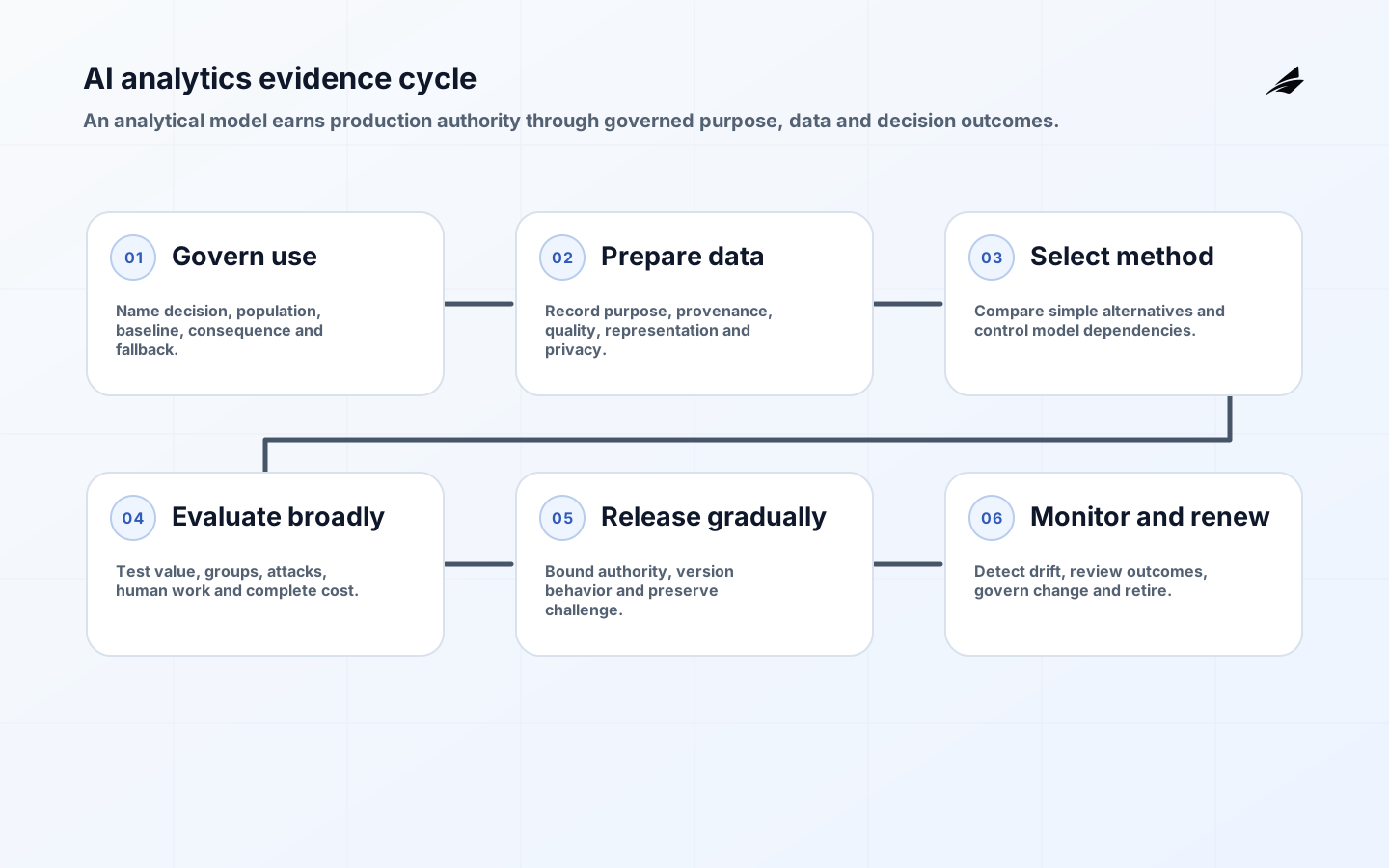
Artificial intelligence data analytics uses statistical learning, machine learning or generative models to classify, forecast, recommend, detect, summarize or explore data. This implementation checklist begins with a decision and finishes with operated evidence. It does not assume AI is superior to rules, conventional statistics or process redesign. Complete the controls in proportion to consequence, legal duty, uncertainty and the autonomy given to the output.
Teams still defining the opportunity should read the artificial intelligence data analytics guide and AI analytics FAQ. The data and artificial intelligence implementation checklist provides a related enterprise view. This article supplies a six-stage acceptance path for one analytical use.
1. Govern the decision and intended use
Name the business question, output, user, affected population, action, owner and fallback. Record the current process and alternatives. Classify consequence across rights, safety, money, access, employment, reputation and systemic impact. Decide whether the output is exploratory, advisory, prioritized for review or authorized to act. Prohibit secondary uses that have not been assessed. Set benefit, risk, cost, fairness, privacy and reliability thresholds before selecting a model.
Use NIST's AI Risk Management Framework Govern, Map, Measure and Manage functions to organize evidence across the lifecycle. NIST states that AI RMF 1.0 is being revised; record the edition and profile used. The OECD AI Principles, updated in 2024, connect innovation with human rights, transparency, robustness and accountability. Translate principles into named controls and decisions rather than an abstract declaration.
| Intended-use field | Question | Acceptance evidence |
|---|---|---|
| Decision role | What action may the output influence? | Workflow and authority map |
| Population | Who is represented, affected or excluded? | Scope and subgroup rationale |
| Baseline | What is done without the model? | Comparable outcome and cost |
| Consequence | What can a wrong or delayed output cause? | Risk tier and stop thresholds |
| Fallback | How does service continue safely? | Rehearsed manual or prior method |
| Challenge | How can people obtain review or correction? | Accessible process and owner |
2. Prepare lawful, representative and usable data
Create a dataset record with purpose, source, collection context, authority, consent where applicable, time range, population, fields, transformations, labels, quality, access, retention and known limitations. Check whether use is compatible with the original purpose and contracts. Minimize personal and sensitive attributes, but do not remove fields needed to test harmful disparities without a reasoned plan. The NIST Privacy Framework can connect data processing with privacy risk; apply binding law directly.
Measure completeness, validity, consistency, timeliness, uniqueness and accuracy for the intended use and relevant segments. The UK Government Data Quality Framework emphasizes fitness for purpose, lifecycle assessment and correction near source. Check selection, survival, measurement and labeling bias. Split data by time or entity to prevent leakage. Keep training, tuning and final evaluation boundaries, and version exact snapshots or reproducible queries.
3. Select and build the analytical method
Compare the simplest credible alternatives: policy rule, descriptive analysis, classical model, machine-learning model, foundation model service and human review. Choose using required accuracy, calibration, explanation, latency, privacy, update frequency, resilience, skill and total cost. A small interpretable model may outperform a complex service when data is limited or decisions need reason codes. A generative interface may improve exploration but is not an authoritative calculator without constrained tools and validation.
Track code, features, prompts, retrieval sources, model, parameters, environment, dependencies, provider and licenses. Protect repositories, builds, artifacts, secrets and service identities. Review third-party terms for data use, retention, model change, availability, geography, intellectual property and exit. Document assumptions and excluded use. Use reproducible pipelines and peer review. Prevent test labels and sensitive production data from entering logs or external prompts. Maintain a software and model dependency inventory for vulnerability and change response.
4. Evaluate outcomes, harms and operations
Build representative normal, difficult, rare, boundary and adversarial cases. Select metrics that match the decision: precision and recall at the operating threshold, calibration, ranking quality, forecast error by horizon, unsupported-claim rate or task success. Report uncertainty and sample size. Evaluate relevant groups and intersectional slices where lawful and meaningful. Investigate differences rather than setting a universal mathematical fairness target without legal, ethical and operational context.
Test privacy leakage, membership or extraction risk where relevant, data poisoning, evasion, prompt injection, malicious files, unauthorized tool use, denial of service, source outage, drift and provider change. Include human factors: reliance, review time, override quality and ability to notice an incorrect output. Measure latency, throughput, recovery and complete unit cost. Independent reviewers should be able to reproduce material results from the record. Fail the release when fallback or challenge cannot protect the intended population.
| Evaluation dimension | Example measure | Release question |
|---|---|---|
| Decision value | Outcome change versus baseline | Does the method improve the real task? |
| Reliability | Error and calibration by operating condition | Are confidence and limits usable? |
| Distribution | Outcome and error across relevant groups | Are differences understood and treated? |
| Security | Adversarial success and contained impact | Can inputs, retrieval or tools be abused? |
| Human factors | Review accuracy, reliance and workload | Can users supervise effectively? |
| Economics | People, compute, data and correction per outcome | Is value durable at expected demand? |
5. Release into a controlled workflow
Begin in shadow mode or with advisory output where consequence warrants it. Release by bounded cohort, region, product or case type. Show users purpose, source context, confidence or limitations and required action without overwhelming them. Require confirmation for consequential actions and prevent bulk execution beyond approved limits. Provide a visible correction and escalation path. Version the deployed model, data, prompt, retrieval, policy and interface so incidents can be tied to the exact configuration.

Rehearse unavailable model, stale feature, corrupt input, upstream schema change, excessive demand, unsafe output and provider rollback. Set kill switches and named suspension authority. Monitor the model separately from the surrounding service: a healthy endpoint can produce harmful decisions, and a good model can be embedded in a broken queue. Train users with realistic counterexamples and observed practice. Communicate material AI use to affected people when law, consequence or responsible service design requires it.
6. Monitor, change and retire the service
Monitor input quality, missingness, distributions, feature and concept drift, output rates, calibration where outcomes arrive, subgroup results, overrides, complaints, incidents, latency, availability and unit cost. Define windows and thresholds before launch and route alerts to people who can act. Delayed ground truth requires proxy monitoring plus scheduled outcome review. Sample outputs for qualitative failure. Compare with the baseline periodically because the manual process, population and business environment also change.
Approve material retraining, model substitution, prompt or retrieval change through regression, risk and operational testing. Track provider release notes but verify behavior independently. The EU AI Act overview explains phased application and risk-based obligations in the EU; classify actual systems with qualified advice and monitor changing guidance. Retire when purpose, authority, data, benefit or support no longer holds. Revoke access, preserve required records, delete data and confirm fallback continuity.
Implementation acceptance record
- Approve intended use, consequence tier, owner, baseline, fallback and challenge route.
- Record lawful data purpose, provenance, quality, representativeness, lineage and retention.
- Document alternative methods, selected design, dependencies, assumptions and supply-chain controls.
- Reproduce evaluation of value, reliability, groups, security, human factors and complete cost.
- Exercise progressive release, failure, rollback, suspension and user correction.
- Assign monitoring, change, incident, renewal and retirement authority with thresholds.
A production approval should identify unresolved risk and the person accepting it. Link evidence to versions, dates and evaluation populations. Expire the approval after a specified interval or material change. Do not call the record a one-time ethics review: it is an engineering and governance baseline that must evolve with the service.
Example: implement a demand forecast
A distributor forecasting weekly demand should first name the inventory decision, horizon, product-location population and cost of stockout versus excess. Compare a seasonal baseline with candidate models using time-based backtesting. Record promotions, closures, substitutions and censored demand, and exclude future information unavailable at prediction time. Evaluate error by volume and business segment, calibration of prediction intervals, planner overrides and the resulting service and inventory outcomes. A lower average error can still harm low-volume critical products.
Release forecasts as planner advice for selected categories. Show recent history, interval, known event inputs and data freshness. When a source feed is stale or demand shifts beyond tested conditions, revert to an agreed baseline and flag review. Monitor forecast and realized outcome when it arrives, override patterns, stockouts, waste, latency and cost. Retraining requires the same backtest and controlled comparison. This example demonstrates why model accuracy, human decision and operational consequence must be accepted together.
Document which overrides improve outcomes and which reflect missing data or incentive conflict. A planner may know about a local closure that the model cannot see, while repeated unexplained uplift may reveal poor trust or a target that rewards availability without penalizing excess. Feed valid context into future design without turning every manual adjustment into a training label.
Key takeaways
- Begin with a bounded decision and compare non-AI alternatives.
- Make purpose, provenance, quality and representativeness dataset requirements.
- Evaluate real outcomes, groups, adversarial behavior, human work and full cost.
- Release gradually with versioning, challenge, fallback and suspension authority.
- Monitor the whole decision service and retire it when evidence no longer holds.
Frequently asked questions
What accuracy is good enough?
There is no universal threshold. It depends on error consequences, prevalence, baseline, human review and operating point. Evaluate the actual decision and define separate limits for important conditions and groups.
How often should a model be retrained?
Retrain when monitored evidence and change justify it, not on a calendar alone. New training can introduce regressions, so it needs versioned data, evaluation and controlled release like any material change.
Conclusion
Responsible artificial intelligence data analytics is an operated decision capability, not a model handoff. Govern purpose, prepare trustworthy data, choose the simplest suitable method, evaluate real consequences, release with controls and monitor changing evidence. That sequence makes both benefit and limitation visible to the people accountable for action.